The purpose of this Blog is to introduce men and women all over the World to the Doctrines of Grace; the 5 Solas; Reformation Theology and the Lord and Savior Jesus Christ.
Showing posts with label Myths. Show all posts

Friday, June 28, 2013

4 Myths About Cessationism


Nathan Busenitz has an excellent article at The Criplegate titled, “What Cessationism is Not.” Here are 4 myths about cessationism he discusses:

Myth #1: Cessationism is anti-supernatural, denying the possibility of miracles.
When it comes to understanding the cessationist position, the question is not: Can God still do miracles in the world today? Cessationists would be quick to acknowledge that God can act at any time in any way He chooses (Psalms 115:3). . . So, the question is not: Can God still do miracles?
Rather, the definitive question is this: Are the miraculous gifts of the New Testament still in operation in the church today–such that what was the norm in the days of Christ and the apostles ought to be expected today?
Myth #2: Cessationism is founded on one’s interpretation of “the perfect” in 1 Corinthians 13:10.
(1) Some (such as F.F. Bruce) argue that love itself is the perfect.
(2) Some (such as B.B. Warfield) contend that the completed canon of Scripture is the perfect.
(3) Some (such as Robert Thomas) contend that the mature church is the perfect.
(4) Some (such as Thomas Edgar) see the believer’s entrance into the presence of Christ (at the moment of death) as the perfect.
(5) Some (such as Richard Gaffin) see the return of Christ (and the end of this age) as the perfect.
(6) Some (such as John MacArthur) view the eternal state (in a general sense) as the perfect.
In any case, my point here is simply this: The interpreter can take any of the above positions, and still remain a cessationist. In fact, there are cessationists who hold to each of the positions listed above (as the names I’ve listed indicate).   Continue at Jared Moore

Friday, October 19, 2012

Five Big Myths About Calvinism

I speak for many when I say that I have not always embraced the doctrines of grace or what is commonly called Calvinism. Its actually unfortunate that a man’s name is associated with the doctrines that came out of the Protestant Reformation. Calvin was not the first to articulate these truths, but merely was the chief systematizer of such doctrines. There was actually nothing in Calvin that was not first seen in Luther, and much of Luther was first found in Augustine. Luther was an Augustinian monk, of course. We would also naturally affirm that there was nothing in any of these men that was not first found in Paul and Peter and John in the New Testament.

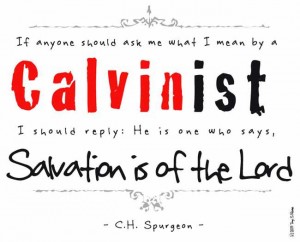
Even now, I have no desire to be a Calvinist in the Corinthian sense of the word – a follower of John Calvin, per say. Though I believe Calvin was a tremendous expositor of the Scriptures and had many great insights, I am not someone who believes he was in any way infallible. I am with Spurgeon who declared, “There is no soul living who holds more firmly to the doctrines of grace than I do, and if any man asks me whether I am ashamed to be called a Calvinist, I answer – I wish to be called nothing but a Christian; but if you ask me, do I hold the doctrinal views which were held by John Calvin, I reply, I do in the main hold them, and rejoice to avow it.” (C. H. Spurgeon, a Defense of Calvinism)   Continue at John Samson

Thursday, July 26, 2012

5 Myths about Reformed Theology

There are a lot of misconceptions about Reformed theology. I tackle these at length in For Calvinism. Here I’ve been asked to address a few of these in a nutshell.

1. “Reformed Theology Is Arrogant and Prideful”

There are several impressions bound up with this critique.

First, the very name suggests that we hold up John Calvin more than Jesus Christ. Truth is, “Calvinism” was coined by critics who wanted to marginalize Reformed teaching, when actually Calvin didn’t teach anything unique that you can’t find, for example, in Augustine or Luther. Furthermore, as important as he was, Calvin was one of many shapers of the Reformed tradition. Our confessions and catechisms (none of them written by Calvin) set forth what we believe. As Charles Spurgeon said, “Calvinism is just a nickname” for what we should call “the doctrines of grace.”

Second, sinful attitudes and behaviors come from our own hearts, not from the word of God. Reformed theology exalts God and his grace, while laying ourselves low as helpless sinners and rebels who are on the receiving end of his generosity. Puffed-up pride is about the most contradictory response one can imagine to the deepest convictions Reformed churches confess.   Continue at Michael Horton

Friday, March 9, 2012

Good and Angry: Four Anger Myths

They may not be many in number, but they do exist: Christians who are thoroughly confused about anger. During counseling, reading, and sermon-listening, four myths have come to my attention repeatedly. Here’s a brief, non-expert—but hopefully thought-provoking—response.

Myth 1: If you don’t let it out, anger will drive you crazy.

This popular notion probably has its roots in Freudian psychoanalysis. Freud’s million-dollar idea (or at least the pop-psych version of it) was that the human subconscious sort of reroutes “repressed” emotions into psychoses that seem unrelated to their causes. Pent up anger can eventually make you think you’ve been abducted by aliens or that people you know and love are afflicted by a strange disease only you know about and that you have to shoot them to cure them. So, to be healthy, we must express not repress.

 This kind of thinking about anger is common in popular film and television. If only the serial killer had openly expressed his anger, he would never have become such a monster. Cue commercial.

Sometimes Christians view anger this way as well. “I just need to vent,” they say.

But if we remove the Freudian assumptions, the idea that it’s healthy to openly express anger looks highly questionable. Is there really a place anger goes to lurk when we’re not feeling it? Certainly our thoughts and beliefs live in memory, but what if anger—and other emotions—really exist only when we’re feeling them?

In any case, if we take an honest, careful look at our own experiences of anger, we find that letting anger loose physically or verbally usually produces more anger, and then more, until an explosion leaves us physically and emotionally exhausted—and not angry anymore. People who indulge anger in this way often believe they’ve done something healthy when, in reality, if they had confronted the angry thoughts earlier in the process, they would have found that the emotion evaporated without any outward expression at all (easier to say than to do, but true, nonetheless).

Some advocates of “venting” nuance the term a bit and recommend physical exercise, etc., as opposed to expressing angry thoughts verbally. In my experience this works, not because anger goes somewhere to be stored, and exercise vents it, but rather because anger exists only as long as angry thoughts are happening to sustain it. Eventually, doing something unrelated breaks our thinking out of the revving-up cycle and the anger fades. This isn’t venting. It’s distraction, and doing crossword puzzles works about as well as beating fists on a punching bag—probably better.  Continue at Aaron Blumer

Thursday, March 1, 2012

The Myths of Progress and Relevance

It is not the church's job to make the gospel "relevant" in the superficial sense of making its teachings fit with what our culture thinks. Our task is to show the Bible's relevance in the substantial sense of being a timeless Word with things to say to every changing time and place.

I must admit there was a time in my ministry when I worried that the Bible seemed out of date and so irrelevant. I worried away, seeking "connection points" and "cultural signals" that could show my audience---whether live or in print---that Jesus is as relevant as MTV. Those who have read any of my recent works will know that I have not actually abandoned the "Areopagean" task of showing how the Risen Judge speaks to contemporary culture. But something changed in my ministry about ten years ago. Something dawned on me---or, more likely, was pointed out to me---that dispelled the worry.

Cultures are constantly changing, in some respects improving, in some respects getting worse, but always in flux. And yet the people of every particular culture think their special perspective is the high point. In this sense we are products of our time and place.

If the Bible affirmed what every passing culture believed, that would surely reveal that it was not a body of wisdom for every culture through all time. Imagine, however, that there was a book containing eternal wisdom for all cultures. What should we expect to find? We would discover that it was always at odds with every culture at some point, for cultures are always in flux, sometimes coinciding with the Truth, sometimes departing from it.

The true relevance of the gospel is found in its studied irrelevance to any particular culture, whether ancient Corinthian or modern New Yorker. We do not need another message that affirms what we already think in all our foibles and cultural particularities. We surely need one that is free to challenge, rebuke, frighten, and enlighten us, as well as comfort and affirm us when appropriate. That message is the gospel. It is precisely because the gospel was not crafted to endorse ancient Athenians or modern Americans that it is wonderfully relevant to both.  Read it all at John Dickson

Monday, February 13, 2012

Five Evangelical Myths or Half Truths

It can happen even in careful systematic theology. How much more so in popular parlance? We take what the Bible actually teaches, rephrase it so we can understand it, and end up believing our own phrasing, rather than the actual biblical truth. It’s not malicious, but it is dangerous. What follows are five common thoughts, common expressions, within the evangelical church that just aren’t so.

1. “All sins are equal in the sight of God.”
Well, no. It is true enough that every sin is worthy of God’s eternal wrath. It is true enough that if we have broken part of the law we have broken the law (James actually says this.) It is true enough that unjust anger is a violation of the commandment against murder (Jesus actually says this.) None of this, however, means all sins are equal in the sight of God. To say that because all sins deserve eternal wrath means they are all equal is like saying that all numbers over 100 are equal. The truth is that Jesus said of the Pharisees that while they rightly tithed their mint and their cumin, they neglected the weightier matters of the law (Matthew 23:23). No sin is weightless, but some weigh more than others. Continue at R. C. Sproul Jr.

Saturday, January 21, 2012

The Myth Of Mother Teresa

Mother Teresa, as goes without saying, was a devout Roman Catholic. As such, some of her beliefs would necessarily have to stand at odds with core Christian beliefs. This has not appeared to trouble many Christians who continue today, even in Protestant churches, to uphold her as a prime example of Christian virtue, love and self-sacrifice. Her devotion to Catholic theology is obvious in her speeches and writing. In a speech she delivered to the Worldwide Retreat For Priests in October of 1984 she made the following quotes:
“At the word of a priest, that little piece of bread becomes the body of Christ, the Bread of Life.”
“Without a priest, without Jesus going with them, our sisters couldn’t go anywhere.” 
“When the priest is there, then can we have our altar and our tabernacle and our Jesus. Only the priests put Jesus there for us. … Jesus wants to go there, but we cannot bring him unless you first give him to us. This is why I love priests so much. We could never be what we are and do the things we do without you priests who first bring Jesus to us.”
“Mary … is our patroness and our Mother, and she is always leading us to Jesus.”
In just these four quotes we get a glimpse of beliefs that contradict so many gospel truths. We see a belief in transubstantiation (that the bread of communion actually becomes the body of Christ) and her belief that Christ is present in this bread. We also see her belief that Mary, the mother of Jesus, is a mediator between God and ourselves (see Catholic Catechism, paragraph #969, #1172 and #494) and as such, plays a role in our salvation.

While she worked with the poor, Mother Teresa was adamant that any type of evangelism was unnecessary. In her book, Life in the Spirit: Reflections, Meditations and Prayers, she says: Read it all at Tim Challies

Monday, January 2, 2012

The Myth of Mutual Submission

“Submit to one another out of reverence for Christ” (Eph 5:21).

This 11-page chapter (available for free as a PDF) concisely and convincingly explains why the phrase “mutual submission” is unhelpful at best:

Wayne Grudem, “The Myth of Mutual Submission as an Interpretation of Ephesians 5:21,” in Biblical Foundations for Manhood and Womanhood    (ed. Wayne Grudem; Foundations for the Family Series; Wheaton: Crossway, 2002), 221–31.


  1. Background
  2. An Acceptable Sense of Mutual Submission
  3. Objections to the Egalitarian Sense of Mutual Submission
    1. The following context specifies the kind of submission Paul has in mind.
    2. The absence of any command for husbands to submit to wives
    3. The meaning of “be subject to” (hypotassō)
    4. The lack of evidence for the egalitarian meaning of hypotassō
    5. The meaning of “one another”
    6. The meaning of Colossians 3:18Titus 2:5, and 1 Peter 3:1
  4. Practical Application
(The entire book is available for free as a PDF.)

Monday, November 28, 2011

The First Christmas: Myths and Realities

I. A Reality Check

Here’s a true-false quiz:

1. Mary and Joseph had to travel as quickly as possible to Bethlehem because Mary could have given birth at any moment.

2. The Bethlehem innkeeper was fully booked, and so Mary had to give birth to Jesus in the barn/stall nearby/behind the inn.

3. Initially, this experience must have been frightening and lonely for Mary and Joseph.

4. “The little Lord Jesus no crying he makes.”

5. The angels who appeared to the shepherds had wings.

How’d you do on the quiz? Check your answers below. (Some of these thoughts are taken from a talk I gave on what really happened that first Christmas.)

Marcus Borg, a member of the liberal Jesus Seminar, claims that the Gospels are in serious conflict: Jesus was born “in a stable” in Luke but in a home in Matthew (Marcus Borg [and N.T. Wright], The Meaning of Jesus: Two Visions [San Francisco: HarperSF, 1999], 180). As it turns out, this isn’t really a conflict at all. Contrary to the traditional Christmas story, Jesus was indeed born in a home! Borg’s claim is based on the notable King James Version’s mistranslation of Luke 2:7: “there was no room for them in the inn.” But the KJV rendering goes against Luke’s in(n)tention.  Keep Reading >>>

Saturday, November 19, 2011

If I Become Rich, Won’t Someone Else Become Poor?

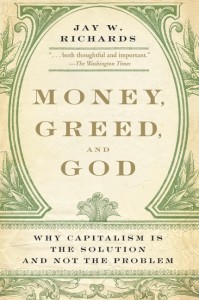
This is the most readable defense of capitalism I’ve read (and it’s more relevant than ever with the recent “Occupy Wall Street”-type protests):


Richards debunks eight myths, which are listed in the book’s table of contents:
  1. Can’t We Build a Just Society? Myth no. 1: The Nirvana Myth (contrasting capitalism with an unrealizable ideal rather than with its live alternatives)
  2. What Would Jesus Do? Myth no. 2: The Piety Myth (focusing on our good intentions rather than the unintended consequences of our actions)
  3. Doesn’t Capitalism Foster Unfair Competition? Myth no. 3: The Zero-sum Game Myth (believing that trade requires a winner and a loser)
  4. If I Become Rich, Won’t Someone Else Become Poor? Myth no. 4: The Materialist Myth (believing that intellect cannot create new wealth)
  5. Isn’t Capitalism Based on Greed? Myth no. 5: The Greed Myth (believing that the essence of capitalism is greed)
  6. Hasn’t Christianity Always Opposed Capitalism? Myth no. 6: The Usury Myth (believing that charging interest on money is always exploitive)  Keep Reading >>>

Tuesday, August 23, 2011

The Myth of Mutual Submission

“Submit to one another out of reverence for Christ” (Eph 5:21).

This 11-page chapter (available for free as a PDF) concisely and convincingly explains why the phrase “mutual submission” is unhelpful at best:

Wayne Grudem, “The Myth of Mutual Submission as an Interpretation of Ephesians 5:21,” in Biblical Foundations for Manhood and Womanhood  (ed. Wayne Grudem; Foundations for the Family Series; Wheaton: Crossway, 2002), 221–31.

Outline:
  1. Background
  2. An Acceptable Sense of Mutual Submission
  3. Objections to the Egalitarian Sense of Mutual Submission
    1. The following context specifies the kind of submission Paul has in mind.
    2. The absence of any command for husbands to submit to wives
    3. The meaning of “be subject to” (hypotassō)
    4. The lack of evidence for the egalitarian meaning of hypotassō
    5. The meaning of “one another”
    6. The meaning of Colossians 3:18, Titus 2:5, and 1 Peter 3:1
  4. Practical Application
(The entire book is available for free as a PDF.)

Thursday, July 28, 2011

Myths and Facts About Sexual Assault

Myth: Men assault impulsively and out of biological need.

Fact: Sexual Assault is a criminal act of violence, using sex as a weapon.  Men assault to express hostility and to dominate.  Men assault because it allows them to express anger and to feel powerful by controlling another person.  Studies show that 50% of sexual assaults are premeditated and well-planned, not impulsive, spontaneous, uncontrollable sexual acts.

Myth: Sexual Assaults are usually reported.

Fact:
Sexual Assault is probably one of the most underreported crimes; researchers estimate that between 50 to 90% of sexual assault cases go unreported.

Myth: Husbands cannot sexually assault their wives.

Fact:
Sexual Assault occurs whenever sexual contact is not mutual/consensual, when choice is taken away. Researchers estimate that sexual assault occurs in 10-14% of all marriages.

Myth: Most sexual assaults occur in dark alleys or to hitchhikers.

Fact:
Most sexual assaults (60%) occur in a private home and the largest percentage of these assaults (38%) occurs in the victim’s home. The idea that most sexual assaults fit the “stranger-in-a-dark-alley” stereotype can lead to a false sense of security. Keep Reading...

Wednesday, March 2, 2011

Myth: Calvinists Take a Dim View of Revival and Awakening

We do not often speak of the Reformation era as a period of aggressive evangelistic preaching; but it indeed was this. Away from the university faculties of theology and the city cathedrals where much of the story of the Reformation played out, there were the itinerant evangelistic preachers who went town to town decrying the virtual idolatry of medieval religion and preaching up the need for living faith in Jesus Christ. Lesser-known figures of the Reformation such as John Frith and Robert Barnes (in England), Patrick Hamilton and George Wishart (Scotland), Pierre Viret and Guillaume Farel (in France and Switzerland) did this kind of itinerant evangelistic preaching—often to very large crowds. There followed what were at first “underground cells” of evangelical believers which met in barns, orchards, and hedges. It is no stretch to call these 16th century events evangelistic awakening or revival. By the early 17th century, we have clear documentation of such events in Northern Ireland and in the west of Scotland with some well-known Reformed preachers such as David Dickson instrumental in evangelistic harvests that endured over years. Read it all HERE

Saturday, June 20, 2009

Watch Out for Myths About Fatherhood

The role of the father is increasingly problematic in the context of modern American culture. Fatherhood has been marginalized and the rule and authority of fathers has been depreciated, ridiculed, and continuously redefined. From the Berenstain Bears to The Simpsons, fathers are all too often the object of ridicule or the subject of the laugh line.

Of course, some fathers bring this marginalization upon themselves as they either neglect or forfeit their own fatherly responsibilities. In many sectors of our society, fathers are most noted by their absence. Indeed, millions of American children are growing up without any significant father figure, much less their biological father. Read the rest HERE