The purpose of this Blog is to introduce men and women all over the World to the Doctrines of Grace; the 5 Solas; Reformation Theology and the Lord and Savior Jesus Christ.
Showing posts with label Mormonism. Show all posts

Thursday, January 10, 2013

So…is Mormonism a cult or what?

A few months ago Franklin Graham found himself in all sort of evangelical hot water when he removed a page from the Billy Graham Evangelistic Association’s website that had labeled Mormonism as a cult. The timing of the removal—a few weeks before the presidential election and a few minutes after Billy Graham gave his presidential imprimatur to Romney—made any nuanced reasoning behind the Graham’s move impossible.

Always good news
They compounded their problems when their defense of the action was “God has not called us to call other people names”—a defense which is about as thoughtful and persuasive as saying “Mormons really are nice people after all.” As Dan Phillips  over at Pyromanics pointed out, how can you possibly argue with someone when they say that God has not called them to do what you think they should be doing? Doesn’t that mean you are arguing with God? Who, exactly, do you think you are?

But there remains an obvious question that bears exploring: Is Mormonism a cult? I want to put forward a nuanced answer: it depends on what you mean by Mormons, and it depends on what you mean by cult.  

First the cult part:


I read dozens of blogs skewering the Grahams for their defrocking Mormonism of its cult status, but I don’t remember seeing anyone lay out what exactly it means to be a cult. Certainly there are several definitions of cult. What are they, and how does one qualify?   Continue at Jesse Johnson

Thursday, November 1, 2012

Why are Evangelicals Fudging on the Gospel to Promote Mitt Romney?

On Sunday in the Aquila Report Bill Evans made some interesting claims concerning Mormonism in his attempt to persuade readers that there is a Christian position in the upcoming presidential election – a position that requires voting for Mitt Romney.

While Mormons are not Christians in the traditional creedal sense of the term, I also have little doubt that there are Mormons who are looking in faith to Christ for salvation. In addition, the argument can be made that Mormons are closer to biblical truth on some issues than many liberal Protestants.
Scott Clark has a thoughtful analysis of Evans’s claim at the Heidelblog so I won’t offer that here. What strikes me is how so many Christian conservatives, from Bill Evans to Billy Graham, feel the need to soften their criticism of Mormonism in order to justify voting for Romney.

Part of what puts Evans, at least, in this position, may be his off-handed dismissal of the two kingdoms perspective. Christians who do not conflate the kingdom of God with the kingdoms of this world have less trouble justifying voting for a candidate who approximates their understanding of justice regardless of his or her religion. To be sure, they do give up the right to claim their perspective on the election as the Christian one, a concession Evans is loath to make.

For a much better perspective on the upcoming election – one grounded in the two kingdoms perspective – see Richard Phillips’s article published by the Aquila Report yesterday. Phillips argues that the church should proclaim the political principles taught in Scripture but should avoid entanglements in politics itself. Why?  Continue at Matthew Tuininga

Monday, October 22, 2012

The Exploitation of Billy Graham

My previous blog was a warning against mixing pulpits and politics. I feel even more strongly so this week. A few days ago an aged Billy Graham allegedly came out in support of (Mormon) presidential hopeful Mitt Romney, calling all Christians (read evangelicals) to vote for him in the upcoming election. There are so many things wrong about this. Frankly, it just doesn’t sound like something the Billy Graham we have come to know and admire would do or say, especially in this final season of his very long life. I’m guessing that the 93-year old evangelist and his reputation are being exploited by right-wing politicos and certain key family members. Whatever is really going on in the backrooms, it is further proof of the Republican captivity of the contemporary evangelical church.

For decades Billy Graham has been the quintessential hero of a trans-partisan evangelicalism. He has stood on an ecumenical platform to proclaim a biblically-faithful and Christ-centered Gospel worldwide, and backed up his message with a life of exemplary morality and gracious statesmanship. In recognition of his achievements and personal charisma, he has been catapulted up into the role of spiritual confidante to numerous United States presidents since the 1940s. 

For the most part he has conducted himself as a religious statesman through these years, lending a spiritual tone to many American administrations. His one horrible stumble was to be discovered on tape affirming some of the anti-Semitic prejudices of then-president Richard Nixon. Duly chastened by this egregious gaffe and the lack of moral courage it seemed to display, Graham distanced himself thereafter from alignment with politicians and their agendas. This is the image of a chastened Graham that emerges in his official biography, Just as I Am (1997). In his latest and possibly last book, Nearing Home (2011), which won the Evangelical Christian Publishers Association 2012 Book of the Year award, we discover an irenic spiritual giant at peace with his own soul and looking forward to eternity.  Continue at Glen G. Scorgie

Wednesday, October 17, 2012

Billy Graham site Removes Mormon 'cult' Reference after Romney meeting

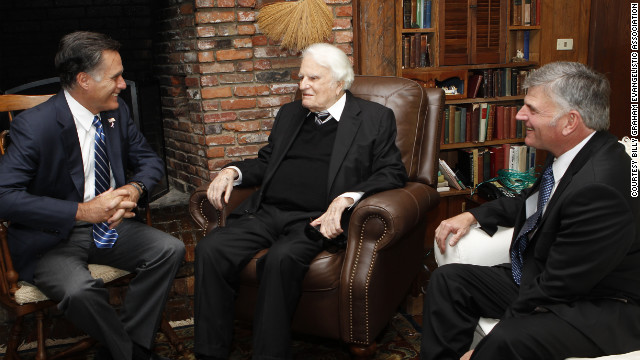
(CNN) - Shortly after Republican presidential candidate Mitt Romney enjoyed cookies and soft drinks with the Rev.  Billy Graham and his son Franklin Graham on Thursday at the elder Graham's mountaintop retreat, a reference to Mormonism as a cult was scrubbed from the website of the Billy Graham Evangelistic Association.
 
In a section of the website called Billy Graham's My Answer there had been the question "What is a cult?"

Answer: "A cult is any group which teaches doctrines or beliefs that deviate from the biblical message of the Christian faith."

"Some of these groups are Jehovah's Witnesess, Mormons, the Unification Church, Unitarians, Spritualists, Scientologists, and others," the site continued.

No longer. On Tuesday, the Billy Graham Evangelistic Association confirmed that page has recently been removed from the site.

“Our primary focus at the Billy Graham Evangelistic Association has always been promoting the Gospel of Jesus Christ," Ken Barun, chief of staff for the association, told CNN in a statement. "We removed the information from the website because we do not wish to participate in a theological debate about something that has become politicized during this campaign."   Continue at CNN


Saturday, August 18, 2012

6 Reasons Why Mormons Are Beating Evangelicals in Church Growth

Our churches face a demographic crisis.
Young people are leavingeven the Southern Baptist Convention is losing members, and when you drill down deeper---comparing church attendance with population growth---the picture looks even more bleak. Simply put, when America's fastest-growing religious segment is "nonreligious," we have a problem. The Barna Group recently compiled the results of a number of national studies and published a list of six reasons why young evangelicals leave the church:
  1. The church is overprotective.
  2. Their experience of Christianity is shallow.
  3. Churches seem antagonistic to science.
  4. The church's approach to sexuality is judgmental and simplistic.
  5. They wrestle with the exclusivity of Christianity.
  6. The church feels unfriendly to those who doubt.
These answers are just what you'd expect, because they correspond to many leading churches in modern evangelicalism that combine nominally traditional doctrine with shallow commitment and have been plagued by rampant divorce and extramarital sex---all against a backdrop of extreme cultural hostility. In other words, we're about 95 percent like the surrounding culture and hated for the 5 percent deviation.

But one religious group shows consistent growth year by year and decade by decade. Mormons, living in the same country and culture as evangelicals, keep growing their church. Why? I propose six reasons.

1. Mormons have bigger families.

This is the easiest and simplest explanation. But it's far from the entire story. In fact, if family size were determinative, then many churches in America would be growing at a rate that exceeded general population growth.  Continue at David French

Thursday, August 2, 2012

The Mormonizing of America

When on vacation last week I ambled into a wonderful little used book store in Fredericksburg, Virginia. There were hundreds of books that caught my eye there, but I left with only one—Faith and Betrayal, by Sally Denton, a biography that traces the life of Jean Rio, the author’s great-great-grandmother. One of England’s earliest and most notable converts to Mormonism, Rio set out from England to Utah in the 1850’s to settle down in Zion (which is to say, Salt Lake City, Utah). The book describes her journey, her arrival, and her eventual disillusionment as she comes to see the ugly underbelly of Mormonism—the violence, the polygamy, the greed and the utter hypocrisy of it all. It was a fascinating little book.

While Faith and Betrayal was interesting as history and biography, I read it at least in part because of an interest I have in Mormonism. It seems that the Church of Jesus Christ of Latter Day Saints is coming into its own in recent days. Mormons tend to be high achievers and are increasingly finding their way into positions of power and influence, whether that is as CEO of a multi-billion dollar company or as a presidential candidate.  Continue at Tim Challies

Thursday, April 26, 2012

Are Mormons Christian?

Note: The FAQs is TGCs new series in which we answer your questions about the latest news and current events. Although the series normally attempts to be as fact-based and objective as possible, this entry relies on scriptural interpretation that some Christians may consider wrong or at least open to debate.

"Are Mormons Christian?" Since the 1820s, when Joseph Smith founded the religious movement, evangelicals and other orthodox Christians have answered with a resounding "no." Over the past decade, though, many Americans have begun to provide a different response. In an interview with CNN, megachurch pastor Joel Osteen said that while the Mormon faith is "not traditional Christianity" he still views them as "brothers in Christ."

And earlier this month, the widely read evangelical blogger David French wrote,
I'd argue that our view of salvation --- whether Arminian or Reformed --- is of enormous consequence, going directly not only to the nature of God but also how we understand each moment of our lives, yet I rarely hear anyone seriously ask, "Are Methodists Christian?" Perhaps that's not so much because the theological differences aren't real and profound but because we've made our historical peace through shared understanding of our faith in Christ. Perhaps its time that we make that same peace with Mormons.
Are Mormons our fellow "brothers in Christ?" Are the theological distinctions between Mormonism and evangelicalism similar to the differences between Presbyterians and Methodists?

In order to examine these questions, I've compiled answers from various resources and subject-area experts and presented them in the form of a FAQ. This article is not intended to be an in-depth explanation of Mormon history or theology, but rather an examination of areas that are relevant to the question of whether Mormons should be considered by evangelicals to be Christians. For more information on Mormonism I recommend Andrew Jackson's Mormonism Explained: What Latter-day Saints Teach and Practice.  Continue at Joe Carter

Tuesday, April 17, 2012

Mormonism isn’t Christianity, even if the President of Fuller Theological Seminary says Otherwise.

Richard J. Mouw wrote an astounding article for CNN in which he used the subject of presidential candidate Mitt Romney in an attempt to legitimize Mormonism.

Mouw, the president of Fuller Theological Seminary who claims to “know cults” and has “studied them and taught about them for a long time,” for some reason seems utterly incapable of spotting one right in front of him.

God gave us a means by which to identify a false prophet, false teacher, or cult. Through the pen of Paul He told us in Galatians 1:6-9 to watch out for anyone (even an angel from Heaven) that preaches “another gospel.” If anyone (which includes religious organizations) preaches “another gospel,” they are anathema! Mr. Mouw, however, is actively directing us away from Scripture and toward human reasoning by advancing his own means of how to identify those that are accursed. From Mouw’s article:
[A cult's] adherents are taught to think that they are the only ones who benefit from divine approval. They don’t like to engage in serious, respectful give-and-take dialogue with people with whom they disagree. Nor do they promote the kind of scholarship that works alongside others in pursuing the truth. Jehovah’s Witnesses, for instance, haven’t established a university. They don’t sponsor a law school or offer graduate-level courses in world religions. The same goes for Christian Science. If you want to call those groups cults I will not argue with you. But Brigham Young University is a world-class educational institution, with professors who’ve earned doctorates from some of the best universities in the world. Several of the top leaders of the Church of Jesus Christ of Latter-day Saints have PhDs from Ivy League schools.”
You read that right (I actually had to read it twice). The Jehovah’s Witnesses and Christian Science are cults because they have not established a university, sponsored a law school, or offered graduate-level courses in world religions, but Mormonism is not a cult because they founded Brigham Young University and several of their top leaders have earned degrees from Ivy League schools.  Continue at Pilgrim

Monday, January 2, 2012

15 Faith-Based Predictions for 2012

To ring in the New Year, CNN's Belief Blog asked experts in religion, faith leaders, and a secular humanist about how the forces of faith and faithlessness will shape the world in 2012.

Here's what they told us:

1. The Republican Party will tap Mitt Romney as its presidential nominee, and America will finally have its "Mormon moment." As evangelicals try to figure out whether they can support a president who practices Mormonism, the rest of us will try to figure out whether Mormonism is a cult, a form of Christianity, or something in between. Meanwhile, visitors to Marriott hotels will finally crack open some of those nightstand copies of The Book of Mormon.
Stephen Prothero, Boston University religion professor and regular CNN Belief Blog contributor

2. Despite all of the lessons that could have been learned from Y2K and Harold Camping, people will still rally around the idea that apocalyptic events are on the calendar for 2012. Some will turn to the end-date of the 5125-year-long cycle in the Mesoamerican Long Count calendar (closely associated with the Maya civilization) and a handful of folks believe cataclysmic events are awaiting on December 21, 2012. But the dates with will pass with little fanfare — except for those profiting from the sale of gold coins, generators, and dried food that you'd probably rather want to die than eat.
Margaret Feinberg, author of "Hungry for God"

3. Continuing revolutions across the Arab world will raise alarming questions about the fate of the remaining Christians in the region, and will put the issue of religious persecution squarely on the political agenda. Sizable Christian populations now survive in only two Arab countries, Egypt and Syria, both of which could soon be under Islamist rule. At a minimum, expect to see inter-faith violence on the ground. In a worst case scenario, Arab Christians could face large scale persecution, forcing millions to seek new homes overseas. Watch too for religious persecution to be an emotive issue in the U.S. presidential race.
Philip Jenkins, Penn State University professor and author of "Laying Down the Sword: Why We Can't Ignore the Bible's Violent Verses"

4. The year will see an increase in the number of people "coming out" as nonbelievers. Major events like the Reason Rally in March will be a catalyst for more people to publicly declare their secular worldview. The statements of popular celebrities George Takei and Ricky Gervais as atheists in 2011 are just the tip of the iceberg.
–Roy Speckhardt, executive director of the American Humanist Association 

Read the rest HERE

Thursday, October 27, 2011

Does Joel Osteen Not Know, or Does He Not Care?

Here we go again. Joel Osteen is in the news once again, this time for saying that Mormonism is just another form of Christianity. Osteen, pastor of “America’s largest church,” as the media repeat over and over, was speaking to The Washington Times in an interview that covered a variety of issues. It was the quintessential Joel on display.

Speaking to the newspaper on Monday, Osteen said, “I see faith in America at an all-time high.” His comments came just as a major research project detailed a significant loss of vitality in America’s Christian congregations. That loss of vitality can be traced, among other things, to a loss of theological and biblical conviction. Joel, of course, is proof positive that you can build a crowd without building a church. He is not inclined to deal in much theological conviction.

In the interview, he distilled his message in these words: “Part of our core message is that seasons change, and when you believe, if you don’t get bitter, and you don’t get discouraged, you may not change overnight, but you can get peace.”    Keep Reading >>>


Image edit by GRK

Friday, October 14, 2011

Mormonism 101

Mormonism is back in the news. And with two Mormon presidential candidates, including Mitt Romney (the front runner for the Republican nomination), there’s a good chance we will be hearing much more about Mormonism for the next twelve months. Denny Burk has a very helpful piece on whether Mormonism is a cult, and Albert Mohler has written a thoughtful article on “Mormonism, Democracy, and the Urgent Need for Evangelical Thinking.” I won’t repeat their arguments, except to reiterate Mohler’s reminder that voting for a president should include examining the candidate’s religious beliefs, but should include other considerations as well.

Presidential elections are important. But believing the truth is even more important. With that in mind, I thought it might be helpful to provide a brief overview of Mormon history and theology. I won’t try to debunk Mormonism or prove Christianity. But I hope this quick survey will show that the two are not the same.

A quick note on secondary sources: Christian materials do not always treat Mormonism fairly or go the extra mile to present Mormon ideas as a Mormon would recognize it. One book that does is Andrew Jackson’s Mormonism Explained: What Latter-day Saints Teach and Practice. I also recommend A Different Jesus? The Christ of the Latter-Day Saints by BYU professor Robert Millet. Richard Mouw concedes too much in his Foreword and Afterword, but it’s still helpful to get Mormon Christology from a Mormon himself.    Keep Reading>>>

Thursday, October 13, 2011

Mormonism, Democracy, and the Urgent Need for Evangelical Thinking

Predictably, Mormonism is in the news again. The presence of two members of The Church of Jesus Christ of Latter-Day Saints among contenders for the 2012 Republican presidential nomination ensured that it was only a matter of time before Evangelicals, along with other Americans, began to talk openly about what this means for the nation, the church, and the stewardship of political responsibility in the voting booth. 

There are numerous ways to frame these questions wrongly. Our responsibility as evangelical Christians is to think seriously and biblically about these issues. The first temptation is to reduce all of these issues to one question. We must address the question of Mormonism as a worldview and judge it by the Bible and historic Christian doctrine. But this does not automatically determine the second question — asking how Mormon identity should inform our political decisions. Nevertheless, for evangelical Christians, our concern must start with theology. Is Mormonism just a distinctive denomination of Christianity?   Keep Reading>>>

Wednesday, October 12, 2011

Rise and Fall of an Evangelical Empire

I don't recall which clue first warned me about the problems with this church. Books by Jesus Seminar heavyweights Marcus Borg and John Dominic Crossan rested near the front of the ornate sanctuary, ready to explain for visitors why Jesus' resurrection was a myth. Rainbow flags signaled this is an "open and affirming" congregation for practicing homosexuals. Perhaps it is no coincidence the church baptized only two children in the last year. Sunday attendance has never topped 100 so far in 2011, though the facility could seat far more.

Even after observing all these worrisome clues, however, I was still taken aback by what I saw on the church's basement bookshelf. Not one but two copies of the New World Translation of the Bible lurked to lure in unsuspecting readers. Do the church leaders not know the Jehovah's Witnesses twist God's Word to recruit for their cult? Or do these leaders just not care? Seeing these blasphemous Bibles in a church took me back to a painful time when I learned that a United Methodist seminary had kicked out a young Anglican congregation meeting in their space and welcomed the Mormons in their place. Apparently it's not enough for liberal Protestants to reject orthodoxy. Some must also welcome heterodoxy.    Keep Reading...

Wednesday, May 18, 2011

The Jesus of the Bible compared with the Jesus of Mormonism

A former Mormon–one who came to a saving knowledge of the true, biblical Christ–penned the following piece found at Mormon Coffee:
This is the Christ of Mormonism:
1. He lives as a humanoid god on a star near Kolob along with his father god, bound by the physical world; he does not transcend the material.
2. He is the brother of satan.
3. He had to earn his own salvation while he was on earth.
4. He offers his “grace” only to those who work hard enough.
5. He is not from everlasting to everlasting, but was created a finite time ago by his father god, who in turn was also created by his own father god, who in turn was created by his own father god, so on and so forth
6. He is not the greatest being possible.
7. He is finite.

Read the rest HERE

Monday, January 31, 2011

Is Joseph Smith the Gateway to Heaven?

Joseph Fielding Smith 
Absolutely amazing blasphemies from the Mormon church:
“[There is] “no salvation without accepting Joseph Smith. If Joseph Smith was verily a prophet, and if he told the truth…no man can reject that testimony without incurring the most dreadful consequences, for he cannot enter the kingdom of God” -Joseph Fielding Smith, Doctrines of Salvation, vol. 1, p.190
George Q. Cannon
“If we get our salvation, we shall have to pass by Joseph Smith; if we enter our glory, it will be through the authority he has received. We cannot get around him.” -1988 Melchizedek Priesthood Study Guide, p. 142, Apostle George Q. Cannon
Brigham Young
“He that confesseth not that Jesus has come in the flesh and sent Joseph Smith with the fullness of the Gospel to this generation, is not of God, but is anti-christ.” -Brigham Young, Journal of Discourses, vol. 9, p.312
“No man or woman in this dispensation will ever enter into the celestial kingdom of God without the consent of Joseph Smith…every man and woman must have the certificate of Joseph Smith, junior, as a passport to their entrance into the mansion where God and Christ are… [Joseph Smith] reigns there as supreme a being in his sphere, capacity, and calling, as God does in heaven. Many will exclaim—”Oh, that is very disagreeable! It is preposterous! We cannot bear the thought!” But it is true.” -Brigham Young, Journal of Discourses, vol. 7, p.289-91

HT: Bob Hanks

Wednesday, January 5, 2011

They Believe What? You’re Kidding, Right?

According to Mormonism (The Church of Jesus Christ of Latter Day Saints, or LDS for short), Jesus is the begotten offspring of an exalted man and one of his many wives who lives on a planet circling a star named Kolob, and his “gospel” is the message of how you, too, can be exalted to godhood.

Christ’s full deity is denied by this group, and the “god” they worship is not eternal but merely an exalted man who has achieved godhood by obeying certain laws. Fundamentally, Mormonism is one of the most polytheistic religions in existence. Christianity is entirely mono-theistic, proclaiming that there is only one God, eternally existent in three Divine Persons, the Father, the Son and the Holy Spirit.

Mormonism worships a different god, follows a different Christ, and proclaims a different gospel from authentic New Testament Christianity. There should be absolutely no doubt on this issue – Mormonism and Christianity are not in any way compatible. 

The following are four contrasts outlined by Dr. John MacArthur: Read it all HERE

Wednesday, September 1, 2010

Mormonism is NOT Christianity

Well, it's happening. There is, as I feared, a growing confusion over what constitutes the content of genuine Christian faith. I am sure Glenn Beck is a nice man. I am sympathetic to his fear over our diminishing liberties and a federal government that has gotten far to big. But the reason why I was not enthusiastic about his gathering in Washington is that it was a rally that blurred lines between religious faith and civic engagement. It's not that our faith should not inform our politics. Quite the contrary. The problem is that as a Christian I must not involve myself in religious observances with non-Christians. Such compromises do not honor God. What is more, the Gospel gets muddied in such events. Now there are many good evangelicals who are openly entertaining the possibility that Glenn Beck is a Christian even though he is a Mormon. I feared this would happen. I feared the lines would be blurred.

Thanks to Justin Taylor for posting the following information: Read it HERE