The purpose of this Blog is to introduce men and women all over the World to the Doctrines of Grace; the 5 Solas; Reformation Theology and the Lord and Savior Jesus Christ.
Showing posts with label Reformation Theology. Show all posts

Tuesday, October 8, 2013

What Total Depravity Is Not

In his Abstract of Systematic Theology, James P. Boyce gives a classically Reformed presentation of sin. In four points, he affirms (1) all men have sinned, (2) all men are sinful from birth (i.e., they possess a sinful nature), (3) the world suffers from the corruption of sin, and (4) all parts of humankind are infected and affected by sin. Altogether, Boyce makes a Scriptural defense of ‘Total Depravity.’

However, in all of his efforts to affirm what Scripture teaches about sin and its effects, he simultaneously relates what ‘Total Depravity’ is not. In fact, he posits more statements related to what sin is not than what it is.  Consider these five.

1. Total Depravity Is Not Maximal in Every Person

Boyce writes,

This corruption has not been equally developed in all. The doctrine of total depravity does not mean such equal development. The Scriptures recognize degrees of wickedness as well as of hardening of the heart, and even blinding of the minds of some. But they also represent that the lack of this development is due to differing circumstances and restraints by which some men are providentially surrounded.    Continua at Via Emmaus

Saturday, August 17, 2013

10 Distinguishing Marks of John Calvin’s Preaching


Steven Lawson contributed a chapter in John Calvin: A Heart for Devotion, Doctrine, and Doxology on John Calvin “The Preacher of God’s Word.” Here is a summary of that chapter, outlining what Steven Lawson suggests are the ten distinguishing marks of Calvin’s preaching.


1.    John Calvin’s preaching was biblical in its substance.

“The Reformer stood firmly on the chief cornerstone of the Reformation—sola Scriptura (“Scripture alone”). … The preacher, Calvin believed, has nothing to say apart from Scripture.”

2.    John Calvin’s preaching was sequential in its pattern.

“For the duration of his ministry, Calvin’s approach was to preach systematically through entire books of the Bible. … Calvin preached from the New Testament on Sunday mornings, from the New Testament or the Psalms on Sunday afternoons, and from the Old Testament every morning of the week, every other week. In this consecutive fashion, Calvin preached through most of the books of the Scriptures.”

3.    John Calvin’s preaching was direct in its message.    Continue at Nathan W. Bingham

Saturday, November 10, 2012

Predestination Destroys Legalism

Predestination destroys legalism. If salvation is by Christ alone, it leaves no room for boasting or trusting in ourselves, even a little. It strips us bare and forces us to abandon all hope in our efforts or rules ... man-made rules non-predestinarians tend to make to demonstrate they are more worthy than others of God's grace (an oxymoron). The Scripture declares: "It is because of Him you are in Christ Jesus, who became to us wisdom from God, righteousness and sanctification and redemption, so that, as it is written, “Let the one who boasts, boast in the Lord.” (1 Cor 1:30-31)

This is not to say that Reformed people cannot be legalistic. Human beings find any way possible to do so, Reformed included. It means to say, rather, that if UNDERSTOOD CORRECTLY the doctrine of Grace ALONE in Christ ALONE will have the real effect of stripping us of legalism etc. Again only God's grace can do so. This likewise was not an attempt to show Reformed superiority but the effect of a true understanding of the Bible will have on someone who beholds the majesty of God and is struck down by the fact that God will have mercy on whom he will have mercy.

----------------------

After I wrote this, I had the following discussion ensue which I believe worth posting.

Visitor: Please explain to me what you mean by God will have mercy on who he will have mercy on. Would you try to say that God would send someone to hell without a choice of accepting and serving Him?
 
Response: Thank you for your question. First, "He will have mercy on whom he has mercy" is not my words but a direct quote from Scripture (Romans :9:15, 16). That being settled, let me answer your question.... everyone who hears the gospel are presented with the command or summons to believe.   Continue at Reformation Theology

Friday, August 3, 2012

John Gerstner Lectures

If you’ve never listened to the later Dr. John H. Gerstner you are neglecting a benefit for your soul from one of God’s wonderful gifts to the church. Dr. Gerstner (1914-1996) was “Professor of Church History at Pittsburgh Theological Seminary and Knox Theological Seminary. He was an authority on the life and theology of Jonathan Edwards. Gerstner counted among his students R.C. Sproul and wrote several books, including Primitive Theology.” The principle work for which he is remembered is The Rational Biblical Theology of Jonathan Edwards. You can read a short memorial of his life and work here.

You can read two of Dr. Gerstner’s articles over at Lionier’s website. The first is “God’s Providence: a Two Edged Sword (Part 3),” and the second “True and False Assurance.”

Ligonier has also posted several of Dr. Gerstner’s audio lecture series:
  • The Westminster Confession of Faith with Dr. John Gerstner

    The Westminster Confession of Faith has, for hundreds of years, served as the doctrinal foundation of the Reformed churches. In this series, Dr. John Gerstner focuses his lifetime of scholarship on a comprehensive treatment of the meaning and application of …Read More 

    Continue at Nicholas T. Batzig

Wednesday, June 27, 2012

You're a Calvinist, Right?

I've been reading Fred Sanders's blog for a long time, and when his book, The Deep Things of God, came out, I was eager to read it. He's a good writer, he loves and quotes the Puritans, he's a reasonable thinker, and he knows how to do careful exegesis.

He's also a Wesleyan.

I don't mean to declare that so menacingly. But the first time I learned Sanders---associate professor at the Torrey Honors Institute of Biola University---was a Wesleyan, I was a bit surprised. It's not that Wesleyans and Arminians can't be careful interpreters and reasonable thinkers---I just don't often resonate with their writings and conclusions quite the way I do with Sanders'.

And so, I had to know: For a guy who loves, quotes, and depends upon Calvin and Calvinists, why isn't Fred Sanders a Calvinist? We corresponded, and he explained the one thing he wished Calvinists would stop accusing Wesleyans of doing and why Wesleyanism is only the opposite of Calvinism in a very small thought-world.

A good many Calvinists grew up in the Reformed tradition, but many of us became Calvinists later in life, when we had to make our faith our own and make sense of what the Bible says for ourselves. How did you become a Wesleyan? What about the tradition attracts you?

I grew up as a free-range evangelical, in pentecostal and baptistic churches of various kinds. But I actually got saved as a teenager when a revival broke out in the youth group at the local United Methodist church. I got an MDiv at Asbury Theological Seminary, a great interdenominational school with definite Methodist roots. So my conversion and my early theological training were in Wesley territory.   Continue at John Starke

Thursday, May 17, 2012

Well Done Phil Johnson!

This is a repost but something we should all be reminded of:
 
I loved reading Phil Johnson’s response to a comment at his Pyromaniacs blog site who wrote…
Your identity as a “Baptist”; your endless quotations from Charles Spurgeon; your faithful devotion to John MacArthur; and especially your willingness to call yourself a “Calvinist” are all huge red flags that tell me something is seriously wrong with your theology. Why do you teach a system of doctrine that is named after a mere man? Why are you following human teachers instead of going to the Bible alone? After all, 1 John 2:27 says, “The anointing which ye have received of him abideth in you, and ye need not that any man teach you.” We ought to go to Scripture alone to establish our doctrine! The truth is in God’s Holy word, not in any theological system or theology textbook developed by mere men. Isn’t that principle what the Reformation was originally about? Sola Scriptura? Didn’t even Calvin himself go to Scripture for the truth instead of reading other men? I believe that if Calvin himself wrote for this blog, he would point people to the truth in God’s Holy word, not to a theology developed by some other man.
Phil’s reply: You have seriously misunderstood sola Scriptura if you really imagine that it rules out human teachers or eliminates systematic theology. The Reformers (including Calvin) often cited the works of Augustine, Tertullian, Jerome, Cyprian, Ambrose, and others-ranging from the early church fathers through Aquinas. They didn’t follow any of them slavishly, of course, but they certainly took them seriously. Not one of the major Reformers would have tolerated the claim that because the Church Fathers were mere men they were therefore irrelevant or incapable of shedding any helpful light on tough theological questions.   Continue at John Samson

Monday, April 23, 2012

Settlers, Pilgrims, and Wanderers

Before Emergent brothers and sisters reject Reformation orthodoxy, they should at least know what it is and what it is not. 
 
Travel writer Pico Iyer confesses that he likes airports a lot. Part mall, part border-crossing, they buzz with the ambient noise of postmodern consciousness, representing an "everywhere" that is really no actual place at all. Those of us who can't remember when we were not always on the go, repeatedly uprooted growing up, living in the fast lane with computers and cell phones, catching planes and channel surfing, know deep inside ourselves what it means to be a wanderer in these "everywhere" places.

The Emergent Church movement is as much the product of this postmodern condition as the megachurch movement from which it recoils, but whereas the latter has seemed obsessed with the novel, the ephemeral, the immanent, and the practical, the next-generation Emergent groups evidence an interest in the ancient, the authentic, the transcendent, and the mysterious. 

While there is much to appreciate in the Emergent movement's instincts that should be celebrated and encouraged, is there a characteristically modern tendency that it shares with its megachurch heritage-a tendency that may finally threaten the noble aspirations of these bright, energetic, and hopeful followers of Christ? 

First and foremost, Emergent identifies with postmodernism, although its celebration of postmodernism is often as sweeping as its critique of modernity. In many respects, Emergent reflects these most-modern rather than postmodern tendencies. In fact, to gain any real insight into the Emergent movement (as about any other in our day), one has to visit its websites. There, one enters a world in which theology and church practice are decided largely by democratic conversation: like a 24-hour live streaming Oprah show.   Continue at Michael Horton

Friday, March 23, 2012

Antinomianism and Reformation Confessions

In the previous post I offered a very brief survey of some controversies, pointing out that while there have been some true-blue antinomians, the charge is often made by those tilting in a more neonomian direction against faithful, apostolic, evangelical preaching. For example, in spite of the fact that Lutheran and Reformed churches have gone on record against antinomianism in no uncertain terms, that has not kept them from being accused of holding at least implicitly to antinomian tenets.

The Lutheran Confession

In his Small Catechism, Luther begins with the Ten Commandments, concluding, “God threatens to punish all that transgress these commandments. Therefore we should dread His wrath and not act contrary to these commandments. But He promises grace and every blessing to all that keep these commandments. Therefore we should also love and trust in Him, and gladly do [zealously and diligently order our whole life] according to His commandments.”

Settling the controversies in its own circles, the Lutherans confess in the fourth article of the Formula of Concord (1577), “We reject and condemn as offensive and detrimental to Christian discipline the bare expression, when it is said: Good works are injurious to salvation.”
For especially in these last times it is no less needful to admonish men to Christian discipline [to the way of living aright and godly] and good works, and remind them how necessary it is that they exercise themselves in good works as a declaration of their faith and gratitude to God, than that the works be not mingled in the article of justification; because men may be damned by an Epicurean delusion concerning faith, as well as by papistic and Pharisaic confidence in their own works and merits (IV.2).
After affirming the civil and elenctic uses of the law (viz., to curb public vice and to drive sinners to Christ), the sixth article defends the “third use”: “..that after they are regenerate and [much of] the flesh notwithstanding cleaves to them, they might on this account have a fixed rule according to which they are to regulate and direct their whole life…” (VI.1). 

The following conclusions are worth quoting at length:  Continue at Michael Horton

Wednesday, October 19, 2011

You Might Be a Pragmatist

I’d imagine most of us on the conservative end of evangelicalism—whether you’re part of the YRR crowd or the OBR (Old, Boring, Reformed) crowd—we understand the wrongheadedness of church growth methodology. It’s easy to see how men like the early pioneers of church growth (Donald McGavran, C. Peter Wagner, Robert Schuller) and their most famous disciples (Bill Hybels, Rick Warren, Joel Osteen) got it wrong.

The theology of the Bible teaches us God is absolutely sovereign over salvation; He alone predestines, calls justifies, and glorifies fallen sinners who are dead in trespasses and sin. Christ is the sovereign head of the church who receives the elect bride from His Father; He alone directs, equips, and grows the church according to the will of the Father. The Holy Spirit is the executor of the Father’s will, drawing the elect to Jesus Christ; He alone regenerates the sinner, seals the elect, and empowers the church for growth and service.

We don’t deny the human element, even as we affirm monergism and divine initiative. God uses means and we’re part of the means He uses to do His work, right? As Paul said, “I planted, Apollos watered, but God gave the growth.” And it’s important to see that the apostolic pattern of planting and watering were not according to a pragmatic, “the end justifies the means” approach. Paul, Apollos, and every other exemplary minister of the apostolic age did ministry according to the means God prescribed (i.e., Eph. 4:11-16) and not according to what seemed reasonable to the culture (i.e., 1 Cor. 2:1-5).

The end goal, as well as the means employed to achieve that end, are important to God. So, when we use pragmatic-oriented church growth principles to plant and water, we go against the grain, planting and watering according to the pattern of the flesh rather than the power of the Spirit. That’s wrong. We, along with Paul, want the faith of those who hear us to rest, not “in the wisdom of men but in the power of God” (1 Cor. 2:5).    Keep Reading...

IMAGE

Saturday, October 15, 2011

Jesus Teaches that Regeneration Precedes Faith

"All that the Father gives me will come to me, and whoever comes to me I will never cast out." (John 6:37)

No one can come to me unless the Father who sent me draws him. And I will raise him up on the last day. (John 6:44)

It is the Spirit who gives life; the flesh is no help at all. The words that I have spoken to you are spirit and life. 64But there are some of you who do not believe...

...And he said, "This is why I told you that no one can come to me unless it is granted him by the Father." (John 6:63, 65)

According to Scripture, all people are born dead in sin (Eph 2:1). This simply means that, as a result of the Fall, people are born without the Holy Spirit and therefore, (left to themselves and being spiritually dead) are hostile to Christ (Rom. 8:7) and unable to understand to spiritual things (1 Cor 1:21). It does not mean they can do (or think) nothing in their fallen state, but it means they can do nothing spiritual or redemptive ... that they will always think God's word is foolish (1 Cor 2:14) until the Holy Spirit, who comes from the outside, works grace in their hearts (Ezek 11:19-20). The natural man may be alive to carnal things, but he is dead to spiritual things. 

So to the question: can any person come to faith in Christ apart from the work of the Holy Spirit, both the Arminian and the Calvinist would definitively answer "no". 

The Arminian asserts that this "prevenient grace" is ultimately resistible by the fallen sinner. Arminian prevenient grace affirms that man in indeed dead in sin, that is, unless the Spirit grants the type of grace that places them in a kind of post-regenerate - pre-conversion state so they can have the opportunity to choose whether to believe or not. As most Arminians will admit, however, this is a logically deduced, rather than biblical, assertion. On the other hand, the Calvinist is convinced that the Bible teaches that regenerative grace itself opens our blind eyes, unplug our deaf ears and gives us a new heart (Ezek 36:26, John 6:63) making God's call effectual, infallibly bringing the sinner to faith in Jesus Christ. 

Arminian synergists assert that prevenient grace resolves the problem of human boasting since God initiates with grace. But in reality this sleight of hand does not resolve the problem at all and only begs the question. For if God gives this prevenient grace to everybody, we must ask: why do some respond positively to Christ and not others? What makes them to differ? Jesus Christ or something else? The problem of boasting is not removed, for if God gives grace to everybody and only some believe, then the heart that believes still thinks that it made the wiser decision by improving on grace while others did not. The person affirming prevenient grace still must ultimately attribute his repenting and believing to his own wisdom, prudence, sound judgment, or good sense. So in the Arminian belief system, they are not willing to confront the obvious question of why some believe and not others? The only answer I have ever heard to this question in all my years debating this was "because some believed". But, this avoids the question, because I did not ask them what they did, but why they did it? And the "why" seems to be a question that Jesus goes out of his way to answer. (John 8:46-47 & John 10:26)   Keep Reading...

Wednesday, August 17, 2011

The Brouhaha over the Brew


Looks like John MacArthur’s most recent article hit a nerve. He knew that before he wrote it—he knew it would offend some people—and yet he was still willing to write it.

I can hear some of you in the YRR crowd ask, “But why? Why would John risk alienating us, an enthusiastic group of young reformers?”

Simple. John thinks you’re worth it. He cares, and he’s willing to say the things you might not particularly like, at first blush anyway.

Of all the people who roam the vast fields of evangelicalism, you YRRers appreciate straight talk. You are right to be suspicious of those who pitch candy-coated messages in pretty packages. That’s not John. He’ll never tickle your ears, and we know that’s why you’re still listening.

Just in case you missed John’s point in the dust-up (not only in our comment thread, but in other playgrounds as well), here it is: It’s irresponsible and wrong for YRR leaders to make beer/wine-drinking one of the badges of the YRR movement. That’s it. So, if that shoe fits you, wear it; If it doesn’t, let it pass.

John clearly would like to persuade you of the wisdom of abstinence, but he's not interested in binding the conscience of the entire YRR movement by an artificial rule. And at the very least, he was calling the YRR leadership to exercise pastoral wisdom and compassion, knowing the devastation alcohol abuse brings in a beer-soaked culture. Here’s a quote: “The last thing I would ever want to do is be the cause of stumbling for one of” [those] “who have been delivered from alcohol addiction.”   Keep Reading...

See also:


Memmo to the Old, Grumpy and Reformed


YRR Jerks?1
YRR Jerks?2

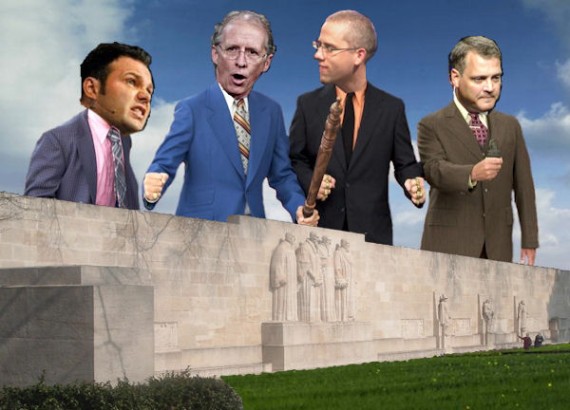
IMAGE1
IMAGE2


Thursday, February 10, 2011

A Manifesto on Hard-Believism

Enter ye in at the strait gate: for wide is the gate, and broad is the way, that leadeth to destruction, and many there be which go in thereat: Because strait is the gate, and narrow is the way, which leadeth unto life, and few there be that find it.
-- Matthew 7:13-14 (in the King's English)

When the disciples heard this, they were greatly astonished, saying, "Who then can be saved?" But Jesus looked at them and said, "With man this is impossible, but with God all things are possible."
-- Matthew 19:25-26

It is still scandalous to say what the Scriptures say, which is that no man who doesn't take up his cross is worthy of Jesus (Mt. 10:38). Many are they who want to extrapolate from sola fide to something that is not fide at all. They assume oddly that because faith alone justifies, real faith may be alone, unaccompanied by works, or that the sum total of salvation is justification alone and not also sanctification.

We saw this in the relatively recent "Lordship salvation" debate, in which many solid Reformed brothers helpfully affirmed the classic doctrine of "faith alone" while also affirming what the Bible both says and implies: saved people are changed people. To have Jesus as Savior is to have him as Lord. It is not legalism to say the new birth begins a new life. Yes, we still battle the flesh -- crucifying it daily -- but this in itself is a change from the old life, in which we cared nothing about battling the flesh. We still have sin in us, but we are conscious of it, convicted about it, and concerned to be rid of it. This is not works salvation; this is the fruit of salvation. Keep Reading>>>

Friday, September 10, 2010

The Five Solas of the Reformation by James Montgomery Boice

“1. Scripture alone. When the Reformers used the words sola Scriptura they were expressing their concern for the Bible’s authority, and what they meant is that the Bible alone is our ultimate authority—not the pope, not the church, not the traditions of the church or church councils, still less personal intimations or subjective feelings, but Scripture only. Other sources of authority may have an important role to play. Some are even established by God—such as the authority of church elders, the authority of the state, or the authority of parents over children. But Scripture alone is truly ultimate. Therefore, if any of these other authorities depart from Bible teaching, they are to be judged by the Bible and rejected. 2. Christ alone. The church of the Middle Ages spoke about Christ. A church that failed to do that could hardly claim to be Christian. But the medieval church had added many human achievements to Christ’s work, so that it was no longer possible to say that salvation was entirely by Christ and his atonement. This was the most basic of all heresies, as the Reformers rightly perceived. It was the work of God plus our own righteousness. The Reformation motto solus Christus was formed to repudiate this error. It affirmed that salvation has been accomplished once for all by the mediatorial work of the historical Jesus Christ alone. His sinless life and substitutionary atonement alone are sufficient for our justification, and any ‘gospel’ that fails to acknowledge that or denies it is a false gospel that will save no one.
3. Grace alone. The words sola gratia mean that human beings have no claim upon God. That is, God owes us nothing except just punishment for our many and very willful sins. Therefore, if he does save sinners, which he does in the case of some but not all, it is only because it pleases him to do it. Indeed, apart from this grace and the regenerating work of the Holy Spirit that flows from it, no one would be saved, since in our lost condition, human beings are not capable of winning, seeking out, or even cooperating with God’s grace. By insisting on ‘grace alone’ the Reformers were denying that human methods, techniques, or strategies in themselves could ever bring anyone to faith. It is grace alone expressed through the supernatural work of the Holy Spirit that brings us to Christ, releasing us from our bondage to sin and raising us from death to spiritual life.
4. Faith alone. The Reformers never tired of saying that ‘justification is by grace alone through faith alone because of Christ alone.’ When put into theological shorthand the doctrine was expressed as “justification by faith alone,” the article by which the church stands or falls, according to Martin Luther. The Reformers called justification by faith Christianity’s “material principle,” because it involves the very matter or substance of what a person must understand and believe to be saved. Justification is a declaration of God based on the work of Christ. It flows from God’s grace and it comes to the individual not by anything he or she might do but by ‘faith alone’ (sola fide). We may state the full doctrine as: Justification is the act of God by which he declares sinners to be righteous because of Christ alone, by grace alone, through faith alone.
5. Glory to God alone. Each of the great solas is summed up in the fifth Reformation motto: soli Deo gloria, meaning ‘to God alone be the glory.’ It is what the apostle Paul expressed in Romans 11:36 when he wrote, ‘to Him be the glory forever! Amen.’ These words follow naturally from the preceding words, “For from him and through him and to him are all things” (v. 36), since it is because all things really are from God, and to God, that we say, ‘to God alone be the glory.’”
–James Montgomery Boice, Whatever Happened to the Gospel of Grace? (Wheaton, Ill.: Crossway, 2001), pp. 65-149.
Posted by John on September 9, 2010 04:42 PM
 

Thursday, August 5, 2010

Matrix of Reformed Baptists


The three part series Matrix of Reformed Baptists seeks to discover the religious, political, and social pressures which formed and developed that which has come to be known as Reformed Baptist Churches.  Without knowing something of these shaping influences over the course of seventeen hundred years of Church history, we cannot rightly understand how these churches came to be what they are today.
In Lesson One it will be seen that from the time of Constantine onward the dominant expression of the Christian Church has been that system wherein the State compelled its citizenry to embrace the “Christian” religion.  From the 4th century through the 15th century this Constantinian Model of Christianity was Roman Catholicism.  After the first few tumultuous and uncertain years of the Protestant Reformation the dust settled and a Constantinian Model of Christianity could be found throughout European countries not only in the Roman Catholic version but also in the Reformed version.  But whether Catholic or Reformed it was Constantianism still.  It was the Corpus Christianum of old whether supported by a Catholic Emperor or a Protestant and Reformed King.
When in the 16th Century the Pope was removed as head of the Catholic Church of England and Henry VIII declared himself to be head of the Church of England nothing essentially changed.  The Church goers in London were just as much compelled in religion under the one as the other.  This series of social and political pressures brings us to the turbulent 17th century in England where Baptist Churches were brought into being. Read the rest HERE