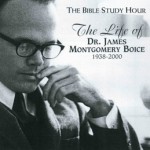
The purpose of this Blog is to introduce men and women all over the World to the Doctrines of Grace; the 5 Solas; Reformation Theology and the Lord and Savior Jesus Christ.
Showing posts with label James Montgomery Boice. Show all posts

Monday, February 4, 2013

Whatever Happened To God?


In any discussion of reformation in doctrine one must come to the realization that the real problem of our time is that there is hardly any doctrine at all to reform. So when we talk about reformation we must focus on a recovery of theology, period. Certainly in the liberal churches there is a lack of exposition of Scripture and sound doctrine, and unfortunately, this is rapidly becoming the case in evangelical circles as well.

Now you might ask which doctrines are missing? I argue that primarily what we need is a recovery of the doctrine of God. You have to have some kind of starting point and that's the point where I think we should begin. People have lost any real sense of the fact that when we come to church we come to worship and learn about God. Years ago I spoke at a conference and my topic was on a number of the attributes of God. Later I got some feedback from a gentleman who was listening to my presentation. He had been in the church for thirty years, and in fact was now an elder, and that was the first time that he ever heard a series of messages on the attributes of God. And after hearing this, his friend asked him, "Well, whom did you think you were worshiping all that time?" But he hadn't really thought about those things and I'm convinced that we have literally thousands of people in our churches today who really seldom, if ever, think about who it is they are worshiping, if they think about God at all.

Now, I think there are some reasons for this. One reason is the terrible impact of television on our culture which has produced a virtually mindless age. Television is not a medium which shares information well, it is primarily an entertainment medium. It puts pictures on the screen onto which people project their own aspirations and desires, and because it works so powerfully and is so pervasive it has the tendency to transform anything it touches into entertainment, and it does it very quickly. One of the most significant books I've read in the last few years in terms of what is actually happening to the mind is Neil Postman's, Amusing Ourselves to Death: Public Discourse in the Age of Show-Business. It's not that entertainment itself is bad. But television is most damaging when it tries to be serious. So when you put news on TV, you get brief little soundbites encased in slick images, and this is not really information, it is entertainment.    Continue at James Montgomery Boice

Tuesday, September 25, 2012

The Sufficiency of Scripture

I took the few minutes needed to read this sermon today. It did my heart much good. 

The 25th Anniversary Sermon, May 23, 1993 by Dr. James Montgomery Boice

THE SUFFICIENCY OF SCRIPTURE

On a morning like this it is a temptation to reminisce over the quarter century of ministry I have had at Tenth Presbyterian Church. And I would do it, except for the fact that others have been doing it all weekend and in a much more complimentary way than I could myself— at least if I were to be honest. I could reveal a lot of things that the others are not aware of, including the disappointments and failures. But that would spoil things, and it is not what this weekend is about. It is certainly not what a worship service such as this should accomplish.

I remember that when John, the author of Revelation, fell at the feet of the angel of God to worship him, the angel replied, “Do not do it! I am a fellow servant with you and with your brothers who hold to the testimony of Jesus. Worship God!” (Revelation 19:10). So I remind you and myself that this is what we are about this morning.

And I direct you to God’s Word.

Our text is 2 Timothy 3:14, 15. “But as for you, continue in what you have learned and have become convinced of, because you know those from whom you learned it, and how from infancy you have known the holy Scriptures, which are able to make you wise for salvation through faith in Christ Jesus.”  Continue at John Samson

The Unnatural Sin of Homosexuality — James Boice

“Therefore God gave them over in the sinful desires of their hearts to sexual impurity for the degrading of their bodies with one another. They exchanged the truth about God for a lie, and worshiped and served created things rather than the Creator—who is forever praised. Amen.

Because of this, God gave them over to shameful lusts. Even their women exchanged natural sexual relations for unnatural ones. In the same way the men also abandoned natural relations with women and were inflamed with lust for one another. Men committed shameful acts with other men, and received in themselves the due penalty for their error.” – Romans 1:24-27

“For centuries [lesbianism and male homosexuality] were hardly spoken of in western society. Although some were no doubt practicing these acts, they were considered so reprehensible that a moral person not only was not to speak about them, but he or she was not even to know what such vices involved. But today? Today they are written about with explicit detail in virtually every newspaper and magazine in our land. Grade-school children discuss them. Not only are we not shocked–but we have become complacent, as if this were a natural expression of an upright spirit. . . Fornication and adultery are not ‘unnatural’ sins, for they are not against nature. Of course, they are true sins, for they break the moral law of God. They result in ‘impurity’ and in the ‘degrading’ of our bodies, as Paul says. But they are not unnatural. On the contrary, they are in one sense quite natural. They are accomplished by using one’s body in a natural way. Not so with homosexuality! 

Homosexuality is ‘unnatural,’ and it is accomplished by using one’s body in an unnatural way, that is, against nature.   Continue at Eric T. Young

Tuesday, September 18, 2012

The Activity of Self-Discipline

God’s holy calling for the believer in Christ includes personal responsibility for self-discipline, by the power of the Holy Spirit, to live in a manner worthy of his or her high position as a new creature in Christ. God’s vision of discipleship, moreover, requires recognition of the war that rages within the believer as indwelling sin fights to maintain the dominance it once enjoyed prior to conversion. Therefore, we must recognize that the transformation the Holy Spirit continues to make in our lives involves the renewing of the mind by the Word of truth, the repenting of inner desires by the indwelling Spirit’s power, and the replacing of sinful habits by the practice of godliness. In a nutshell, a return to the apostolic pattern of maintaining a connection between sound doctrine and the discipline of godly living is indispensable to the ongoing process of sanctification. However, the late James Montgomery Boice observedthat Christians are lazy and unwilling to persevere on the hard road of godliness. Instead, we tend to look for the easy way out. As a result, spiritual growth is often lacking. Boice suggested three ways in which we try to avoid the struggle against sin.
  1. We tend to seek out formulas, simple recipes for spiritual success. Slogans such as “Let go and let God” or “Just let Jesus take control” are attractive to our spiritual slothfulness.
  2. We are prone to look for a new experience, a charismatic-type of “second work of grace” that immediately transforms us from being a defeated Christian to a victorious one.
  3. Total avoidance of the struggle against sin is a common response.
All these have one thing in common: they are ways of seeking to find spiritual victory in the Christian life without the daily grind of discipline, but that will never happen. Scripture repeatedly links progress in godliness to the disciplined effort of the disciple:   Continue at Paul Tautges

Monday, August 6, 2012

The Benefits of Not Ignoring Election in Your Bible

So many people think that election is useless and perhaps even pernicious. It is nothing of the sort. It is part of the Bible's inspired teaching and is therefore "useful," as Paul insisted all Scripture is (2 Tim. 3:16-17). Here's a look at ways election impacts things like evangelism and worship:
 

1. Election is humbling. Those who do not understand election often suppose the opposite, and it is true that those who believe in election sometimes appear prideful or smug. But this is an aberration. God tells us that he has chosen some by grace entirely apart from merit or even an ability to receive grace, precisely so that pride will be eliminated: "For it is by grace you have been saved, through faith--and this not from yourselves, it is the gift of God--not by works, so that no one can boast" (Eph. 2:8-9).

2. Election encourages our love for God. If we have a part in salvation, however small, then our love for God is diminished by just that amount. If it is all of God, then our love for him must be boundless. Sadly, today's church frequently takes the love of God for granted. "Of course, God loves me," we say. "I love myself; why shouldn't God love me too?" Consider the little girl who loved the Barney theme song from television ("I love you, you love me; we're a happy family"). But she sang it this way: "I love me, you love me; we're a happy family." That is how we tend to think of God's love. We think we deserve it. Understanding that we are elected by grace alone undermines our self-centered, self-satisfied way of thinking.  Continue at Old Truth

Tuesday, November 22, 2011

Monopoly Money and the Righteousness of God

Romans 10: 1 Brothers, my heart’s desire and prayer to God for them is that they may be saved. 2 For I bear them witness that they have a zeal for God, but not according to knowledge. 3 For, being ignorant of the righteousness of God, and seeking to establish their own, they did not submit to God’s righteousness. 4 For Christ is the end of the law for righteousness to everyone who believes. 

In reading through his commentary on these verses, Dr. James Montgomery Boice used a number of illustrations, one of which particularly caught my attention:

“… a platoon of American soldiers is captured by soldiers from the north during the Vietnam War and put in a prisoner of war camp. The American soldiers have no money and have to barter for whatever one soldier has and another soldier wants, which is not a very satisfactory arrangement. But one day a CARE package arrives, and in it is a game of Monopoly. The soldiers are delighted, not because of the game but because of the money. They divide it up, each man getting an equal number of white, pink, green, blue, beige, and gold bills (except for the sergeant, who gets an extra $500). Now, whenever one soldier has an extra cigarette and a second soldier wants it, the first can sell it to him for $100, or whatever. The money is very useful.   Keep Reading >>>

Monday, February 28, 2011

The true Calvinist

This post is a little “off the beaten path” but in view of recent observations and discussions, even with some of you, I am posting this excerpt from a chapter called, “The True Calvinist” in Boice and Ryken’s, The Doctrines of Grace: Rediscovering the Evangelical Gospel. If anyone is looking for a good overview on the topic, this book is an excellent resource.

I am not ashamed to say that Reformed Theology and The Doctrines of Grace (or Calvinism)  have put me on the most solid theological footing ever. The more I see the purity of these doctrines woven throughout the pages of my Bible, the more I proclaim with Paul, “For by grace you have been saved through faith. And this is not your own doing; it is the gift of God” (Ephesians 2:8). 

I have also come to see, now more than ever before, that the unadulterated Gospel message — that is, the preaching of “Jesus Christ and him crucified” (1 Corinthians 2:2) will always be the object of great scorn and antagonism. The Gospel is always under attack and the Bride of Christ will always stand (but also prevail!) against tremendous opposition. This is every bit as true today as it was in the days of the early church. Keep Reading>>>

Wednesday, October 13, 2010

Sin the Despotic King and the King Whose Name is Grace


“Follow sin, and sin will rob you of your innocence and character.

Follow sin, and sin will wither away your health.

Follow sin, and sin will turn to ashes even the common, precious things of life – things like friendship, love, laughter, the innocence of children, hope and contentment.

Follow sin, and sin will usher you to damnation and smirk as you stagger through the door.

How different is the king whose name is Grace! Grace sees us staggering and comes alongside to help us and bear us up.  Grace sees us destitute and pours the inexhaustible riches of Christ and the Father into our laps.  Grace sees us dying and imparts eternal life. The Bible says through Paul that “the wages of sin is death, but the gift of God is eternal life in Christ Jesus our Lord.” (Romans 6:23).

Grace says, “What do you need? Tell me. Tell me anything at all.” And then grace provides that need in accord with God’s perfect wisdom, invincible power, and unlimited supply. It is because of Grace that the author of Hebrews urges: “Let us then approach the throne of grace with confidence, so that we may receive mercy and find grace to help us in our time of need.” (Heb. 4:16). “

- James Montgomery Boice, Romans Volume 2, The Reign of Grace, pages 638

Friday, September 10, 2010

The Five Solas of the Reformation by James Montgomery Boice

“1. Scripture alone. When the Reformers used the words sola Scriptura they were expressing their concern for the Bible’s authority, and what they meant is that the Bible alone is our ultimate authority—not the pope, not the church, not the traditions of the church or church councils, still less personal intimations or subjective feelings, but Scripture only. Other sources of authority may have an important role to play. Some are even established by God—such as the authority of church elders, the authority of the state, or the authority of parents over children. But Scripture alone is truly ultimate. Therefore, if any of these other authorities depart from Bible teaching, they are to be judged by the Bible and rejected. 2. Christ alone. The church of the Middle Ages spoke about Christ. A church that failed to do that could hardly claim to be Christian. But the medieval church had added many human achievements to Christ’s work, so that it was no longer possible to say that salvation was entirely by Christ and his atonement. This was the most basic of all heresies, as the Reformers rightly perceived. It was the work of God plus our own righteousness. The Reformation motto solus Christus was formed to repudiate this error. It affirmed that salvation has been accomplished once for all by the mediatorial work of the historical Jesus Christ alone. His sinless life and substitutionary atonement alone are sufficient for our justification, and any ‘gospel’ that fails to acknowledge that or denies it is a false gospel that will save no one.
3. Grace alone. The words sola gratia mean that human beings have no claim upon God. That is, God owes us nothing except just punishment for our many and very willful sins. Therefore, if he does save sinners, which he does in the case of some but not all, it is only because it pleases him to do it. Indeed, apart from this grace and the regenerating work of the Holy Spirit that flows from it, no one would be saved, since in our lost condition, human beings are not capable of winning, seeking out, or even cooperating with God’s grace. By insisting on ‘grace alone’ the Reformers were denying that human methods, techniques, or strategies in themselves could ever bring anyone to faith. It is grace alone expressed through the supernatural work of the Holy Spirit that brings us to Christ, releasing us from our bondage to sin and raising us from death to spiritual life.
4. Faith alone. The Reformers never tired of saying that ‘justification is by grace alone through faith alone because of Christ alone.’ When put into theological shorthand the doctrine was expressed as “justification by faith alone,” the article by which the church stands or falls, according to Martin Luther. The Reformers called justification by faith Christianity’s “material principle,” because it involves the very matter or substance of what a person must understand and believe to be saved. Justification is a declaration of God based on the work of Christ. It flows from God’s grace and it comes to the individual not by anything he or she might do but by ‘faith alone’ (sola fide). We may state the full doctrine as: Justification is the act of God by which he declares sinners to be righteous because of Christ alone, by grace alone, through faith alone.
5. Glory to God alone. Each of the great solas is summed up in the fifth Reformation motto: soli Deo gloria, meaning ‘to God alone be the glory.’ It is what the apostle Paul expressed in Romans 11:36 when he wrote, ‘to Him be the glory forever! Amen.’ These words follow naturally from the preceding words, “For from him and through him and to him are all things” (v. 36), since it is because all things really are from God, and to God, that we say, ‘to God alone be the glory.’”
–James Montgomery Boice, Whatever Happened to the Gospel of Grace? (Wheaton, Ill.: Crossway, 2001), pp. 65-149.
Posted by John on September 9, 2010 04:42 PM