The purpose of this Blog is to introduce men and women all over the World to the Doctrines of Grace; the 5 Solas; Reformation Theology and the Lord and Savior Jesus Christ.
Showing posts with label Charles Finney. Show all posts

Friday, April 5, 2013

The Moralists Will Be Back

It is an historical fact that moralism (the confusion of justification with sanctification) never dies, it just goes dormant periodically. The Reformation defeated 1000 years of moralism only to see forms of it re-emerge in the Protestant churches even before Luther died. It resurfaced in the Remonstrant theology, in Richard Baxter (and in those orthodox Reformed whom he influenced), in the Scottish neonomians in the 18th century, in the Oxford (Tractarian) movement in the 19th century, in Charles Finney, and has more or less dominated American Protestantism (whether “evangelical” or liberal) for most of American history. 
 
Over the last few years in the NAPARC world and in satellite groups, the orthodox have won several strategic victories in the courts and assemblies of the Reformed churches. The following denominations or federations have rejected the Federal Vision/NPP and related forms of moralism (justification by grace and cooperation with grace) in no particular order (from memory):   Continue at Heidel Blog

Tuesday, March 12, 2013

“Charles Finney: The Greatest Distorter of Christian Truth in Our Age”

Dr. Michael Horton, Professor of Systematic Theology and Apologetics at Westminster Seminary California, wrote an article for Modern Reformation Magazine back in 1995 titled “The Legacy of Charles Finney.”  Growing up in evangelical, Southern Baptist and Church of God circles, Charles Finney was always a man to be praised.  Horton however exposes Finney’s unbiblical and unorthodox theology.  Here are some quotes from Finney and Horton’s responses:

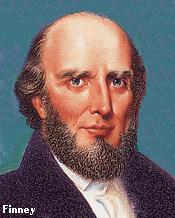
Who is Finney?
Charles Finney (1792-1875) ministered in the wake of the “Second Awakening,” as it has been called. A Presbyterian layover, Finney one day experienced “a mighty baptism of the Holy Ghost” which “like a wave of electricity going through and through me … seemed to come in waves of liquid love.” The next morning, he informed his first client of the day, “I have a retainer from the Lord Jesus Christ to plead his cause and I cannot plead yours.”Refusing to attend Princeton Seminary (or any seminary, for that matter); Finney began conducting revivals in upstate New York. One of his most popular sermons was “Sinners Bound to Change Their Own Hearts.” [Emphasis Mine]
Denying the Perseverance of the Saints (Eternal Security)
First, in answer to the question, “Does a Christian cease to be a Christian, whenever he commits a sin?” Finney answers:

“Whenever he sins, he must, for the time being, cease to be holy. This is self-evident. Whenever he sins, he must be condemned; he must incur the penalty of the law of God … If it be said that the precept is still binding upon him, but that with respect to the Christian, the penalty is forever set aside, or abrogated, I reply, that to abrogate the penalty is to repeal the precept, for a precept without penalty is no law. It is only counsel or advice. The Christian, therefore, is justified no longer than he obeys, and must be condemned when he disobeys or Antinomianism is true … In these respects, then, the sinning Christian and the unconverted sinner are upon precisely the same ground (p. 46).”
Horton responds,   Continue at Jared Moore

Monday, May 14, 2012

Are Churches Secularizing America?

Several years ago, a mainline theologian told me of his experience at an evangelical megachurch. He was visiting his children and grandchildren during spring break and then Easter Sunday arrived. Nothing visibly suggested that it was a Christian service, but this distinguished theologian tried to reign in his judgments. There was no greeting from God or sense that this was God's gathering. The songs were almost exclusively about us, our feelings, and our intentions to worship, obey, and love; but it was not clear whom they were talking about or why. He concluded, "Well, evangelicals don't really have a liturgy. They put all of the content into the sermon, so I'll wait." 

His patience, however, was not rewarded. Although it was Easter, the message (with no clear text) was on how Jesus gives us the strength to overcome our obstacles. Lacking even a benediction, this theologian left discouraged. He had come to an evangelical church at Easter and instead of meeting God and the announcement of a real victory over sin and death by Jesus Christ, he encountered other Christians who were being given fellowship and instructions for making their own "Easter" come true in their life. 

Pressed with leading questions by his son-in-law as to his reaction to the service (like, "Did it touch your heart?"), the theologian broke his silence: "I assume you're trying to 'evangelize' me right now," he said. "But there was no 'gospel' anywhere in that service that might convert me if I were unconverted." He concluded, "Not even in the most liberal churches I've been in was the service so devoid of Christ and the gospel. It's like 'God who?'"

Since then, a mainline Methodist theologian told me of an almost identical experience-curiously also at Easter-in a conservative Presbyterian church that was known around the university for its "Bible-believing" and "Christ-centered" ministry. He too left disappointed (the sermon was something about how Jesus overcame his setbacks and so can we), further substantiating his appraisal that evangelicals are as likely as mainliners today to talk pop-psychology, politics, or moralism instead of the gospel.

Over a century ago, Princeton theologians Charles Hodge and B. B. Warfield observed that according to the system of revivalism associated especially with Charles Finney, God was not even necessary. If conversion and revival are "simply the philosophical result of the right use of means" rather than a miracle of God's grace, all you have to do is find the right techniques, procedures, and methods that work across the board: in business, politics, and religion. A lot of the church growth literature of the past few decades assumes the same outlook. Could evangelicalism grow and experience success even if God didn't exist?   Continue at Michael Horton

Saturday, April 28, 2012

The Centrality of Preaching


Preaching has fallen on hard times. The great Protestant Reformer, John Calvin, wrote: “At the present day there are many who are well-nigh sickened by the very name of preaching, because there are so many stupid, ignorant men who blurt out their worthless brain waves from the pulpit.” That was 450 years ago! Today not only has preaching been decentralized, but the greater part of what is called “preaching” no longer deserves to be at the center. This has created a vacuum and few have raised a voice while a Pandora’s Box of replacements has rushed in to fill the void.”

A.W. Tozer said of the danger: “One of the most popular current errors, and the one out of which springs most of the noisy, blustering religious activity in evangelical circles, is the notion that as times change the church must change with them…That mentality which mistakes Hollywood for the Holy City is too gravely astray to be explained otherwise than as a judicial madness visited upon professing Christians for affronts committed against the Spirit of God.”

And John MacArthur aptly described it: “Worship services in many churches today are like a merry-go-round. You drop a token in the collection box; it is a good ride. There’s music and lots of motion up and down. The ride is carefully timed and seldom varies in length. Lots of good feelings are generated, and it is the one ride you can be sure will never be the least bit threatening or challenging. But though you spend the whole time feeling as if you’re moving forward, you get off exactly where you got on.”

A BRIEF HISTORY OF PREACHING

The 16th century Reformation, 17th century Puritanism, and the 18th century “Great Awakening” were all revivals of preaching! Whatever else they were, they brought preaching back to the center. Similarly, periods of decline were marked by a corresponding decline in preaching. The 19th century languished under the influence of Charles Finney’s “new measures.” Preaching was reduced to “moral suasion.” This is reflected in modern “crusade evangelism” in which the sermon has become a mere prelude to the “invitation.” The 20th century dawned with the pulpit histrionics of Billy Sunday. Preaching had become “pulpiteerism.” A more sophisticated retreat was found in the “quiet talks” of inspirational liberalism. “Sharing” rather than preaching marked the advent of a “kinder, gentler” Christianity.”

“The miserable phrase, sharing Christ, which so sickens those of us who believe that the work of preaching not that of sharing an experience but of proclaiming a message.” (J. Gresham Machen)  Continue at Tom Lyon

Friday, March 16, 2012

Do You Know Charles Finney?

Perhaps you’ve heard Charles Finney’s name in your local church as “a great revivalist”; perhaps as a pastor you have quoted him as “a great man of God” whose example is to be followed by your church; perhaps as a parent you have named your son after this “great evangelist of God”; Whichever be the case, it is of utmost importance for you to know what Finney really believed or rather what he did not believe.

Here is a list of doctrines which Finney denied vehemently.  Unless otherwise specified, all quotes are from Charles G. Finney, Finney’s Systematic Theology (Bethany, 1976)

1. Original Sin : The doctrine of the Fall which teaches that after Adam and Eve sinned against God, their natures were so corrupted that they were unable to save themselves and became needful of salvation by grace alone.

However Finney says in his systematic theology that this doctrine is “anti-scriptural and nonsensical dogma” (p. 179). Finney was thus theologically, a Pelegian (a follower of Pelagius, the 5th-century heretic, who was condemned by more church councils than any other person in church history, for denying this doctrine), denying even the necessity of grace in salvation.

2. Substitutionary Atonement : The doctrine which teaches that Jesus Christ, our Lord died on the cross for our sins as a substitute. This vicarious suffering of the Saviour paves way for God to appease the wrath He has against man and save him.

However Finney rejected this view entirely and espoused a view which is called “Moral Example Theory”, which says “The atonement would present to creatures the highest possible motives to virtue. Example is the highest moral influence that can be exerted…If the benevolence manifested in the atonement does not subdue the selfishness of sinners, their case is hopeless”. (p. 209). 

For Finney, if Adam leads us into sin, not by our inheriting his guilt and corruption, but by following his poor example, this leads logically to the view of Christ, the Second Adam, as saving by example[1]. Thus according to Finney, we are not helpless sinners who need to be redeemed, but wayward sinners who need a demonstration of selflessness so moving that we will be excited to leave off selfishness[1].

3. Regeneration : The teaching of the Bible that new birth in Christ is a supernatural work wrought by the Holy Spirit, in the heart of the sinner, through the preaching of the gospel.   Continue at Jay Dharan

Saturday, February 25, 2012

Are Churches Secularizing America?

Several years ago, a mainline theologian told me of his experience at an evangelical megachurch. He was visiting his children and grandchildren during spring break and then Easter Sunday arrived. Nothing visibly suggested that it was a Christian service, but this distinguished theologian tried to reign in his judgments. There was no greeting from God or sense that this was God’s gathering. The songs were almost exclusively about us, our feelings, and our intentions to worship, obey, and love; but it was not clear whom they were talking about or why. He concluded, “Well, evangelicals don’t really have a liturgy. They put all of the content into the sermon, so I’ll wait.”

His patience, however, was not rewarded. Although it was Easter, the message (with no clear text) was on how Jesus gives us the strength to overcome our obstacles. Lacking even a benediction, this theologian left discouraged. He had come to an evangelical church at Easter and instead of meeting God and the announcement of a real victory over sin and death by Jesus Christ, he encountered other Christians who were being given fellowship and instructions for making their own “Easter” come true in their life.

Pressed with leading questions by his son-in-law as to his reaction to the service (like, “Did it touch your heart?”), the theologian broke his silence: “I assume you’re trying to ‘evangelize’ me right now,” he said. “But there was no ‘gospel’ anywhere in that service that might convert me if I were unconverted.” He concluded, “Not even in the most liberal churches I’ve been in was the service so devoid of Christ and the gospel. It’s like ‘God who?’”

Since then, a mainline Methodist theologian told me of an almost identical experience-curiously also at Easter-in a conservative Presbyterian church that was known around the university for its “Bible-believing” and “Christ-centered” ministry. He too left disappointed (the sermon was something about how Jesus overcame his setbacks and so can we), further substantiating his appraisal that evangelicals are as likely as mainliners today to talk pop-psychology, politics, or moralism instead of the gospel.

Over a century ago, Princeton theologians Charles Hodge and B. B. Warfield observed that according to the system of revivalism associated especially with Charles Finney, God was not even necessary. If conversion and revival are “simply the philosophical result of the right use of means” rather than a miracle of God’s grace, all you have to do is find the right techniques, procedures, and methods that work across the board: in business, politics, and religion.  Continue at Michael Horton

Friday, July 29, 2011

Why “Let Go and Let God” Is a Bad Idea

What is “let-go-and-let-God” theology? It’s called Keswick theology, and it’s one of the most significant strands of second-blessing theology. It assumes that Christians experience two “blessings.” The first is getting “saved,” and the second is getting serious. The change is dramatic: from a defeated life to a victorious life; from a lower life to a higher life; from a shallow life to a deeper life; from a fruitless life to a more abundant life; from being “carnal” to being “spiritual”; and from merely having Jesus as your Savior to making Jesus your Master. People experience this second blessing through surrender and faith: “Let go and let God.”

Keswick theology comes from the early Keswick movement. Keswick (pronounced KE H-zick) is a small town in the scenic Lake District of northwest England. Since 1875, it has hosted a weeklong meeting in July for the Keswick Convention. The movement’s first generation (about 1875– 1920) epitomized what we still call “Keswick theology” today.

People who influenced Keswick theology include John Wesley, Charles Finney, and Hannah Whitall Smith. Significant proponents of Keswick theology include Evan H. Hopkins (Keswick’s formative theologian), H. Moule (Keswick’s scholar and best theologian), F. B. Meyer (Keswick’s international ambassador), Andrew Murray (Keswick’s foremost devotional author), J. Hudson Taylor and Amy Carmichael (Keswick’s foremost missionaries), Frances Havergal (Keswick’s hymnist), and W. H. Griffith Thomas, and Robert C. McQuilkin (leaders of the victorious life movement). People who were influenced by Keswick theology include leaders of the Christian and Missionary Alliance (A. B. Simpson), Moody Bible Institute (D. L. Moody and R. A. Torrey), and Dallas Seminary (Lewis Chafer and Charles Ryrie).    Keep Reading...

See Also: Let Go and Let God? A Survey and Analysis of Keswick Theology


Monday, July 4, 2011

Altar Calls In The First 1800 Years Of The Church

One may read thousands of pages of the history of the Christian Church without finding a single reference to the 'old-fashioned altar call' before the 19th century. Most Christians are surprised to learn that history before the time of Charles G. Finney (1792-1875) knows nothing of this type of 'invitation'.

The practice of urging men and women to make a physical movement at the conclusion of a meeting was introduced by Mr. Finney in the second decade of the nineteenth century. Dr. Albert B. Dod, a professor of theology at Princeton Seminary at the time of Mr. Finney's ministry, pointed out the newness of the practice and showed that this method was without historical precedent.

The preceding words are from James E. Adams' work entitled
"Decisional Regeneration". Adam's historical review continues . . .

 
In his review of Finney's Lectures on Revival, Professor Dod stated that one will search the volumes of church history in vain for a single example of this practice before the 1820's. Instead, history tells us that whenever the gospel was preached men were invited to Christ - not to decide at the end of a sermon whether or not to perform some physical action. Keep Reading...

Image

Wednesday, February 16, 2011

The Skeleton in the Closet

A few days ago, I posted a very informative article by Dr. R. C. Sproul concerning the widespread destructive Pelagian influence on the modern day church (found here.) Below is a video on the same vital theme.

airo: “One of the main reasons for the resurgence of Pelagianism today is the ministry of Charles Finney. Many call him America’s greatest revivalist. Few are aware he rejected essential Christian truth.”

Nicenecouncil.com: “For years Charles G. Finney has gotten a free ride from evangelical preachers and churches for various reasons, but mostly because few had ever taken the time to read his obtuse books or even try to understand his theology. Many supposedly came to Christ under him, and that was enough to convince the multitudes that he must be sound and Biblical. But now a number of writers and theologians are opening the door to his theology, and many are shocked to see what he truly believed – Charles G. Finney was clearly and undeniably a heretic – he did not preach nor teach the true gospel, as set forth in the Scriptures. In fact it is not an exaggeration to say that he was one of the greatest heretics of church history!”

Finney’s influence is widespread in our day, but even more troubling is the pervasive Pelagianism that he taught. Why is this such a problem? Dr. Sproul explains: See Video HERE

Tuesday, November 30, 2010

Charles Grandison Finney, Part 1: Finney's System

Finney’s approach to Christianity began with an embarrassment over traditional theology, especially the theology of the Westminster Confession. He rejected the authority of that confession and of any kind of church tradition. Finney insisted that people who taught traditional Reformed theology were both thoughtless and inconsistent. He accused them of being unwilling to define their concepts, even to themselves.
Instead of the authority of tradition, Finney accepted the double authority of reason and consciousness. By reason, Finney meant something like plausibility; this kind of reason was his chief tool in understanding the Bible. He supplemented reason with consciousness or self-awareness, which (he argued) granted full and immediate access to one’s own mental states. In Finney’s system, no interpretation of Scripture was allowable which contradicted one’s own self-awareness. That is why he rejected Jonathan Edwards’s distinction between natural and moral freedom. Read it all HERE

Saturday, October 30, 2010

God-Centered Evangelism

If I have heard it once, I’ve heard it a thousand times: “A Calvinist evangelist? Isn’t that an oxymoron? Calvinism undermines evangelism.” This accusation has been repeated so many times that few make the effort to argue it. Instead, it is simply assumed. Never mind that some of the church’s greatest evangelists have been Calvinists. One need only be reminded of men such as George Whitefield, David Brainerd, or “the father of modern missions,” William Carey. “Yes,” we are told, “these men were great evangelists and Calvinists, but that is because they were inconsistent.” But is this true?

The fact of the matter is that Calvinism is not inconsistent with evangelism; it is only inconsistent with certain evangelistic methods. It is inconsistent, for example, with the emotionally manipulative methods created by revivalists such as Charles Finney. But these manipulative methods are themselves inconsistent with Scripture, so it is no fault to reject them. In order for evangelism to be pleasing to God, it must be consistent with the whole system of biblical teaching. But what does such evangelism look like? Continue Reading>>>

Friday, July 2, 2010

Charles Finney, Ergun Caner & Fundamentalism

Finney’s manipulation consisted of the “artful, unfair, and insidious” control of the emotional state of his hearers in order to bring about a “decision” which was anything but. We make decisions when we decide to take a certain course of action, generally after thoughtful consideration. Finney’s “decision” had nothing to do with thought. His hearers were whipped into a terror over the thought of hell. This sudden emotional state was a work of Finney’s art, and he knew how to mold it into a decision to follow God. He utilized every form of pressure to bring about the desired end.

Over the years evangelists have learned that other emotions can be equally well utilized to bring about a decision. Various moral crusaders have capitalized upon a manufactured sense of outrage, while missions promoters have made an equally good use of pity. Often these tactics are aimed at producing a donation, but there is no reason why they cannot be turned to the purposes of Finneyite evangelist as well.

Any emotion will do, provided that the speaker can stoke that emotion into flames and that he has the skill to turn it in whichever direction he chooses. Read the rest HERE