The purpose of this Blog is to introduce men and women all over the World to the Doctrines of Grace; the 5 Solas; Reformation Theology and the Lord and Savior Jesus Christ.
Showing posts with label Poverty. Show all posts

Wednesday, February 13, 2013

Toxic Charity

There is some of the missionary in every Christian. As the Lord extends to us the ability to trust in him and as he begins that work of transforming us from the inside out, he gives us the desire to share our faith with others and to extend his love to them. Since the church’s earliest day this desire has motivated Christians to leave behind all they know and to travel to the earth’s farthest reaches. A relative newcomer on the scene is the short-term missions trip and other similar means through which Christians can participate on a part-time basis as “vacationaries.” Such ministry is the subject of Robert Lupton’s Toxic Charity.

Toxic Charity is a book about doing missions right. The subtitle pretty much lays it out: “How Churches and Charities Hurt Those They Help (And How to Reverse It).” Lupton honors the mindset that compels Christians toward foreign short-term missions and inner-city projects at home, but believes that the church has failed to ask simple questions like these: Who is really benefiting? Who are we really seeking to serve? Is it the poor and those in need, or are we primarily serving ourselves? He contends that “what Americans avoid facing is that while we are very generous in charitable giving, much of that money is either wasted or actually harms the people it is targeted to help. …The compassion industry is almost universally accepted as a virtuous and constructive enterprise. But what is so surprising is that its outcomes are almost entirely unexamined.”   Continue at Tim Challies

Wednesday, June 20, 2012

Why You Should Consider Cancelling Your Short-Term Mission Trips

Editors' Note: We're continuing a series on short-term missions. The first by Darren Carlson dealt with the history and opportunities provided by short-term missions.
**********
I have seen with my own eyes or know of houses in Latin America that have been painted 20 times by 20 different short-term teams; fake orphanages in Uganda erected to get Westerners to give money; internet centers in India whose primary purpose is to ask Westerners for money; children in African countries purposefully mutilated by their parents so they would solicit sympathy while they beg; a New England-style church built by a Western team in Cameroon that is never used except when the team comes to visit; and slums filled with big-screen TVs and cell phone towers.

I have seen or know of teams of grandmothers who go to African countries and hold baby orphans for a week every year but don't send a dime to help them otherwise; teams who build houses that never get used; teams that bring the best vacation Bible school material for evangelism when the national church can never bring people back to church unless they have the expensive Western material; teams that lead evangelistic crusades claiming commitments to Christ topping 5,000 every year in the same location with the same people attending.

Short-term missions is fraught with problems, and many wish such trips did not exist, at least in the common form today. Writing in his book Toxic Charity, Robert Lupton says, "Contrary to popular belief, most missions trips and service projects do not: empower those being served, engender healthy cross-cultural relationships, improve quality of live, relieve poverty, change the lives of participants [or] increase support for long-term missions work." Ouch!   Continue at Darren Carlson

Thursday, February 16, 2012

Gambling and the Common Good

Kentucky, the state where I live, is abuzz these days with discussion over expanded gambling.The governor here wants it, and conservative Christian groups don’t. This argument is hardly limited to here. I lived through it in my ancestral home on the Mississippi Gulf Coast, as the casino industry promised an economic turnaround if voters would just give them the right to exist. Almost every state is involved in some discussion of state-sponsored gambling.

I think there are bigger issues involved than how they are typically framed.

First of all, pro-gambling elected officials aren’t evil villains (necessarily). Yes, some of them are personally corrupt and poised to profit from the industry they are enabling. But many of these elected officials have good aims. They want to educate children, build infrastructure, and so on without raising a tax burden. I think gambling is an illusory way to do this, but, still, I acknowledge good intentions at the root of some of the cheerleaders for the industry. Continue at Russell Moore

Saturday, November 19, 2011

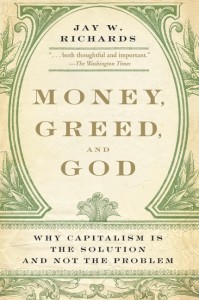
If I Become Rich, Won’t Someone Else Become Poor?

This is the most readable defense of capitalism I’ve read (and it’s more relevant than ever with the recent “Occupy Wall Street”-type protests):


Richards debunks eight myths, which are listed in the book’s table of contents:
  1. Can’t We Build a Just Society? Myth no. 1: The Nirvana Myth (contrasting capitalism with an unrealizable ideal rather than with its live alternatives)
  2. What Would Jesus Do? Myth no. 2: The Piety Myth (focusing on our good intentions rather than the unintended consequences of our actions)
  3. Doesn’t Capitalism Foster Unfair Competition? Myth no. 3: The Zero-sum Game Myth (believing that trade requires a winner and a loser)
  4. If I Become Rich, Won’t Someone Else Become Poor? Myth no. 4: The Materialist Myth (believing that intellect cannot create new wealth)
  5. Isn’t Capitalism Based on Greed? Myth no. 5: The Greed Myth (believing that the essence of capitalism is greed)
  6. Hasn’t Christianity Always Opposed Capitalism? Myth no. 6: The Usury Myth (believing that charging interest on money is always exploitive)  Keep Reading >>>

Monday, October 17, 2011

My Take: Are evangelicals dangerous?

Are evangelicals dangerous? Well, certainly not in the sense that more secular voices warn. The vast majority of evangelicals are not attempting to create a theocracy, or to oppose democracy.

To the contrary, evangelicals are dangerous to the secularist vision of this nation and its future precisely because we are committed to participatory democracy.

As Christians committed to the Bible, evangelicals have learned to advocate on behalf of the unborn, believing that every single human being, at every stage of development, is made in God’s image.

Evangelicals worry about the fate of marriage and the family, believing that the pattern for human relatedness set out in Scripture will lead to the greatest human flourishing.

We are deeply concerned about a host of moral and cultural issues, from how to address poverty to how to be good stewards of the earth, and on some of these there is a fairly high degree of disagreement even among us.

Above all, evangelicals are those who believe that Jesus Christ is Lord and are most concerned about telling others about Jesus. 

Most of America’s evangelical Christians are busy raising their children, working to support their families and investing energy in their local churches.   Read it all HERE

Friday, October 7, 2011

Examples of Mercy Ministry

In light of this series (where I argue that the church is not called to the task of social ministry to non-believers), I thought it would be helpful to describe what kind of mercy ministries am I involved in, and how I justify these ministries biblically. So below is a brief list of ministries that I regularly participate with, and a short explanation of why I see them as having a biblical foundation.

Despite the reputation those previous posts may have gotten me, I love mercy ministry. I love being able to express love and kindness toward others with the express purpose of introducing them to the Messiah. I do reject the concept that the church has as its goal the lowering of the poverty rate, correcting social ills or eradicating homelessness. The poor we will always have with us, Jesus said. But I embrace the mandate that the church has to take the gospel to the world, and in various circumstances it can be wise to use material means to gain a hearing for the gospel. There is a very real danger that food or assistance becomes associated with attending a Bible study or sermon. So for all of these ministries, there is a massive responsibility on the church elders to make sure that the method of bringing the gospel to others is not creating a culture of dependence. We love others, so we want to challenge them to change—not to maintain their situation. And we all know that there is hope for real change only in the gospel, and the radical repentance that comes with it.

As a side note, Grace Church also oversees dozens of evangelistic outreaches and ministries. Perhaps I will describe some of those in a future post. But here is a brief list of ministries that I personally work with on behalf of Grace Church.   Keep Reading...

Wednesday, September 21, 2011

Discontinuity: the Poor, Israel, and the Church

Much of the push for the church to engage in social transformation and indiscriminate care for the poor of the world comes from a wrong understanding of the relationship between the church and Israel. There is no doubt that Israel was called to care for the poor in their land—regardless of their creed. The alien, foreigner, slave, and sojourning widow were all protected by the Law, and if Israel would have kept the law, there would have been no poor in the land.

The question is this: does the church have a similar task? Is the church charged to care for the poor of the world, in the same way Israel was? I have argued elsewhere that the answer is “no,” but here I want to explain why the difference is important and helpful in understanding God’s mission to the world.

First, it has to be noted that Israel’s call to care for the poor was constrained in a very significant way. While it was not limited by creed, it was bound by geography. Israel was not called to care for the poor in Egypt. When a drought hit a neighboring country, the Israelites would have been more likely to celebrate than send a food pack. Contrast that with the church; we are quick to send aide around the world, but are rightly cautious to aide the non-believing poor in our own community. Why is that?     Keep Reading...

Saturday, April 30, 2011

Money and Possessions in Proverbs

The Bible says a lot about money and possessions. There are a lot of verses about wealth and poverty. With some topics, we can get off track because the Bible says so little. What should we think of tanning? Well, we don’t have a lot of specific instructions, so there’s not much to be dogmatic about.

But when it comes to money and possessions there’s an opposite problem. Because the Bible says so much about money it is tempting to develop an imbalanced theology of money.

On the one hand, it’s easy to see where Prosperity Theology comes from. Take a few promises of the Mosaic covenant out of their national context, take the promise in Malachi 3 about throwing open the storehouses of heaven, mix in some of Jesus’ statements about receiving whatever you ask for in faith, and you can bake up a little health and wealth gospel.

On the other hand, it’s possible to come up with an imbalanced Austerity Theology. Point out that Jesus had nowhere to lay his head, turn to the story of the rich young ruler, stir in the parable of the rich fool, and you’ll have a theology that says money is bad and so are those who have it. Keep Reading...