The purpose of this Blog is to introduce men and women all over the World to the Doctrines of Grace; the 5 Solas; Reformation Theology and the Lord and Savior Jesus Christ.
Showing posts with label Protestantism. Show all posts

Thursday, December 12, 2013

The People's Pope, The Man of the Year

Once there was a boy so meek and modest, he was awarded a Most Humble badge. The next day, it was taken away because he wore it. Here endeth the lesson.” And here endeth the opening quote from TIME’s story to announce Pope Francis as the Person of the Year for 2013. Nancy Gibbs continues:
How do you practice humility from the most exalted throne on earth? Rarely has a new player on the world stage captured so much attention so quickly—young and old, faithful and cynical—as has Pope Francis. In his nine months in office, he has placed himself at the very center of the central conversations of our time: about wealth and poverty, fairness and justice, transparency, modernity, globalization, the role of women, the nature of marriage, the temptations of power.
For all of these reasons and more, he is a natural and obvious choice for this distinction.   Continue at Tim Challies

Monday, June 18, 2012

The Illusion of an Infallible Magisterium

In an article entitled, “Who’s in Charge Here? The Illusions of Church Infallibility” Dr. Michael Horton writes:

In my experience with those who wrestle with conversion to Roman Catholicism—at least those who have professed faith in the gospel, the driving theological issue is authority. How can I be certain that what I believe is true? The gospel of free grace through the justification of sinners in Christ alone moves to the back seat. Instead of the horse, it becomes the cart. Adjustments are made in their understanding of the gospel after accepting Rome’s arguments against sola scriptura. I address these remarks to friends struggling with that issue.

Reformation Christians can agree with Augustine when he said that he would never have known the truth of God’s Word apart from the catholic church. As the minister of salvation, the church is the context and means through which we come to faith and are kept in the faith to the end. When Philip found an Ethiopian treasury secretary returning from Jerusalem reading Isaiah 53, he inquired, “Do you understand what you are reading?” “How can I,” the official replied, “unless someone guides me?” (Ac 8:30-31). Explaining the passage in the light of its fulfillment in Christ, Philip baptized the man who then “went on his way rejoicing” (v 39). 

Philip did not have to be infallible; he only had to communicate with sufficient truth and clarity the infallible Word.

For many, this kind of certainty, based on a text, is not adequate. We have to know—really know—that what we believe is an infallible interpretation of an ultimate authority. The churches of the Reformation confess that even though some passages are more difficult to understand, the basic narratives, doctrines and commands of Scripture—especially the message of Christ as that unfolds from Genesis to Revelation—is so clearly evident that even the unlearned can grasp it.   Continue at John Samson

Tuesday, June 12, 2012

Rome Sweet Home?

In recent years, a trickle of members — even ministers — in confessional Reformed and Presbyterian as well as Lutheran churches have converted to Roman Catholicism. Graduates of solid seminaries, they nevertheless wrestled with the Reformation for a while only to conclude that Rome is “home.” Reviewing recently the testimonies on a parachurch website that seeks to draw evangelicals and confessional Protestants to Rome, the recurring response of fellow travelers was “welcome home.”

Having engaged recently in conversations with two friends who have been drawn to Rome, I have wrestled myself with the question, Why? What’s up?

I know there are some who have a superficial knowledge of (and concern for) theological issues. They may be attracted to the cultural resources: a long and deeply thought-out moral theology that at least in its official positions is pro-life in a fuller sense than single-issue politics. They’re tired of bandwagons and bellicose leaders who appoint themselves spokespersons for the whole church. Thoughtful, if untheological, many younger Christians are drawn to the more mature character of Roman Catholic reflection on these issues. With cultural refinement and upward mobility, the evangelical churches of their youth can seem, well, tacky or at least shallow in comparison with the tradition in which Dante, Michelangelo, and Raphael were shaped.

But why would people who seriously embraced Reformation theology be drawn to Rome? It’s uncharitable and unwise to presume to know all of the factors in any case, much less to make that a rule for all the others. However, I have a few speculations.  Continue at Michael Horton

Tuesday, January 10, 2012

The Church in Rome

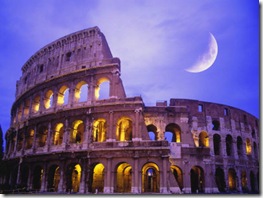
Rome, caput mundi: A PROJECT FOR ROME, A VISION FOR ITALY
 
After visiting my friend Leonardo De Chirico in Rome, I couldn’t stop telling people about the multiple ways in which God is working through him and the church he serves—cultivating a city-wide church planting initiative, caring for refugees, and offering a compelling example of warm-hearted gospel service. I asked Leo if he would provide an overview of the ministry, which he has done in the following. When you think of Rome, please pray for the De Chirico’s.
Rome is known as Caput Mundi (Capital of the world), la Città Eterna (The Eternal City), Limen Apostolorum (Threshold of the Apostles), the city of the seven hills or simply l’Urbe (The City). Ancient Rome was a major center of Western civilization, and Rome is still the seat of the Roman Catholic Church which controls the Vatican City as its sovereign territory, an enclave of Rome.
Today, Rome is modern and cosmopolitan with more than 2.7 million residents. The metropolitan area has a population of about 4 million. It is the third most-visited tourist destination in the EU and a city of cultural and political importance. It hosts the head offices of the vast majority of the major Italian companies, as well as the headquarters of three of the world’s 100 largest companies. 

Tourism is inevitably one of Rome’s chief industries, with numerous notable museums. Rome is also the hub of the Italian film industry, thanks to the Cinecittà studios. The city is also a center for banking as well as electronics and aerospace industries. Numerous international headquarters, university campuses, government ministries, conference centers, sports venues and museums are located in Rome’s principal business districts.  Keep Reading >>>

See Also: The Vatican’s Current Flight with Evangelicals

Friday, September 9, 2011

What Makes Evangelicalism Evangelical?

The evangelical movement in America emerged in the twentieth century as conservative Protestants sought to perpetuate an intentional continuity with biblical Christianity. While the roots of the movement can be traced through centuries prior to its emergence in twentieth century America, its organizational shape appeared mainly in the years after World War II. And, as anyone who considers the movement with a careful eye understands, evangelical definition has been a central preoccupation of the movement from the moment of its inception. 

The word “evangelical” long predates the coalescence of the evangelical coalition of the last century. The word has been applied to Methodism in the eighteenth century, to nonconformists and low church Protestants in Great Britain in the nineteenth century, and to a host of groups, churches, and movements ever since. As early as the nineteenth century, frustration and confusion arose over the use and misuse of the term. The seventh Earl of Shaftesbury expressed the late-nineteenth century frustration when he declared, “I know what constituted an evangelical in former times . . . I have no clear notion what constitutes one now.”      Keep Reading...

Saturday, July 30, 2011

Evangelical Annihilationism in Review

Evangelicalism is variously defined by various people. I define it as the religion of Trinitarian Bible-believers who glory in Christ’s Cross as the only source of peace with God and seek to share their faith with others; and I note that in the West (to look no further) evangelicalism, like Protestant liberalism, Roman Catholicism of all stripes, and Eastern Orthodoxy, has a communal mindset of its own. Factors shaping that mindset during the past half-century include the dogmatic, devotional, apologetic and activist nurture given in evangelical churches and parachurch movements; the reading matter (books, journals, magazines) that evangelicals produce for each other; the feeling of superior faithfulness to the Bible, its God and its Christ, which evangelical institutions cultivate; a sense of being threatened by the big battalions of the liberal Protestant, Roman Catholic, and American secular establishments, leading to bluster when these ideological power bases are discussed; a passion for effective evangelism; and an idealizing of scholars and leaders as gurus, whence a sense of betrayal and outrage surfaces if any of these are felt to be stepping out of line. Within the distinctive corporate identity of evangelicalism an awareness of privilege and vocation, a siege mentality, a low flashpoint in debate, a certain verbal violence, and a tendency to shoot our own wounded — all obtrude.

Whether the movement’s recent recovery of confidence and burgeoning intellectual life1 are mellowing this raw mindset is not yet clear; certainly, however, the rigidities hinted at above have been apparent as evangelicals have intramurally debated annihilationism during the past ten years.   Keep Reading...

Tuesday, April 26, 2011

Why Conservative Churches Are Growing: David Brooks and the Limits of Sociology

With amazing insight and candor, Kelley spoke for mainline Protestantism when he noted that it had been generally assumed that churches, “if they want to succeed, will be reasonable, rational, courteous, responsible, restrained, and receptive to outside criticism.” These churches would be highly concerned with preserving “a good image in the world” — and that meant especially within the world of the cultural elites. These churches, intending to grow, would be “democratic and gentle in their internal affairs” as the larger world defines those qualities. These churches will intend to be cooperative with other religious groups inb order to meet common goals, and thus “will not let dogmatism, judgmental moralism, or obsessions with cultic purity stand in the way of such cooperation and service.”

Then Kelley dropped his bomb: “These expectations are a recipe for the failure of the religious enterprise, and arise from a mistaken view of what success in religion is and how it should be fostered and measured.” Read it all HERE

Monday, December 20, 2010

Carried Away by Loose, General, Sentimental Talk

Never was there a time when it was more necessary that we should consider carefully what the Apostle has to teach us, and what all parts of the Bible teach us, concerning ‘the wiles of the devil’. 

Men wanted to be happy and to enjoy themselves, and dismissed the man who kept on warning us as a ‘warmonger’, a ‘difficult person’ with whom nobody could work, an ‘individualist’. Precisely the same, it seems to me, is happening in the realm of the spiritual today. People say, ‘Do not be negative; let us be positive; let us just preach the simple gospel’. But the Bible is full of negatives, full of warnings, ever showing us these terrible possibilities. If you find in yourself a dislike of the warnings of the Scripture and of this negative teaching, it is obvious that you have been duped by the wiles of the devil. You have not realized the situation in which you are placed.

Incipient heresy can be detected from the very earliest days. There is an enemy who comes and sows tares. Continue Reading>>>

Saturday, September 18, 2010

Romanticism’s Revenge: The Pope Makes a Visit to the United Kingdom

Judging by recent news reports, Pope Benedict XVI like so many pontiffs before him suffers from the malady often passed down from one bishop of Rome to the next: he is a consummate Anglophile. Like Paul in anguish for his people, one could say that the Roman pontiff has “great sorrow and unceasing anguish in his heart” for British Protestants. Today, he begins his four day trip to the United Kingdom, extending in the process an implicit call for the British to return to the Roman Church. Though short, his visit to her Majesty’s realm resonates with a subtle but powerful message: the vision of the via media, the “middle way” often invoked by the clergy and laity of the Church of England, can only be found in the Church of Rome.
The Pope’s four day excursion in bonnie Scotland and merry England is not a courtesy call: there is serious business afoot. There will be many meetings and even a joint prayer service together with Archbishop of Canterbury Rowan Williams in Westminster Abbey. But the primary reason for Benedict’s appearance is the beatification of the Church of England’s most famous defector: John Henry Newman. It behooves us as careful observers of current events to consider the content of the life and character of this man to understand the message of the Pope’s visit. Continue reading>>>

See also Papal Protest