The purpose of this Blog is to introduce men and women all over the World to the Doctrines of Grace; the 5 Solas; Reformation Theology and the Lord and Savior Jesus Christ.
Showing posts with label Doctrine. Show all posts

Wednesday, June 18, 2014

When It’s Time to Leave a Church

I detest church hopping. Yet I accept the fact that there are times when Christians transfer church membership. But there is a proper time and way to leave a church.

What are the legitimate reasons for leaving a church? When is the right time to leave a church? How should one leave a church to join another?

Red Lights: Wrong Reasons for Leaving a Church

Here are seven wrongs reasons for leaving a church. 

Sin. Someone has sinned. Maybe it was a leader. Is this a good reason to leave? No. It is not promote holiness to leave because of sin. There was gross sin in the church of Corinth. But Paul commanded the church to deal with the sinning member, not leave the church (1 Corinthians 5:9-13). When Paul bids the saints to “come out from among them,” he was talking about the world, not the church (2 Corinthians 6:14-18). We should respond to sinning brothers with restoration, not amputation (Galatians 6:1-5).

Disagreements over secondary doctrinal issues. Biblical convictions matter. But don’t be willing to die on every hill. Contend earnestly for the faith (Jude). But don’t break fellowship over every disagreement about scripture. Paul advised Timothy, “Remind them of these things, and charge them before God not to quarrel about words, which does no good, but only ruins the hearers. Do your best to present yourself to God as one approved, a worker who has no need to be ashamed, rightly handling the word of truth. But avoid irreverent babble, for it will lead people into more and more ungodliness…” (2 Timothy 2:14-16)    Continue at H. B. Charles Jr.

Saturday, March 8, 2014

15 Pointers for Preachers

  1. Preach doctrinally. Don’t only teach Bible doctrines such as justification and sanctification in your Sunday school. Preach these doctrines also during your worship service.  

  2. Preach discriminatorily. Address both believers and unbelievers in your preaching. Don’t assume that everyone in your congregation is saved. But don’t think either that no one is saved.

  3. Preach applicatorily. Apply your text to your listeners. With the use of practical illustrations, help them apply your message to their daily life. Remember a sermon without an application is like a lecture. You are preaching, not lecturing.

  4. Preach clearly. Organize your thoughts. Avoid high-sounding words. Consider the children in your congregation. If you have to employ a big word (e.g. justification), explain it using simple words.

  5. Preach evangelistically. Yes, preach against sin, but don’t stop there. Preach about salvation too. If you preach the Law without the gospel, you will make your congregation despair. Further, don’t think that the gospel is only for unbelievers. Believers need it as well for their sanctification.    Continue at Biblical Spirituality

Tuesday, March 4, 2014

Hell Glorifies God

hellHell glorifies God—that is the premise of Thor Ramsey’s book The Most Encouraging Book on Hell Ever, the newest release from Cruciform Press. It is very encouraging to see a Christian publisher (who consistently aims at the general Christian audience) invest in a topic so essential to true Christianity. It is one thing to notice a few biblically-faithful publishers putting out academic defenses of the doctrine of hell (rare in itself), but it is another thing (and refreshing) to see diligent work put into the placing of such vital truth in the hands of the average person in the pew. 

This book is refreshingly honest, and bold. In a day when too many publishers find it fashionable to waste paper and ink on so-called biblical treatments of hell (which are nothing more than pathetic regurgitations of old heresies), this book does not attempt to improve God’s reputation. As the author writes in his Introduction, “there is a swath of fashionable new preachers with a mission to clean up God’s nasty reputation as a bloodthirsty old clod. Unfortunately, in the process of doing God the big favor of helping his PR, they’re reinventing the doctrine of eternal punishment with a new and improved gospel. It’s gospel-riffic!” This book is a much-needed antidote to the plague of unbiblical teachings from famous, fashionable, and rich preachers who treat hell “like the Christian’s dirty little secret—the pock mark on the church’s history formed during its teenage years.”    Continue at Paul Tautges

Wednesday, November 13, 2013

Four Points About Tongues from 1 Corinthians 14

A goodly portion of Paul’s first epistle to the Corinthians is focused on correcting that congregation’s abuse of spiritual gifts—tongues in particular. The whole theme of the apostle’s admonition about how the gifts were to function is neatly summarized in 1 Corinthians 14:40: “All things should be done decently and in order.” Along the way, it’s hard to miss the stress the apostle places on that which edifies. The point Paul makes repeatedly is that the gifts should always be used in a way that enlightens and instructs the mind. “I would rather speak five words with my mind in order to instruct others, than ten thousand words in a tongue” (v. 19).

That principle has been largely ignored—and often diametrically opposed—in the doctrine and practice of the modern charismatic movement. The real point of 1 Corinthians 14 is often buried under endless arguments about the exegetical nuances of that passage. I want to take a more big-picture perspective of the text and point out a few of that chapter’s most important ideas.

1. “Tongues” were real languages.

Paul is clearly no proponent of any kind of “speech that is not intelligible” (v. 9). Sounds and syllables without meaning are of no use whatsoever. “There are doubtless many different languages in the world, and none is without meaning” (v. 10). Throughout the chapter, he is talking about real languages with real meaning. The ecstatic gibberish of the modern charismatic movement does not even fit the apostle’s definition of a language.  Continue at Phil Johnson

Saturday, September 7, 2013

Abuse Does Not Take Away Use

In my online forays, I've observed it's increasingly common for people to explicitly reject a doctrine, or the notion of orthodox teaching in general, on the basis of its abuse. You'll often read something along these lines: "I grew up in a church that had a heavy emphasis on doctrine X (depravity, judgment, sola scriptura, etc.). My pastors and elders used that doctrine to berate people, cow them into submission, or excuse horrible evils." So now, whenever they hear doctrine X, they can't accept it because they know (feel) it's a tool being used to control them or bring about another harmful result. In fact, some will go further and elevate this reaction into a principle of theological methodology: if a doctrine could be or has been used to hurt or damage, it must be rejected out of hand.   

I understand the impulse. For those who have been beat down with the Bible like it's a weapon, or doctrines like they're billy clubs, when they see someone pick them up—even as agents of healing—some post-traumatic stress makes sense. It can be hard to distance or differentiate a doctrine from its uses, especially if that's all you've ever known. It doesn't matter if someone's trying to offer you an oxygen mask; if someone used one to choke you out in the first place, you're going to flinch when you see it.    Continue at Derek Rishmawy

Friday, August 30, 2013

When the Faith "Once for All Delivered" . . . Isn't Delivered

Wes Bredenhof (Yinkahdinay) posted this link to a short essay from the Banner (the official publication of the Christian Reformed Church).  Rev. Bredenhof was saddened upon reading it, as was I.  The provocative essay is entitled "Relics of a Bygone Era" and recounts the difficult task of a son and daughter packing up the earthly remains from their recently deceased father, which included the father's Reformed books, personal teaching notes, and favorite cassette sermon tapes (Relics of a Bygone Era).  The author writes,

Dad had been a staunch defender of a somewhat cramped version of Calvinism formed by his upbringing in the Gereformeerde Kerk in the Netherlands. Early on, his parents had put the kibosh on his aspirations to ministry; unless he had a distinct call from the Lord, he had a duty to help his father run the farm. But disappointment did not snuff out his enthusiasm for the cause of John Calvin. He read commentaries and wrote essays that he read at men’s society meetings. Dad eloquently argued points of doctrine, articulating and defending each letter of TULIP. He collected cassette tapes of sermons by Dutch dominees and those Christian Reformed ministers who shared his passion. In retirement he pored over black-bound tomes and cobbled together sermons, reading them to the captive audience in a nearby retirement home. He had become a preacher after all.

The essay concludes with the following lament:  Continue at Kim Riddlebarger

Tuesday, August 20, 2013

How to Spot a Liberal Seminary

Airport security seems to have surrendered common sense as a weapon in the war against terror. In a desperate attempt to appear politically correct and unbiased toward Arab Muslims, the TSA eschews profiling techniques. Profiling is when a person is singled out based on certain traits that they have in common with previous terrorist attacks. For example, the 9/11 bombers were all young, single, Arab, Muslim, males. 

sneaky terroristThe lack of profiling begets some silly scenarios, as when a soldier traveling with his platoon in full uniform had his nail clippers confiscated…but not his gun. Or, the case in February 2011, when Alaska State Representative, Sharon Cissna refused to allow the TSA to inspect the scars of her mastectomy surgery. She was barred from boarding the plane because common sense might look like bias, even though it is an undisputed fact that no lady’s prosthetic breast (or nail clippers for that matter) have ever been used in any assault on land, air, or sea.
On the other hand, if profiling had been allowed, perhaps they would have prevented what happened on Northwest Airlines flight 253 on Christmas Eve 2010 when Umar Farouk Abdul-mutal-lab, a 23 year told, single, Muslim  male, who paid cash for a one-way ticket, and checked no luggage, cruised through airport security without any hassles. But when the plane was in flight, he promptly activated the explosives stashed in his underwear. Fortunately, instead of exploding, his underwear just caught on fire. Three passengers incapacitated him (while, as I imagine, children nearby chanted “Liar, liar…”).   Continue at Clint Archer

Friday, May 31, 2013

Andy Stanley’s Poison Pill for the Doctrine of Scripture

Andy Stanley’s comments on Adam and Eve have been making the rounds since they appeared on HereIBlog.com yesterday. In short, Stanley affirms the historicity of Adam and Eve, but not because Genesis says so. Rather, he bases his belief on what Jesus says about Adam and Eve. You can listen to the entire discussion above, but here are the relevant excerpts:

The foundation of our faith is not the Scripture. The foundation of our faith is not the infallibility of the Bible. The foundation of our faith is something that happened in history. And the issue is always – Who is Jesus? That’s always the issue. The Scripture is simply a collection of ancient documents that tells us that story…

Here’s why I believe this actually happened. Not because the Bible says so, but because of the Gospels – Jesus talks about Adam and Eve. And it appears to me that he believed they were actually historical figures. And if he believed they were historical, I believe they were historical because anybody that can predict their own death and resurrection and pull it off – I just believe anything they say.

Let me say first of all that I am genuinely grateful that Stanley affirms the historicity of Adam and Eve. In this day and age, that position is under siege, and I don’t want to minimize the importance of Stanley’s affirmation in this regard.    Continue at Denny Burk

Monday, May 27, 2013

John Calvin Vs. Martin Luther: Similarities and Differences

This article was originally posted at my site. Only some of my articles are posted on SBC Voices. If you would like access to all of my articles, you can follow my feed here. You can also connect with me on Twitter, Facebook, and Google+.
John Calvin vs. Martin Luther

Introduction

Timothy George seeks to detail the lives and beliefs of the Reformers in his book Theology of the Reformers. Two of the Reformers he examines are John Calvin and Martin Luther. This article will seek to critique and examine the clear similarities and differences between John Calvin vs. Martin Luther specifically mentioned by George. According to George’s distinctions between these two men concerning the essentials of the Reformation, their similarities in life and theology far outweighed their differences.

Similarities in Life and Theology

Unlike Luther, Calvin was born into the church. His father was an administrative assistant for the Bishop of Noyon. His mother also was considered a very pious woman (168). Both these men however studied law, with Calvin graduating, and Luther foregoing finishing law school to become a monk, and eventually a Doctor of Theology. Calvin, however, was not a novice in the biblical languages, but was not formally theologically trained like Luther.

Although their upbringing and education were similar, their personalities were different. Calvin was shy to the point of being unsociable. Luther however was a man of action, and is described by George as having a “volcano of a personality” (175). In spite of these differences in personality, both Calvin and Luther were reluctant to fight the opposition, but Calvin was more reluctant than Luther. Both men, however, were brought into the fight by the encouragement of those who surrounded them.    Continue at Jared Moore

Is Divine Election Fair?

“…just as He chose us in Him before the foundation of the world, that we would be holy and blameless before Him. In love He predestined us to adoption as sons through Jesus Christ to Himself, according to the kind intention of His will, to the praise of the glory of His grace, which He freely bestowed on us in the Beloved. ” Ephesians 1:4-6

Perhaps the biggest hurdle people stumble over concerning the Biblical doctrine of Divine Election, is the idea that it just doesn’t seem fair. It is the issue I struggled with for quite some time, as like many others, I had the idea that in order for God to be fair, He has to treat all people equally. 

However, consider this: When a person gives that which he has no obligation to give, he is considered gracious in giving to other people; but he is certainly not considered unjust because he doesn’t give to an additional party. 

For example, consider a man who has a million dollars that he wants to give away and he decides to give $100,000 to ten different organizations. An eleventh organization hearing about this act of charity would not have a just case against the man if they were to make the claim that he hasn’t been fair.  Continue at John Samson

Tuesday, May 21, 2013

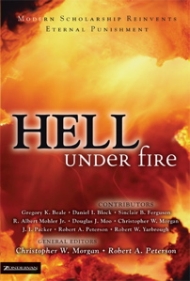
Is Hell Real? Hell Under Fire: Modern Scholarship Reinvents Eternal Punishment

This book, Hell Under Fire: Modern Scholarship Reinvents Eternal Punishment,  provides a biblical, systematic, and practical theology of  hell. The contributors to this volume unite in affirming the historic  Christian doctrine regarding the final destiny of the unsaved: They will  suffer everlasting conscious punishment away from the joyous presence  of God.

Of all the teachings of Christianity, the doctrine of hell is easily  the most troubling, so much so that in recent years the church has been  quietly tucking it away. Rarely mentioned anymore in the pulpit, it has  faded through disuse among evangelicals and been attacked by liberal  theologians. Hell is no longer only the target of those outside the  church. Today, a disturbing number of professing Christians question it  as well. Perhaps more than at any other time in history, hell is under  fire.

More on Hell and Eternal Punishment:
The implications of the historic view of hell make the popular  alternatives, annihilationism and universalism, seem extremely  appealing. But the bottom line is still God’s Word. What does the Old  Testament reveal about hell? What does Paul the apostle have to say, or  the book of Revelation? Most important, what does Jesus, the ultimate  expression of God’s love, teach us about God’s wrath?    Continue at Bob Hanks

Wednesday, April 10, 2013

Doctrine Matters (Free eBook on Ten Theological Trademarks)

Permalink
Here is the theological summary of one preacher’s lifetime of investment in a local church: Doctrine Matters: Ten Theological Trademarks from a Lifetime of Preaching, from John Piper.

Preaching, you could say, is where the rubber begins to meet the road on what a church believes. It is the living statement of faith. And in the case of John Piper, we have this statement captured online in over 1,200 sermons, including a whole series where he devotes a single message to the main theological emphases of his near 33-year preaching tenure. These theological emphases, preached as ten sermons last year and now edited into this volume, embody the legacy Piper hopes to leave at Bethlehem Baptist.

But don’t think that these messages are the memoirs of a retired pastor. You don’t store these truths away to collect dust. The vision of God in these pages doesn’t take a pat on the head — it turns the world upside down.   Continue at Jonathan Parnell

Monday, March 25, 2013

Confessions of a Woman Who Didn't Like Theology

A couple of years ago, we were sitting in our living room as I confessed to another young Reformed couple, "I don't like theology." We all observed a moment of embarrassed silence in honor of my ignorance.

I recently reflected on that moment as I sat in an enthusiastically Reformed conference. When I say "enthusiastically Reformed," I mean the sort of zeal you find in that first-semester seminary student who's just discovered the doctrines of grace and can't seem to speak of much else. He manages to foist TULIP into an impressive array of situations, from a discussion of biblical texts to a tour of the art museum.
While I've grown immensely in my understanding of the importance of biblical truth, the stubborn fact remains: love for theology and doctrine doesn't come naturally to me. It's an acquired taste.

But why should you care? Perhaps I lost you at "I don't like theology." Nevertheless, I'm convinced you should care, and here's why: I represent members of your church. Maybe a large segment, maybe a smaller one, but I guarantee they're out there. With this reality in mind, l'd like to offer three insights from an unnatural theology lover.

1. Even when learning doesn't come naturally, we can love theology and doctrine if it's served consistently with a big helping of gentleness and grace.   Continue at Ashley Haupt

Friday, February 8, 2013

Spurgeon and the Down-Grade Controversy

by John F. MacArthur, Jr.


[At the end of the Puritan age] by some means or other, first the ministers, then the Churches, got on “the down grade,” and in some cases, the descent was rapid, and in all, very disastrous. In proportion as the ministers seceded from the old Puritan godliness of life, and the old Calvinistic form of doctrine, they commonly became less earnest and less simple in their preaching, more speculative and less spiritual in the matter of their discourses, and dwelt more on the moral teachings of the New Testament, than on the great central truths of revelation. Natural theology frequently took the place which the great truths of the gospel ought to have held, and the sermons became more and more Christless. Corresponding results in the character and life, first of the preachers and then of the people, were only too plainly apparent.

In March 1887, Charles Spurgeon published the first of two articles entitled “The Down Grade” in his monthly magazine, The Sword and the Trowel. The articles were published anonymously, but the author was Robert Shindler, Spurgeon’s close friend and fellow Baptist pastor. Shindler wrote the articles with input from Spurgeon, who footnoted the first article with a personal endorsement: “Earnest attention is requested for this paper. We are going down hill at breakneck speed.”

Tracing the state of evangelicalism from the Puritan age to his own era, Shindler noted that every revival of true evangelical faith had been followed within a generation or two by a drift away from sound doctrine, ultimately leading to wholesale apostasy. He likened this drifting from truth to a downhill slope, and thus labeled it “the down-grade.”   Continue at Mike Ratliff

Wednesday, December 5, 2012

Oh to Grace How Great a Debtor -- A Reply to Tullian Tchividjian


I was glad to see some some constructive dialogue in the comments section of Tullian Tchividjian's reply to my critique of his article on total depravity and Christians.  Let me say at this point (even though I look forward to the day when such statements are not necessary) that: 1) I bear no ill will to Tullian nor was I launching a personal attack against him; 2) I wrote an article expressing concern about something he had written, not heresy charges in a court of the church; and 3) it has been my impression that the whole point of blogging is to stimulate useful thinking among Christians.  This is why I engaged in a public response to a public article rather than private dialogue.  

Being something of an internet veteran, I was not surprised, however,  to see that it took only three comments to Tullian's reply for one of his supporters to accuse me of sin.  I hope in this response to allay such concerns and hopefully to advance constructive dialogue further.
 
My aim in this reply will therefore be simply to clarify my original concerns with Tullian's previous article.  They are these: 

1.  The doctrine of total depravity does not merely state that after the Fall all men and women are effected by sin in the totality of their beings.  The doctrine also states that they have no disposition towards God but only hostility and spiritual inability (see Berkhof, p. 247 for this definition).  I agree that Tullian specified the former and not the latter of these two components.  The problem is that the term "total depravity" includes both.  In his reply, Tullian gave numerous citations from Reformed confessions regarding the on-going depravity of Christians.  I would not quarrel with any of them, but would only note that none of these define Christians with the term "total depravity," nor with the definition of this specific doctrine.  So, in this respect, my critique of Tullian was saying, "Please don't use the term 'total depravity' for regenerate Christians, even while seeking to qualify the term, because it is not accurate."   Continue at Rick Phillips

Wednesday, October 24, 2012

Doctrine in Focus: Sovereign Election

Courtesy of Dr Steven Lawson, from his excellent book Foundations of Grace.

Consistent with the other authors of Scripture, Nehemiah wrote about the doctrine of sovereign election. He recognized that, out of the mass of lost humanity, God had determined whom He would save. Since men are totally depraved and will not seek God, it is necessary that God make a distinguishing choice to save. It is obvious, then, that the reason some are saved and others are lost lies entirely with God. All of mankind would remain lost if left to themselves. But God chose His people from among those who were not seeking Him. Never was this truth more clearly seen than in the case of Abraham:

"You are the Lord, the God who chose Abram....." - Nehemiah 9:7a

From among the unconverted multitudes in the land of Ur, God chose Abraham. He did not make this choice on the basis of any good works within Abraham, whether actual or potential. Neither did He make it on the basis of foreseen faith in Abraham. Rather, this sovereign choice originated exclusively within God. Regarding this lofty truth, James Montgomery Boice writes, "Notice that God is the subject of every action: (1) 'You ....chose Abram and brought him out of Ur of the Chaldeans and named him Abraham,' (2) 'You found his heart faithful to You,' (3) 'You made a covenant with him,' and (4) 'You have kept Your promise.'....The emphasis is entirely upon God." Boice is right. According to God's inscrutable wisdom, He chooses whom He will for reasons known only to Himself. As it was with Abraham, so it is with all God's elect.  Continue at Vince and Lori

Tuesday, October 2, 2012

“Francis Schaeffer at 100″


Francis Schaeffer at 100

The year 2012 is the 100th anniversary of the birth of Francis Schaeffer (1912-1984). It is difficult to think of an evangelical figure in the 20th century who so seriously engaged the philosophies and ideologies of the secular world and set them over against the Christian worldview than Francis Schaeffer.

But Schaeffer was no ordinary evangelical. The man wore knickers and knee high socks when he lectured, sporting not only long hair but a goat’s-chin beard! Most importantly, Schaeffer did not fear man, but feared God. Not only did he engage secular worldviews, but he confronted his fellow evangelicals, even rebuking them for doctrinal concession and compromise.

As many have observed, it is not an overstatement to say that the Schaeffers transformed, reshaped, and in many ways reformed American evangelicalism. Those writing in this new issue of Credo Magazine are proof, each writer bearing testimony to how Francis Schaeffer has made a monumental impact on how we understand and articulate the Christian faith and life in the world of ideas. Contributors include Bruce Little, William Edgar, Bryan Follis, Stephen Wellum, and many others.

Here is a preview of the cover and table of contents to get you started!  Continue at CredoMag

Thursday, September 20, 2012

The Bible Doctrine of the Separated Life

The question of the separated life is a very important one, not only because it is a practical question which must be faced by every thoughtful Christian, but also because of the doctrinal ramifications that it has. Insistence upon the obligation to live what is called "the separated life" is very prevalent in some circles of earnest Christians today. The details of the separation demanded vary greatly; practices which are tolerated by some groups are denounced by others as inconsistent with Christian duty and fellowship, and vice versa. In general, "the separated life," as the term is commonly used, may be understood to be a life which is separated not only from what can be proved by Scripture to be sinful, but also from various other practices which may be indifferent in themselves; and this separation is regarded as binding on the conscience of the Christian, and is sometimes made a term or condition of ecclesiastical or even of Christian fellowship.

This problem is far more important than is at first apparent. It is far more important than the mere question whether Christians ought to participate in or to abstain from certain particular kinds of conduct. Other problems of the greatest importance are involved. If we give a wrong answer to the question, "What is the Bible doctrine of the separated life?" we are certain to fall into serious errors in other doctrines. Using the term "separated life" in the Biblical, not the popular, sense, we may say that the separated life is an ethical implication of the covenant of grace and is related to the doctrine of sanctification as the latter deals with the nature and place of good works in the Christian life. The other doctrines which are involved in the question of the separated life are: (1) Christian liberty in the use of things indifferent; (2) liberty of conscience from the commandments of men; (3) the sufficiency of Scripture as the standard of faith and conduct; (4) the nature and limits of the authority of the Christian church. The purpose of the present paper is to set forth the teaching of Scripture concerning the separated life, and then to show how erroneous teaching about the separated life affects the four doctrines enumerated above.  Continue at Johannes G. Vos

Monday, May 21, 2012

When Presuppositions Lead Men Astray

This post is not to throw stones but to point out to all of us how dangerous our unexamined thoughts are. We see this in casual ways when we infer what wasn’t written or implied – such as when we read Bible passages that are very familiar. Another way is when we defend a position – in politics or religion, related to style of worship or doctrinal distinctives. What follows is an example of a blogger for whom I have much respect has written a post to make the point that we each should “draw the line” on what music is good and proper – ostensibly in worship.

This post is NOT a forum to debate whether “Christian rap” or “Christian hip-hop” is good; the reason for this post is to examine the subtle tendency we have to use faulty logic (making sweeping arguments without discriminating actual facts) and misapplication of Scripture (based on unexamined presuppositions).

In this post http://5ptsalt.com/2012/05/16/christian-rap-is-a-lost-cause/ the author condemns a form of music by saying it “uses the ways, lusts, pride, dress and manner of the world.” And he gives no example of “Christian rap” that fulfills this charge. Nor does he acknowledge that nearly every generation of Christians makes a similar charge at what’s new in music – as Spurgeon did with organs in churches. Handel used grand orchestras to portray his message of God’s glory and people today still love some of his music without loving his Lord. Was Handel as guilty as the un-named “Christian rappers”?  Continue at Manfred

Tuesday, May 15, 2012

A Practical Example Showing Why Doctrine Is Important

Here's a set of talking points the Jehovah's Witnesses hand to their door-to-door teams to instruct them on how to foment doubt about the deity of Christ. Some lazy JW saw an article I wrote on the deity of Christ and as a kind of shorthand reply, he e-mailed me a copy of the handout he was given by his church.*

I wonder how many evangelicals would be prepared to give an answer. Continue at 
Phil Johnson