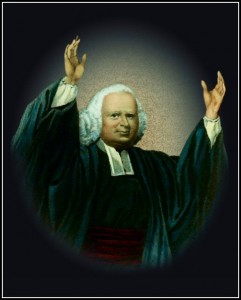
The purpose of this Blog is to introduce men and women all over the World to the Doctrines of Grace; the 5 Solas; Reformation Theology and the Lord and Savior Jesus Christ.
Showing posts with label George Whitefield. Show all posts

Thursday, February 27, 2014

Whitefield’s Sin Exposing Spotlight

Whitefield was convinced that any presentation of the gospel must begin by exposing the listener’s sin and his dire need for salvation. This necessitated the preacher’s confronting his hearers’ rebellion against God and warning of the eternal consequences of their rejection. Whitefield plainly understood that none rightly desire the gospel of Christ until they know of their own condemnation before God. Whitefield preached those truths that reveal sin, namely, the holiness of God, the fall of Adam, the demands of the law, the curse of disobedience, the certainty of death, the reality of the final judgment, and the eternality of punishment in hell.

When addressing the unregenerate masses, Whitefield sought to ensure that their depravity was fully laid bare. Martyn Lloyd-Jones aptly stated, “No man could expose the condition of the natural unregenerate heart more powerfully than George Whitefield.” Only when confronted with their sinfulness, Whitefield insisted, would unbelievers seek to embrace Christ as their Savior and Lord. He peeled back the outer layers of people’s self-righteousness in order to bring about self-awareness of their sinful hearts.   Continue at Steven Lawson

Thursday, August 30, 2012

Hurrying To Hear George Whitefield Preach The Gospel

This is the true account of Nathan Cole describing the moment he heard that the gospel was coming to Connecticut. George Whitefield was the preacher -as fields were emptied, people converged eagerly to listen with bated breaths.

“Now it pleased God to send Mr. Whitefield into this land; and my hearing of his preaching at Philadelphia, like one of the Old apostles, and many thousands flocking to hear him preach the Gospel, and great numbers were converted to Christ; I felt the Spirit of God drawing me by conviction, longed to see and hear him, and wished he would come this way. And I soon heard he was come to New York and the Jerseys and great multitudes flocking after him under great concern for their Souls and many converted which brought on my concern more and more hoping soon to see him but next I heard he was at Long Island, then at Boston, and next at Northampton.

Then one morning all on a Sudden, about 8 or 9 o’clock there came a messenger and said Mr. Whitefield preached at Hartford and Weathersfield yesterday and is to preach at Middletown this morning [October 23, 1740] at ten of the Clock. I was in my field at Work. I dropt my tool that I had in my hand and ran home and run through my house and bade my wife get ready quick to go and hear Mr. Whitefield preach at Middletown, and run to my pasture for my horse with all my might fearing that I should be too late to hear him.   Continue at George Whitefield

Friday, May 4, 2012

Calvinism & Evangelism

“We must have the heathen converted; God has myriads of His elect among them, we must go and search for them somehow or other.” – C. H. Spurgeon
 
Some say that Calvinism kills all zeal for evangelism. History, of course, tells us a very different story. Someone sent me the following few paragraphs:

As Mitch Cervinka explains: One needs only examine Protestant history to see that Calvinists have been on the forefront of evangelism and missions. George Whitefield was outspoken in affirming all five points of Calvinism, yet he was one of the most zealous and effective evangelists of the Great Awakening. Wherever he traveled, both in England and America, people would turn out by the thousands to hear him preach in the open fields. 

The modern missionary movement began in 1792 when the Calvinistic Baptist, William Carey, left England to minister the gospel in India. With the help of William Ward and Joshua Marshman, he founded 26 churches and 126 schools, and translated the Bible into 44 languages including Sanskrit.  Continue at John Samson

Thursday, February 16, 2012

Satan’s Schemes by George Whitefield

He is full of hatred, envy, and revenge: For what other motives could induce him to molest innocent man and woman in paradise? And why is he still so restless in his attempts to destroy us, who have done him no wrong?

He is a being of great power, as is evident in his being able to act on the imagination of our blessed Lord, so as to depict some sort of vision to Him of all the kingdoms of the world and their splendor, and all this in a moment of time. His power is also displayed in the transporting of the sacred body of our dear Savior, through the air up to the highest point of the temple; and also of his driving a herd of pigs so furiously that the whole herd rushed down a steep bank into a lake and died in the water. Yes, so great is Satan’s power, that, I do not doubt, that if God was to permit him to use his full strength, he could turn the earth upside down, or pull the sun out of its orbit.

But Satan is most known for his remarkable ability to use his cleverness against mankind. Since he is not given power from God to take us by force, he is therefore required to wait for opportunities to betray us, and to catch us by the use of deception. He, therefore, made use of the serpent, which was the most crafty of all the beasts of the field, in order to tempt our first parents; and accordingly he and his accomplices are described in the New Testament as being cunning and crafty in their deceitful scheming. In the words of our text, this morning, the Apostle says, “We are not unaware of his schemes:” thereby implying, that we are more in danger of being seduced by his system of deception, than overpowered by his strength.  Read it all HERE

Monday, October 24, 2011

Are You Depending Upon A Righteousness of Your Own? Your Righteousness Shall Perish With You


George Whitefield (1714-1770)

“To the one who does not work but believes in him who justifies the ungodly, his faith is counted as righteousness” ― Romans 4:5

George Whitfield,

Are any of you depending upon a righteousness of your own? Do any of you here, think to save yourselves by your own doings? I say to you…your righteousness shall perish with you. Poor miserable creatures! What is there in your tears? What in your prayers? What in your performances, to appease the wrath of an angry God? Away from the trees of the garden; come, ye guilty wretches, come as poor, lost, undone, and wretched creatures, and accept of a better righteousness than your own. As I said before, so I tell you again, the righteousness of Jesus Christ is an everlasting righteousness: it is wrought out for the very chief of sinners. Ho, every one that thirsteth, let him come and drink of this water of life freely. Are any of you wounded by sin? Do any of you feel you have no righteousness of your own? Are any of you perishing for hunger? Are any of you afraid ye will perish forever? Come, dear souls, in all your rags; come, thou poor man; come, thou poor, distressed woman; you, who think God will never forgive you, and that your sins are too great to be forgiven; come, thou doubting creature, who art afraid thou wilt never get comfort; arise, take comfort, the Lord Jesus Christ, the Lord of life, the Lord of glory, calls for thee: through his righteousness there is hope for the chief of sinners, for the worst of creatures. What if thou hadst committed all the sins in the world? What if thou hadst committed the sins of a thousand, what if thou hadst committed the sins of a million of worlds? Christ’s righteousness will cover, the blood of the Lord Jesus Christ will cleanse, thee from the guilt of them all. O let not one poor soul stand at a distance from the Savior. My dear friends, could my voice hold out, was my strength equal to my will, I would wrestle with you; I would strive with arguments, till you came and washed in this blood of the Lamb; till you came and accepted of this everlasting righteousness.   Keep Reading>>>

Monday, January 31, 2011

UNCONDITIONAL ELECTION


UNCONDITIONAL ELECTION
“So too at the present time there is a remnant, chosen by grace. But if it is by grace, it is no longer on the basis of works; otherwise grace would no longer be grace.” – Romans 11:5, 6

In this the fifth session in our biblical study of the Doctrines of Grace, Dr. John Piper deals with the subject of Unconditional Election. Here are a few quotes, as we get started:

“Whatever may be said about the doctrine of election, it is written in the Word of God as with an iron pen, and there is no getting rid of it. To me, it is one of the sweetest and most blessed truths in the whole of revelation, and those who are afraid of it are so because they do not understand it. If they could but know that the Lord had chosen them it would make their hearts dance with joy.” – C. H. Spurgeon

“The verb “elect” means to select, or choose out. The biblical doctrine of election is that before the Creation God selected out of the human race, foreseen as fallen, those whom he would redeem, bring to faith, justify and glorify in and through Jesus Christ. This divine choice is an expression of free and sovereign grace, for it is unconstrained and unconditional, not merited by anything in those who are its subjects. God owes sinners no mercy of any kind, only condemnation; so it is a wonder, and matter of endless praise, that he should choose to save any of us; and doubly so, when his choice involved the giving of his own Son to suffer as sin-bearer for the elect.” – Dr. J. I. Packer

“I believe the doctrine of election, because I am quite certain that, if God had not chosen me, I should never have chosen Him; and I am sure He chose me before I was born, or else He never would have chosen me afterwards; and He must have elected me for reasons unknown to me, for I never could find any reason in myself why He should have looked upon me with special love.” – C. H. Spurgeon 

“God intentionally designed salvation so that no man can boast of it. He didn’t merely arrange it so that boasting would be discouraged or kept to a minimum – He planned it so that boasting would be absolutely excluded. Election does precisely that.” – Mark Webb 

“Some people today say that they are perplexed by the doctrine of God’s sovereignty and election. I am amazed that anyone who believes in God should stumble at God’s sovereignty and election. For if there is a God, a King, eternal, imortal, invisible, and almighty, He has to be sovereign, and He must do all things according to His will, and He must choose according to His purpose! Whom shall He consult? With whom shall He seek counsel and advice? One may DISLIKE THESE DOCTRINES; but you cannot get rid of them without denying altogether the existence of the infinite, wise, glorious God of heaven and earth. God would not be God were He not absolutely sovereign in His eternal pre-arrangments and His present doings. – Horatius Bonar (1808-1889)

“The doctrines of our election, and free justification in Christ Jesus are daily more and more pressed upon my heart. They fill my soul with a holy fire and afford me great confidence in God my Saviour.” – George Whitefield, Works, p. 79

“Oh, the excellency of the doctrine of election and of the saint’s final perseverance! I am persuaded, till a man comes to believe and feel these important truths, he cannot come to himself, but when convinced of these, and assured of their application to his own heart, he then walks by faith indeed! . . . Love, not fear, constrains him to obedience.” – George Whitefield, Works, p. 101

“To know that from eternity my Maker, foreseeing my sin, foreloved me and resolved to save me, though it would be at the cost of Calvary; to know that the divine Son was appointed from eternity to be my Savior, and that in love he became man for me and died for me and now lives to intercede for me and will one day come in person to take me home; to know that the Lord ‘who loved me and gave himself for me’ (Gal 2:20) and who ‘came and preached peace’ to me through his messengers (Eph. 2:17) has by his Spirit raised me from spiritual death to life-giving union and communion with himself, and has promised to hold me fast and never let me go – this is knowledge that brings overwhelming gratitude and joy.” – Dr. J. I. Packer

HT: JS

Friday, January 21, 2011

First Great Awakening: America in the 1730s to 1740s

Evangelist George Whitefield toured Benjamin Franklin’s Philadelphia in 1739 following a stint in Ireland. As in Whitefield’s native England, Philadelphia ministers barred the famed preacher from using their pulpits. So Whitefield took his message about the new birth directly to the masses, preaching in fields and town squares—wherever an audience gathered. 

Revival despite differences

The huge, diverse crowds that turned out to hear Whitefield impressed Franklin. The future founding father of the United States never actually believed what Whitefield preached, that sinners must be born again by believing in Jesus Christ, who died on the cross and resurrected from the dead. He marveled at how the crowds agreed with what Whitefield preached, “notwithstanding his common abuse of them, by assuring them they were naturally half beasts and half devils.” He might not have approved of the message about man’s depravity, but Franklin couldn’t deny the evidence of revival that accompanied Whitefield’s visit.  Continue Reading>>>

Wednesday, January 5, 2011

Remember Regeneration

“Do not marvel that I said to you, ‘You must be born again.’ ” — John 3:7
John Wesley and George Whitefield both said that the trans-Atlantic revival of the 1740s was fueled by the recovery of two great doctrines: justification by faith and the new birth.

This is a striking observation in light of the present evangelical scene. In recent years books and blog posts, conferences and colloquiums have sprung up like mushrooms (some nourishing, some poisonous) to deal with the doctrine of justification. The recent gathering of the Evangelical Theological Society in Atlanta is just one example. Continue Reading>>>