The purpose of this Blog is to introduce men and women all over the World to the Doctrines of Grace; the 5 Solas; Reformation Theology and the Lord and Savior Jesus Christ.
Showing posts with label Andy Naselli. Show all posts

Tuesday, July 24, 2012

Preach: Theology Meets Practice

Two preachers talk shop:

Mark Dever and Greg Gilbert. Preach: Theology Meets Practice. 9Marks. Nashville: Broadman & Holman, 2012. 212 pp. 27-page sample PDF.

Excerpts:
What expositional preach is and is not (pp. 36–38):

Expositional preaching is preaching in which the main point of the biblical text being considered becomes the main point of the sermon being preached. . . .
  1. We’re not saying expositional preaching has to go verse by verse through a book of the Bible. . . .
  2. We’re not saying expositional preaching rules out topical preaching as a legitimate practice. . . .
  3. We’re not saying expositional preaching is just a series of lectures, the main goal of which is information transfer. . . .
  4. We’re not saying expositional preaching is marked by any particular style. . . .
  5. We’re not saying expositional preaching is not evangelistic preaching.
On using the original languages (p. 83):

One of the preacher’s greatest enemies is familiarity: He thinks he understands a particular text because he has known its meaning all his life, and because of that he winds up missing its point when he preaches it. Looking at a text in the original languages helps minimize that kind of mistake.  Continue at Andy Naselli

Saturday, November 12, 2011

When Satan Tempts Me to Despair

I love how Christian replies to Apollyon when they face off in John Bunyan’s The Pilgrim’s Progress. After Apollyon accuses Christian of a series of sins, he basically replies, “You’re right. But I’m actually even worse than that.” That disarming statement sets up the death blow:

Apollyon accused,
  1. “You almost fainted when you first set out, when you almost choked in the Swamp of Despond.
  2. You also attempted to get rid of your burden in the wrong way, instead of patiently waiting for the Prince to take it off.
  3. You sinfully slept and lost your scroll,
  4. you were almost persuaded to go back at the sight of the lions, and
  5. when you talk of your journey and of what you have heard and seen, you inwardly desire your own glory in all you do and say.”

[Christian replied,]
  1. “All this is true, and much more that you have failed to mention,” Christian agreed.
  2. “But the Prince whom I now serve and honor is merciful and ready to forgive.
  3. Besides, these infirmities possessed me while I was in your country, for there I allowed them to come in. But I have groaned under them, have been sorry for them, and have obtained pardon from my Prince.”
—John Bunyan, The Pilgrim’s Progress: From This World to That Which Is to Come (ed. C. J. Lovik; Wheaton: Crossway, 2009), 89–90 (formatting added). Cf. my review and “The Pilgrim’s Progress for Children.”   Keep Reading >>>

Wednesday, October 5, 2011

How to Manipulate People to Make (Fake) Professions of Faith

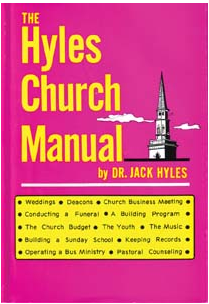
Jack Hyles, “The Invitation Time,” chapter 27 in The Hyles Church Manual (Murfreesboro, TN: Sword of the Lord, 1968), 279–82 (numbering added; this chapter reprints most of ch. 7 in Hyles’s Let’s Build an Evangelistic Church):

After observing for nearly twenty-two years the preaching of hundreds of preachers across America, I have come to the conclusion that many of us need intensive help in the conducting of a public invitation. Many wonderful gospel messages can be rendered ineffective by a weak invitation.

On the other hand, many average preachers can be rewarded greatly with the use of an effective, pungent, public invitation. Though in many places a public invitation is seldom used and even considered out of date, it is still true that the greatest soul-winning churches utilize an effective, spiritual, Spirit-filled, powerful invitation as their greatest means of evangelism. May we look at a few practical pointers concerning the invitation.

1. Starting the Invitation


Do not reveal the closing of the sermon. When the sermon reaches a high point or a climax, then would be a good time to close abruptly. Even if the sermon is not completed, sometimes God may lead one to close prematurely in order to start the invitation from a high spiritual plane. This also prevents the unsaved from “digging in,” so to speak, before the invitation is given.    Keep Reading...

Tuesday, August 30, 2011

Essential vs. Peripheral Doctrine

Erik Thoennes, Life’s Biggest Questions: What the Bible Says About the Things That Matter Most, (Wheaton: Crossway, 2011), 35–37 (formatting added):

Essential vs. Peripheral Doctrine
The ability to discern the relative importance of theological beliefs is vital for effective Christian life and ministry. Both the purity and unity of the church are at stake in this matter. The relative importance of theological issues can fall within four categories:
  1. absolutes define the core beliefs of the Christian faith;
  2. convictions, while not core beliefs, may have significant impact on the health and effectiveness of the church;
  3. opinions are views or personal judgments that generally are not worth dividing over; and
  4. questions are currently unsettled issues.
These categories can be best visualized as concentric circles, similar to those on a dart board, with the absolutes as the “bull’s eye” (see fig. 3.4).   Keep Reading...

Tuesday, August 23, 2011

The Myth of Mutual Submission

“Submit to one another out of reverence for Christ” (Eph 5:21).

This 11-page chapter (available for free as a PDF) concisely and convincingly explains why the phrase “mutual submission” is unhelpful at best:

Wayne Grudem, “The Myth of Mutual Submission as an Interpretation of Ephesians 5:21,” in Biblical Foundations for Manhood and Womanhood  (ed. Wayne Grudem; Foundations for the Family Series; Wheaton: Crossway, 2002), 221–31.

Outline:
  1. Background
  2. An Acceptable Sense of Mutual Submission
  3. Objections to the Egalitarian Sense of Mutual Submission
    1. The following context specifies the kind of submission Paul has in mind.
    2. The absence of any command for husbands to submit to wives
    3. The meaning of “be subject to” (hypotassō)
    4. The lack of evidence for the egalitarian meaning of hypotassō
    5. The meaning of “one another”
    6. The meaning of Colossians 3:18, Titus 2:5, and 1 Peter 3:1
  4. Practical Application
(The entire book is available for free as a PDF.)

Thursday, August 18, 2011

Themelios 36.2

The Gospel Coalition just released the latest issue of Themelios. It is available as a 199-page PDF and in HTML.
  1. D. A. Carson | Editorial: Generational Conflict in Ministry
  2. Carl Trueman | Minority Report: A Word to the Conscience
  3. Scott M. Manetsch | Is the Reformation Over? John Calvin, Roman Catholicism, and Contemporary Ecumenical Conversations
  4. John C. Peckham | Intrinsic Canonicity and the Inadequacy of the Community Approach to Canon-Determination
  5. Mark R. Saucy | Canon as Tradition: The New Covenant and the Hermeneutical Question
  6. Dan Strange | Not Ashamed! The Sufficiency of Scripture for Public Theology
  7. Sinclair B. Ferguson | A Preacher’s Decalogue
  8. Book Reviews
    1. Old Testament | 2 reviews
    2. New Testament | 16 reviews
    3. history and historical theology | 6 reviews
    4. systematic theology and bioethics | 12 reviews
    5. ethics and pastoralia | 5 reviews
    6. missions and culture | 12 reviews

    Gospel Coalition 

Friday, July 29, 2011

Why “Let Go and Let God” Is a Bad Idea

What is “let-go-and-let-God” theology? It’s called Keswick theology, and it’s one of the most significant strands of second-blessing theology. It assumes that Christians experience two “blessings.” The first is getting “saved,” and the second is getting serious. The change is dramatic: from a defeated life to a victorious life; from a lower life to a higher life; from a shallow life to a deeper life; from a fruitless life to a more abundant life; from being “carnal” to being “spiritual”; and from merely having Jesus as your Savior to making Jesus your Master. People experience this second blessing through surrender and faith: “Let go and let God.”

Keswick theology comes from the early Keswick movement. Keswick (pronounced KE H-zick) is a small town in the scenic Lake District of northwest England. Since 1875, it has hosted a weeklong meeting in July for the Keswick Convention. The movement’s first generation (about 1875– 1920) epitomized what we still call “Keswick theology” today.

People who influenced Keswick theology include John Wesley, Charles Finney, and Hannah Whitall Smith. Significant proponents of Keswick theology include Evan H. Hopkins (Keswick’s formative theologian), H. Moule (Keswick’s scholar and best theologian), F. B. Meyer (Keswick’s international ambassador), Andrew Murray (Keswick’s foremost devotional author), J. Hudson Taylor and Amy Carmichael (Keswick’s foremost missionaries), Frances Havergal (Keswick’s hymnist), and W. H. Griffith Thomas, and Robert C. McQuilkin (leaders of the victorious life movement). People who were influenced by Keswick theology include leaders of the Christian and Missionary Alliance (A. B. Simpson), Moody Bible Institute (D. L. Moody and R. A. Torrey), and Dallas Seminary (Lewis Chafer and Charles Ryrie).    Keep Reading...

See Also: Let Go and Let God? A Survey and Analysis of Keswick Theology


Thursday, April 14, 2011

Eschatological Essentials

Sam Storms, The Restoration of All Things (The Gospel Coalition Booklets; Wheaton: Crossway, 2011), pp. 7–8 (numbering added):

The eschatological hope of the Christian is summarized well in the thirteenth and final article of The Gospel Coalition’s Confessional Statement. This statement does not address the variety of end-time scenarios present in the evangelical world but is designed to identify those essential elements of our eschatological hope that are embraced by all who affirm the authority of the inspired text. It is, therefore, a broadly evangelical statement that avoids the denominational and sectarian distinctives that have so often marred the discussion of God’s end-time purposes. It reads as follows:
  1. We believe in the personal, glorious, and bodily return of our Lord Jesus Christ with his holy angels,
  2. when he will exercise his role as final Judge,
  3. and his kingdom will be consummated.
  4. We believe in the bodily resurrection of both the just and the unjust—the unjust to judgment and eternal conscious punishment in hell, as our Lord himself taught,
  5. and the just to eternal blessedness in the presence of him who sits on the throne and of the Lamb, in the new heaven and the new earth, the home of righteousness.
  6. On that day the church will be presented faultless before God by the obedience, suffering, and triumph of Christ, all sin purged and its wretched effects forever banished.
  7. God will be all in all and his people will be enthralled by the immediacy of his ineffable holiness, and everything will be to the praise of his glorious grace.
HT: Andy Naselli

Monday, January 10, 2011

Judgmentalism

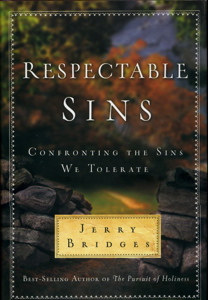
That’s the title of chapter 17 in this painfully convicting book:

Jerry Bridges. Respectable Sins: Confronting the Sins We Tolerate. Colorado Springs, CO: NavPress, 2007. 185 pp.

Judgmentalism is a sinfully “critical spirit, a condemning attitude” (D. A. Carson,  Jesus’ Sermon on the Mount and His Confrontation with the World  p. 105). We can be judgmental about nearly anything.

The point of this post is not to debate disputed positions; it’s about our disposition. It’s not about who’s right and who’s wrong; it’s about applying the gospel to our sinfully critical spirits and condemning attitudes. We might think of judgmental people as those with “stricter” standards, but people with “looser” standards can be judgmental, too. Whatever our views may be on disputed issues like the ones below, we can be guilty of judgmentalism. Jesus died for that sin. Continue Reading>>>

Friday, September 3, 2010

Hell: Remembering the Awful Reality

Friday, June 4, 2010

Andy Naselli on Why “Let Go and Let God” Is a Bad Idea

Many evangelicals may only be vaguely familiar with traditional Keswick theology. So I asked Andy a few questions about it. He’s condensed several years of research and several hundreds of pages of writing into 1000 words, so I encourage you to take five minutes and benefit from Andy’s expert....Keswick (pronounced KEH-zick) is a small town in the scenic Lake District of northwest England. Since 1875, it has hosted a week-long meeting in July for the Keswick Convention. In my book, “the early Keswick movement” refers to a movement from 1875 to 1920 that was

1. conservatively evangelical;
2. based on and distinguished by the belief that the majority of Christians are living in defeat and that the secret to living the victorious Christian life is consecration followed by Spirit-filling; and
3. stimulated by annual conventions at Keswick, England, and literature by its propagators.

So “Keswick theology” (as I use the term) refers to the view of sanctification shared by the prominent propagators of the early Keswick movement. Read the rest HERE

And HERE

And HERE