The purpose of this Blog is to introduce men and women all over the World to the Doctrines of Grace; the 5 Solas; Reformation Theology and the Lord and Savior Jesus Christ.
Showing posts with label Justice. Show all posts

Friday, December 28, 2012

Where Was God in All the Goodness of 2012?

Permalink
As this year ends, the question I am asking is: Where was God when so many good things happened this past year? 

How can God be a God of justice, yet allow so much good to happen to people who dishonor him by disbelieving in him, or giving lip service to his existence, or paying no more attention to him than the carpet in their den, or rejecting the kingship of his Son, or scorning his word, or preferring a hundred pleasures before him?

How can God be righteous and do so much good to us who are so unrighteous? 

Where was God in 2012?
  • Where was God when nine million planes landed safely in the United States?
  • Where was God when the world revolved around the sun so accurately that it achieved the Winter solstice perfectly at 5:12 AM December 21 and headed back toward Spring?
  • Where was God when the President was not shot at a thousand public appearances?
  • Where was God when American farms produced ten million bushels of corn, and 2.8 million bushels of soybeans — enough food to sell $100 billions worth to other nations?
  • Where was God when no terrorist plot brought down a single American building or plane or industry?    Continue at Desiring God

Friday, April 20, 2012

The Post-Christian Condition — Anders Breivik and the Limitations of Justice

The trial of Anders Behring Breivik represents one of the greatest tests of human justice in decades. Breivik stood in an Oslo courtroom this week and declared: “I admit to the actions, but not to the guilt.” The “actions,” of course, were the killing of 77 people on July 22, 2011. Eight were killed in a car bomb in Oslo. Breivik then shot 69 people to death on Utoya Island — most of them teenagers and young people involved in a summer camp sponsored by one of Norway’s major political parties.

Breivik has celebrated his murderous actions in court, calling his massacre the most “spectacular” event in recent European history. Having admitted to the killings, Breivik told the court, “I would do it again.”

He may have an opportunity to do so. Norwegian law allows Breivik to be imprisoned for only 21 years, even if found guilty of all 77 killings. Officials in Norway have attempted to assure their fellow citizens that Breivik is unlikely to be released, but the law allows criminals to be held in captivity after their sentence only on psychological grounds that represent a threat, and Breivik has been found sufficiently sane to stand trial.
How can this be? What sane nation would allow for a maximum sentence of 21 years in prison for premeditated murder — much less the calculated killing of 77 people?  Continue at Al Mohler

Friday, December 16, 2011

Don't Like Handouts? Neither Does the Bible

Many passages in Holy Scriptures implore rulers to treat the poor fairly.

It is only a slight exaggeration to suggest God measures nations largely by justice towards "the least of these." Is charity best dispensed publicly through a secular state or privately by churches? Does Washington really not do enough?

Despite the demagoguery trumpeted every election, America's rich pay almost all our taxes while the less fortunate are net recipients of government largesse. 

Washington's focus has shifted from defense and foreign affairs into social programs advancing egalitarianism. The federal government's primary endeavor reflects paying people not to produce.

Many assume these public initiatives represent biblical governance concerning the destitute but such passages were proclaimed under very different political and economic contexts. Americans take for granted that those without political connections can still acquire property, enjoy legal rights, access the ballot, testify in courts, and obtain medicine, police, fire and other protections.

However, throughout antiquity (and many places still), justice was seldom blind. Far more frequently the state pillaged the poor. Government didn't exist to protect all citizens equally, but to empower rulers as an instrument of plunder.

Might made right. Without defined constitutional parameters, justice generally reflects the whims of the powerful.  Keep Reading >>>


Tuesday, December 6, 2011

Mission Critical

Your church cannot do everything that everyone wants it to do. Some requests are simply impossible to fulfill; others would be inappropriate. Church leaders turn to God's Word as our guide in prioritizing how we spend limited time, treasure, and talent.
This is some of what I've learned while discussing these issues with Kevin DeYoung and Greg Gilbert, authors of What Is the Mission of the Church? It's also what I've seen while serving in churches seeking to do good in their communities. In my experience, churches unclear about their mission from God spend much time talking about everything they should do and exasperate over how little they can actually accomplish.

Even so, healthy churches will disagree about how exactly to serve their different communities, and some may engage in activities that make others uncomfortable. At least within The Gospel Coalition's fellowship of churches, that's a healthy debate we're happy to facilitate. TGC's Theological Vision for Ministry, a consensus document for Council members, explains their unswerving commitment to seek justice while leaving room for diverse applications.  Keep Reading>>>

Saturday, November 26, 2011

The Ordinary Means of Growth

We are living in a confused and confusing time for confessional Christians (Christians who are anchored by a public and corporate theological commitment to be faithful to the Bible’s teaching on faith and practice as expounded by the great confessions of the Protestant Reformation). We are witnessing the final demise of theological liberalism, the rise of Pentecostalism, the beginnings of the so-called emerging church movement, the breakdown of evangelicalism, and an utter discombobulation about how the church is to conduct its life and ministry in an increasing “post-Christian” culture. All around us, in the name of reaching the culture with the Gospel, we see evangelical churches compromising (usually without intending to) in both message and methods.

It is not uncommon today to hear certain buzz-words and catch phrases that are meant to capture and articulate new (and presumably more culturally-attuned) approaches to ministry: “Purpose-driven,” “missional,” “contextualization,” “word and deed,” “ancient-future,” “emerging/emergent,” “peace and justice.” Now, to be sure, there are points, diagnoses, and emphases entailed in each of these terms and concepts that are helpful, true, and timely. Sadly, however, the philosophies of ministry often associated with this glossary are also often self-contrasted with the historic Christian view of how the church lives and ministers. That view is often called “the ordinary means of grace” view of ministry.

The fundamental assumption underlying these new approaches is that “everything has changed,” and so our methods must change. I would want to dispute both parts of that equation. Whatever the entailments of our present cultural moment, constituent human nature has not changed.  And thus the fundamental human problem has not changed. Neither has the Gospel solution to it. Nor have the effectiveness of God’s Gospel means. Furthermore, one of the things that has always marked faithful and effective Christian ministry in every era and area of the world is a confidence in God’s Word, both in the Gospel message and in Gospel means. Faith still comes by hearing.

In sum, there are basically three views of Gospel ministry. There are those who think that effective cultural engagement requires an updating of the message. There are those who think that effective ministry requires an updating of our methods. And there are those who think that effective ministry begins with a pre-commitment to God’s message and methods, set forth in His Word.  Keep Reading >>>

Saturday, November 19, 2011

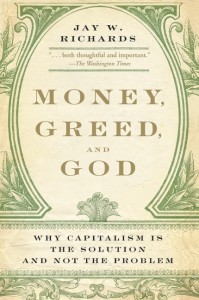
If I Become Rich, Won’t Someone Else Become Poor?

This is the most readable defense of capitalism I’ve read (and it’s more relevant than ever with the recent “Occupy Wall Street”-type protests):


Richards debunks eight myths, which are listed in the book’s table of contents:
  1. Can’t We Build a Just Society? Myth no. 1: The Nirvana Myth (contrasting capitalism with an unrealizable ideal rather than with its live alternatives)
  2. What Would Jesus Do? Myth no. 2: The Piety Myth (focusing on our good intentions rather than the unintended consequences of our actions)
  3. Doesn’t Capitalism Foster Unfair Competition? Myth no. 3: The Zero-sum Game Myth (believing that trade requires a winner and a loser)
  4. If I Become Rich, Won’t Someone Else Become Poor? Myth no. 4: The Materialist Myth (believing that intellect cannot create new wealth)
  5. Isn’t Capitalism Based on Greed? Myth no. 5: The Greed Myth (believing that the essence of capitalism is greed)
  6. Hasn’t Christianity Always Opposed Capitalism? Myth no. 6: The Usury Myth (believing that charging interest on money is always exploitive)  Keep Reading >>>

Monday, November 14, 2011

Let's Talk About Sex

What's happening at Penn State is crushing. It's a lose-lose. These children have already been abused and the way the university is handling the situation and the way the students are reacting only appear to be heaping shame upon shame. It's a time for all of us to grieve for these children and cry out to God for justice. 

However, there is a much larger question at stake: how should what happened at Penn State affect the way we handle reports of abuse in the church? I've seen two solutions so far:
  1. we should immediately change our policies whether church or otherwise so that all abuse is immediately reported to the police and then reported to the proper higher ups
  2. we should use diligence before proceeding to protect the reputation of those who may be falsely accused.
Justin Taylor offers both perspectives in his article How the Penn State Scandal Changes Our World. I'm sensitive to both for two reasons. I'm sensitive to the first because I am a father of two daughters in a culture where over 66% of people are sexually abused in some fashion. However, I'm sensitive to the second  because we live in our culture of lawsuits and revenge and I personally know of someone who is listed on the sexual predator list because he (over 18) gave someone (under 18) a wedgie. The parents were out for blood because of their sons hurt pride. We must protect our children from sexual abuse and we must protect innocent people from being branded as sexual predators who are not. Both scenarios are grievous offense.   Keep Reading   >>>

Wednesday, November 2, 2011

Mohler and Wallis Debate Justice and the Church


"The separation in our minds," T.S. Eliot once wrote, "which results simply from dwelling constantly upon the adjective social may lead to crimes as well as errors." The logic of Elliot's claims highlights how qualifiers occasionally obscure what they originally qualified.

This tricky relationship was on full display in last Thursday's debate between Jim Wallis, founder and editor of Sojourners magazine, and Albert Mohler, president of The Southern Baptist Theological Seminary. The question was whether "social justice is an essential part of the mission of the church," with Mohler staking his ground around the negative and Wallis the affirmative. Debates themselves have limited usefulness, but as far as they go this was a helpful and instructive one. 

The formal remarks were largely preparatory for the final 15 minutes of direct conversation, during which I wondered why the whole time wasn't spent this way.

Yet if the formal remarks seemed less than exhilarating, it is largely because Wallis and Mohler's styles made it seem as though they would spend the evening talking past each other. Wallis peppered his remarks with personal narratives, biblical exegesis, and stories of those pursuing the sort of social justice he sees as "integral" to the mission of the church. Mohler took a different tack, systematically defining terms and making a general biblical case for why the unique mission of the church is the proclamation "that Christ died according to the Scriptures."   Keep Reading >>>

Friday, September 30, 2011

Still a Place for Priorities

I like Russell Moore. He is a powerful preacher and an elegant writer. In particular, I’m thankful for his work on orphans, adoption, and abortion. I like him so much I asked him to write the chapter on “Kingdom” in Don’t Call it a Comeback. We are on the same team.

But I want to make a few comments on his recent blog post “Gospel or Justice, Which?” Instead of repeating a number of points I make with Greg Gilbert in our book What is the Mission of the Church?, I’ll simply add some brief thoughts to the mix.

1. I completely agree that Jesus ministered to bodies as well as souls. Moreover, part of his motivation was a profound sense of pity for those who were diseased and distressed. Jesus cared for hurting people. Luke 7:13: “And when the Lord saw her, he had compassion on her and said to her, ‘Do not weep.’” If we care nothing for those who are sick, who are confused, who are sad—if we have no desire to see hurting people with hurting bodies be helped, then we do not have the heart of Jesus. I think this is Moore’s main point, to which I say “Amen.” I’m grateful for the beautiful reminder.

2. It’s not quite right to say the mission of Jesus is the mission of the church (at least not without several qualifications). We are not God incarnate. We do not turn away the Father’s wrath. We do not die for the forgiveness of sins. Jesus’ mission was to give his life as a ransom for many (Mark 10:45). This is not our mission.     Keep Reading...

Saturday, August 27, 2011

Watch R.C. Sproul Teaching Series for Free

The Holiness of God - R. C. Sproul

The Holiness of God examines the meaning of holiness and why people are both fascinated and terrified by a holy God. This series closely explores God’s character, leading to new insights on sin, justice, and grace. The result is a new awareness of our dependence upon God’s mercy and a discovery of the awesomeness of His majestic holiness. Dr. R.C. Sproul says, “The holiness of God affects every aspect of our lives — economics, politics, athletics, romance — everything with which we are involved.”


Chosen by God - R. C. Sproul

Many people reject Reformed theology or Calvinism because they believe it teaches that God drags people kicking and screaming into the church against their will. This, however, is a gross distortion of the biblical doctrine of election, which is grounded in God’s love for His people. In this series, Dr. Sproul carefully explains the meaning of God’s sovereignty in the work of redemption and shows how it relates to the will of man.

What Is Reformed Theology? - R. C. Sproul

There is something healthy about returning to one’s roots. When it comes to evangelical Christianity, its roots are found in the soil of the sixteenth-century Protestant Reformation. Just as the Reformers protested the corrupt teaching of the Roman Catholic Church, so today evangelicalism itself is in need of a modern reformation. In What Is Reformed Theology?, Dr. R.C. Sproul offers a comprehensive introduction to Reformed theology. Simply put, it is the theology of the Protestant Reformers and the heart of historical evangelicalism. As C.H. Spurgeon once said, Reformed theology is nothing other than biblical Christianity.

See: R. C. Sproul

Tuesday, May 3, 2011

The Death of Osama bin Laden: What Kind of Justice Has Been Done?

Understandably, news of Osama bin Laden's demise at the hands of U. S. Navy Seals provoked cries of celebration. The mastermind of terror, even against civilians (indeed, against fellow Muslims) has been brought to justice. But what kind of justice?

In the immediate aftermath of 9/11, President George W. Bush authorized "Operation Infinite Justice." Especially after his comment that "this crusade, this war on terrorism, is going to take a while," however, the mission was renamed "Operation Enduring Freedom." Reportedly, the name-change was due at least in part to the concern raised by Muslims that only God can execute "infinite justice." One would have hoped that the change had been provoked instead by Christian reaction.

Islam, of course, is not just a religion; it's a cultural and even geo-political reality. As such, its strict adherents excoriate co-religionists like Abdullahi Ahmed An-Na'im who call for an "Islamic Reformation" that would make jihad into a spiritual struggle rather than an armed military conflict. Keep Reading...

How Should Christians Think about the Death of Osama bin Laden?

Doubtless there will be much commentary in days ahead about the appropriate Christian response to the death of Osama bin Laden.

I think it’s appropriate for Christians to intermingle grieving and gratitude.

Grief for a life made in the image of God but so destructive of human life and so dishonoring to God.

And gratitude for justice being served as an instrument of God’s wrath.

If it’s true that “God’s emotional life is infinitely complex beyond our ability to fully comprehend,” it should be no surprise that his followers would reflect some of that complexity as well. After all, we are the people who are “sorrowful yet always rejoicing.”

A couple of early pieces that point to this tension in the Christian life: Keep Reading...

Friday, March 11, 2011

Doing Away with Hell? Part Two

The doctrine of hell has recently come under vicious attack, both from secularists and even from some evangelicals. In many ways, the assault has been a covert one. Like a slowly encroaching tide, a whole complex of inter-related cultural, theological, and philosophical changes have conspired to undermine the traditional understanding of hell. Yesterday, we considered the first and perhaps most important of those changes–a radically altered view of God. But other issues have played a part as well.

A second issue that has contributed to the modern denial of hell is a changed view of justice. Retributive justice has been the hallmark of human law since premodern times. This concept assumes that punishment is a natural and necessary component of justice. Nevertheless, retributive justice has been under assault for many years in western cultures, and this has led to modifications in the doctrine of hell.

The utilitarian philosophers such as John Stuart Mill and Jeremy Bentham argued that retribution is an unacceptable form of justice. Rejecting clear and absolute moral norms, they argued that justice demands restoration rather than retribution. Criminals were no longer seen as evil and deserving of punishment, but were seen as persons in need of correction. The goal–for all but the most egregious sinners–was restoration and rehabilitation. The shift from the prison to the penitentiary was supposed to be a shift from a place of punishment to a place of penance, but apparently no one told the prisoners. Keep Reading>>>

Wednesday, February 9, 2011

Why Should we Believe in Jesus?

“The reason Jesus is essential to believe in is because there is a holy God who is infinitely just and infinitely loving. And in his justice he is angry at us because we have sinned against him. We have rejected him, we haven’t trusted him, we haven’t loved him as we ought, we have broken his commandments. All we have to do is list out, “Thou shall not steal, thou shall not lie, thou shall not lust or covet and shall love him only above all things.” 

And we’ve broken those and so wrath rests upon us.

Jesus is the Son of God sent into the world as the atonement, the sacrifice that bears our sins and that provides our righteousness. So that if there were no Christ we would only have guilt and judgment and condemnation and Hell from God.

But because Christ came and God sent him, in his love we can look away from ourselves. This is what faith means: we look away from ourselves, we cast ourselves on Christ for his mercy and we trust his death to be our punishment.

And we trust his righteousness to be imputed to us so that now in Christ, that is in relation to Christ, by faith, God looks upon us as having fulfilled his whole law, as having all of our sins forgiven, and being acceptable in the beloved Jesus Christ. So that now we have eternal joy, eternal glory.

So the practical answer, “Why believe in Jesus?” is because it’s the only way to escape Hell, to know God, to have everlasting joy in the presence of God.

And we believe it because it’s true.” – John Piper