What is God’s glory? The Bible speaks of God’s glory in two primary ways. First, there is the intrinsic glory of God, which is the sum total of all His divine perfections and attributes. It is who God is—His infinitely vast greatness. Glory in the Old Testament (kabod)
originally meant “heaviness,” “importance,” or “significance.” It came
to represent the stunning magnificence of certain objects, such as the
blazing sun or the regal majesty displayed by a king. Hence, glory came to be used to describe the magnificent splendor and awesome radiance of God Himself revealed to man. Continue at Steve Lawson
Showing posts with label Steve Lawson. Show all posts
Showing posts with label Steve Lawson. Show all posts
Monday, May 19, 2014


Thursday, February 27, 2014
Whitefield’s Sin Exposing Spotlight

Whitefield was convinced that any presentation of the gospel must
begin by exposing the listener’s sin and his dire need for salvation.
This necessitated the preacher’s confronting his hearers’ rebellion
against God and warning of the eternal consequences of their rejection.
Whitefield plainly understood that none rightly desire the gospel of
Christ until they know of their own condemnation before God. Whitefield
preached those truths that reveal sin, namely, the holiness of God, the
fall of Adam, the demands of the law, the curse of disobedience, the
certainty of death, the reality of the final judgment, and the
eternality of punishment in hell.
When addressing the unregenerate masses, Whitefield sought to ensure
that their depravity was fully laid bare. Martyn Lloyd-Jones aptly
stated, “No man could expose the condition of the natural unregenerate
heart more powerfully than George Whitefield.” Only when confronted with
their sinfulness, Whitefield insisted, would unbelievers seek to
embrace Christ as their Savior and Lord. He peeled back the outer layers
of people’s self-righteousness in order to bring about self-awareness
of their sinful hearts. Continue at Steven Lawson
Saturday, November 30, 2013
Was Charles Spurgeon a Calvinist?

Was Charles Spurgeon a Calvinist? The Prince of Preachers himself answers this question in the affirmative:
“It is no novelty, then, that I am preaching; no new doctrine. I love to proclaim these strong old doctrines, that are called by nickname Calvinism, but which are surely and verily the revealed truth of God as it is in Christ Jesus.” —Charles Spurgeon
In Dr. Steven Lawson’s book, The Gospel Focus of Charles Spurgeon,
Dr. Lawson argues that not only was Spurgeon a Calvinist, but his
fervent commitment to the doctrines of grace actually “sharpened” his
“gospel focus.”
We’ve compiled several adapted excerpts from The Gospel Focus of Charles Spurgeon to outline Spurgeon’s beliefs concerning the sovereignty of God in salvation.
Note: The eBook edition of Dr. Lawson’s The Gospel Focus of Charles Spurgeon is a free download in November.
Total Depravity
For Spurgeon, total depravity
was where the message of the gospel begins. The saving message of grace
starts with total depravity. Man is entirely corrupted by sin. He is
spiritually dead and unable to save himself. He could not be more
hopeless and helpless. Continue at Nathan Busenitz
Saturday, November 16, 2013
Scripture: Charles Spurgeon’s Unshakable Foundation

Throughout his ministry, Spurgeon’s preaching
rested squarely on this impregnable rock—that the Bible is exactly what
it claims to be, the inspired Word of the living God. As he stepped into
the pulpit, he spoke with confidence in the infallible purity and
saving power of God’s Word. For Spurgeon, when the Bible speaks,
God speaks.
Spurgeon’s strong belief in the doctrines of grace was firmly rooted
and grounded in this truth. He did not proclaim the doctrines of
sovereign grace simply because the Reformers or Puritans affirmed them.
Rather, he believed them because he found them clearly stated in the
Bible. Though he considered himself a staunch Calvinist, Spurgeon
asserted, “I believe nothing merely because [John] Calvin taught it, but
because I have found his teaching in the Word of God.” He further
stated: “‘Calvinism’ did not spring from Calvin; we believe that it
sprang from the great Founder of all truth. Perhaps Calvin derived it
mainly from the writings of Augustine. Augustine obtained his views,
without doubt, through the Spirit of God, from the diligent study of the
writings of Paul, and Paul received them of the Holy Ghost, from Jesus
Christ.”`Continue at Steven Lawson
Saturday, August 17, 2013
10 Distinguishing Marks of John Calvin’s Preaching
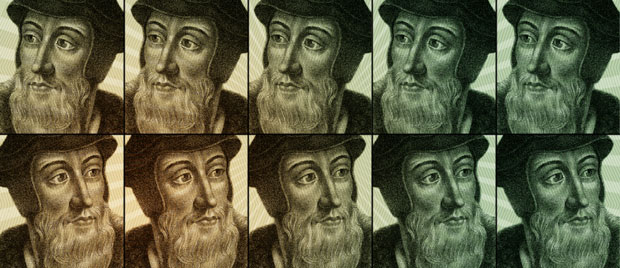
Steven Lawson contributed a chapter in John Calvin: A Heart for Devotion, Doctrine, and Doxology on
John Calvin “The Preacher of God’s Word.” Here is a summary of that
chapter, outlining what Steven Lawson suggests are the ten
distinguishing marks of Calvin’s preaching.
1. John Calvin’s preaching was biblical in its substance.
“The Reformer stood firmly on the chief cornerstone of the Reformation—sola Scriptura (“Scripture alone”). … The preacher, Calvin believed, has nothing to say apart from Scripture.”
2. John Calvin’s preaching was sequential in its pattern.
“For the duration of his ministry, Calvin’s
approach was to preach systematically through entire books of the
Bible. … Calvin preached from the New Testament on Sunday mornings, from
the New Testament or the Psalms on Sunday afternoons, and from the Old
Testament every morning of the week, every other week. In this
consecutive fashion, Calvin preached through most of the books of
the Scriptures.”
3. John Calvin’s preaching was direct in its message. Continue at Nathan W. Bingham
Monday, March 25, 2013
Shepherds Conference 2013
General Sessions
General Session I — John MacArthur

General Session II — Phil Johnson
General Session III — Steve Lawson
General Session IV — John MacArthur
General Session VI — Al Mohler
See the rest HERE
Wednesday, March 6, 2013
Columns from Tabletalk Magazine, March 2013

The March edition of Tabletalk is
out. This issue features articles examining the church’s witness to a
youth-driven culture. Past generations tended to value maturity, hard
work, and sacrifice, but many in our current culture display
selfishness, emphasize the idea that the new is always better than the
old, and desire to achieve much with minimal effort. These cultural
currents impact the church, and the church must recognize how they have
done so. God’s Word calls Christians to mature in their faith and to
honor the elderly among us. God’s people must grow in wisdom and
integrity, and the elder men and women of the church must lead the way
on this path to maturity.
Contributors include R.C. Sproul along with Stephen J. Nichols, Nathan Finn, Guy Prentiss Waters, Robert W. Carver, Tom Ascol, R.C. Sproul Jr., Steven J. Lawson, Jonathan K. Dodson, David Robertson and Rosemary Jense.
We do not post all of the feature articles or the daily devotionals from the issue, so you’ll have to subscribe to get those. But for now, here are links to several free columns and articles from this month:
- Jesus Christ, Anointed One by R.C. Sproul
- Relevant, Old Paths by Burk Parsons
- Kids These Days by R.C. Sproul Jr.
- Praying for Politicians by David Robertson
- Why Follow Jesus? by Jonathan Dodson
- A Friend to Africa’s Orphans: An Interview with Rosemary Jensen
- One Family Under God by Tom Ascol
- His Heart Trusts in Her by Steven Lawson
If you have not yet subscribed to Tabletalk, now is the perfect time. Your print subscription also gives you free access to the digital edition of Tabletalk. For those living in the U.S.
and Canada it’s only $23 for a year, and $20 to renew. You save even
more if you get a 2- or 3-year subscription (as little as $1.36 per
issue). We offer special discounts for churches or businesses who want
multiple copies of each issue.
Get your subscription to Tabletalk today by calling one of Ligonier Ministries’ resource consultants at 800-435-4343 or by subscribing online.
Wednesday, October 24, 2012
Doctrine in Focus: Sovereign Election
Courtesy of Dr Steven Lawson, from his excellent book Foundations of Grace.
Consistent with the other authors of Scripture, Nehemiah wrote about the doctrine of sovereign election. He recognized that, out of the mass of lost humanity, God had determined whom He would save. Since men are totally depraved and will not seek God, it is necessary that God make a distinguishing choice to save. It is obvious, then, that the reason some are saved and others are lost lies entirely with God. All of mankind would remain lost if left to themselves. But God chose His people from among those who were not seeking Him. Never was this truth more clearly seen than in the case of Abraham:
Consistent with the other authors of Scripture, Nehemiah wrote about the doctrine of sovereign election. He recognized that, out of the mass of lost humanity, God had determined whom He would save. Since men are totally depraved and will not seek God, it is necessary that God make a distinguishing choice to save. It is obvious, then, that the reason some are saved and others are lost lies entirely with God. All of mankind would remain lost if left to themselves. But God chose His people from among those who were not seeking Him. Never was this truth more clearly seen than in the case of Abraham:
"You are the Lord, the God who chose Abram....." - Nehemiah 9:7a
From among the unconverted multitudes in the land of Ur, God chose
Abraham. He did not make this choice on the basis of any good works
within Abraham, whether actual or potential. Neither did He make it on
the basis of foreseen faith in Abraham. Rather, this sovereign choice
originated exclusively within God. Regarding this lofty truth, James
Montgomery Boice writes, "Notice that God is the subject of every
action: (1) 'You ....chose Abram and brought him out of Ur of the Chaldeans and named him Abraham,' (2) 'You found his heart faithful to You,' (3) 'You made a covenant with him,' and (4) 'You
have kept Your promise.'....The emphasis is entirely upon God." Boice
is right. According to God's inscrutable wisdom, He chooses whom He will
for reasons known only to Himself. As it was with Abraham, so it is
with all God's elect. Continue at Vince and Lori
Tuesday, October 23, 2012
Preserving Grace in John
Steve Lawson on every Arminian’s favorite verse:
Those who put their trust in Jesus Christ never perish in the spiritual sense. They receive eternal life, which delivers them from suffering eternal destruction:“For God so loved the world, that he gave his only Son, that whoever believes in him should not perish but have eternal life.” —John 3:16Jesus promised that all who believe upon Him never perish. That is, they do not suffer eternal destruction in hell. They do not endure everlasting damnation in the flames of hell. Calvin states, “So it follows that until Christ set about rescuing the lost, everyone was destined for eternal destruction. . . . God specifically states that although we appear to have been born for death, certain deliverance is offered to us through faith in Christ. So we should not fear death, which would otherwise hang over us. . . . In this way we are freed from the condemnation of eternal death and made heirs of eternal life, because through the sacrifice of His death He has atoned for our sins so that nothing will prevent God from acknowledging us as His sons.” Charles H. Spurgeon proclaims, “This proves the final perseverance of the saints; for if the believer ceased to be a believer he would perish; and as he cannot perish, it is clear that he will continue a believer. If thou wert to lose it, it would prove that it was not everlasting, and thou wouldest perish; and thus thou wouldst make this word to be of no effect. Whosoever with his heart believeth in Christ is a saved man, not for to-night only, but for all the nights that ever shall be, and for that dread night of death, and for that solemn eternity which draws so near.” This is to say, believers are eternally secure, forever safe, and kept in God’s saving grace.—Steve Lawson, Foundations of Grace (Reformation Trust, 2006), 296. HT: Thirsty Theologian
Monday, October 15, 2012
God's Shalls and Wills
Dr Steve Lawson, at the 2012 Expositor's Conference, talking about the
role and power of the Holy Spirit in conversion vs the power of man in
his own conversion. He finishes with a fantastic long quote by Charles
Spurgeon.
This clip reminds us of a conversation we had with a pastor at the Conference. During lunchtime, a pastor from New York was telling us (about six of us at the table) a powerful story about a couple from his church. This couple had a set of parents who were unsaved. The church had been praying for the parents' conversion for many years. During the conference in AL, the couple called the pastor to tell him that, after years of praying and witnessing, the Lord had granted their parents salvation in NY that very week. The parents are in their mid 80's. The Lord granted them salvation while listening to one of John MacArthur's sermons from the 1970's. This was such a great testimony to the power of the Gospel, the power of the Holy Spirit, and the fact that when God says "It Shall Be Done", He means it. It WILL happen.
If you have an unsaved family member or friend, keep praying and keep sharing the Gospel with them. In God's timing, if it's His will they be saved, they WILL be saved. Watch this clip and be encouraged.
Saturday, October 13, 2012
Definite Atonement in John: World & All

Of all the Gospels, John’s
gospel is the most theological, and presents the doctrines of grace in
stark relief. John also poses a challenge to interpreters with his
extensive use of the word world (kosmos), which appears in his gospel seventy-eight times, compared to fourteen times in the synoptics combined. John uses world
in several different ways, and the student must be careful to
understand each use correctly in its context. Steve Lawson lists ten
different uses:*
- Entire Universe (John 1:9, 10; 17:5).
- Physical Earth (John 13:1; 16:33; 21:25).
- World System (John 1:10; 12:31; 14:30; 15:18–21; 16:11; 17:14).
- Humanity Minus Believers (John 7:7; 15:18).
- Large Group (John 12:19).
- General Public (John 7:4; 14:22).
- Jews and Gentiles, all groups of people, as opposed to the Jewish people only (John 1:29; 4:42).
- Human Realm, contrasted with the realm of heaven and angelic beings (John 1:10; 3:12–16).
- Non-Elect (John 17:9).
- Elect Only (John 3:17; 6:33; 12:47).
Lawson summarizes: Continue at Thirsty Theologian
Friday, October 12, 2012
Sovereign Election in John
If you are a believer, have you ever stopped to think
about the fact that, before you came to Christ, he was praying for you?
Do you know that he still does?
HT: Thirsty TheologianEven before their conversion, all believers already belong to God by virtue of eternal election. They are considered to be the possession of God because He has chosen them to be His own:“I am praying for them. I am not praying for the world but for those whom you have given me, for they are yours.” —John 17:9Jesus made a careful distinction between those for whom He prayed—the elect of God—and those for whom He did not pray—unbelievers. The Lord focused His priestly intercession upon those the Father chose as His own possession before time began, then gave to the Son. Standing behind this verse is the monumental doctrine of sovereign election. MacArthur writes, “‘They were Yours’ (cf. v. 9) is a potent assertion that before conversion, they belonged to God (cf. 6:37). That is true because of God’s election. They were chosen before the foundation of the world (Eph. 1:4), when their names were written in the Lamb’s book of life (Rev. 17:8).”—Steve Lawson, Foundations of Grace (Reformation Trust, 2006), 281.

Wednesday, October 10, 2012
Steve Lawson at Expositor's Conference - the Exclusivity of the Gospel
We said we would only take a day or two break from the highlights of the 2012 Expositor's Conference, so here is another clip. However, after this one, we will take one or two more breaks before finishing these, due to some other recent things that are too good to put off.
In this, our third clip from the Expositors Conference, Dr Steve Lawson uses Romans 1 masterfully to explain the exclusivity of the Gospel of Jesus Christ, and also mentions the warning from Paul in Galatians regarding false teachers preaching a false gospel. Excellent preaching. Watch this clip.
In this, our third clip from the Expositors Conference, Dr Steve Lawson uses Romans 1 masterfully to explain the exclusivity of the Gospel of Jesus Christ, and also mentions the warning from Paul in Galatians regarding false teachers preaching a false gospel. Excellent preaching. Watch this clip.
HT: VinceandLori
Saturday, July 28, 2012
What’s the Answer to the Modern Day Church?

We now stand in the twenty-first century, almost five hundred years
removed from John Calvin’s time, but we find ourselves in an equally
critical hour of redemptive history. As the organized church was
spiritually bankrupt at the outset of Calvin’s day, so it is again in
our time. Certainly, to judge by outward appearances, the evangelical
church in this hour seems to be flourishing. Megachurches are springing
up everywhere. Christian contemporary music and publishing houses seem
to be booming. Men’s rallies are packing large coliseums. Christian
political groups are heard all the way to the White House. Yet the
evangelical church is largely a whitewashed tomb. Tragically, her
outward facade masks her true internal condition.
Tweet this
…the evangelical church is largely a whitewashed tomb. —Steven Lawson
“We Want Again Calvins!”
What are we to do? We must do what Calvin and the Reformers did so
long ago. There are no new remedies for old problems. We must come back
to old paths. We must capture the centrality and pungency of biblical
preaching once again. There must be a decisive return to preaching that
is Word-driven, God-exalting, Christ-centered, and Spirit-empowered. We
desperately need a new generation of expositors, men cut from the same
bolt of cloth as Calvin. Pastors marked by compassion, humility, and
kindness must once again “preach the Word.” In short, we need Calvins
again to stand in pulpits and boldly proclaim the Word of God. Continue at Steve Lawson
Thursday, June 21, 2012
Stream the 2012 West Coast Conference for Free

On June 8–9, more than 3,000 saints gathered in Seattle to stand firm
for the central doctrines of the Christian faith. Drs. Steven Lawson,
John MacArthur, and R.C. Sproul boldly
proclaimed the authority of the Bible, the Trinity, the resurrection of
Jesus, the exclusivity of Christ, justification by faith alone, the
mortification of sin, and the existence of God.
All of the messages from this conference—including a very special
time of questions and answers with Drs. Lawson, MacArthur, and Sproul—are available for you to stream for free. Thank you to everyone who attended.
By making these messages free to watch, our prayer is that the thunder of God’s Word would continue to echo through the body of Christ for His glory and our good. Continue at Ligonier
Thursday, April 12, 2012
Charles Spurgeon on Calvinism — Irresistible Grace

In Steven Lawson’s latest book, The Gospel Focus of Charles Spurgeon,
Lawson argues that Charles Spurgeon’s fervent commitment to the
doctrines of grace “sharpened” his “gospel focus.” So what exactly did
Spurgeon believe about the five points of Calvinism? Using excerpts from
The Gospel Focus of Charles Spurgeon,
we’ll answer that question in what will be a five part series on the
blog. Our prayer is that these truths will sharpen your gospel
focus also.
Today we discover what Charles Spurgeon believed about the doctrine of Irresistible Grace.
Charles Spurgeon affirmed the doctrine of irresistible grace. This is
the sovereign work of the Holy Spirit, who convicts, calls, draws, and
regenerates elect sinners. This work unfailingly results in the faith of
all those chosen. All whom the Father chose in eternity past and all
those for whom the Son died are those whom the Spirit brings to faith in
Jesus Christ. None whom the Father elected and for whom Christ died
fail to believe. The Holy Spirit grants repentance and faith to these
elect sinners and ensures their conversion.
This irresistible call is distinct from the general call of the
gospel. The former is extended only to the elect and cannot be resisted.
The latter is extended to all who hear the gospel and is resisted apart
from the Spirit’s effectual call. Spurgeon explained: “The general call
of the gospel is like the common ‘cluck’ of the hen which she is always
giving when her chickens are around her. But if there is any danger
impending, then she gives a very peculiar call, quite different from the
ordinary one, and the little chicks come running as fast as they can,
and hide for safety under her wings. That is the call we want, God’s
peculiar and effectual call to his own.” This effectual call always
secures its desired effect—the salvation of God’s own. Continue at Nathan W. Bingham
Saturday, January 21, 2012
10 Distinguishing Marks of John Calvin’s Preaching
Published in celebration of the five hundredth anniversary of John Calvin’s birth (2009), John Calvin: A Heart for Devotion, Doctrine, and Doxology
corrects the many caricatures of John Calvin, as each chapter
progressively paints a portrait of a man who truly had, as the title
suggests, a heart for devotion, doctrine, and doxology.
Steven Lawson contributed a chapter on John Calvin as “The Preacher
of God’s Word.” Here is a summary of that chapter, outlining what Steven
Lawson suggests are the ten distinguishing marks of Calvin’s preaching.
1. John Calvin’s preaching was biblical in its substance.
“The Reformer stood firmly on the chief cornerstone of the Reformation—sola Scriptura (“Scripture alone”). … The preacher, Calvin believed, has nothing to say apart from Scripture.”
2. John Calvin’s preaching was sequential in its pattern.
“For the duration of his ministry, Calvin’s
approach was to preach systematically through entire books of the
Bible. … Calvin preached from the New Testament on Sunday mornings, from
the New Testament or the Psalms on Sunday afternoons, and from the Old
Testament every morning of the week, every other week. In this
consecutive fashion, Calvin preached through most of the books of
the Scriptures.” Continue at Nathan W. Bingham
Saturday, October 29, 2011
Theologian for the Ages: John Calvin
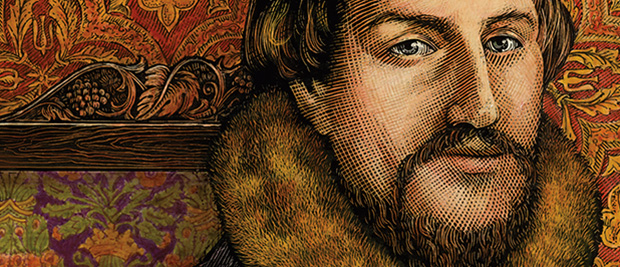
John Calvin (1509–1564) is easily the most important Protestant
theologian of all time and remains one of the truly great men who have
lived. A world-class theologian, a renowned teacher, an ecclesiastical
statesman, and a valiant Reformer, Calvin is seen by many as the
greatest influence on the church since the first century. Apart from the
biblical authors themselves, Calvin stands as the most influential
minister of the Word the world has ever seen. Philip Melanchthon revered
him as the most able interpreter of Scripture in the church, and
therefore labeled him simply “the theologian” (J. H. Merle d’Aubigné, History of the Reformation in Europe in the Time of Calvin, Vol. 7 [1880;
repr., Harrisonburg, Va.: Sprinkle, 2000], 82). And Charles Spurgeon
said that Calvin “propounded truth more clearly than any other man that
ever breathed, knew more of Scripture, and explained it more clearly” (C. H. Spurgeon, “Laus Deo,” The Metropolitan Tabernacle Pulpit: Sermons Preached by C. H. Spurgeon, Vol. 10 [Pasadena, Texas: Pilgrim, 1976], 310).
Calvin was born on July 10, 1509, to Gerard and Jeanne Cauvin in the
French cathedral city of Noyon, some sixty miles north of Paris. Gerard
was a notary, or financial administrator, for the Roman Catholic bishop
of the Noyon diocese and, thus, a member of the professional class. At
age fourteen, John entered the leading educational institution of
Europe, the University of Paris, to study theology in preparation for
the priesthood. There, he was immersed in the principles of the
Renaissance, humanism, and scholarship. A serious and remarkably learned
young man, he graduated with a master’s degree (1528). Keep Reading >>>
Monday, May 23, 2011
Friday, October 1, 2010
Subscribe to:
Posts (Atom)