The purpose of this Blog is to introduce men and women all over the World to the Doctrines of Grace; the 5 Solas; Reformation Theology and the Lord and Savior Jesus Christ.
Showing posts with label Atheism. Show all posts

Monday, April 22, 2013

Skepticism, Agnosticism and Atheism A Brief History of Unbelief

The last two years have been good for atheism. A rash of books making the case for unbelief, including Richard Dawkins' The God Delusion (2006) and Christopher Hitchens' God Is Not Great: How Religion Poisons Everything (2007), have sold millions of copies. Strident atheist Philip Pullman's The Golden Compass, one of his atheistic tomes designed to rescue children from belief in God, was made into a movie. Even pop star Elton John got into the act, calling for a ban on religion. Leaders of the so-called New Atheism are aggressive and proselytizing. They don't just condemn belief in God; they also condemn respect for belief in God. 

But how new is the New Atheism? It is said best in Ecclesiastes 1:9: "There is nothing new under the sun." To be sure, explicit and public atheism is a somewhat new phenomenon. But atheism, agnosticism, and good old-fashioned doubt have strong and lengthy histories worth learning. Because atheism is parasitic on theism and even more on Christianity, to learn the history of atheism is to learn the history of the church.


Take the New Atheist creed of "no heaven, no hell, just science," which articulates the widely held division in modern thought between faith and reason. To fully understand the story of that division, it is wise to consider the creation of the world as told in Genesis. We learn from Moses that the Creator is distinct and different from the created world. Where ancient mythologies saw gods as personifications of natural phenomena such as rain and fire, ancient Israel viewed nature as separate from God and man. God created nature and man was its steward. Nature is not to be worshiped, God alone is. Nature and the natural process in and of themselves are not divine. God, apart from a few notable exceptions, doesn't speak to his people through nature but through historic events such as deliverance from Egypt. It is wise to remember as we proceed that this separation between nature and God is a biblical precept.

We know unbelief predates Christopher Hitchens because we read about it throughout the Old Testament-in the Book of Job, Psalms, Proverbs, Ecclesiastes, and Isaiah. In Proverbs, for instance, a man questions whether anyone can know God-a charge that is refuted in the same chapter (Prov. 30:1-4); and from the psalmist we learn, "The fool has said in his heart, 'There is no God.'" (Ps. 53:1). Still, the Old Testament discussion of atheism is against an atheism that ignores God's Law and punishment more than against an outright disbelief in God.    Continue at M. Z. Hemingway

Saturday, February 2, 2013

Raising Our Children . . . Without God?

We live in a culture that is shaking its fist in rebellion against God. More and more, people in our society are choosing to abandon the Bible as the ultimate authority and embrace the self-centered, godless philosophies that the Apostle Paul warns about in Colossians 2:8:
Beware lest anyone cheat you through philosophy and empty deceit, according to the tradition of men, according to the basic principles of the world, and not according to Christ.
One of these deceitful philosophies is atheism. And in today’s culture, the atheistic worldview is being pushed not only to adults, but also to our children. At Answers in Genesis, we chose the theme for the next two years “Standing Our Ground, Rescuing Our Kids.” Why? Because secularists know that if they can win the hearts and minds of just one generation, they will win the culture.

In a recent article titled “Why I Raise My Children Without God,” the guest writer (who remains anonymous), a mother of two teenagers, explains why she no longer tells her children about God. She lists a series of objections to believing in God and attempts to defend them, and she directly states the intent of secularists to capture the coming generation: “We are creating the next generation of kids, and there is a wave of young agnostics, atheists, free thinkers and humanists rising up.” Sadly, the point of her article is to share her atheistic views and how they have affected her parenting, in the hope of influencing others in a similar way.  Continue at Steve Golden

Saturday, January 19, 2013

Teaching on Hell—Worse Than Child Sexual Abuse?

“I tell you, my friends, do not be afraid of those who kill the body and after that can do no more. But I will show you whom you should fear: Fear him who, after the killing of the body, has power to throw you into hell. Yes, I tell you, fear him.” (Luke 12:4–5)
Well, Richard Dawkins, an atheist and the author of The God Delusion, recently made a controversial statement during an interview that raising your child to believe in hell is worse than sexual abuse. Dawkins tells the interviewer, “It seems to me that telling children such that they really, really believe that people who sin are going to go to hell and roast forever … It seems to me to be intuitively entirely reasonable that that is a worse form of child abuse that will give more nightmares, that will give more genuine distress” than being sexually abused. (You can view the whole video clip on YouTube.)

Now, Dawkins is known for his extreme distaste for Christianity and the God of the Bible. But his outrageous statements in that interview show his open rebellion against God, and they stirred a lot of debate. Even some secularists have been upset with what he had to say.

Really, as I’ve said many times, Dawkins is trying to convince himself. He is, so to speak, putting his hands over his ears and yelling at God, “No, no, no! I refuse to believe.” And so, as Romans 1 tells us, he “suppresses the truth in unrighteousness.” While he is in his earthly body for such a short time (very short—compared to eternity), he wants to yell at God and essentially be his own god! But there will come a time when his earthly body will die (like everyone else), and then he will face his Creator and answer for his outright, willful rebellion. I pray for Richard Dawkins. Unless he repents, his future is one in hell for eternity, but that’s not God’s fault.    Continue at Ken Ham

Monday, December 3, 2012

A Dangerous Christmas?

It is a fact that Christianity is not a religion. It is a philosophy,” according to Bill O’Reilly. As part of his “war on Christmas” focus, the talk-show host faced off with the head of an Atheist organization in a recent interview. (For a different take, see this article from  the Washington Post.) According to his guest, government-supported celebrations of Christmas constitute the state’s privileging of one religion. If I understand him correctly (and I don’t take that for granted), Mr. O’Reilly counters the argument by suggesting that while particular denominations are “religions,” Christianity itself is not a religion but a philosophy. In fact, he takes this as a settled consensus. Oddly, he includes Judaism along with Methodism and Roman Catholicism as “religions,” although Judaism is arguably distinct from Christianity.
 
I confess that I am not a regular Fox News viewer and only catch Bill O’Reilly when friends shamelessly forward clips like these. Although the political aspect of the debate is important, my concern here is the religious aspect.

How far will some go to protect the vestiges of cultural Christianity in our increasingly secular society? Is this civil religion so deeply ingrained that we are willing to redefine the very nature and message of Christianity in the name of Christendom? Perhaps Mr. O’Reilly has given us that answer.

Could it be, ironically, that the atheist had a better idea about the nature of Christianity? To be sure, the danger of Christmas for him is mainly political, as its benefit seems to be for Mr. O’Reilly. But at least he gets that it’s about a specific religion and its central claim.

For many today, Christianity is indeed a philosophy—an ideology, a culture, and a set of ethical principles. It may come with different specifics, depending on whether it hails from the left or the right side of the aisle. However, if I may so bold, those who take this view should probably not celebrate Christmas at all.

Christianity is first and foremost an announcement that God our Creator is also our Redeemer; that “God so loved the world that he gave his only-begotten Son, so that whoever believes in him will never perish but have everlasting life” (Jn 3:16). This announcement is proclaimed in the gospel and sealed by baptism and the Lord’s Supper. It is explained in the ecumenical creeds, especially the Nicene, and shapes our common as well as private prayer, devotion, and life in the world. Christ did not come to be the world’s greatest philosopher or social reformer, but to “save his people from their sins” (Mat 1:21).   Continue at Michael Horton

Wednesday, August 1, 2012

God Is Not Dead Yet

You might think from the recent spate of atheist best-sellers that belief in God has become intellectually indefensible for thinking people today. But a look at these books by Richard Dawkins, Sam Harris, and Christopher Hitchens, among others, quickly reveals that the so-called New Atheism lacks intellectual muscle. It is blissfully ignorant of the revolution that has taken place in Anglo-American philosophy. It reflects the scientism of a bygone generation rather than the contemporary intellectual scene.

That generation's cultural high point came on April 8, 1966, when Time magazine carried a lead story for which the cover was completely black except for three words emblazoned in bright red letters: "Is God Dead?" The story described the "death of God" movement, then current in American theology.

But to paraphrase Mark Twain, the news of God's demise was premature. For at the same time theologians were writing God's obituary, a new generation of young philosophers was rediscovering his vitality.

Back in the 1940s and '50s, many philosophers believed that talk about God, since it is not verifiable by the five senses, is meaningless—actual nonsense. This verificationism finally collapsed, in part because philosophers realized that verificationism itself could not be verified! The collapse of verificationism was the most important philosophical event of the 20th century. Its downfall meant that philosophers were free once again to tackle traditional problems of philosophy that verificationism had suppressed. Accompanying this resurgence of interest in traditional philosophical questions came something altogether unanticipated: a renaissance of Christian philosophy.  Continue at William Lane Craig

See Also: A New Day for Apologetics


Saturday, June 2, 2012

20 Questions that Atheists Need to be Able to Answer

Here are some puzzling phenomena that every person should try to struggle with, and find the answers. (H/T Justin Brierley)

Here’s the full list:
1.What caused the universe to exist?
2.What explains the fine tuning of the universe?
3.Why is the universe rational?
4.How did DNA and amino acids arise?
5.Where did the genetic code come from?
6.How do irreducibly complex enzyme chains evolve?
I’m leaving out numbers 7 and 8 because they lack specificity.

9.How is independent thought possible in a world ruled by chance and necessity?
10.How do we account for self-awareness?
11.How is free will possible in a material universe?
12.How do we account for conscience?
13.On what basis can we make moral judgements?
14.Why does suffering matter?   Continue at WinteryKnight

Saturday, April 7, 2012

Communicating the Claims of Easter

The focus of my last post was the public character of the resurrection that makes the gospel rather different from the sheer power of personal assertion or experience. Here are some suggestions for communicating this central Christian claim to others—and not only at Easter! 

    Suggestions for Conversations
  1. The gospel’s effects are deep and wide, so you can start anywhere in the argument. For example, in the philosophers’ forum in Athens, Paul began by telling his Epicurean and Stoic audience that they misunderstood who God is and how he relates to the world. God is neither irrelevant and aloof from the world (contra the Epicureans) nor part of the world (contra the Stoics). Though he doesn’t depend on the world, the world depends on him and God is concerned and involved with the world he has created, governs, and saves. It’s an argument for Christian theism, showing unbelievers how they cannot even live consistently with their own assumptions unless the Triune God known in Scripture is the source of all reality. You can also begin the conversation by sharing your own experience—the difference Christ has made in your life, as long as you realize that this isn’t the gospel itself. Or you can go straight to the resurrection and work more inductively, from the most particular claim to its broader implications.
  2. On one hand, don’t assume that you and your conversation partner share the same assumptions. On the other hand, don’t assume that you don’t share any common ground. Especially to the extent that one has been shaped by the naturalistic presuppositions that dominate academic culture in our day, a claim like the resurrection will be ruled impossible at the start. Miracles do not happen because they cannot happen: that’s the a priori assumption of the deistic/atheistic worldview of today’s Epicureans. If you’re reasoning with modern “Stoics”—basically, a pantheistic worldview, the assumption will be that everything is divine and miraculous; so the idea of special divine interventions like the resurrection will seem just as foreign to New Agers as to New Atheists. Again, you can begin by exposing the irrationality and inconsistency of these worldviews and then discuss the resurrection within the context of a biblical worldview or begin with the resurrection claim. One strength of the latter approach is that the resurrection, as a historical event, disproves their worldview. Here is an event that actually happened, which their worldview cannot account for. Even if they do not accept the argument, much less trust in Christ, this can at least help to weaken their excuse that the biblical claim is nothing more than private assertion or experience, unaccountable to public debate. It can help to expose to our friend the fact that he or she is “suppressing the truth in unrighteousness”—that is, no longer rejecting the claim because of reason but because of the same irrational act of mere will that he or she had attributed to believers.  Continue at Michael Horton
IMAGE

Friday, April 6, 2012

Easter for Atheists and Skeptics

“Turn your scars into stars and your cross into a stepping stone.” Trivializations such as these have now become a staple even in many evangelical churches at Easter. 

A mainline Methodist tells the story of visiting a well-known evangelical church at Easter, hoping to hear the gospel. Waiting in anticipation, he says there was nothing in the service that pointed worshipers upward, to God and his saving deed in Christ. Perhaps it’s all in the sermon, he thought. However, his patience was not rewarded. The message was about how Jesus made it possible for us to come back from our losses even stronger than we were before. 

Just a few hours ago a friend sent me this announcement from a local church in his area for the upcoming Easter 2012 service: “Join us for two special Sundays. The Living Lord’s Supper! A live re-enactment of Da Vinci’s Last Supper featuring drama and music.” The sermon: “How Easter Can Change Your Life!” “Pastor Jack Millwood will explain how the power of Easter can change you from the inside out!…This true story (i.e., Palm Sunday and Easter) has changed the world- it can help you make the changes you want to make in your life!”

On Saturday, March 26, atheists and skeptics gathered on the Washington Mall for the “Reason Rally,” where speakers and singers mocked religion. Richard Dawkins, the movement’s pop star, called on the 20,000 gathered there to “ridicule and show contempt…publicly” for the beliefs of religious people. The movement’s organizers take pride in being the “marines” for a new war on faith. War language was all over the place<—an "onward atheist soldiers" sort of theme. As USA Today reporter Cathy Lee Grossman reported, “Outrage was the parlance of the day, however, for many speakers, including David Silverman, Reason Rally organizer and American Atheists president. He reveled in the group’s reputation as the marines of atheism, as the people who storm the faith barricades and bring ‘unpopular but necessary’ lawsuits. Silverman may have gone a bit further in his rhetoric than he intended. In a thundering call for ‘zero tolerance’ for anyone who disagrees with or insults atheism, Silverman proclaimed, ‘Stand your ground!’”   Continue at Michael Horton

Friday, March 16, 2012

Atheists Cower in Fear of Creation Museum

The Budget Travel website recently started a contest asking people to vote on the top 15 places that kids should see before they turn 15. The Creation Museum started well. When I first saw the site, it was ranked first with about 640 votes and about 80 positive comments. Well, word got out to popular atheist PZ Myers and on Wednesday morning (2/15/12), he encouraged his blog readers to visit the site and start voting on this “awful poll” for any tourist attraction that had a chance of beating the Creation Museum (which had slipped to #2 by the time he posted). His readers (one person called them the PZombies) immediately followed his advice and started voting.

I don’t have a problem with anyone voting in the poll. They have every right to do it, and there are some fabulous places that a person can vote for in addition to the Creation Museum. However, it’s the behavior of many of these atheists that is so enlightening. As I am typing this, there are eleven fake names that have been added to mock the Creation Museum, such as the Creation Tower of Jesus, Creationism & Fairy Tales Museum, and the Creation Museum of Child Indoctrination Anti-Intellectualism.

Those fake names are the least of my concerns, although they show the immaturity of some of these atheists (for the record, I don’t believe PZ Myers encouraged his readers to add these to the list). What is far worse are the numerous comments that have been added to the Creation Museum’s link for voting. Over 500 comments have been made about the Creation Museum, but by my count, no more than 13 comments exist for any other place. The first 50 or so comments were overwhelmingly positive for the museum. That was until the atheists arrived. It’s certainly okay for people to express their opinions, so I’m not calling on anyone to ban these folks from the site. I want to use this as an example to point out their utter hypocrisy and their irrational fear of biblical creationists.   Continue at Tim Chaffey

Wednesday, December 28, 2011

At Last! Someone With a Backbone!

I needed some post-Christmas cheer, and I have an Air Force Base commander to thank for giving it to me.

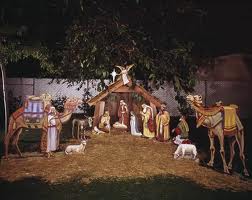
As you'll see from this Christian Post article, the commander in question basically told a group of militant atheists to go pound sand when they demanded he take down a Nativity scene erected at the base.

I'm glad, and three cheers to the Air Force. I agree with his assessment of the Constitution, and I would even go farther than him.

It never ceases to irritate me when I consider how the courts and modern politicians have distorted the so-called Establishment Clause beyond recognition. All this provision of the Constitution was intended to do was to prevent Congress from establishing a state religion, with the Church of England as a comparative example. Congress shall not "establish a religion, nor PREVENT THE FREE EXERCISE THEREOF." That's all it means. No more, no less. It was never intended to ban Nativity scenes or anything of the sort. A Nativity scene is not establishing a state church.

If our Founding Fathers were still alive—men who might actually know a little something about the Constitution because they wrote it—they would be aghast at what today's courts and politicians have done. And someone would get quite the lecture.

As a final aside, I can't help but be amused a bit with militant atheists. They're so threatened by something in which they claim not to believe. Some atheists I know personally actually share my opinion, finding it amusing as well. 

HT: 7thsola

Thursday, December 22, 2011

My Take: Kim Jong il and the Danger of Deifying Leaders

Editor's Note: R. Albert Mohler, Jr., is president of The Southern Baptist Theological Seminary, the flagship school of the Southern Baptist Convention and one of the largest seminaries in the world.
 
By R. Albert Mohler, Jr., Special to CNN

There are no atheists in dictatorships. The death of North Korea’s “Dear Leader” Kim Jong il underlies a basic fact of earthly politics: when a political regime denies any transcendent supernatural reality, it deifies itself.

The communist regime that has been in control of North Korea for over half a century is officially atheistic, following the example of its first protector state, the Soviet Union.

Like the Russian communists, the North Koreans sought to expunge any trace of Christianity or other religious faiths. But make no mistake, this does not mean that the Pyongyang regime did not believe in worship.

To the contrary, the North Korean regime mandated worship, the worship of its own supreme leader.

As Cold War historian John Lewis Gaddis explained, North Korea’s founding dictator Kim Il Sung “was allowed to build a Stalinist state, with its own cult of personality centered on himself, at just the time when Khrushchev was condemning such perversions of Marxism-Leninism elsewhere.”  Keep Reading >>>

Saturday, November 26, 2011

'Tis the Season in Which We Celebrate America's Christian Heritage

One of our local radio stations is already playing Christmas music full-time. It’s amazing how many songs have been written about Christmas. Most of them are secular, but the most common message they convey is one of family joy, of children and Santa Claus, of remembrance of all the Christmases we enjoyed in the past with loved ones who are no longer with us.

So despite the attempts by atheists to ban Christianity from American public life, particularly in the public schools, they cannot eradicate Christmas from family life, let alone the shopping malls. As anyone can see, Christmas has acquired great economic power. And that is because Christianity is at the foundation of our spiritual life and political system.

Secular humanism tries to give the impression that Christianity was just a passing phase in American history, and that our culture is advancing into a new secular religion more in keeping with modern values. But the humanist movement cannot remove the need in people’s lives for attachment to their Creator. In recent years we’ve seen a revival of religious fervor in America, particularly in the South where mega-churches have been built to accommodate the large numbers of people who need all the spiritual nourishment they can get.

Everybody seems to recognize that our modern civilization is in very big trouble. We have a national debt in the trillions of dollars. We are at war with radical Islam. We have a socialist regime in Washington at odds with our constitutional form of government. Our technological advances are astounding, yet we have mobs in the streets calling for the end of capitalism, the very system that created all of these goodies.

Perhaps a refresher course in American history and our Christian roots is needed to strengthen our convictions of how the American people should go about reconstructing their future. Getting people to live in obedience to the Ten Commandments has always been an uphill battle, even in colonial times.

Paul Johnson, a great admirer of the American system of political and religious freedom, wrote in his book, A History of the American People: "There was a spiritual event in the first half of the 18th century in America, and it proved to be of vast significance, both in religion and in politics."

He is referring to the Great Awakening, a religious revival started by impassioned preachers determined to bring as many souls as possible to the saving grace of Jesus Christ.  Keep Reading >>>

Thursday, September 1, 2011

The Limits of Science

The kind folks at Evangelical Press sent me this book to review: Is God Past His Sell-By Date by John Blanchard.  It is a shorter version of his award-winning Does God Believe in AtheistsThe former is around 230 pages while the latter is around 650.  Is God Past His Sell-By Date is intended for skeptics, people who doubt or question the Christian faith, the existence of God, the person/work of Jesus, and so forth.  The book mostly deals with creation, humanity, evil, science, suffering, and the gospel.  Even though I’m not a skeptic, this book helped me think through some of my own doubts and questions I have about life in general as well as the Christian faith.  At the end of each chapter there is a short testimony written by different Christians who used to be skeptics.  I appreciated these testimonies; they were “real life” examples of how God brings people out of doubt and into [the] faith.

One section that stands out for me is where Blanchard discusses the limits of science (p. 64-5).  Drawing on several scientists themselves, he lists the following limits (which I’ve edited for the sake of space):

1) Science can tell us nothing about why the universe should have come into being.  It cannot answer the question that Stephen Hawking asked (and could not answer himself): “Why does the universe bother to exist?”   Keep Reading...

Saturday, August 27, 2011

A Laboratory for Christianity’s Destruction

As the BBC reports, some church leaders in the Netherlands want to transform their small nation into a laboratory for rethinking Christianity — “experimenting with radical new ways of understanding the faith.”

Religious Affairs Correspondent Robert Pigott tells of Rev. Klaas Hendrikse, a minister of the PKN, the mainstream Protestant denomination in the Netherlands. Pastor Hendrikse doesn’t believe in life after death, nor even in God as a supernatural being. He told the BBC that he has “no talent” for believing historic and orthodox doctrines. “God is not a being at all,” he says, but just an experience.

Furthermore, as Pigott reports, “Mr. Hendrikse describes the Bible’s account of Jesus’s life as a mythological story about a man who may never have existed, even if it is a valuable source of wisdom about how to lead a good life.”

By any normative definition of Christian belief, Klass Hendrikse is an unbeliever, but in the largest Dutch denomination, he is considered a minister in good standing. As a matter of fact, he is not even unusual. A study undertaken by the Free University of Amsterdam determined that about one of every six Protestant ministers is either agnostic or atheist.   Keep Reading...

Tuesday, August 2, 2011

A Vulnerable Moment for a Well-known Atheist

During the 1950s and ’60s, evangelist Charles Templeton preached to large crowds. He was a close friend of Billy Graham and, many believed, a better preacher. But Charles was plagued with nagging doubts about the reliability of the Bible, specifically the Genesis account of creation. Feeling unable to stand under the strain, Templeton made the sad decision to bid farewell to God.
 
Many years later, investigative reporter, Lee Strobel interviewed Charles Templeton. It is one of the most powerful interviews I have ever heard.

Although advanced in years, Templeton maintained his rejection of the Bible. But when Strobel asked a question about Jesus Christ, he noted a clear change in Templeton’s body language. With softened posture and a “melancholy and reflective tone,” Templeton spoke of Jesus with a deep admiration. Keep Reading...

Tuesday, October 12, 2010

The Great Exchange: Replacing the Glory of God for a Lie

How do we account for this mysterious reality where the great majority of men and women even amongst those who profess the name of Christ are indifferent towards the presence of God? Is it perhaps because they are uninformed? Or because of sheer ignorance?
Will that work however? When before the judgment seat of Christ is it possible for us to plead ignorance? When our time comes to die and we stand before the thrice holy God, in giving a defense to how we lived our lives—how self-absorbed we are, our reveling in sin and our putting of ourselves on the throne of our lives, can we say, “I did not know You were there”?
Can we come before the Lord of Glory, the one true living God and cry out before Him, “God, you did not do enough to reveal yourself to me!”
Is that true? Has God truly not done enough? May it never be! Continue Reading>>>