It is a disturbing fact that the most vigorous form of
anti-trinitarianism currently on the market is to be found within the
sphere of conservative evangelicalism. In the nineteenth century, the
dominant variety of anti-trinitarianism was the old-world Unitarianism
which found fertile soil in America. (See Earl Morse Wilbur, A History of Unitarianism: Socinianism and its Antecedents (Cambridge: Harvard University Press, 1945); for the stream of American theology I am here calling liberal, see Gary Dorrien, The Making of American Liberal Theology: Imagining Progressive Religion 1805-1900 (Louisville: Westminster/John Knox, 2001) and The Making of American Liberal Theology: Idealism, Realism, and Modernity 1900-1950 (Westminster/John
Knox, 2003). For evangelical Christians of a conservative temperament,
Unitarianism as a theological movement was as easy to ignore as any
version of liberal theology. It offered a pervasively non-supernatural
interpretation of Christianity, and thereby rendered itself irrelevant
to churches which were committed to a range of traditional doctrines
such as incarnation, atonement, miracle, revelation, the inspiration of
scripture, and heaven and hell. Continue at Fred Sanders
Showing posts with label Liberal Theology. Show all posts
Showing posts with label Liberal Theology. Show all posts
Monday, May 12, 2014


Tuesday, August 20, 2013
How to Spot a Liberal Seminary
Airport security seems to have surrendered common sense as a weapon
in the war against terror. In a desperate attempt to appear politically
correct and unbiased toward Arab Muslims, the TSA eschews profiling
techniques. Profiling is when a person is singled out based on certain
traits that they have in common with previous terrorist attacks. For
example, the 9/11 bombers were all young, single, Arab, Muslim, males.
 The
lack of profiling begets some silly scenarios, as when a soldier
traveling with his platoon in full uniform had his nail clippers
confiscated…but not his gun. Or, the case in February 2011, when Alaska
State Representative, Sharon Cissna refused to allow the TSA to inspect
the scars of her mastectomy surgery. She was barred from boarding the
plane because common sense might look like bias, even though it is an
undisputed fact that no lady’s prosthetic breast (or nail clippers for
that matter) have ever been used in any assault on land, air, or sea.
On the other hand, if profiling had been allowed, perhaps they would
have prevented what happened on Northwest Airlines flight 253 on
Christmas Eve 2010 when Umar Farouk Abdul-mutal-lab, a 23 year told,
single, Muslim male, who paid cash for a one-way ticket, and checked no
luggage, cruised through airport security without any hassles. But when
the plane was in flight, he promptly activated the explosives stashed
in his underwear. Fortunately, instead of exploding, his underwear just
caught on fire. Three passengers incapacitated him (while, as I imagine,
children nearby chanted “Liar, liar…”). Continue at Clint Archer
Thursday, March 17, 2011
We Have Seen All This Before: Rob Bell and the (Re)Emergence of Liberal Theology

Protestant Liberalism emerged in the 19th century as influential theologians argued for a doctrinal revolution. Their challenge to the church was simple and straightforward: The intellectual challenges of the modern age made belief in traditional Christian doctrines impossible. Friedrich Schleiermaher wrote his impassioned speeches to the “cultured despisers” of religion, arguing that something of spiritual value remained in Christianity even when its doctrines were no longer credible. Church historians such as Adolf von Harnack argued that a kernel of spiritual truth and power remained even when the shell of Christianity’s doctrinal claims was removed. In the United States preachers such as Harry Emerson Fosdick preached that Christianity must come to terms with the modern age and surrender its supernatural claims.
The liberals did not set out to destroy Christianity. To the contrary, they were certain that they were rescuing Christianity from itself. Their rescue effort required the surrender of the doctrines that the modern age finds most difficult to accept, and the doctrine of hell was front and center on their list of doctrines that must go. Read the rest HERE
Saturday, March 5, 2011
The Making of American Liberal Theology
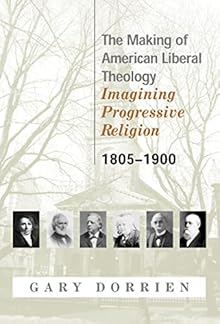
The Making of American Liberal Theology Imagining Progressive Religion 1805-1900 (WJK 2001) is the first volume of Gary Dorrien’s magisterial three volume series on the history of American liberalism. I don’t know much about Dorrien except that when he began the series he was at Kalamazoo College and now he is at Union Theological Seminary. From what I’ve read (and I did not read every page), he is sympathetic to liberalism (hence the position at Union), but also fair and clear. I doubt that many evangelicals need to read these volumes, but some pastors and students may want to have them as reference material on their shelves.
So what is liberalism?
Like any “ism” it’s diverse and not easy to define. But certain characteristics shine through in Dorrien’s narrative. For the sake of historical accuracy and for the sake of spotting recurring themes in the contemporary church, it’s important to understand something about the basic themes of liberal theology (note: the headings are mine, all the indented text is from the book).
1. True religion is not based on external authority Keep Reading>>>
Thursday, December 17, 2009
Subscribe to:
Posts (Atom)