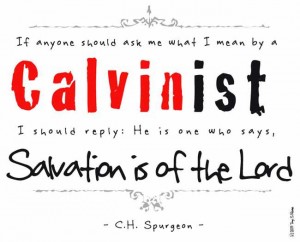
Packer begins his defense of divine
sovereignty in salvation by appealing to what he believes is, or at
least should be, an evangelical consensus on the practice of prayer. He
appears to assume that no one who embraces a high view of Scripture
could possibly think otherwise. It is more than simply that we pray, but also how and what we specifically ask God to do that Packer believes supports his understanding of the activity of God in saving a human soul. Continue at Sam Storms
Scriptures teach consistently that faith comes through the proclamation of the gospel, not through good works. Christ himself was not arrested and arraigned because he was trying to restore family values or feed the poor...The mounting ire of the religious leaders toward Jesus coalesced around him making himself equal with God and forgiving sins in his own person, directly, over against the temple and its sacrificial system. Michael Horton
The purpose of this Blog is to introduce men and women all over the World to the Doctrines of Grace; the 5 Solas; Reformation Theology and the Lord and Savior Jesus Christ.
Showing posts with label Evangelism. Show all posts
Wednesday, May 28, 2014
Praying for God to Save the Lost
Monday, May 19, 2014
False Conversions, Manipulation & the Solution
Much debate surrounds the biblical commands to
evangelize and disciple. Unfortunately, many drift to one side of the
spectrum or the other, leaving an unhealthy imbalance. On one hand, a
particular church emphasizes evangelism to the neglect of discipleship.
The lack of discipleship will inevitably lead to a spiritually anorexic,
toxic, and disappointed family of God. On the other hand, the church
who trivializes evangelistic efforts and endeavors will soon face
stagnation, legalistic tendencies, and no growth.
Coupled in with these few depictions of philosophies are the
overwhelmingly brutal comments, attacks, misrepresentations, and
presuppositions about each other. Fighting, arguing, and bickering will
only cause us to self-implode, while a lost and depraved world enjoys
the show. Continue at Eric Fuller
Saturday, April 5, 2014
The Mercy-Ministry Mandate: Stopping Short of Real Mercy
The current mercy ministry ideology was summarized in an article recently:
“Seeking holistic thriving helps us keep the created dignity of those we serve at the heart of our efforts—.”
There it is! The preservation of the ‘created dignity’ of sinful man
is not only deemed possible without calling men to repentance and faith,
but is viewed as “the heart” of the church’s mission to the culture.
Instead of gospel-proclamation, the holistic thriving of society is
advanced by scores of people who apparently no longer believe that
man’s primary need is reconciliation with God. Helping our communities
achieve sociological and psychological wholeness seems the new
definition of Christian compassion. Continue at Jerry Wragg
Saturday, March 8, 2014
15 Pointers for Preachers
-
Preach doctrinally. Don’t only teach Bible doctrines such as justification and sanctification in your Sunday school. Preach these doctrines also during your worship service.
-
Preach discriminatorily. Address both believers and unbelievers in your preaching. Don’t assume that everyone in your congregation is saved. But don’t think either that no one is saved.
-
Preach applicatorily. Apply your text to your listeners. With the use of practical illustrations, help them apply your message to their daily life. Remember a sermon without an application is like a lecture. You are preaching, not lecturing.
-
Preach clearly. Organize your thoughts. Avoid high-sounding words. Consider the children in your congregation. If you have to employ a big word (e.g. justification), explain it using simple words.
Preach evangelistically. Yes, preach against sin, but don’t stop there. Preach about salvation too. If you preach the Law without the gospel, you will make your congregation despair. Further, don’t think that the gospel is only for unbelievers. Believers need it as well for their sanctification. Continue at Biblical Spirituality
Wednesday, October 23, 2013
Calvinism and the Roots of the Missionary Movement
Over at Kevin DeYoung’s blog, Jason Helopoulos asks “Does Calvinism Kill Missions?”
and answers with a resounding historical ‘no.’ I agree, and want to
put a little finer point on it: from the perspective of Baptist history,
Calvinists birthed the missions movement. (For background on Calvinism/Arminianism in the Baptist context, see links below.)
I’ve recently been reading Jason Duesing’s fascinating volume Adoniram Judson: A Bicentennial Appreciation of the Pioneer American Missionary,
which has a great deal of fresh information on the celebrated Baptist
missionary Judson and his context. I was particularly intrigued by
Robert Caldwell’s essay on the “New Divinity” theology and Judson’s
preparation as a missionary. The New Divinity theologians, heirs of
Jonathan Edwards such as Joseph Bellamy and Samuel Hopkins, argued that a
right understanding of Calvinism would prompt activism for the gospel.
The New Divinity helped to birth important reform movements such as
antislavery advocacy and the American missions movement. (English
Calvinist Baptists such as William Carey also spearheaded the British
missionary initiative.) Continue at Thomas Kidd
Thursday, October 3, 2013
I Have Decided to Follow Jesus…Maybe
The unfortunate answer is that they were never born again (cf. 1 Jn 2:4-6).
Folks proclaim regularly in their testimony of conversion that “I asked
Jesus into my heart in grade school, but never got serious about
Christianity until twenty years later when I dedicated my life to Him
after a serious issue in life.” Continue at Parker Reardon
Thursday, July 4, 2013
Does Calvinism Kill Missions?
It is often asserted that Calvinism creates a barrier to evangelism
and missions. The accusation usually comes in the form of questions. How
could those who believe the Scriptures teach predestination and
election truly have a heart for missions? If God has determined who
shall be saved, why would there be any need to engage in evangelism or
missions? And yet, we can safely say that this is an argument lacking
historical proof (and theological basis).
It must be acknowledged that Calvinists have not only robustly
encouraged, engaged, and propagated missions, but have led some of the
great mission’s and evangelistic movements in the history of the church.
Even a cursory glance at the history of missions and missionaries
produces a hall of fame filled with Calvinists. It could rightly be
argued that Calvinism is not only not a barrier to missions and evangelism, but has actually proven to be a spur to
missions and evangelism. In fact, it has often been the driving force
in missions. This is just a sampling of the history of missions and some
notable Calvinists, who have led the way into foreign fields. One
doesn’t have to be a thorough going Calvinist to be struck by the impact
of Calvinism upon missions.
- John Calvin: Calvin sent missionaries from Geneva into France and as far away as Brazil. Most of these young men sent to France died a martyr’s death, but the church of Geneva continued to send them.
- John Eliot: A missionary sent to the American Indians in the 1600′s. He is believed to be the first missionary among this people group. As many have said, if William Carey is the father of the modern mission’s movement, then John Eliot is its grandfather. Continue at Jason Helopoulos
Wednesday, February 13, 2013
Toxic Charity
There is some of the missionary in every Christian. As the Lord
extends to us the ability to trust in him and as he begins that work of
transforming us from the inside out, he gives us the desire to share our
faith with others and to extend his love to them. Since the church’s
earliest day this desire has motivated Christians to leave behind all
they know and to travel to the earth’s farthest reaches. A relative
newcomer on the scene is the short-term missions trip and other similar
means through which Christians can participate on a part-time basis as
“vacationaries.” Such ministry is the subject of Robert Lupton’s Toxic Charity.
Toxic Charity
is a book about doing missions right. The subtitle pretty much lays it
out: “How Churches and Charities Hurt Those They Help (And How to
Reverse It).” Lupton honors the mindset that compels Christians toward
foreign short-term missions and inner-city projects at home, but
believes that the church has failed to ask simple questions like these:
Who is really benefiting? Who are we really seeking to serve? Is it the
poor and those in need, or are we primarily serving ourselves? He
contends that “what Americans avoid facing is that while we are very
generous in charitable giving, much of that money is either wasted or
actually harms the people it is targeted to help. …The compassion
industry is almost universally accepted as a virtuous and constructive
enterprise. But what is so surprising is that its outcomes are almost
entirely unexamined.” Continue at Tim Challies
Thursday, November 29, 2012
John Calvin, Missionary and Church Planter
So long as some Christians have called themselves Calvinists, other
Christians have probably alleged that Calvinists care little about
evangelism, missions, and church planting. The critique isn't new. But
only recently have we learned the extent of the zeal and effectiveness
of the early reformers in evangelism, missions, and church planting.
Elias Medeiros, Harriet Barbour professor of missions at Reformed
Theological Seminary in Jackson, Mississippi, will lead a workshop on The Reformer's Commitment to the Propagation of the Gospel to All Nations at TGC's National Conference in April, likely presenting this wider understanding.
But in this short article, I want to give a small taste of John
Calvin's missionary and church planting zeal in particular. If you want
to get a sense of Calvin's theology of missions and activity, you can
read Calvin's sermon on 2 Timothy 1:8-9, "The Call to Witness," Herman J. Selderhuis's John Calvin: A Pilgrim's Life, and Frank James III's series of lectures, The Calvin I Never Knew.
From these works, I have compiled several fascinating, surprising, and
convicting facts about the missionary and church planting movement John
Calvin launched in France and throughout Europe.
Calvin, Equipper and Sender of Missionaries
In the 1550s the population of Geneva doubled as refugees, many of
them from France, poured in. Many of them sat under Calvin's preaching
five times each week.
They heard sermons like this one on 2 Timothy 1:8-9, where he said:
If the gospel be not preached, Jesus
Christ is, as it were, buried. Therefore, let us stand as witnesses, and
do him this honor, when we see all the world so far out of the way;
and remain steadfast in this wholesome doctrine. . . . Let us here
observe that St. Paul condemns our unthankfulness, if we be so
unfaithful to God, as not to bear witness of his gospel; seeing he hath
called us to it. Continue at John Starke
Tuesday, November 6, 2012
A Calvinist Evangelist?
If I have heard it once, I’ve heard it a thousand times:
“A Calvinist evangelist? Isn’t that an oxymoron? Calvinism undermines
evangelism.” This accusation has been repeated so many times that few
make the effort to argue it. Instead, it is simply assumed. Never mind
that some of the church’s greatest evangelists have been Calvinists. One
need only be reminded of men such as George Whitefield, David Brainerd,
or “the father of modern missions,” William Carey. “Yes,” we are told,
“these men were great evangelists and Calvinists, but that is because
they were inconsistent.” But is this true?
The fact of the matter is that Calvinism is not inconsistent with
evangelism; it is only inconsistent with certain evangelistic methods.
It is inconsistent, for example, with the emotionally manipulative
methods created by revivalists such as Charles Finney. But these
manipulative methods are themselves inconsistent with Scripture, so it
is no fault to reject them. In order for evangelism to be pleasing to
God, it must be consistent with the whole system of biblical teaching.
But what does such evangelism look like?
A classic answer to that question is found in R.B. Kuiper’s little book God-Centred Evangelism.
This book surveys the entire biblical scope of teaching on the subject
of evangelism. Kuiper defines evangelism quite simply as “the
promulgation of the evangel.” It is, in other words, the proclamation of
the gospel. Kuiper explains that his book “is a plea for God–centered,
in contradistinction to man-centered, evangelism.” The book, then,
presents a theology of evangelism. Continue at Keith Mathison
Friday, October 19, 2012
Five Big Myths About Calvinism
Even now, I have no desire to be a Calvinist in the Corinthian sense
of the word – a follower of John Calvin, per say. Though I believe
Calvin was a tremendous expositor of the Scriptures and had many great
insights, I am not someone who believes he was in any way infallible. I
am with Spurgeon who declared, “There is no soul living who holds more
firmly to the doctrines of grace than I do, and if any man asks me
whether I am ashamed to be called a Calvinist, I answer – I wish to be
called nothing but a Christian; but if you ask me, do I hold the
doctrinal views which were held by John Calvin, I reply, I do in the
main hold them, and rejoice to avow it.” (C. H. Spurgeon, a Defense of
Calvinism) Continue at John Samson
Monday, October 1, 2012
Evangelism Starts at Home
No doubt about it, the boy's life had been rough. In his ten years,
he had known more suffering than the camp counselor had seen in her
whole life. He was unable to live at home because of the regular abuse
he suffered there. No wonder, then, that the counselor was looking for
reasons to hope wherever she could find them. With relief, the young
woman shared with the rest of us the conversation she had had with this
child. When she had asked him if he had ever "asked Jesus into his
heart," he had replied that, yes, he had done that when he was six.
Then, as they had flipped through the pages of the boy's Bible, they had
come upon a picture of the crucifixion. The boy had paused to look.
"What's that story about?" he had wanted to know. He evidently did not
know that Christ had died on a cross. I found myself wondering how this
boy could have any idea of how the death of Christ applied to him if he
did not even know the basics of the crucifixion story. The counselor's
confidence, however, was unshaken. The child had asked Jesus into his
heart when he was six, so he certainly must be saved.
This child
had not been raised in a Christian home with the benefit of Christian
instruction. However, children growing up in our churches often reveal a
similar lack of understanding regarding the biblical gospel.
Certainly
our church children know the crucifixion story. But could they give
any kind of clear (even if simple) explanation of what it has to do with
them? I have worked with children of elementary and junior high age
for many years, almost all of them from Christian homes. It might
surprise you to listen in when I ask these children about the gospel.
The conversation usually goes something like this.
Me: "What do we need to do to be right with God?""How does that help? What does Jesus dying on the cross have to do with your sins?" That is often as far as the conversation can go. From this point on, the child will usually keep repeating that Jesus saves us from our sins and we need to accept him into our hearts. Very rarely can an elementary or junior high student explain to me that Jesus died in our place, to take the judgment of God our sins deserved. Almost never do I find a child who understands that Jesus also lived in our place, fulfilling God's commands since we could not. My consistent experience has been that children raised in Christian homes and Christian churches do not clearly understand the gospel. Yet it is the gospel God uses to save people of whatever age. Our church children, like everyone else, must understand the gospel. Continue at Starr Meade
Child: "Ask/accept Jesus into our hearts."
Me: "What does that mean? How does that help?" The child often falls silent at this point and cannot go on.
Or, I might ask: "Why did Jesus come to earth?"
"To save us from our sins."
"How did he do that?"
"He died on the cross to save us from our sins."
Tuesday, June 19, 2012
SEVEN REASONS WHY CALVINISTS BELIEVE IN EVANGELISM
1) Because God has commanded it. The gospel is to preached to every creature (Mark 16:15). This is why Calvinists have been at the forefront of missionary endeavor. The man acknowledged as "the Father of Modern Missions" was William Carey, and William Carey was a Calvinist. If a missionary (strictly speaking) is someone who leaves his homeland to preach the gospel elsewhere, then John Calvin qualifies as a missionary. Spurgeon said of him: " John Calvin…is looked upon now, of course, a theologian only, but he was really one of the greatest of gospel preachers. When Calvin opened the Book and took a text, you might be sure that he was about to preach "Through grace are ye saved, and that not of yourselves, it is the gift of God." (MTP 14:216) Even if we had no other reason, we would still evangelize…because it is a clear command from God.
2) Because we believe that God has ordained the means
of bringing many sons to glory as well as the end. Hyper-Calvinists believe He
has ordained the end but not the means, non-Calvinists
believe that He has ordained the means but not the end, Calvinists
alone consistently take the balanced view that He has ordained both. If
we don't evangelize, someone else rightly will. Calvinists believe as much in
man's responsibility as they do in God's sovereignty.
3) Evangelism gives Calvinists the glorious opportunity to
praise the God whom they believe unconditionally elected them to salvation. We
love to preach the gospel in all its fullness. Just to recount the old, old
story of Jesus and His love thrills our soul and leads us to praise His name. We
glorify God when we proclaim the gospel. Continue at Colin Maxwell
Friday, June 1, 2012
Works and Words: Why You Can't Preach the Gospel with Deeds
When it comes to the enduring
question of word versus deed in the Christian's calling, the issue is
always one of balance. How are Christians to think about the relative
roles of words (proclaiming the gospel) and deeds
(loving action) in what Christ has called his people to be and do? We
need to set our scales to a balance that matches Scripture.
"Balance" may sound simple, but finding and maintaining
our equilibrium on such a complex subject is never easy. It's like
walking a tightrope. Only one direction will keep us upright and moving
forward, and any number of missteps could lead us to fall off one side
or the other. Misguided claims abound. Here's a prominent example.
How often do we hear these days, with passion and
approval, the famous dictum attributed to Francis of Assisi: "Preach the
gospel at all times. Use words if necessary"? In this saying, the
word-versus-deed question rears its head, stressing in this instance how
important it is for Christians to "preach the gospel" with their
actions. Let the gospel be seen rather than spoken, it's implied. Words
may serve a useful backup role, but our actions must take center stage
if we are to make a difference in the world.
At first blush, this sounds right. Except that it isn't.
According to those who know the relevant history
well—the Franciscans—Francis never uttered these words. But more
important, on its face this dictum represents a significant error. It's
simply impossible to preach the gospel without words. The gospel is
inherently verbal, and preaching the gospel is inherently verbal
behavior.
But perhaps we should lighten up, we may say. Let us
view the phrase as a mere aphorism and avoid pressing its language too
literally. According to this reading, the saying is a rhetorical trope
designed to emphasize the importance of backing up our gospel words with
Christ-following lives. Continue at Duane Litfin
Tuesday, May 8, 2012
Getting John 1:12 Right: Should You Invite Jesus Into Your Heart?
Author: Jim Elliff from an article found here:
Is it useful to critique any person’s or ministry’s method of
evangelism? For one thing, there are not enough people calling on others
to follow Christ. Should I attempt to cripple their efforts in the
slightest way, even for the few who might listen to me? I hope I will
not. I would rather think that I’m improving our evangelism. And it does
need improving.
The apparent results of the method of evangelistic appeal built upon
the verse in question (John 1:12, along with Rev. 3:20) surely cannot be
argued with. I think I could say with ease that almost all the
evangelistic results coming out of America are rooted in a method that
emerges from the problematic view of John 1:12 which I will unfold. One
campus organization whose workers almost always use this verse, with
what I believe is an errant understanding of it, claims that tens of
thousands are won to Christ each year through their multiple worldwide
ministries. I’ve known many involved in this ministry, and can attest to
the sincerity of these workers, and their willingness to be bold for
Christ. Surely the majority of evangelistic workers cannot be wrong.
Surely pastors who have taught this particular view cannot be in error.
At least from the ad hominem side of the argument, I’m going to look
pretty silly if I’m opposing such faithful people and am in error
myself. So, I’ll tread gently. I’m talking to friends who care as
strongly as I do about good evangelism. Continue at John Samson
Friday, May 4, 2012
Calvinism & Evangelism
“We must have the heathen converted; God has myriads of His elect
among them, we must go and search for them somehow or other.” – C. H.
Spurgeon
Some say that Calvinism kills all zeal for evangelism. History, of
course, tells us a very different story. Someone sent me the following
few paragraphs:
As Mitch Cervinka explains: One needs only examine Protestant history
to see that Calvinists have been on the forefront of evangelism and
missions. George Whitefield was outspoken in affirming all five points
of Calvinism, yet he was one of the most zealous and effective
evangelists of the Great Awakening. Wherever he traveled, both in
England and America, people would turn out by the thousands to hear him
preach in the open fields.
The modern missionary movement began in 1792 when the Calvinistic
Baptist, William Carey, left England to minister the gospel in India.
With the help of William Ward and Joshua Marshman, he founded 26
churches and 126 schools, and translated the Bible into 44 languages
including Sanskrit. Continue at John Samson
Tuesday, April 17, 2012
Is Calvinism Anti-Missionary?
In the March issue of Credo Magazine, “Make Disciples of All Nations,” we interviewed Kenneth Stewart, Professor of Theological Studies at Covenant College and the author of Ten Myths About Calvinism (IVP). Here is what Ken had to say about Calvinism and Missions…
Calvinism is largely anti-missionary. True or False?
It is historically false. Surprisingly,
the charge that it is true seems to have grown up especially since 1960
when it was given respectability by the Southern Methodist University,
Perkins School of Theology professor W. Richey Hogg. More recently, the
charge has been repeated by the late historian of Southwestern Baptist
Seminary, William Estep and the evangelical apologetics writer, Norman
Geisler. A better knowledge of mission history would have kept them
from making this indefensible claim.
What about the Reformers? Did Luther, Calvin, and others care about evangelism and missions?
In the sixteenth century, transoceanic
missionary activity required both a supportive monarchy and a national
program of overseas expansion. As neither Switzerland nor Saxony were
maritime nations, their transoceanic missionary efforts awaited
developments beyond their control. Until those developments came,
Lutheranism concentrated on the missionary penetration of adjacent
territories (Poland, the Baltic countries and Holland). Swiss Reformed
missionary penetration of Holland, France and Hungary ran along similar
lines. And it was just as perilous work as missions to the tropics.
Many may be unaware that several “Genevan Calvinists” sought to take the gospel to Brazil. Who were these men and what is their story?
In the 1550’s, largely-Catholic France
(which was itself playing colonial catch-up with neighboring Spain and
Portugal) determined to try an adventure in South American colonization.
Though they were unwelcome there (given the prior Spanish and
Portuguese division of the continent) they focused their energies on an
island off Brazil’s coast. But not enough French Catholics were willing
to go on the colonial adventure and so Huguenots were welcomed (Genevans
among them). These made a serious attempt to evangelize the aboriginal
peoples on the Brazilian coast before being ordered home by the
unsympathetic colonial governor. Continue at Matthew Barrett
Friday, February 24, 2012
Iran Sentences Pastor to Execution for Converting to Christianity
The Story: Iranian pastor Youcef Nadarkhani faces
imminent execution for charges of abandoning Islam and refusing to
recant his Christian faith, the American Center for Law and Justice reports.
The 34-year-old husband and father of two, whose case was temporarily
delayed in December, may now be executed at any moment without warning,
according to a new---and apparently final---trial court verdict.
Unfortunately, many of the details surrounding the case remain unclear.
The Background: Pastor Nadarkhani's clash with the
Iranian government began in 2006 when he was briefly imprisoned on
charges of apostasy and evangelism. In 2009 he was arrested for
protesting mandated Islamic instruction in his son's school. This
charge, however, was soon changed to fit his original "crimes" of
apostasy and evangelism.
Nadarkhani was sentenced to death in September 2010 but proceeded to
remain alive in prison. In July 2011, his lawyer received a written
verdict from the Iranian Supreme Court, which upheld the death sentence
yet included a provision for annulment should the pastor recant his
faith. In September 2011, the Commission on International Religious
Freedom and even President Obama issued statements denouncing Iran's
egregious human rights breach and demanding Nadarkhani's immediate
release. Continue at Matt Smethurst
Saturday, February 11, 2012
Evangelism and the Extent of the Atonement
At the time in my spiritual life when I began to embrace the
doctrines of grace, the one that was hardest to swallow was the L in our
beloved TULIP acronym: limited atonement—or perhaps better stated
(though ruining the acronym): particular redemption, or definite
atonement. To make a long story short, I eventually came to see that the
doctrine was biblical. Both the intent and extent of the atonement was
divinely ordained to infallibly secure the salvation of all those whom
the Father had chosen from before the foundation of the world (John 6:39; 10:11, 14–15; Ac 20:28; Eph 5:25).
Jesus’ death didn’t simply make salvation possible, and then leave the
appropriation of the cross’s benefits to the sovereign will of the
sinner. No, it actually purchased the salvation of God’s elect (1Pet 2:24; Rev 5:9).
Interestingly, one of my chief objections
to the doctrine wasn’t so much on textual or exegetical grounds. It was
that it contradicted the way I had always heard the Gospel preached in
evangelism. All around me, I heard the Gospel preached as if it was
merely: “Jesus died for you, so you should believe in Him.” Evangelism
boiled down to telling people that Jesus died specifically for them, and
that, if He loved them so much that He would die for them, the least they could do was live for Him. Continue at Mike Riccardi
Saturday, January 21, 2012
The Myth Of Mother Teresa
Mother Teresa, as goes without saying, was a devout Roman Catholic.
As such, some of her beliefs would necessarily have to stand at odds
with core Christian beliefs. This has not appeared to trouble many
Christians who continue today, even in Protestant churches, to uphold
her as a prime example of Christian virtue, love and self-sacrifice. Her
devotion to Catholic theology is obvious in her speeches and writing.
In a speech she delivered to the Worldwide Retreat For Priests in
October of 1984 she made the following quotes:
“At the word of a priest, that little piece of bread becomes the body of Christ, the Bread of Life.”
“Without a priest, without Jesus going with them, our sisters couldn’t go anywhere.”
“When the priest is there, then can we have our altar and our tabernacle and our Jesus. Only the priests put Jesus there for us. … Jesus wants to go there, but we cannot bring him unless you first give him to us. This is why I love priests so much. We could never be what we are and do the things we do without you priests who first bring Jesus to us.”
“Mary … is our patroness and our Mother, and she is always leading us to Jesus.”
In just these four quotes we get a glimpse of beliefs that contradict
so many gospel truths. We see a belief in transubstantiation (that the
bread of communion actually becomes the body of Christ) and her belief
that Christ is present in this bread. We also see her belief that Mary,
the mother of Jesus, is a mediator between God and ourselves (see Catholic Catechism, paragraph #969, #1172 and #494) and as such, plays a role in our salvation.
While she worked with the poor, Mother Teresa was adamant that any type of evangelism was unnecessary. In her book, Life in the Spirit: Reflections, Meditations and Prayers, she says: Read it all at Tim Challies
Subscribe to:
Posts (Atom)