The purpose of this Blog is to introduce men and women all over the World to the Doctrines of Grace; the 5 Solas; Reformation Theology and the Lord and Savior Jesus Christ.
Showing posts with label Revival. Show all posts

Thursday, June 19, 2014

Should We Pray for Revival?

When do you think the following observations were made?
  • Ministers today seem more concerned with political power in society than spiritual fervency in the church, while pop culture contributes to the moral decay among the youth.
  • While marked by an increasing ethnic diversity and various religious beliefs, the nation’s established religious groups –– particularly Protestants –– demonstrate a sterile spirituality. One pastor bemoans the obsession with gambling and rudeness, while churches are attended at convenience.
  • College campuses teem with students chasing after the latest philosophies, the more unbiblical the better. The more educated a person you find, the less likely you are to discover a Christian. Meanwhile, churches are filled with people who listen to pastors preach then contradict the sermon by the way they live.    Continue at Alvin Reid

Tuesday, March 12, 2013

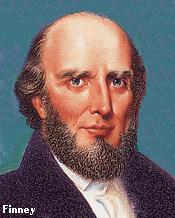
“Charles Finney: The Greatest Distorter of Christian Truth in Our Age”

Dr. Michael Horton, Professor of Systematic Theology and Apologetics at Westminster Seminary California, wrote an article for Modern Reformation Magazine back in 1995 titled “The Legacy of Charles Finney.”  Growing up in evangelical, Southern Baptist and Church of God circles, Charles Finney was always a man to be praised.  Horton however exposes Finney’s unbiblical and unorthodox theology.  Here are some quotes from Finney and Horton’s responses:

Who is Finney?
Charles Finney (1792-1875) ministered in the wake of the “Second Awakening,” as it has been called. A Presbyterian layover, Finney one day experienced “a mighty baptism of the Holy Ghost” which “like a wave of electricity going through and through me … seemed to come in waves of liquid love.” The next morning, he informed his first client of the day, “I have a retainer from the Lord Jesus Christ to plead his cause and I cannot plead yours.”Refusing to attend Princeton Seminary (or any seminary, for that matter); Finney began conducting revivals in upstate New York. One of his most popular sermons was “Sinners Bound to Change Their Own Hearts.” [Emphasis Mine]
Denying the Perseverance of the Saints (Eternal Security)
First, in answer to the question, “Does a Christian cease to be a Christian, whenever he commits a sin?” Finney answers:

“Whenever he sins, he must, for the time being, cease to be holy. This is self-evident. Whenever he sins, he must be condemned; he must incur the penalty of the law of God … If it be said that the precept is still binding upon him, but that with respect to the Christian, the penalty is forever set aside, or abrogated, I reply, that to abrogate the penalty is to repeal the precept, for a precept without penalty is no law. It is only counsel or advice. The Christian, therefore, is justified no longer than he obeys, and must be condemned when he disobeys or Antinomianism is true … In these respects, then, the sinning Christian and the unconverted sinner are upon precisely the same ground (p. 46).”
Horton responds,   Continue at Jared Moore

Thursday, January 10, 2013

Those Who Received His Word - Passion 2013

Welcome back, especially you, One Star Hater.

Yesterday, I told the story of one hypothetical kid who went to Passion 2013, got very fired up about something he could stake his life on, and who agreed with Jefferson Bethke about the event.  But then I went and spoiled the whole thing by asking a pretty simple (and it seems to me: obvious) question about the whole thing: Continue at Frank Turk 

Tuesday, September 25, 2012

A Lesson From the Lakeland Revival - Todd Bentley

A couple of weeks ago I invested an hour and a half in watching Lakeland: The Movie, a documentary about Todd Bentley and the Lakeland “Revival.” You may remember that in April of 2008, a preacher and revivalist named Todd Bentley was invited to Ignited Church in Lakeland, Florida. The plan was to have Bentley there for five days of revival services. In the end he stayed for four months. What was meant to be a small, local event soon saw hundreds of thousands of people from 65 countries travel to Florida. Millions more participated through the Internet. Night after night Bentley would hold wild services full of singing, preaching, speaking in tongues, prayer for healing and miracles and, of course, the inevitable collection of money. 

The revival was marked by what were said to be great manifestations of the work of the Holy Spirit—speaking in tongues, ecstatic prophecies, miraculous healings and even the claim that somewhere around thirty people had been raised from the dead. Just about every major media outlet covered it at one time or another. Most of them went looking for evidence that miracles had actually happened; not surprisingly, not a single miracle was ever verified.

By August the revival was beginning to slow down a little bit and Bentley decided to leave Lakeland and to take the revival on the road. Teaching that the Holy Spirit could be passed from him to others by the laying on of hands, he would tour the country and take this outpouring of the Spirit with him. But no sooner did he leave Lakeland than the media exploded with reports that Bentley and his wife would be separating. Apparently he had been carrying on an inappropriate relationship with one of the women connected to his ministry. He and his wife soon divorced and shortly afterward he had married this other woman. The revivals and his ministry came to a screeching halt, at least for a time.   Continue at Tim Challies

Friday, November 18, 2011

Steady, Gradual Growth—Vance Havner (1901-1986)

Vance Havner was a beloved and influential American preacher, known particularly for his pithy, insightful quotes. Of him, Billy Graham once said, “I do not know of any man in my generation who has stirred revival fires in the hearts of so many people throughout the nation as has Vance Havner . . .”1
 
The following quote, taken from a collection designed for daily devotion, brings Havner’s sharp mind to bear on the problem of spasmodic discipleship. And though he was known as a revival preacher, whose meetings were marked by dramatic spiritual encounters with the Lord, it was his conviction that sanctification comes typically in orderly fashion.

We do not grow in grace and the knowledge of Christ by leaps and bounds but some try. They bounce from one mountain peak of Christian experience to another. Every year or so they make a new start, turn a new leaf, have a new thrill. Children do not grow by suddenly gaining a few inches or adding a few pounds now and then. They grow gradually, daily, by food, rest, and exercise. Christian growth comes the same way by feeding on the Word, resting in the Lord, and exercising unto godliness. It has been said that nothing is more detrimental to Christian experience than too many Christian “experiences.”2

Thursday, March 31, 2011

How To Know What Real Revival Looks Like

In 1972 I heard J. I. Packer lecture at my seminary. One simple sentence of his has echoed in my mind ever since: “Do not neglect the revival dimension in your ministry.” Revival is powerfully Christ-exalting. That is what I desire. And I am guessing that you, as you follow The Resurgence, feel the same passion.

What is a true revival?

But how can we distinguish true revival from false? Not everything labeled “revival” can be trusted and welcomed. Fortunately, we have guidance from a master theologian, Jonathan Edwards, who studied the Bible profoundly and experienced revival personally. Keep Reading>>>

Wednesday, March 2, 2011

Myth: Calvinists Take a Dim View of Revival and Awakening

We do not often speak of the Reformation era as a period of aggressive evangelistic preaching; but it indeed was this. Away from the university faculties of theology and the city cathedrals where much of the story of the Reformation played out, there were the itinerant evangelistic preachers who went town to town decrying the virtual idolatry of medieval religion and preaching up the need for living faith in Jesus Christ. Lesser-known figures of the Reformation such as John Frith and Robert Barnes (in England), Patrick Hamilton and George Wishart (Scotland), Pierre Viret and Guillaume Farel (in France and Switzerland) did this kind of itinerant evangelistic preaching—often to very large crowds. There followed what were at first “underground cells” of evangelical believers which met in barns, orchards, and hedges. It is no stretch to call these 16th century events evangelistic awakening or revival. By the early 17th century, we have clear documentation of such events in Northern Ireland and in the west of Scotland with some well-known Reformed preachers such as David Dickson instrumental in evangelistic harvests that endured over years. Read it all HERE

Friday, January 21, 2011

First Great Awakening: America in the 1730s to 1740s

Evangelist George Whitefield toured Benjamin Franklin’s Philadelphia in 1739 following a stint in Ireland. As in Whitefield’s native England, Philadelphia ministers barred the famed preacher from using their pulpits. So Whitefield took his message about the new birth directly to the masses, preaching in fields and town squares—wherever an audience gathered. 

Revival despite differences

The huge, diverse crowds that turned out to hear Whitefield impressed Franklin. The future founding father of the United States never actually believed what Whitefield preached, that sinners must be born again by believing in Jesus Christ, who died on the cross and resurrected from the dead. He marveled at how the crowds agreed with what Whitefield preached, “notwithstanding his common abuse of them, by assuring them they were naturally half beasts and half devils.” He might not have approved of the message about man’s depravity, but Franklin couldn’t deny the evidence of revival that accompanied Whitefield’s visit.  Continue Reading>>>

Wednesday, January 5, 2011

Remember Regeneration

“Do not marvel that I said to you, ‘You must be born again.’ ” — John 3:7
John Wesley and George Whitefield both said that the trans-Atlantic revival of the 1740s was fueled by the recovery of two great doctrines: justification by faith and the new birth.

This is a striking observation in light of the present evangelical scene. In recent years books and blog posts, conferences and colloquiums have sprung up like mushrooms (some nourishing, some poisonous) to deal with the doctrine of justification. The recent gathering of the Evangelical Theological Society in Atlanta is just one example. Continue Reading>>>

Tuesday, November 30, 2010

Charles Grandison Finney, Part 1: Finney's System

Finney’s approach to Christianity began with an embarrassment over traditional theology, especially the theology of the Westminster Confession. He rejected the authority of that confession and of any kind of church tradition. Finney insisted that people who taught traditional Reformed theology were both thoughtless and inconsistent. He accused them of being unwilling to define their concepts, even to themselves.
Instead of the authority of tradition, Finney accepted the double authority of reason and consciousness. By reason, Finney meant something like plausibility; this kind of reason was his chief tool in understanding the Bible. He supplemented reason with consciousness or self-awareness, which (he argued) granted full and immediate access to one’s own mental states. In Finney’s system, no interpretation of Scripture was allowable which contradicted one’s own self-awareness. That is why he rejected Jonathan Edwards’s distinction between natural and moral freedom. Read it all HERE