The purpose of this Blog is to introduce men and women all over the World to the Doctrines of Grace; the 5 Solas; Reformation Theology and the Lord and Savior Jesus Christ.
Showing posts with label Devil. Show all posts

Friday, November 15, 2013

Did the Devil Make Me Do It?

_225_350_Book.807.coverI just sinned. Did the Devil make me do it?

The authors of the New Testament almost never speak about a Christian's sin in terms of demonic influence. Paul refers to false teachers who have been captured by the Devil to do his will (2 Tim. 2:26) and ill-qualified elders in a church who are in danger of falling into a snare of the Devil (1 Tim. 3: 6-7). But when he speaks to believers about their sin it's usually in direct terms. So, for example, in Ephesians 4:25-32 Paul instructs us:

Therefore, having put away falsehood, let each one of you speak the truth with his neighbor, for we are members one of another. Be angry and do not sin; do not let the sun go down on your anger, and give no opportunity to the devil. Let the thief no longer steal, but rather let him labor, doing honest work with his own hands, so that he may have something to share with anyone in need. Let no corrupting talk come out of your mouths, but only such as is good for building up, as fits the occasion, that it may give grace to those who hear. And do not grieve the Holy Spirit of God, by whom you were sealed for the day of redemption. Let all bitterness and wrath and anger and clamor and slander be put away from you, along with all malice. Be kind to one another, tenderhearted, forgiving one another, as God in Christ forgave you.
Paul does indeed mention the Devil in this passage, telling us not to give him an opportunity to tempt us by clinging to anger and rage. But while our sin might give Satan an opportunity to advance his agenda through us, Paul doesn't understand our sin to be fundamentally caused by the Devil and his demons.   Continue at Mike McKinley

Monday, February 4, 2013

Watch Out or the Devil’s Gonna Get You

In rural America, off a country road, on the soft soil of a weathered field, stands a sobering message for every passer-by: Go to church or the devil will get you!


The words are neatly strewn across a homemade billboard adorned with flood lights and a painted silhouette of a red figure, apparently Satan, holding a sling-blade. Go to church, the warning hisses, or be his victim.

As hokey as it sounds, the warning is right, you know, at least in a sense.

Now to be clear, if the sign means (and it likely does) that you’d better attend a weekly meeting or else Lucifer will eat your lunch, then no, that’s not right. That would be Anglo folk religion — more akin to African animism than anything Christian.

But, more positively, if “go to church” means be part of a gospel-shaped community, and “the devil will get you!” means you’re more susceptible to his schemes apart from such community, then the sign is absolutely right. By all means, if this meaning is the case, go to church or the devil will get you. Here’s why: first, Satan is real and he hates you; second, God designs that Christians persevere in faith by means of one another.    Continue at Jonathan Parnell

Tuesday, August 28, 2012

If I Were the Devil…

One of the most common—and frustrating—reasons I hear many Christians offer for not reading their Bibles is, “The Bible’s too hard to understand.” But there are tons of other excuses we make for how we approach (or rather, don’t) the Scriptures. Some pastors have seemingly given up preaching the BIble. Many Christians debate the extent of the Bible’s truthfulness and authority. On and on I could go. But where do these ideas come from, ultimately?

According to J.I. Packer, from no less a source than the Devil himself. I love the way Packer addresses this in his foreword to Knowing Scripture:

If I were the devil (please, no comment), one of my first aims would be to stop folk from digging into the Bible. Knowing that it is the Word of God, teaching people to know and love and serve the God of the Word, I should do all I could to surround it with the spiritual equivalent of pits, thorn hedges and traps, to frighten people off. With smug conceit, no doubt, as if receiving a compliment, I should acknowledge that wise old Jonathan Edwards (1703- 1758) had me absolutely pegged when he wrote:   Continue at Aaron Armstrong

Monday, July 30, 2012

If I Were the Devil: Paul Harvey (Warning for a Nation)


This speech was broadcast by legendary ABC Radio commentator Paul Harvey on  April 3, 1965:

If I were the Devil . . . I mean, if I were the Prince of Darkness, I would of course, want to engulf the whole earth in darkness. 

I would have a third of its real estate and four-fifths of its population, but I would not be happy until I had seized the ripest apple on the tree, so I should set about however necessary to take over the United States. 

I would begin with a campaign of whispers. With the wisdom of a serpent, I would whisper to you as I whispered to Eve: “Do as you please.” “Do as you please.”   

To the young, I would whisper, “The Bible is a myth.” I would convince them that man created God instead of the other way around. 

I would confide that what is bad is good, and what is good is “square”.  In the ears of the young marrieds, I would whisper that work is debasing, that cocktail parties are good for you. 

I would caution them not to be extreme in religion, in patriotism, in moral conduct. And the old, I would teach to pray. I would teach them to say after me: “Our Father, which art in Washington” . . .

If I were the devil, I’d educate authors in how to make lurid literature exciting so that anything else would appear dull an uninteresting. 

I’d threaten T.V. with dirtier movies and vice versa. And then, if I were the devil, I’d get organized. 

I’d infiltrate unions and urge more loafing and less work, because idle hands usually work for me. 

I’d peddle narcotics to whom I could. I’d sell alcohol to ladies and gentlemen of distinction. And I’d tranquilize the rest with pills. 

If I were the devil, I would encourage schools to refine young intellects but neglect to discipline emotions . . . let those run wild. 

I would designate an atheist to front for me before the highest courts in the land and I would get preachers to say “she’s right.” With flattery and promises of power, I could get the courts to rule what I construe as against God and in favor of pornography, and  thus, I would evict God from the courthouse, and then from the school house, and then from the houses of Congress and then, in His own churches I would substitute psychology for religion, and I would deify science because that way men would become smart enough to create super weapons but not wise enough to control them.

If I were Satan, I’d make the symbol of Easter an egg, and the symbol of Christmas, a bottle. 

If  I were the devil, I would take from those who have and I would give to those who wanted, until I had killed the incentive of the ambitious. 

And then, my police state would force everybody back to work. 

Then, I could separate families, putting children in uniform, women in coal mines, and objectors in slave camps. 

In other words, if I were Satan, I’d just keep on doing what he’s doing.
Paul Harvey, Good Day.

Tuesday, March 6, 2012

Fierce Tornadoes and the Fingers of God

Why would God reach down his hand and drag his fierce fingers across rural America killing at least 38 people with 90 tornadoes in 12 states, and leaving some small towns with scarcely a building standing, including churches?

If God has a quarrel with America, wouldn’t Washington, D.C., or Las Vegas, or Minneapolis, or Hollywood be a more likely place to show his displeasure? 

We do not ascribe such independent power to Mother Nature or to the devil.

 God alone has the last say in where and how the wind blows. If a tornado twists at 175 miles an hour and stays on the ground like a massive lawnmower for 50 miles, God gave the command.
  • “The wind of the Lord, shall come, rising from the wilderness, and it shall strip Ephraim’s treasury of every precious thing” (Hosea 13:15).
  • The Lord turned the wind into a very strong west wind, which lifted the locusts and drove them into the Red Sea” (Exodus 10:19).
  • God appointed a scorching east wind” (Jonah 4:8).
  • God commanded and raised the stormy wind” (Psalm 107:25).
But why Marysville and not Minneapolis? Why Henryville and not Hollywood?
God has spoken about these things. Consider three ways he addresses — all of us.

1. Job, “Blessed be the name of the Lord.”

Job’s ten children died because “a great wind came across the wilderness and struck the four corners of the house, and it fell upon the young people” (Job 1:19).  Continue at John Piper

Wednesday, December 7, 2011

8 Departure Dangers from Gospel Centrality

"Only let us hold true to what we have attained."
-- Philippians 3:16

There are lots of distractions from and temptations to discard a commitment to gospel-centeredness. Here are just 8.

1. The Devil's Accusation
Every now and then I will hear some variation of this accusation from the evil one: "How can you get up there and talk about the gospel? You're a self-righteous hypocrite." Satan often tries to stifle gospel proclamation by reminding the proclaimer of his unworthiness. The specific accusation may change, but the motive is the same: get the gospel-centered preacher off his game. If the devil can get us to doubt our calling, our legitimacy as ministers, our capability as proclaimers, or merely our authorization to present the gospel, he knows he's closer to getting the gospel unheard.

2. The Devil's Insinuation
This word from the accuser is one I hear more often than any other: "This gospel stuff is gonna get old. Don't you think if you play this same old record every day people are going to get tired of it?" The devil would love to convince us that the gospel is not versatile or resilient, that it is not the every day power of salvation for all who believe.

3. Exasperation
Many times we are tempted to depart from gospel-centrality because we are fed up in not seeing the results we want or expect. Don't do that. Don't give up.

Read the rest HERE

IMAGE

Friday, November 18, 2011

Does Calvinism Make God a “Moral Monster”?

Among the caricatures of Calvinism is the widespread claim that it renders God the author of evil, suffering, sin, and even the fall of humanity itself. In his recent book, Against Calvinism, Roger Olson carefully distinguishes the official teaching of Calvinism from where he thinks it logically leads. However, there are over three dozen statements in his book about Calvinism leading by good and necessary logic to a deity who is a “moral monster,” indistinguishable from the devil.

I respond to this charge directly in my companion volume, For Calvinism. A thoughtful review of my book from an Arminian perspective came to my attention today and this question again rose to the surface. (By the way, Calvinists talk so much about predestination more because of the charges leveled repeatedly against it than because of its alleged centrality.)

If God knew that Adam and Eve were going to transgress his law, why didn’t he change the circumstances so that they would have made a different choice?

Why would God create people he knew would be condemned for their original and actual sin?

The questions multiply.

Taking on this question in a blog post is a little dangerous. For a statement of the Reformed position and its scriptural basis, I’d refer readers to For Calvinism

However, there is one point that is worth pondering briefly: Non-Calvinist theologies are just as vulnerable on this question. Classic Arminian theology shares with Calvinism—indeed with all historic branches of Christianity—that God’s foreknowledge comprehends all future events. There is nothing that happens, nothing that you and I do, that lies outside of God’s eternal foreknowledge.    Keep Reading >>>

Friday, October 14, 2011

The Devil is in the White Spaces

It is always shocking to me when people tollerate, follow, and even adore teachers who clearly flaunt biblical standards for conduct, and then act surprised when false teachers and outright heresy are entertained in the church. “Naïve” doesn’t even begin to describe this kind of complicit partnership with false teaching. Because the Scripture warns that “Satan comes as an angel of light,” we simply cannot marvel when his deceptions have somehow “crept in unawares.”

Second Timothy 4:3 predicts that, “the time is coming when people will not endure sound teaching.” Too often people assume these opening words to mean that one day, as evangelical ministry marches on with expansive gospel-momentum, a blatant, rather foul stench straight from hell will mount an offensive against sound doctrine so sudden and obvious that all who love Christ will cry out in unison, “Damn the heresy!” If only that was the way it worked.

Instead of opposing the truth with blatant lies, Satan does a far greater work in the white spaces between Paul’s words. When the Apostle warns that “a time is coming,” we shouldn’t imagine a sudden plunge from the heights of doctrinal precision, but rather a slow, imperceptible decline via subtle spiritual optical illusions. The enemy knows that discerning shepherds would never allow their sheep to suddenly deny truth and turn aside to doctrines of demons. His tactics have to be implemented over long periods of time, introducing slight, unnoticeable deviations to the truth. So just exactly how was the enemy able to bring us to the place where we no longer endure sound, in-depth preaching and teaching, and yet celebrate casual conversations with false teachers?    Keep Reading...

Wednesday, September 28, 2011

Multi-Site Churches Are from the Devil

Okay, that title is homage to James MacDonald, who says congregationalism is from Satan and whom I had the privilege of spending a couple days with at the recent 9marks @ Southeastern Conference.  During the Baptist21 Panel, our moderator stirred up a bit of a hornet’s nest by asking me what I thought about multi-site churches.  Why me? I thought.  Mark Dever is sitting right there.  He loves talking about this stuff.  Aww… man.  Ask me about basketball.

So, after I finished my pity party, I answered my brother’s question, stated something like: “Thabiti, what arguments for multi-site have you found persuasive?”  My articulate response: “Uh, none.”

Okay, this should be the end of the post.  But because I’m in the Miami airport and the people-watching has become a bit weird, I think I’d rather invite you all to my misery and discovery.

Idolatry
At bottom, I think the kind of multi-site churches (realizing there are a few different approaches) that feature one pastor being beamed into several sites around a region—and in some cases around the country or world—is simply idolatry.  It’s certainly cult of personality multiplied and digitized for a consumer audience.  As a brilliant young man remarked to me this morning, “The pastor now becomes the new icon in the midst of the Protestant worship service.”  I think that’s well said.  Video multi-site tends to idolatry, pride, and self-promotion—even where the ambition of spreading the gospel is genuine.  In other words, the ends do not justify the means because some of the ends produced will undoubtedly be odious in God’s sight.   Keep Reading...

Thursday, September 15, 2011

The Devil is in the Details: Biblical Inerrancy and the Licona Controversy

The affirmation of biblical inerrancy is nothing more, and nothing less, than the affirmation of the Bible’s total truthfulness and trustworthiness. The assertion of the Bible’s inerrancy — that the Bible is “free from all falsehood or mistake” — is an essential safeguard for the Bible’s authority as the very Word of God in written form. The reason for this should be clear: to affirm anything short of inerrancy is to allow that the Bible does contain falsehoods or mistakes.

Lamentably, the issue of biblical inerrancy has been and remains an issue of some controversy within evangelicalism. Addressing this crisis, a group of leading evangelicals met in Chicago in 1978 under the auspices of the International Council on Biblical Inerrancy to adopt what became known as The Chicago Statement on Biblical Inerrancy.

The opening words of that statement set the issue clearly:   Continue Reading...

Wednesday, September 7, 2011

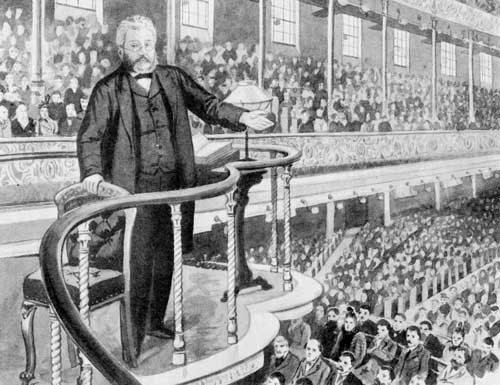
Charles Spurgeon on Preaching and the Church

Hear the Gospel; only mind that what you hear is the Gospel. You hear some very smart sermons and very clever sermons and, as a rule, I may say that the cleverer they are, the worse they are! Where you see so much of the man, you will see very little of his Master.—1893, Sermon 2327

If you hear a real Gospel sermon, it directs you to look to Jesus Christ. That teaching which leads you to think of the priest and to think of the church, whatever there may be about them that is good, is not ‘the doctrine of God our Saviour’ (Titus 2:10).—1895, Sermon 2416

If the devil never roars, the Church will never sing! God is not doing much if the devil is not awake and busy. Depend upon it: a working Christ makes a raging devil! When you hear ill reports, cruel speeches, threats, taunts and the like, believe that the Lord is among His people and is working gloriously.—1891, Sermon 2196

If we add to our churches by becoming worldly, by taking in persons who have never been born again; if we add to our churches by accommodating the life of the Christian to the life of the worldling, our increase is worth nothing at all; it is a loss rather than a gain! If we add to our churches by excitement, by making appeals to the passions rather than by explaining the truth of God to the understanding; if we add to our churches otherwise than by the power of the Spirit of God making men new creatures in Christ Jesus, the increase is of no worth whatever! -1892, Sermon 2265          All Sufficient Grace

Saturday, September 3, 2011

Is Your Church Family Really Loveless?

In his preface to Spiritual Depression, Geoffrey Thomas relays the brief account of a young woman who visited Dr. Lloyd-Jones with concern for the church.  The woman in question was involved in a long evangelistic campaign in London.  The campaign, sponsored by an American evangelist, was not supported by Lloyd-Jones.  Being attracted to the campaign and its methods, the young woman made two visits to Lloyd-Jones with two critiques.  She claimed (a) that the gospel was not preached at Westminster Chapel, and (b) the people of the church lacked love for one another.  Here’s how she remembers the second conversation, which took place in a dark period of her spiritual life:

Woman: “We don’t love one another in this church.”

Lloyd-Jones (tenderly): “Don’t say that.  It’s the devil that makes you say that.”
A couple questions come immediately to mind for me.

1.  How would one individual in a church be able to pronounce that the entire church is without love? 

How could any one person have data enough to conclude this?  And if the conclusion were accurate, we’d have to stop using the term “church” to describe that group of people.  For whatever we might call that body of people, we could not call it a “church” since love is a distinguishing mark of the church (John 13:34-35; 1 John 3:14-15).   Keep Reading...

Wednesday, August 31, 2011

Spiritual Depression: Its Causes and Cures

I’ve begun reading the book I most wanted to read during vacation, D. Martyn Lloyd-Jones’ Spiritual Depression: Its Causes and Cures.  Recently a new friend gave me a hardback copy published by Granted Ministries.  It’s a handsome volume with an insightful foreword by Geoffrey Thomas.

I know, I’m late to the Spiritual Depression party.  I’ve heard it quoted often.  Many people have shared personal testimonies about how much it’s helped them.  

And on the strength of the quotes (often extended), the personal recommendation of friends, and my general love and trust for Lloyd-Jones, I’ve recommended the book a number of times myself.  But until now, I’ve actually never read it.  I’m excited to be correcting that omission over the next couple days.  And along the way, I’m equally excited to hear the good Doctor’s original sermons that became this classic treatise on the Christian life.

So, over the next few days, Lord willing, I hope to post some reflections and thoughts as I read through the book.  Today, I want to offer a brief summary of Thomas’ biographical foreword and Lloyd-Jones’ brief preface.

Spiritual Depression: Its Causes and Cures, 1

Spiritual Depression, 2

Spiritual Depression, 3

Saturday, August 13, 2011

Satan the Proud and Powerful (Part 1)

Where did the idea of a red-flanneled, pitchfork-bearing Devil come from? The roots of this grotesque caricature of Satan are found in the Middle Ages. It was popular sport in medieval days to mock the Devil by describing him in ludicrous terms. There was a method in this madness. The medieval church believed in the reality of Satan. It was aware that Satan was a fallen angel who suffered from an overdose of pride. Pride was Satan’s supreme weakness. To resist Satan, that proud but fallen creature, required fierce combat. The combat focused on Satan’s most vulnerable point, his pride. The theory was this: Attack Satan at his point of weakness and he will flee from us.

What better way to attack Satan’s pride than to depict him as a cloven-hoofed court jester in a red suit? These silly images of Satan were intentional caricatures. Unfortunately, later generations responded to the caricatures as if they were intended to be the real thing.    Keep Reading...

Thursday, March 3, 2011

The Satanic Power of a Question

The first attack on the human race did not come from outer space. No alien fleet of space ships. No downloaded virus into a vein to ultimately kill, steal and destroy. It was not even a physical attack; no swords, clubs, guns or bombs. But O, the devastation it caused.

For those who know their Bibles, you will know I am referring to the attack on the first parents of mankind in a Garden called Eden, when the serpent attacked Adam and Eve… with a question. That was all it was. A simple question. 

Oh it was a loaded question. The question spoke volumes about how God could not be trusted – how His word was not to be believed. It spoke of how God did not really have their best interests at heart – that He was holding out on them – that if God really did love them, then things would be different. Built into the question was an undermining of God, His word and His love; and more than that, an insinuation that God did not want them to achieve the most beautiful thing possible – the ability to be like God.

Think of it from the devil’s perspective (and I mention the devil because there are passages in Scripture which tells us clearly that it was the devil who entered into the serpent in the garden). If you were the devil, how would you tempt a perfect man and woman who were living in a perfect environment? Keep Reading>>>

Wednesday, March 2, 2011

How To Sucker Punch the Devil

Here is an example of this sucker punch in action:
When the devil throws our sins up to us and declares that we deserve death and hell, we ought to speak thus: "I admit that I deserve death and hell. What of it? Does this mean that I shall be sentenced to eternal damnation? By no means. For I know One who suffered and made satisfaction in my behalf. His name is Jesus Christ, the Son of God. Where he is, there shall I be also."

-- Martin Luther, Letters of Spiritual Counsel
See what he did there? Read the whole thing HERE

Wednesday, November 24, 2010

The Source of False Doctrine

What difference would it make if we seriously thought about the origins of false doctrines?

It is vitally important to realise that heresies do not originate in the minds of men and women. Ultimately heresy originates with the devil.

When the apostle Paul takes the Corinthian church to task for tolerating false teachers he compares their approach to the deception of Eve by the serpent (2 Cor. 11:3). But the deception in the Garden is more than a useful illustration. The super-apostles at Corinth are the servants of the devil disguising themselves as apostles of Christ.

Similarly Paul warned Timothy about “deceitful spirits and the teachings of demons” (1 Tim. 4:1), and of false teachers who are caught in the snare of the devil (2 Tim. 2:24-25). After all the devil is the father of lies (John 8:44). One of the English Puritans said that the devil never lets the wind blow for too long in the same direction. Continue Reading>>>

Wednesday, August 4, 2010

Winning the Private War in the Mind

Ephesians 6:12 For we do not wrestle against flesh and blood, but against the rulers, against the authorities, against the cosmic powers over this present darkness, against the spiritual forces of evil in the heavenly places.
Over the years there have been extremely dubious or downright ridiculous teachings about spiritual warfare in the Church at large. Much of it was borne out of ignorance, speculation, superstition or religious tradition. Yet there is a reality to spiritual warfare and it is something God certainly wants us to know about, or else He would not have revealed it to us in His Word. If we just stay with the Scripture, we will be on safe and sure ground. God wants us to understand the warfare, know our enemy and live a life free from his clutches.
In Ephesians 6:12 the Apostle outlines the arena of warfare in which all Christians are engaged. One scholar translated the original words as follows: “For our wrestling match is not against persons with bodies, but against rulers with various areas and descending orders of authority, against the world-dominators of this present darkness, against spiritual forces of wickedness in the heavenlies.” The picture here is of a very highly structured and well organized kingdom with descending orders of authority and different rulers and sub rulers responsible for different areas of their territory. Read it all HERE