The purpose of this Blog is to introduce men and women all over the World to the Doctrines of Grace; the 5 Solas; Reformation Theology and the Lord and Savior Jesus Christ.
Showing posts with label Mary Worship. Show all posts

Thursday, February 28, 2013

Exposing the Heresies of the Catholic Church: Mary Worship

After his prophetic vision of the eternal glories of heaven at the end of the book of Revelation, the apostle John described how he was overwhelmed by what he’d seen.
And when I heard and saw, I fell down to worship at the feet of the angel who showed me these things. But he said to me, “Do not do that. I am a fellow servant of yours and of your brethren the prophets and of those who heed the words of this book. Worship God.” (Revelation22:8-9)
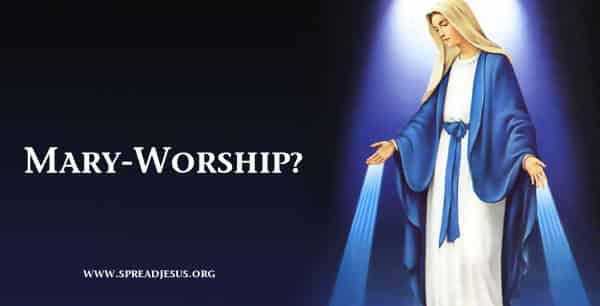
The Roman Catholic Church has committed the same error as John, promoting a mere citizen of heaven to an improper place of authority and honor. Despite the overwhelming testimony of Scripture, the Catholic Church has elevated Mary—a self-described servant of the Lord (Luke 1:38)—to the same level as God, if not higher.

In his Ineffabilis Deus in 1854, Pope Pius IX established as dogma the immaculate conception of Mary, which preserved her from inheriting original sin. His concluding statements provide a good summary of the Catholic view of Mary.
Let all the children of the Catholic Church, who are so very dear to us, hear these words of ours. With a still more ardent zeal for piety, religion and love, let them continue to venerate, invoke and pray to the most Blessed Virgin Mary, Mother of God, conceived without original sin. Let them fly with utter confidence to this most sweet Mother of mercy and grace in all dangers, difficulties, needs, doubts and fears. Under her guidance, under her patronage, under her kindness and protection, nothing is to be feared; nothing is hopeless. Because, while bearing toward us a truly motherly affection and having in her care the work of our salvation, she is solicitous about the whole human race. And since she has been appointed by God to be the Queen of heaven and earth, and is exalted above all the choirs of angels and saints, and even stands at the right hand of her only-begotten Son, Jesus Christ our Lord, she presents our petitions in a most efficacious manner. What she asks, she obtains. Her pleas can never be unheard.
Those words are echoed and expanded on throughout Roman Catholic history. Tradition dictates that Mary is part of the monarchy of heaven, soliciting grace and mercy from the Lord on behalf of sinners, and covering sin by distributing from her Treasury of Merit. She became a co-redeemer with Christ in His suffering on the cross, and is now a co-mediator alongside Him in heaven—essentially an alternative avenue of access to God. She replaces the Holy Spirit in bestowing aid and comfort to believers. In effect, she becomes an additional member of the Trinity.

That blasphemy stands in sharp contrast to what Scripture actually says about Mary, and even what she says about herself. Luke 1:46-55 records her humble reaction to the news that she would give birth to the Son of God.    Continue at John F. MacArthur Jr.

Monday, November 5, 2012

Spiritual Formation at Worship

Within spiritual formation and similar circles, there has been much criticism of worship as found in evangelical Protestantism.  Much of this criticism is aimed at the seeker-sensitive churches with their push for polished performances, entertainment, and the desire to keep the seeker (i.e. unsaved people who are attending the services) as comfortable as possible by offering them an environment and experience similar to what they would encounter at a secular gathering or concert.  The idea is that people unfamiliar with church life feel more at home and will be more likely to return if they do not encounter something foreign or “weird” in the form of worship.  This approach is obviously working, if one evaluates a church on the basis of nickels and noses, as the largest churches in the world have adopted this philosophy.   But there has been a considerable push back against this viewpoint within not only more conservative evangelical churches but also from the emergent and spiritual formation camps.  Mike King believes the church should offer an alternative experience and states, “It should be a bit odd and peculiar for visitors to enter our sanctuaries and engage in worship.  This isn’t bad.  It’s good.  It shows that we are a subculture that’s distinct.”[1]And Dan Kimball observes that “many of these very things [methods promoted by the seeker-sensitive movement] are contrary to what emerging generations value and are seeking in their spiritual experience...The things that seeker-sensitive churches removed from their churches are the very things nonbelievs want to experience if they attend a worship service.  So I don’t think there will be much controversy about bringing back all the spiritual elements and going deeper with our teaching!”[2]

It would be hoped that many who have grown tired of the splash and show of consumer-oriented, market-driven strategy would seek out biblically-based churches that major on Christ, the gospel and Scripture.  There are many churches throughout the world that are seeking to please the Lord, not the consumer, and that draw their marching orders from Scripture and not from the culture.  Some reacting to the seeker-model will head for these churches and be discipled according to biblical principles.  Continue at Gary Gilley
 

Saturday, January 21, 2012

The Myth Of Mother Teresa

Mother Teresa, as goes without saying, was a devout Roman Catholic. As such, some of her beliefs would necessarily have to stand at odds with core Christian beliefs. This has not appeared to trouble many Christians who continue today, even in Protestant churches, to uphold her as a prime example of Christian virtue, love and self-sacrifice. Her devotion to Catholic theology is obvious in her speeches and writing. In a speech she delivered to the Worldwide Retreat For Priests in October of 1984 she made the following quotes:
“At the word of a priest, that little piece of bread becomes the body of Christ, the Bread of Life.”
“Without a priest, without Jesus going with them, our sisters couldn’t go anywhere.” 
“When the priest is there, then can we have our altar and our tabernacle and our Jesus. Only the priests put Jesus there for us. … Jesus wants to go there, but we cannot bring him unless you first give him to us. This is why I love priests so much. We could never be what we are and do the things we do without you priests who first bring Jesus to us.”
“Mary … is our patroness and our Mother, and she is always leading us to Jesus.”
In just these four quotes we get a glimpse of beliefs that contradict so many gospel truths. We see a belief in transubstantiation (that the bread of communion actually becomes the body of Christ) and her belief that Christ is present in this bread. We also see her belief that Mary, the mother of Jesus, is a mediator between God and ourselves (see Catholic Catechism, paragraph #969, #1172 and #494) and as such, plays a role in our salvation.

While she worked with the poor, Mother Teresa was adamant that any type of evangelism was unnecessary. In her book, Life in the Spirit: Reflections, Meditations and Prayers, she says: Read it all at Tim Challies