The purpose of this Blog is to introduce men and women all over the World to the Doctrines of Grace; the 5 Solas; Reformation Theology and the Lord and Savior Jesus Christ.
Showing posts with label Israel. Show all posts

Wednesday, May 1, 2013

You Say “This Is History’s Darkest Hour”? G. Campbell Morgan Says, “Oh, Be Quiet!”

C. Campbell Morgan


My first pastor was Marden Wickman, at Powell Valley Covenant Church in Gresham, Oregon. I came to faith in Christ through that church, and Pastor Wickman baptized me. For 35 years now Nanci (who grew up in that church) and I have lived less than a mile from Powell Valley Covenant’s church building. I drive by it several times a week and am flooded with memories.

I loved Marden Wickman, who loved to preach God’s Word. There was one preacher he quoted more than any other—G. Campbell Morgan. Under Pastor Wickman’s influence, I bought Morgan’s Westminster Pulpit, the five volume collection of his sermons, and I also read many of Morgan’s books.

The Unfolding Message of the Bible by C. Campbell MorganG. Campbell Morgan was a British scholar and the pastor who preceded Martyn Lloyd Jones at Westminster Chapel. One of his many books was The Unfolding Message of the Bible, which he wrote in 1961. That was over fifty years ago.

Recently I was reading a portion in this book where G. Campbell Morgan said something I think evangelical Christians in America really need to hear today—especially those who are obsessed with how bad things are in our culture, and those convinced that as a result of how bad it’s getting, Christ absolutely has to return right away.

I should back up and say I was a new Christian in the seventies when everyone was reading Hal Lindsey’s The Late Great Planet Earth, the bestseller of the decade. We listened to Bible teachers “proving” from Scripture that Christ had to return by 1980. They based this largely on the predominant interpretation of Matthew 24:32-34, calculating that Israel’s return as a nation in 1948 demanded that Christ would come within thirty years of that event, or at least forty. And besides, we said, “Look around, how much darker can things get?” And here we are, forty years later.  (One of my friends didn’t get dental work done—“Why spend the money when Christ is going to return within a year or two?” Believe me, he lived to regret it.)

I do believe in the imminent return of Christ, which means He CAN return any time, as has been true for 2,000 years. But it also means, despite all the books persuading people these are the darkest days of history and that current events in Iran and Iraq are fulfilling Bible prophecies, He does not HAVE TO return anytime.

Listen to Dr. Morgan, writing over fifty years ago:    Continue at Randy Alcorn

Tuesday, February 5, 2013

Suffering Now or Later: Revelation 14:1-20


Revelation 14:1-20 asks the question, is it worth it to endure as a Christian? Does it pay to be a Christian? Is it worth it to be a Christian if your family faces discrimination, if your children are threatened with death? Does it pay to be a Christian for fourteen Khmu familes in Laos, whose homes and church buildings have been destroyed more than once? In 2003 fourteen Khum families were evicted from their homes. And now they are being forced to move again. The roof of their church has been torn off by unbelievers over and over.  But the Khum are staying strong in the faith. They continue to worship together three times a week. What keeps them going? What is their secret? And what will keep us going so that we trust Jesus until the end?

Revelation 13 focuses on the persecution of God’s people, but chapter 14 teaches us how we can endure persecution. Is it worth it to be a Christian? Is the cost and sacrifice too great? Let’s look at the first five verses in chapter 14.

Children of God


The 144,000 are with the Lamb on Mt. Zion. Who are the 144,000? I argued in Revelation 7 that the 144,000 represented the church of Jesus Christ—all Christians. I am not going to review those arguments again here. If that is right, these verses represent our story. John is talking about our lives, our destiny. This isn’t the story of Christians who live in another galaxy far, far away. This is our story. This is about uncle Jim who is a Christian and your mother and father, and your sons and daughters who know Christ.

Where are these Christians? They are on Mt. Zion. And where is that? Mt Zion stands for heaven. The heavenly Jerusalem. So, even though John is talking about Christians, he takes us to the future. He transports us to heaven itself. And why does he do this here? We immediately see after the persecution of Revelation 13 one reason why Christians should endure persecution. They are promised a heavenly reward. They will be with Lamb on Mt. Zion forever. They have the name of the Lamb and the name of the Father on their foreheads. This language is obviously symbolic. It means that they belong to God. They are his children.

Christian, who are you? You are a child of God. You are part of his family. Do you ever feel like you are a nobody? Do you feel that no one cares for you? We all have moments like that. You may feel like even fellow-believers in the church don’t love you. But we are reminded here that you belong to God. God loves you and you are his child. You are precious to him. Maybe you even feel like your husband or wife doesn’t love you. But God loves you. And his love should motivate you to obey him and to keep his commandments. Continue at Thomas Schreiner

Thursday, October 18, 2012

Is the Sabbath Still Required for Christians?

Tom Schreiner’s 40 Questions About Christians and Biblical Law releases later this month. As I’ve said before, I think it’s now the go-to book for an accessible introduction to all the major issues related to gospel and law, the role of law in redemptive history, application of the law today, etc. I could not recommend it more highly.

Kregel has kindly given me permission to reprint some of the entries. I’ll do so throughout the week. I won’t reproduce the footnotes or the discussion questions, but other than that it’s the full entry.

Today I’ll reprint question #37, “Is the Sabbath Still Required for Christians?”


Believers today continue to dispute whether the Sabbath is required. The Sabbath was given to Israel as a covenant sign, and Israel was commanded to rest on the seventh day. We see elsewhere in the Old Testament that covenants have signs, so that the sign of the Noahic covenant is the rainbow (Gen. 9:8–17) and the sign of the Abrahamic covenant is circumcision (Gen. 17). The paradigm for the Sabbath was God’s rest on the seventh day of creation (Gen. 2:1–3). So, too, Israel was called upon to rest from work on the seventh day (Exod. 20:8–11; 31:12–17). What did it mean for Israel not to work on the Sabbath? Figure 5 lists the kinds of activities that were prohibited and permitted.

The Sabbath was certainly a day for social concern, for rest was mandated for all Israelites, including their children, slaves, and even animals (Deut. 5:14). It was also a day to honor and worship the Lord. Special burnt offerings were offered to the Lord on the Sabbath (Num. 28:9–10). Psalm 92 is a Sabbath song that voices praise to God for his steadfast love and faithfulness. Israel was called upon to observe the Sabbath in remembrance of the Lord’s work in delivering them as slaves from Egyptian bondage (Deut. 5:15). Thus, the Sabbath is tied to Israel’s covenant with the Lord, for it celebrates her liberation from slavery. The Sabbath, then, is the sign of the covenant between the Lord and Israel (Exod. 31:12–17; Ezek. 20:12–17). The Lord promised great blessing to those who observed the Sabbath (Isa. 56:2, 6; 58:13–14). Breaking the Sabbath command was no trivial matter, for the death penalty was inflicted upon those who intentionally violated it (Exod. 31:14–15; 35:2; Num. 15:32–36), though collecting manna on the Sabbath before the Mosaic law was codified did not warrant such a punishment (Exod. 16:22–30). Israel regularly violated the Sabbath—the sign of the covenant—and this is one of the reasons the people were sent into exile (Jer. 17:21–27; Ezek. 20:12–24).   Continue at Justin Taylor


Wednesday, October 3, 2012

Columns from Tabletalk Magazine, October 2012

The October edition of Tabletalk is out. This issue features articles examining the relationship between the church and Israel, a relationship commonly misunderstood by the average layperson. This issue explores the various historical positions regarding this matter, and seek to help readers understand the composition and nature of the “called out ones,” from the covenant of works in Adam all the way through the manifestations of the covenant of grace in redemptive history. Further, it pays special attention to how the nation of Israel, instituted at Sinai, factors into God’s dynamic plan of salvation.
 
Contributors include R.C. Sproul along with Cornelis P. Venema, Iain M. Duguid, Ketih A. Mathison, John Starke, Jon Bloom, Barnabas Piper, R.C. Sproul Jr., Russell D. Moore and Andrew Peterson.

We do not post all of the feature articles or the daily devotionals from the issue, so you’ll have to subscribe to get those. But for now, here are links to several free columns and articles from this month:

If you have not yet subscribed to Tabletalk, now is the perfect time. For those living in the U.S. and Canada it’s only $23 for a year, and $20 to renew. You save even more if you get a 2- or 3-year subscription (as little as $1.36 per issue). We offer special discounts for churches or businesses who want multiple copies of each issue.

Get your subscription to Tabletalk today by calling one of Ligonier Ministries’ resource consultants at 800-435-4343 or by subscribing online. You can also get free shipping on individual 2012 issues of Tabletalk.

Saturday, June 16, 2012

Church History and Israel’s Future

Romans 11:26 promises that all Israel will be saved. Dispensationalists understand this verse to refer to a national salvation of ethnic Israel after the fullness of the Gentiles has come in.
 
Non-premillennialists sometimes imply that such an interpretation is a dispensationalist invention, because it means that God still has a future plan for national Israel.

But did you know that many throughout church history, including many in the Reformed tradition have shared that same interpretation?

None other than John Calvin, in his commentary on Romans 11:25-26, noted that “when the Gentiles shall come in, the Jews also shall return from their defection to the obedience of faith.” Other Reformers, such as Martin Bucer, Peter Martyr, and Theodore Beza similarly concluded that there would be a future calling and conversion of the Jewish people.

A belief in the future salvation of national Israel was especially strong among the Dutch Reformed and the English Puritans of the seventeenth century. Regarding the Dutch Calvinists of that time period, J. Van Den Berg explains that for “virtually all Dutch theologians of the seventeenth century, ‘the whole of Israel’ indicated the fullness of the people of Israel ‘according to the flesh’: in other words, the fullness of the Jewish people. This meant that there was a basis for an expectation of a future conversion of the Jews—an expectation which was shared by a large majority of Dutch theologians” (Puritan Eschatology, 140).

Commenting on the English Puritans, Iain Murray similarly notes: “This same belief concerning the future of the Jews is to be found very widely in seventeenth-century Puritan literature. It appears in the works of such well-known Puritans as John Owen, Thomas Manton and John Flavel. … It is also handled in a rich array of commentaries, both folios and quartos – David Dickson on the Psalms, George Hutcheson on the Minor Prophets, Jeremiah Burroughs on Hosea, William Greenhill on Ezekiel, Elnathan Parr on Romans and James Durham on Revelation: a list which could be greatly extended.” (The Puritan Hope, 43).   Continue at Nathan Busenitz

Thursday, May 10, 2012

John MacArthur on Calvinism, Dispensationalism, Israel and Hermeneutics

In April 2007, I made my way through Dr. MacArthur’s controversial lecture, “Why Every Self-Respecting Calvinist Is a Premillennialist” (given at the Shepherd’s Conference at Grace Community Church, on March 7, 2007). The lecture can be ordered here (Click here: MacArthur: Why Every Self-Respecting Calvinist is a Premillennialist « Faith by Hearing).
 
Regrettably, I am just now getting around to completing my response–my day job kept getting in the way.  Better late than never, perhaps?

As we have come to expect of him, Dr. MacArthur spoke with great passion, covered much ground quickly, and had a great deal to say. No question, Dr. MacArthur commands authority. One can easily see why Dr. MacArthur is so widely-respected. When it comes to the gospel, he’s on the side of the angels. When it comes to eschatology, however, I must beg to differ.

As a Reformed amillennarian (who was raised a dispensationalist) I had a powerful gut-level reaction to Dr. MacArthur’s lecture.  While this lecture was well-received by the friendly and largely dispensational home court audience to whom it was delivered, surely Dr. MacArthur knew that his words would amount to picking a fight with those Reformed amillennarians who may have been present. This was not the playful jab that conference speakers often take at one another at such events. No, this was a warning of sorts–a shot fired across the bow.   Continue at Kim Riddlebarger

Monday, April 30, 2012

The Church: The Gospel Made Visible

What Does the Bible Say?

The Nature of the Church

The church is the body of people called by God’s grace through faith in Christ to glorify him together by serving him in his world.

The People of God in the Old Testament: Israel

In order to understand the church in the full richness of God’s revealed truth, we must examine both the Old and New Testaments. Christians may sometimes use the phrase “a New Testament church,” but the shape of the visible church today bears a clear continuity—though not identity—with the visible people of God in the Old Testament.

God’s eternal plan has always been to display his glory not just through individuals but through a corporate body. In creation God created not one person but two, and two who have the ability to reproduce more. In the flood God saved not one person but several families. In Genesis 12 God called Abram and promised that Abram’s descendents would be as numerous as the stars in the sky or the sand on the seashore. In Exodus God dealt not only with Moses but with the nation of Israel—12 tribes comprised of hundreds of thousands of people yet bearing one corporate identity (see Exod 15:13–16). He gave laws and ceremonies that should be worked out not only in the lives of individuals but also in the life of the whole people.

In the Old Testament, Israel is called God’s son (Exod 4:22), his spouse (Ezek 16:6–14), the apple of his eye (Deut 32:10), his vine (Isa 5:1–7; Nah 2:2), and his flock (Ezek 34:4). Through these names God foreshadowed the work he would eventually do through Christ and his church.   Continue at B&H Blog

Monday, April 2, 2012

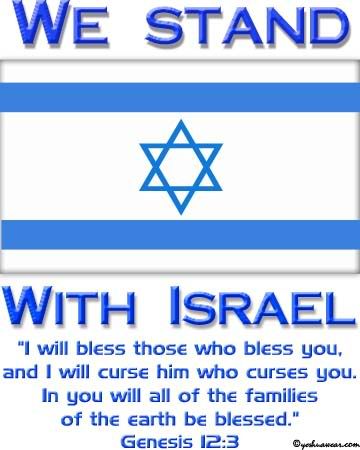
Is It True That God Blesses Those Who Bless Israel and Curses Those Who Curse Israel?

It must be true, because this is what God says, isn’t it? Well, actually God says this, “I will bless those who bless you, And I will curse him who curses you; And in you all the families of the earth shall be blessed” (Genesis 12:3).

 When God makes a promise we can know that it is certain, and that He will not change. The problem is, however, when we hear Him saying what He did not say. This text does say that God will bless those who bless Israel, but rather those who bless Abraham, to whom God is speaking. Later, however, in Numbers 24, it gets a little more clear. There Balaam, clearly speaking about the nation of Israel says, “Blessed is he who blesses you, And cursed is he who curses you.”

That should settle the matter, should it not? The difficulty is still, however, answering about whom this promise is made. Does not Paul himself say, “But it is not that the word of God has taken no effect. For they are not all Israel who are of Israel” (Romans 9:6). Here it is all too easy to get confused. What could it mean that not all Israel is of Israel?   Continue at R. C. Sproul Jr.

Wednesday, March 21, 2012

Jesus As the New Israel

The New Testament authors understood Jesus to be the culmination of the Old Testament. He is the Last Adam, true Israel, the suffering servant, the son of David, the faithful remnant, the ultimate prophet, the reigning king, the final priest.

Here is a good, concise summary of the Israel/remnant theme from a New Testament perspective:

. . . Jesus had become a remnant of one. He was the embodiment of faithful Israel, the truly righteous and suffering servant. 

Unlike the remnant of the restoration period, he committed no sin (Isa. 53:9; 1 Pet. 2:22). 

As the embodiment of the faithful remnant, he would undergo divine judgment for sin (on the cross), endure an exile (three days forsaken by God in the grave), and experience a restoration (resurrection) to life as the foundation of a new Israel, inheriting the promises of God afresh. 

As the remnant restored to life, he becomes the focus of the hopes for the continued existence of the people of God in a new kingdom, a new Israel of Jew and Gentile alike. 

As the nucleus of a renewed Israel, Christ summons the “little flock” that will receive the kingdom (Dan. 7:22, 27; Luke 12:32) and appoints judges for the twelve tribes of Israel in the new age (Matt. 19:28; Luke 22:30).  Continue at Justin Taylor

Saturday, March 17, 2012

The Underestimated Doctrine of Conversion

If you were a fan of the comic strip Calvin and Hobbes, you might remember that Calvin had a transmogrifier machine. The boy Calvin leads his imaginary tiger Hobbes up to a cardboard box with the word “Transmogrifier” handwritten on it, and explains, “You step into this chamber, set the appropriate dials, and it turns you into whatever you’d like to be.” Hobbes wryly observes, “It’s amazing what they do with corrugated cardboard these days.”


The promise of true change is a little unbelievable, isn’t it? It’s the stuff of comic strips and daydreams.

But make no mistake: this is exactly what Christianity promises—true and real change. Divine pardon. Reconciliation with God. Smashed idols. A new spirit. A new self. A new family.

Since this year’s Together for the Gospel theme is the Underestimated Gospel, we thought we’d jump on the bandwagon and devote the pre-T4G Journal to the underestimated doctrine of conversion. Forget Calvin’s transmogrifier machine. How about a whole new creation!

9Marks is deeply interested in the doctrine of conversion (it’s the fourth mark) because it’s tightly tied to the doctrine of the church. If the church is a house, conversion is the timber. The timber you use will dramatically affect the kind of house you get. Will you include the timber of divine sovereignty? Human responsibility? Repentance? Faith? My own article on the corporate component of conversion explores these matters further.

But start with Jared Wilson’s reflections on the beauty of the doctrine and Owen Strachan’s historical observations. Thomas Schreiner and Steve Wellum also help us to get our doctrine right. This is critical, friends. Owen’s piece especially will help you to see why, as will Bobby Jamieson’s instructive book review on Revival and Revivalism.

Once you’ve got the doctrine right, you need to think about how it connects to the life of the church. For that purpose we’ve called in Jeramie Rinne, Michael Lawrence, Mike Mckinley, and Shai Linne. Zach Schlegel’s review of Finally Alive might also surprise you with its pastoral insight.

There is underestimated power in the doctrine of conversion, but only if we get it right. Have you? Have your people? Does it show up in the habits, practices, and structures of your church’s life together?  Read it all HERE

Wednesday, September 21, 2011

Discontinuity: the Poor, Israel, and the Church

Much of the push for the church to engage in social transformation and indiscriminate care for the poor of the world comes from a wrong understanding of the relationship between the church and Israel. There is no doubt that Israel was called to care for the poor in their land—regardless of their creed. The alien, foreigner, slave, and sojourning widow were all protected by the Law, and if Israel would have kept the law, there would have been no poor in the land.

The question is this: does the church have a similar task? Is the church charged to care for the poor of the world, in the same way Israel was? I have argued elsewhere that the answer is “no,” but here I want to explain why the difference is important and helpful in understanding God’s mission to the world.

First, it has to be noted that Israel’s call to care for the poor was constrained in a very significant way. While it was not limited by creed, it was bound by geography. Israel was not called to care for the poor in Egypt. When a drought hit a neighboring country, the Israelites would have been more likely to celebrate than send a food pack. Contrast that with the church; we are quick to send aide around the world, but are rightly cautious to aide the non-believing poor in our own community. Why is that?     Keep Reading...

Thursday, August 25, 2011

An Observation about Israel in Ephesians 2:11-21 & 3:5, 6

The following passage really makes up the heart of Paul's Epistle to the Ephesians. Here he reveals a great mystery which was hidden in previous ages:
"Therefore remember that at one time you Gentiles in the flesh, called "the uncircumcision" by what is called the circumcision, which is made in the flesh by hands— 12 remember that you were at that time separated from Christ, alienated from the commonwealth of Israel and strangers to the covenants of promise, having no hope and without God in the world. 13 But now in Christ Jesus you who once were far off have been brought near by the blood of Christ ... So then you are no longer strangers and aliens, but you are fellow citizens with the saints and members of the household of God, 20 built on the foundation of the apostles and prophets, Christ Jesus himself being the cornerstone, 21 in whom the whole structure, being joined together, grows into a holy temple in the Lord."
Notice in this passage that Paul speaks to Gentiles as having been previously separate and alienated from Israel and the covenants of promise, but in Christ, Gentiles have also become citizens of Israel. The phrase "brought near" was their modern day parlance for Jewish proselytes. According to this passage we Gentiles now partake of the same promises and are no longer strangers to the commonwealth of Israel, but citizens of it. Notice the clear reference to Jesus Christ as the true Israel, and this includes are all who are joined to His body. Let’s have a closer look: Verse 12 "alienated from the commonwealth of Israel" Paul now joins Gentiles to (vr. 19) "you are no longer strangers and aliens". No longer aliens to what? No longer aliens to the commonwealth of Israel. That means that Gentiles who are in Christ are now "citizens" (v. 19) of Israel built as a house with Christ as the chief cornerstone. In other words, Jesus Christ is the True Israel of God (its fulfillment and foundation) as are all who are joined in union to Him. To say it another way, both OT and NT saints who are in union with Christ are now citizens of Israel. Likewise According to Ephesians 3: 4-6, God made known a mystery to Paul "...the mystery of Christ, which was not made known to the sons of men in other generations as it has now been revealed to his holy apostles and prophets by the Spirit. This mystery is that the Gentiles are fellow heirs, members of the same body, and partakers of the promise in Christ Jesus through the gospel."  Keep Reading...

Wednesday, August 24, 2011

Biblical Pillars for Mercy Ministry

Yesterday John Piper gave a challenge to his readers to try to support their understanding of showing love to the unbelieving poor with “strong pillars” of theological argument. People are lost and on their way to hell, and many of them are suffering in this life as well. It has always struck me as particularly meaningless and eternally inconsequential when churches use their resources to do that which God has not called us to do. The poor, as Piper said, deserve better than bad arguments with bad theological foundations.

Last week I made the case that the Bible does not command churches to use their resources to lower the poverty rate, and I quibbled with Tim Keller’s statement that Christians owe the poor as much as we can possibly give them. But Keller’s views on mercy ministry are really so extreme, that it is easy to be accused of arguing with a straw man (plus I want to take this to heart) so I want to spend a few posts explaining what I see is a full biblical view of mercy ministry.

So over the next few weeks/months, I will use this blog to explain how our response to the poor should be influenced by Scripture (only one post a week, so no need to tune out till November if this doesn’t interest you). If you have sat on a mission’s committee and been frustrated by the social agenda of many missionaries, if you have seen the homeless man on the side of the road with the sign that says “will work for beer” and wondered what you should do, if have ever dared to ask the question: “does the Bible command Christians to work for social justice issues?” then this series of posts will be helpful to you.   Keep Reading...

Tuesday, July 12, 2011

The Temple of Eden

In his book The Temple and the Church’s Mission (IVP/Apollos, 2004), G. K. Beale argues that the Garden of Eden was the “first archetypal temple.” He provides 14 conceptual and linguistic parallels between Eden and future tabernacle/temple structures. My brief summary:

1. The Garden as the unique place of God’s presence. Eden was the place where God walked back and forth with man, paralleled this with later references to the Tabernacle (Gen. 3:8 with Lev. 26:12, Deut. 23:14; 2 Sam. 7:6–7).

2. The Garden as the place of the first priest. Adam was placed in the garden to “cultivate and keep it” (Gen. 2:15). Taken alone, “cultivation” has obvious agricultural meaning. But this pair of terms (“cultivate/keep” also translated “serve/guard”) is used elsewhere in the OT to describe the work of the priest (Num. 3:7–8; 8:25–26; 18:5–6; 1 Chr. 23:32; Ezek. 44:14). Thus “the task of Adam in Genesis 2:15 included more than mere spadework in the dirt of a garden. It is apparently that priestly obligations in Israel’s later temple included the duty of ‘guarding’ unclean things from entering (cf. Num. 3:6–7, 32, 38; 18:1–7), and this appears to be relevant for Adam, especially in view of the unclean creature lurking on the perimeter of the Garden and who then enters” (p. 69).

3. The Garden as the place of the first guarding cherubim. After sin was introduced into the garden, Adam and Eve are barred from the tree of life by cherubim. This reveals that Adam’s work included more than gardening—he was to protect the garden from evil and uncleanness. (Gen. 3:24 with Ex. 25:18–22; 1 Kgs. 6:29-35, 8:6–7; Ezek. 28:14–16, 41:18). Keep Reading...

Monday, June 20, 2011

Israel and the Church: (Part 5)

The question of land is at the centre of theological debate concerning Israel and is one that carries with it significant consequences, both politically and missiologically. As we have already seen, views on this subject are quite polarised. On the one hand we have Zionists like Derek Prince claiming that “God attaches far more importance to [the land of Israel] than most of us imagine”57 and that “the land is given eternally to Israel.”58 At the other hand we have Stephen Sizer suggesting that “In the New Testament, the land, like an old wineskin, had served its purpose. It was, and remains, irrelevant to God’s ongoing redemptive purposes for the world.”59
So, what may we say about the land God promised to Abraham?
Firstly, there is no doubt that God promised a piece of land to Abraham and his descendants. Gen 15:18 says “On that day the LORD made a covenant with Abram, saying, “To your offspring I give this land, from the river of Egypt to the great river, the river Euphrates, the land of the Kenites, the Kenizzites…”” and in 17:1-8 the covenant is confirmed “… I will give to you and to your offspring after you the land of your sojourning, all the land of Canaan, for an everlasting possession, and I will be their God.”” This covenant is then repeated in 26:2-4 to Isaac “… to you and to your offspring I will give all these lands, and I will establish the oath that I swore to Abraham your father” and in 28:13-15 to Jacob “I am the LORD, the God of Abraham your father and the God of Isaac. The land on which you lie I will give to you and to your offspring… Behold, I am with you and will keep you wherever you go, and will bring you back to this land. For I will not leave you until I have done what I have promised you.” So, God promised a piece of land (albeit rather vaguely defined 60 ) to Abraham and his descendants. Keep Reading...

Monday, March 7, 2011

What is the Importance of the Parting of the Red Sea?

Question: What is the importance of the parting of the Red Sea?

Answer: The importance of the parting of the Red Sea is that this one event is the final act in God delivering his people from slavery in Egypt. The exodus from Egypt is the single greatest act of salvation in the OT, and is continually recalled to represent God’s saving power. The events of the exodus, including crossing of the Red Sea, are immortalized in the Psalms as Israel brings to remembrance God’s saving works in their worship (e.g., Psalm 66:6; 78:13; 106:9; 136:13). Keep Reading>>>

Saturday, February 26, 2011

The Unity of The Bible: Judges – Ruth

Judges 2:1-23 As long as men lived who had seen the wondrous works of YHWH, Israel served Him. When those elders died, Israel fell into idolatry. This began a vicious cycle of enemies oppressing Israel, Israel crying for mercy, God helping and delivering them by their judges, Israel refusing to follow YHWH faithfully. This cycle went on, and on, and on. Because of their failure to keep covenant with YHWH, not all Canaanites were dispossessed of their land.

Judges 3:1-7 Israel did not seek counsel from YHWH, but carelessly entered into a league with the Gibeonites. YHWH left some of the nations of Canaan to test Israel. Israel often chose to follow the gods of Canaan above YHWH. Keep Reading>>>

Thursday, November 25, 2010

Jesus and Israel: One Covenant or Two?

Every year, thousands of Christian books are published worldwide. Of those thousands, there are usually only a small handful that are worth reading. Of those that are worth reading, there are only a few that are worth reading repeatedly. David Holwerda’s Jesus & Israel: One Covenant or Two? is one of those rare few. The basic purpose of Holwerda’s book is to examine the topic of promise and fulfillment in Scripture from a Reformed, covenantal perspective. In order to thoroughly deal with this significant topic, each chapter of the book is devoted to addressing one specific issue that sheds light on the relationship between Jesus and Israel. The topics that are addressed include, for example, the temple, the land, and the law. Though not an explicitly stated purpose of the book, the examination of these issues from a covenantal perspective also provides a very helpful contrast with the popular dispensationalist ideas of promise and fulfillment. Continue Reading>>>

Tuesday, October 5, 2010

The Threat of Christian Zionism

If the phenomenal success of the bestselling Left Behind series indicates anything about the prevailing eschatological mindset across a wide swath of the evangelical landscape in modern America, then we would do well to pause and consider. Where is this fascination with the sensational, and frequently outright bizarre, interpretation of the significance of current events coming from? What is driving the obsession to see end-time prophetic events transpiring in every headline? What connection does this mindset have with the implacable opposition to any measure taken for peace in the Middle East which would leave the Gaza Strip, the Golan Heights, the West Bank, or any part of Jerusalem outside of the complete control of the modern state of Israel? More importantly, what ideologies, theological convictions, or ways of understanding the bible lie beneath these phenomena, and how much of an impact are they having on the theological moorings of the Church today? I suspect that the impact is significant enough to warrant a strong warning statement about the movement known as Christian Zionism, and the hyper-Dispensationalism which drives it, from the leaders of the evangelical Church. Unfortunately, however, it has not received the united front of resistance with which other threats to the health of the Church have been met with, such as Openness theology and gender-role confusion. Is this because many Evangelical leaders share enough theological convictions in common with the more extreme examples of the movement that they are loathe to give a clear denunciation? Or do they simply not perceive the errors as being a significant or widespread enough a danger to warrant the time and effort of a thoroughgoing rebuttal? Whatever the reason, there seems to be a general lack of attentiveness to a very rampant problem in Evangelicalism. Perhaps it is time to make clear just what Christian Zionism is (as well as all its theological bedfellows), what convictions are driving it, and what results it is tending towards in the thoughts and practice of the contemporary believer. Continue Reading>>>