The purpose of this Blog is to introduce men and women all over the World to the Doctrines of Grace; the 5 Solas; Reformation Theology and the Lord and Savior Jesus Christ.
Showing posts with label Jared Moore. Show all posts

Tuesday, January 7, 2014

Anti-Calvinist No More: I Repented

I grew up attending a Church of God of Prophecy in Sparta, TN with my parents and three sisters. My parents still attend Shiloh Church of God of Prophecy today. My dad is a deacon, and my mom has taught Sunday school and Children’s Church. It’s a small family church, made up of my aunts, uncles, cousins, and other believers. I first heard God’s word and understood His grace and love for me in Christ at this church. Members of this small church loved me. Some of my fondest memories of observing the genuine constant repentance and faith in Christ of Christians originated here.

When I was fifteen years of age, I started attending another church, a Southern Baptist church with a friend. I publicly repented of my sin and trusted in Christ at a youth lock-in when I was 17 years of age. I had heard the gospel for years, but I had never grasped the concept of salvation by grace through faith alone in Christ alone. My good works could not save me. I needed God to save me. I surrendered to preach a year later when I was 18 years of age. This church put me through an internship, and they ordained me once another church was willing to call me into pastoral ministry in an official capacity.   Continue at Jared Moore

Thursday, December 19, 2013

Issues in the SBC

I was recently interviewed by Scott Oakland at Reformed Cast about my book 10 Sacred Cows in Christianity That Need to Be Tipped. I ended up discussing several issues that I see in the SBC:

1. “Entertaining Sermons”: Some preachers pursue entertaining their hearers while preaching since we live in an entertainment-centered culture. Biblically speaking, however, the word of God should keep the attention of God’s people because it’s God-breathed (2 Tim. 3:16-17). Where the Bible speaks, God speaks.

2. “Anything for Souls”: Several churches bribe their hearers to attend worship so people will hear the gospel, but such practices undercut the value of the gospel. These practices are antithetical to repentance of sin and faith in Christ for reconciliation to God.

3. “Numbers Equal Revival”: There’s a temptation to believe that if our churches are growing then we’re experiencing revival. Yet, I believe the New Testament church was “revived” even when sinners were killing Christians, even when their numbers were decreasing. Faithfulness to God is the goal. If we’re not being obedient to God’s word, we’re not experiencing revival regardless how much our numbers are increasing.    Continue at Jared Moore

Tuesday, October 22, 2013

Ministry Isn't For Wimps

The blessings of ministry far outweigh the realities below; however, ministry is definitely not easy. Don’t waste your time and money going to seminary or college for pastoral training if you are not prepared for the negative aspects of ministry mentioned below. Furthermore, always remember that God has called you to love His church, not merely His mature church, but His immature church, as well. Moreover, a call to ministry is a call to bleed.


If you enter pastoral ministry …

10. Not everyone will like you.

9. You will make people angry regardless of how godly you handle yourself; it comes with the position.

8. You will feel like a failure often, and when you do appear to succeed, the fruit that is produced cannot be accredited to you. God alone gives the increase (1 Cor. 3:7). Thus, there is little “sense of accomplishment in ministry” that you may be accustomed to in other vocations.   Continue at Jared Moore

Friday, October 4, 2013

A Call to Ministry is a Call to Bleed

“38And whoever does not take his cross and follow me is not worthy of me. 39Whoever finds his life will lose it, and whoever loses his life for my sake will find it” (ESV). Matthew 10:38-39 
 
Has God called you to the ministry?

After being raised by Christian parents and attending evangelical churches for 17 years (my whole life), I repented and trusted in Christ alone for my salvation. A year later, I believed I was called to ministry, made this belief public at Gum Springs Baptist Church in Walling, TN. Following a 10 month internship, and after being called to serve at another local church as youth pastor, Gum Springs ordained me to the gospel ministry. I can remember the excitement of my first ministry position. I was amazed at the privilege of preaching the gospel, and I couldn’t wait to help other Christians use their spiritual gifts, and make hundreds of disciples. My bubble was burst pretty quickly.  I soon realized that not everyone in the church wanted to use their gifts to build up other Christians for God’s glory. I also realized that I had no power to bring sinners to repentance and faith in Christ. 

So, you think you’re called to the ministry?  Based on my experience, and in light of Scripture, here are three thoughts to consider before you enter the ministry:   Continue at Jared Moore

Monday, July 1, 2013

Easy Believism at VBS

I stumbled upon a church who was sharing their excitement about almost 400 children making decisions to make Jesus their Forever Friend at Vacation Bible School (VBS). Almost 60 of these children then went through a baptism class to be baptized. What startles me about telling children to make Jesus their Forever friend is that this language is not found in Scripture. I understand the desire for sinners to be saved. I want children to know Jesus as well; however, we must be sure that they understand the gospel before we treat them like Christians. If we tell children that “Jesus is their forever friend because they accepted Him” and this language is not in the Bible, then we just lied to these children. The sad reality is that Jesus can be your “forever friend” and you still go to hell. If children do not repent and believe in Christ, believing He lived and died to forgive them of their sins and rose from the dead to bring them into right relationship with God, they’re not Christians. Consider the words of Christ, “If anyone would come after me, let him deny himself and take up his cross and follow me” (Matt. 16:24). Does that sound like a “typical friendship,” especially like the friendships children currently understand? Not in the least.

What is missing from “asking Jesus to be your forever friend?”  Continue at Jared Moore

Friday, June 28, 2013

4 Myths About Cessationism


Nathan Busenitz has an excellent article at The Criplegate titled, “What Cessationism is Not.” Here are 4 myths about cessationism he discusses:

Myth #1: Cessationism is anti-supernatural, denying the possibility of miracles.
When it comes to understanding the cessationist position, the question is not: Can God still do miracles in the world today? Cessationists would be quick to acknowledge that God can act at any time in any way He chooses (Psalms 115:3). . . So, the question is not: Can God still do miracles?
Rather, the definitive question is this: Are the miraculous gifts of the New Testament still in operation in the church today–such that what was the norm in the days of Christ and the apostles ought to be expected today?
Myth #2: Cessationism is founded on one’s interpretation of “the perfect” in 1 Corinthians 13:10.
(1) Some (such as F.F. Bruce) argue that love itself is the perfect.
(2) Some (such as B.B. Warfield) contend that the completed canon of Scripture is the perfect.
(3) Some (such as Robert Thomas) contend that the mature church is the perfect.
(4) Some (such as Thomas Edgar) see the believer’s entrance into the presence of Christ (at the moment of death) as the perfect.
(5) Some (such as Richard Gaffin) see the return of Christ (and the end of this age) as the perfect.
(6) Some (such as John MacArthur) view the eternal state (in a general sense) as the perfect.
In any case, my point here is simply this: The interpreter can take any of the above positions, and still remain a cessationist. In fact, there are cessationists who hold to each of the positions listed above (as the names I’ve listed indicate).   Continue at Jared Moore

Monday, May 27, 2013

John Calvin Vs. Martin Luther: Similarities and Differences

This article was originally posted at my site. Only some of my articles are posted on SBC Voices. If you would like access to all of my articles, you can follow my feed here. You can also connect with me on TwitterFacebook, and Google+.
John Calvin vs. Martin Luther

Introduction

Timothy George seeks to detail the lives and beliefs of the Reformers in his book Theology of the Reformers. Two of the Reformers he examines are John Calvin and Martin Luther. This article will seek to critique and examine the clear similarities and differences between John Calvin vs. Martin Luther specifically mentioned by George. According to George’s distinctions between these two men concerning the essentials of the Reformation, their similarities in life and theology far outweighed their differences.

Similarities in Life and Theology

Unlike Luther, Calvin was born into the church. His father was an administrative assistant for the Bishop of Noyon. His mother also was considered a very pious woman (168). Both these men however studied law, with Calvin graduating, and Luther foregoing finishing law school to become a monk, and eventually a Doctor of Theology. Calvin, however, was not a novice in the biblical languages, but was not formally theologically trained like Luther.

Although their upbringing and education were similar, their personalities were different. Calvin was shy to the point of being unsociable. Luther however was a man of action, and is described by George as having a “volcano of a personality” (175). In spite of these differences in personality, both Calvin and Luther were reluctant to fight the opposition, but Calvin was more reluctant than Luther. Both men, however, were brought into the fight by the encouragement of those who surrounded them.    Continue at Jared Moore

Tuesday, March 12, 2013

“Charles Finney: The Greatest Distorter of Christian Truth in Our Age”

Dr. Michael Horton, Professor of Systematic Theology and Apologetics at Westminster Seminary California, wrote an article for Modern Reformation Magazine back in 1995 titled “The Legacy of Charles Finney.”  Growing up in evangelical, Southern Baptist and Church of God circles, Charles Finney was always a man to be praised.  Horton however exposes Finney’s unbiblical and unorthodox theology.  Here are some quotes from Finney and Horton’s responses:

Who is Finney?
Charles Finney (1792-1875) ministered in the wake of the “Second Awakening,” as it has been called. A Presbyterian layover, Finney one day experienced “a mighty baptism of the Holy Ghost” which “like a wave of electricity going through and through me … seemed to come in waves of liquid love.” The next morning, he informed his first client of the day, “I have a retainer from the Lord Jesus Christ to plead his cause and I cannot plead yours.”Refusing to attend Princeton Seminary (or any seminary, for that matter); Finney began conducting revivals in upstate New York. One of his most popular sermons was “Sinners Bound to Change Their Own Hearts.” [Emphasis Mine]
Denying the Perseverance of the Saints (Eternal Security)
First, in answer to the question, “Does a Christian cease to be a Christian, whenever he commits a sin?” Finney answers:

“Whenever he sins, he must, for the time being, cease to be holy. This is self-evident. Whenever he sins, he must be condemned; he must incur the penalty of the law of God … If it be said that the precept is still binding upon him, but that with respect to the Christian, the penalty is forever set aside, or abrogated, I reply, that to abrogate the penalty is to repeal the precept, for a precept without penalty is no law. It is only counsel or advice. The Christian, therefore, is justified no longer than he obeys, and must be condemned when he disobeys or Antinomianism is true … In these respects, then, the sinning Christian and the unconverted sinner are upon precisely the same ground (p. 46).”
Horton responds,   Continue at Jared Moore

How to Raise a Pharisee in 12 Easy Steps

Pharisee
Carey Hardy offers some practical advice for Christians seeking to be biblical parents. Brief excerpts of his 12 steps for raising a Pharisee are provided here, but you can read the full length article by following the link at the end of this summary.

Here’s 12 easy steps for raising your children to become Pharisees:

1. Major on external instead of internal issues.
See the Sermon on the Mount (Matt. 5–6).  This is majoring on controlling the child’s behavior without using Scripture and prayer to deal with his heart.

2. Exercise excessive control.
This is not balancing discipline with instruction.  This is manifested by the creation of TOO MANY rules and restrictions, rules that are POINTLESS, or rules that are HARSH AND TOO STRICT.

3. Overreact to failure.
This includes not allowing the freedom to fail. It’s treating failure as the end of the world. You must see failure as an opportunity for instruction. But many parents live in FEAR of failure—and thus they become excessive controllers. This may be manifested in calling attention to every mistake. It’s a performance-based love…expecting perfection.

4. Be unforgiving and impatient.
A grouchy/irritable parent, frustrated over everything that goes wrong.  Instead of a home that is filled with joy, there is an oppressive, negative atmosphere. Sinful choices by your children definitely need to be dealt with. But make sure there is a visible end to the consequences, with the home thus returning to a pleasant atmosphere of peace and tranquility.

5. Elevate preference over biblical principle.
Some parents are prone to emphasize rules that really don’t reflect the Bible at all. Instead, the rules reflect personal preferences.   Continue at Jared Moore

Thursday, January 31, 2013

God is Sovereign While Man is Accountable.

This article is part of a series on the Love of God by D.A. Carson. He originally presented these papers in a lecture series at Dallas Theological Seminary. Part 1 can be found here, and part 2 can be found here.

I recently read an article by D. A. Carson titled “God's Love and God's Sovereignty.” I strongly commend the article to you, especially to those who overemphasize God's sovereignty or overemphasize man's responsibility. You can find Carson’s full article here (pdf). I’ve provided a summary below, followed by my response. You can also find Carson’s book The Difficult Doctrine of the Love of God here for free (pdf).  

Carson, D. A.  “God’s Love and God’s Sovereignty.”  Bibliotheca Sacra 156 (July-September 1999): 259-271.

Summary of Main Points
 
This third address in this series on God’s love will focus on God’s love for humans, but especially in relation to His own transcendence and sovereignty. Helpful to our study of God’s love is to note some specific texts where the vibrant, affective element in the love of God is almost overpowering. One of the most striking is Hosea 11. God revealed His love for Israel, His son, by calling them out of Egypt. Yet, Israel rebelled, often choosing idolatry instead of obedience.  God speaks of their impending judgment (Hosea 11:1-7), but then it seems that God cannot endure the thought (Hosea 11:8-11). God will judge Israel through exile, but He will also redeem them due to His own compassion.   Continue at Jared Moore

Wednesday, January 30, 2013

Believe God, Not Porn


This article was originally posted at my site.  You can also connect with me on Twitter and Facebook.
On December 30, 2012, Russell Moore tweeted,
The Bible Belt: When the strip club you pass on the highway has “Happy Birthday Jesus” on the neon sign outside.
This begs the question concerning whether or not a strip club can celebrate the birth of Christ while communicating that a woman’s value is solely dependent upon her sexual availability. You see this lie perpetuated in how women are portrayed on Television, in movies, books, music, etc. and even in how women portray themselves. Of course, this devaluing of humanity is not reserved for women only. Men too are often reduced to sexual objects in our culture and society (Consider the young man who cannot keep his shirt on in the Twilight movie series). What Christians must understand is that how we view other humans and how we want other humans to view us reveals what we believe about the value of humanity. Both Porn and God make arguments about the value of humanity. Porn communicates that the value of men and women is bound up supremely in their sexual availability. God, on the other hand, argues that man is valuable because he or she is created in His image (Gen. 1:26-27). Who will we believe?   Continue at SBCVoices

Saturday, December 29, 2012

Can a “Moral” Government Produce a “Moral” Society?

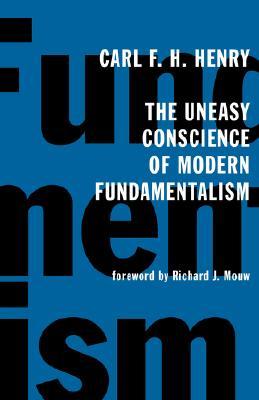
I recently read Carl F. H. Henry’s book The Uneasy Conscience of Modern Fundamentalism. Here are a few thoughts concerning applying Henry’s points to my life and ministry.

I appreciated Henry’s emphasis on the all-encompassing reality of Christ’s reign in the life of the believer.  I also appreciated his emphasis on Jesus being the answer for all that is wrong with the world.  Sin is the disease and Christ is the cure.  Every so-called answer other than Christ is a mere Band-Aid on a bleeding artery.  Only Jesus can save the man from his drugs, regenerate him, save his soul from hell, and provide him the Holy Spirit to compel him to go and sin no more.

I did not learn anything new in this work, but Henry did reveal inconsistencies in my life and ministry.  With the past Presidential election and the current emphasis on the economy in the media, it is tempting to think, even as an evangelical Christian, that we need more jobs and this can be sustained by a mere “moral” government or “moral” society.  Apart from the rule and reign of the Triune God, is there any sustainable morality?  No.  Also, will a good economy sustain man either physically or eternally?  No.  Is the chief end of man economic?  No.  I knew these answers prior to reading this book, but ashamedly, these realities were in the back of my mind instead of the front.  The truth of the all-encompassing reign of Christ will affect my ministry in how I present applying the moral commands in Scripture concerning loving one’s neighbor.  Continue at Jared Moore

Friday, December 7, 2012

Kevin DeYoung on Christ’s Empathy and Victory

Kevin DeYoung wrote an article in 2006 titled, “Divine Impassibility and the Person of Christ in the Book of Hebrews.”  I recommend the article.  I’ve included a summary below, followed by my response.

DeYoung, Kevin“Divine Impassibility and the Passion of Christ in the Book of Hebrews.”  Westminster Theological Journal 68 (2006): 41-50.

The doctrine of divine impassibility has lost favor within Christianity today.  Most believe that God suffers.  There are four main theological reasons why God’s impassibility is being rejected: 1) A suffering God is the only possible theodicy.  2) God is love, and if God is love He must enter into the pain of His creatures—anything less would be diabolical.  3) The biblical description of God in His passions must be taken at full face value and not diminished as anthropopathic language.  4) When Jesus Christ—the fullness of the Godhead in bodily form—suffered, He showed the true suffering nature of God Himself.  The concern of this paper is with this fourth reason.  According to those who argue for God’s passibility, the suffering of Christ must entail the suffering of God.  I disagree.  By looking at Hebrews, especially 2:5-18, I hope to demonstrate that God remains impassible even though the Impassible suffered in Christ.

This passage directs us towards two points crucial in our understanding of how Jesus Christ can suffer while God does not: 1) The incarnation involved some sort of change.  Christ the exact representation of God was made a little lower than the angels.  Not every thing Jesus did or felt revealed the character of God since He is fully human.  Jesus ate, slept, drank, etc.    Continue at Jared Moore

Monday, September 3, 2012

A Case for Cessationism: A Response to Dave Miller

Dave Miller recently wrote an article titled “God told me that the Bible does NOT teach Cessationism.”  Cessationism is the belief that the miraculous spiritual gifts detailed in Scripture have ceased, and are no longer present in the church.  I disagree with Miller’s article for many reasons:

1) He’s overly simplistic and dismissive. It’s undeniable that for over 1600 years of church history, the miraculous spiritual gifts were inactive in the church.  They were only present among heretics.  In spite of this fact, Miller believes cessationism is “hermeneutical wishful thinking.”  There must be a lot of wishful thinkers in church history!  You cannot dismiss hundreds of years of church history as hermeneutical wishful thinking.

2) The reason I’m a cessationist is because I believe the purpose of the miraculous gifts has ceased.  It’s not because of wishful thinking. I was raised a charismatic!  The reason I’m a cessationist is because I asked what Scripture identified as the purpose of the miraculous spiritual gifts.  The answer is that the miraculous gifts were given for the building up of the church so that early Christians could trust the truth being presented as coming from God (See where Christ healed one person out of a multitude in John 5:2-9 to validate His identity: Acts 2:22-23 ; Paul speaks of the signs of an apostle as proof for his apostleship in 2 Cor. 12:12; miracles were random in Scripture; and spiritual gifts were given to individual Christians to encourage and build up other Christians/the church: 1 Cor. 12:7 and the context of the chapter; Rom. 12:1-8; 1 Pet. 4:10-11).  Thus, the question is if this purpose is still needed today.  Does the message of Christ and the apostles need to be revalidated with each generation?  No.  The gospel spread without repeated validation for over 1600 years.  Furthermore, it’s a wicked generation who seeks a sign beyond the signs that have already been provided (Matt. 12:39). The person who says, “I’ll only believe the gospel if God . . .” reveals his or her unrepentant heart.  If he or she will not hear Scripture, he or she will not hear the message accompanied by miracles either (Luke 16:31).   Continue at Jared Moore