The purpose of this Blog is to introduce men and women all over the World to the Doctrines of Grace; the 5 Solas; Reformation Theology and the Lord and Savior Jesus Christ.
Showing posts with label Francis Schaeffer. Show all posts

Tuesday, April 23, 2013

Christians and the Environment

I am rather a skeptic when it comes to many of the claims of global warming and environmentalism. However, this skepticism about the prognostications of doom and gloom does not indicate that I am unconcerned about the planet we live on. It is quite the opposite, really. I want my skepticism to allow me to find better solutions than those posited by the green movement. I want my diagnosis of the problem and my understanding of solutions to be grounded in the Bible. I have been helped here by Francis Schaeffer and his book Pollution and the Death of Man. It is, in my assessment, still one of the best treatments of a Christian understanding of creation care.

Schaeffer begins with the reassurance that as Christians we are able to acknowledge what today’s secular humanists cannot: That mankind has been called by God to exercise dominion over the earth. We are not here by chance and we are not here by mistake. We were placed here by God to care for this planet and have been called to be faithful stewards of it. But like everything else in this world, our ability to exercise this kind of stewardship has been affected by our sinful state. “By creation man has dominion, but as a fallen creature he has used that dominion wrongly. Because he is fallen, he exploits created things as thought they were nothing in themselves, and as though he has an autonomous right to them.” We no longer consistently tend the world in love, but instead ravage and pillage it. Though we may not believe in all of the dire claims being made about the state of our planet and its perilous future, we must at least acknowledge that we have not cared for the world as God has called us to.   Continue at Tim Challies

Friday, April 19, 2013

Why Pastors Quit

Guest Blogger: Jason Helopoulos
 
Statistics regarding pastors are not encouraging. The Francis Schaeffer Institute of Church Leadership Development reports that 35-40% of ministers last less than 5 years in the ministry. Many statistics show that 60-80% of those who enter the ministry will no longer be laboring in the ministry 10 years later. Whether these statistics are right or not, it is clear that there are struggles with persevering in the ministry. I would suggest that the reasons below are the greatest struggles to perseverance in the ministry (though you are welcome to add others in the comments). As we consider each, I want to offer a little encouragement to young pastors and aspiring seminarians:

Conflict: This is arguably one of the biggest surprises to young pastors. Conflict happens in the church; and it happens all the time. Those in ministry will often be called upon to mediate conflict, navigate the waters of a conflict, and are regularly the target of much conflict. Pastors will find that there are hateful, petty, arrogant, rude, brooding, and discontent people in their congregations. Unfortunately, and coming as a surprise to many pastors, is the fact that the unconverted don’t tend to cause the majority of conflict; it is the converted who often launch the hardest persecutions. As William Still one said, “They want their part of the Gospel or their emphasis, usually that which they wrongly think does not touch them, call upon them, or challenge them.” It is also the true that pastors are often the source of conflict themselves. Sin, errors in judgment, and mistakes in leadership can cause firestorms.

Encouragement: When pastors are engaged in conflict, they must search their own hearts to see if their passions are out of control (James 4:1-2). Has sin had a way with them? This must be their first and foremost concern. However, most pastors will find that a great deal of conflict in the church will not be a result of their own personal sin. To survive, a pastor must not carry every burden and conflict. There are times to “let go” and move on. Thick skin and a tender heart are good traits for a pastor. You must teach without fear the whole counsel of God, stand by your convictions, and be winsome; but let the chips fall no matter who may be offended.     Continue at Jason Helopoulos

Tuesday, October 2, 2012

“Francis Schaeffer at 100″


Francis Schaeffer at 100

The year 2012 is the 100th anniversary of the birth of Francis Schaeffer (1912-1984). It is difficult to think of an evangelical figure in the 20th century who so seriously engaged the philosophies and ideologies of the secular world and set them over against the Christian worldview than Francis Schaeffer.

But Schaeffer was no ordinary evangelical. The man wore knickers and knee high socks when he lectured, sporting not only long hair but a goat’s-chin beard! Most importantly, Schaeffer did not fear man, but feared God. Not only did he engage secular worldviews, but he confronted his fellow evangelicals, even rebuking them for doctrinal concession and compromise.

As many have observed, it is not an overstatement to say that the Schaeffers transformed, reshaped, and in many ways reformed American evangelicalism. Those writing in this new issue of Credo Magazine are proof, each writer bearing testimony to how Francis Schaeffer has made a monumental impact on how we understand and articulate the Christian faith and life in the world of ideas. Contributors include Bruce Little, William Edgar, Bryan Follis, Stephen Wellum, and many others.

Here is a preview of the cover and table of contents to get you started!  Continue at CredoMag

Thursday, January 26, 2012

Know Your Evangelicals: Francis Schaeffer

Name: Francis A. Schaeffer (1912-1984)

Why you should know him: Schaeffer was one of the most influential figures in American evangelicalism in the period between World War II and the mid-1980s.

Previous roles: Founder of L'Abri Fellowship International; Lecturer and author of eighteen books.

Education:
B.A., Hampden-Sydney College
B.Div. Faith Theological Seminary
Honorary D.Div., Highland College

Area of expertise/interest: Apologetics, philosophy, Western culture, abortion, neo-Calvinism

Books: The God Who is There (1968); Escape from Reason (1968); Death in the City (1969); The Church at the End of the Twentieth Century (1970); The Mark of a Christian (1970); Pollution and the Death of Man (1970); The Church Before the Watching World (1971); True Spirituality (1971); Back to Freedom and Dignity (1972); Basic Bible Studies (1972); Genesis in Space and Time (1972); He is There and He is Not Silent (1972); The New Super-Spirituality (1972); Art and the Bible (1973); Everybody Can Know (1973); No Little People (1974); Two Contents, Two Realities (1974); Joshua and the Biblical Flow of History (1975); No Final Conflict (1975); How Should We Then Live? (1976); Whatever Happened to the Human Race? (with C. Everett Koop) (1979); A Christian Manifesto (1981); The Great Evangelical Disaster (1983)

Online essays and articles: Continue at Joe Carter

Tuesday, December 6, 2011

What Would Francis Schaeffer Say to the Gospel-Centered Movement?

As I recently read through Crossway’s collection of the Letters of Francis SchaefferI was struck by how applicable Schaeffer’s insights are today, particularly in regard to evangelical movements, leaders, and doctrine. His counsel deserves to be heeded by those of us in the “gospel-centered” stream of evangelicalism.

With this in mind, I have selected some favorite excerpts from these letters and woven them together creatively. Using Schaeffer’s own words, I am imagining out loud what counsel he might give us today.

What Francis Schaeffer Might Say to the Gospel-Centered Movement Today

1. Make sure your loyalty to Christ supersedes any loyalty you have for the “movement.”

[Brothers and sisters,] I see the need for Christians across the face of the earth who are indeed brothers in Christ, standing on the fundamentals of the faith and separated from unbelief, to come into personal fellowship one with the other to the praise of our Lord. And yet how quickly such a thing can grow into that which is merely cold, formal, and dead. The cry of my heart is that God may have mercy on us.

I increasingly see the dangers involved in organization, and I do think that most of us get the cart before the horse. That is, we organize first and then go forward, rather than growing close to one another through spiritual and personal contacts and then letting whatever organization grow naturally out of that-as the tree puts forth the leaf and then the bud and then the flower as the Lord leads.   Keep Reading >>>

Wednesday, October 26, 2011

Purity, Power, and the Missing Mark of the Church

Arguably the best general description of the effect the New Testament Church had on its society is given by Luke in Acts 17:6. When an unruly mob could not find Paul and Silas — the source of their irritation — they dragged other Christians before the city officials and declared, “These men who have turned the world upside down have come here also” (Acts 17:6). What was intended as a damning criticism, however, was actually an unintended accolade because unbelievers were admitting that the early Christians were having a substantial impact upon society, a society characterised by polytheism, gladiatorial combats, sex outside of marriage, divorce, infanticide, and abortion. This account sounds just like life in early twenty-first century Western civilization, doesn’t it? Well, it does, except for the bit about the church turning the world upside down.

Our postmodern, pluralistic society is not far removed in essence from first-century Graeco-Roman society. Ungodliness is still here, immorality is still in evidence, and the life-is-cheap attitude still pervades. But society in the West does not really notice or take seriously the church. Why? Could it be because the reality of the living God is not being seen in the Western church? Could it be because there is no attention-grabbing evidence of the transforming power of the gospel? Could it be because, to some extent, the sign ichabod is metaphorically hanging over the doors of many sanctuaries and around the necks of many Christians? And if all this is the case, why is it the case? Could it be because, generally speaking, Christians in the West are simply not as devoted to the Apostles’ teaching as we should be? I am increasingly convinced that this is the case.   Keep Reading>>>

Tuesday, August 2, 2011

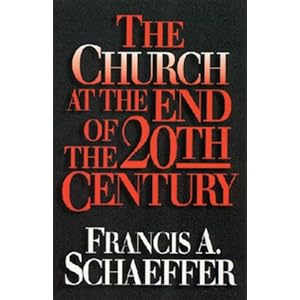
The Church at the End of the Twentieth Century

"He is the image of the invisible God, the firstborn of all creation.  For by Him all things were created, whether in heaven or on earth, visible and invisible, whether thrones or dominions, rulers or authorities-all things were created through Him and for Him.  And He is before all things and in Him all things hold together.  And He is the head of the body, the church.  He is the beginning, the firstborn from the dead, that in everything He might be preeminent," Col. 1:15-18.

You will probably notice fairly quickly that I give positive reviews to almost all the books I read.  The reason for that is simple: I don't have time for nonsense.  As a husband and father with a job that takes a lot of time to do to provide for my family, I simply see no reason to read something that will not, from all indications, be edifying.  I tend to read blogs and articles in which I'm often in disagreement but those are not terribly time consuming.  Now that I've made this point I'm certain that I will probably come across a book that will inspire a negative review and, in fact, I think I may be reading a commentary that fits that bill!   Keep Reading...

Friday, July 29, 2011

Accommodation or Separation?

While it is true that we live and minister within a cultural setting, there will inevitably be certain aspects of the culture that we cannot embrace or celebrate. We are called to be in the world, but not of the world.

Though we make every effort to present the gospel message with excellence and effectiveness to the world around us, we should be careful to do so in a way that both stays true to the biblical gospel and stays within the biblical boundaries of moral propriety. Catch-words like “relevance” and “contextualization” are not a valid justification for condoning coarse speech or morally-questionable behavior in order to identify with certain youth subcultures.

The power of the gospel is not in us, our cleverness, or our ability to camouflage with the culture. Thus, we don’t need to cuss to reach sailors, or drink to reach alcoholics; and we certainly don’t need to engage in sinful enterprises in order to reach sinners. To use fleshly methods to reach the lost is self-defeating, bringing a reproach on the pure name of the Savior we proclaim.   Keep Reading...

Wednesday, July 13, 2011

The Turning Point of Francis Schaeffer’s Life and Ministry

In 1951 Francis Schaeffer’s life and ministry were turned upside down, despite already having walked with the Lord for many years and having seen much fruit in ministry. He was 39.

In the introduction to his book True Spirituality, Schaeffer recounts what happened.

I faced a spiritual crisis in my own life. I had become a Christian from agnosticism many years ago. After that I had become a pastor for ten years in the United States, and then for several years my wife, Edith, and I had been working in Europe. During this time I felt a strong burden to stand for the historical Christian position and for the purity of the visible church. Gradually, however, a problem came to me—the problem of reality. This has two parts: first, it seemed to me that among many of those who held the orthodox position one saw little reality in the things that the Bible so clearly says should be the result of Christianity. Second, it gradually grew on me that my reality was less than it had been in the early days after I had become a Christian. I realized that in honesty I had to go back and rethink my whole position. Keep Reading...

Monday, May 30, 2011

Francis Schaeffer’s Works Online in MP3 Format

Francis August Schaeffer (30 January 1912 – 15 May 1984)[1] was an American Evangelical Christian theologian, philosopher, and Presbyterian pastor. He is most famous for his writings and his establishment of the L'Abri community in Switzerland. Opposed to theological modernism, Schaeffer promoted a more Historic Protestant faith and a presuppositional approach to Christian apologetics, which he believed would answer the questions of the age. A number of scholars credit Schaeffer's ideas with helping spark the rise of the Christian Right in the United States. Schaeffer's wife, Edith (Seville) Schaeffer has become a prolific author in her own right. Schaeffer is also the father of author, filmmaker and painter Frank Schaeffer
 
Wikipedia

Francis Schaeffer MP3s


Monday, August 30, 2010

God, the Gospel, and Glenn Beck

It’s taken us a long time to get here, in this plummet from Francis Schaeffer to Glenn Beck. In order to be this gullible, American Christians have had to endure years of vacuous talk about undefined “revival” and “turning America back to God” that was less about anything uniquely Christian than about, at best, a generically theistic civil religion and, at worst, some partisan political movement.
Rather than cultivating a Christian vision of justice and the common good (which would have, by necessity, been nuanced enough to put us sometimes at odds with our political allies), we’ve relied on populist God-and-country sloganeering and outrage-generating talking heads. We’ve tolerated heresy and buffoonery in our leadership as long as with it there is sufficient political “conservatism” and a sufficient commercial venue to sell our books and products. Read the rest HERE

Thursday, April 22, 2010

Rahab the Prostitute: Trophy of Grace

Rahab was a pagan Canaanite woman who slept with way too many men. We might imagine her being a chain-smoker with an ankle tattoo that said “YRCH” (the moon-deity that Jericho was probably named after). At this point some want to make the Bible a little more pious than it is (reduce it from “R” to “PG”). For example, Matthew Henry said Rahab used to be a prostitute but by the time the spies came she was a dainty Proverbs 31 woman because she worked so hard making the flax roof. I love Matthew Henry, but that’s just bad. A better perspective, I think, is that of Francis Schaeffer in Joshua and the Flow of Biblical History. Read it all HERE

Wednesday, December 30, 2009

Patience with God - Faith for People Who Don’t Like Religion (or Atheism)

For all his insights into the new atheism, Schaeffer's views on God, the Bible, Evangelicals, and salvation leave much to be desired.

Frank Schaeffer is the "prodigal son" of Francis and Edith Schaeffer—leading Evangelical thinkers of the 1970s and 80s. Among his earlier books, Frank’s Crazy for God is his tell-all exposé of everything he thinks is wrong with the "Religious Right." The sub-title of that memoir says it all: How I Grew Up As One of the Elect, Helped Found the Religious Right, and Lived to Take It All (Or Almost All) of It Back.

Having deemed the faith of his parents hypocritical and unreasonable, Frank now journeys to discover a faith of his own. Like all people, Frank sees his own faith as the happy medium between competing extremes. Thus, Patience with God unfolds in a three-fold way. Read the rest HERE