The purpose of this Blog is to introduce men and women all over the World to the Doctrines of Grace; the 5 Solas; Reformation Theology and the Lord and Savior Jesus Christ.
Showing posts with label Thabiti Anyabwile. Show all posts

Thursday, June 5, 2014

Are Christians Prone to Over-Compensate for Cultural “Losses”?

Is the state of the culture a report card for the church?

I think I first heard Kevin DeYoung and John Piper ask and answer that question. They both concluded “no.” I think I agree with them. There is no direct relationship between the effectiveness of the church and the broader unbelieving culture.

Yet, it seems most Christians tend to assume a relationship. If the church was doing _____ then the culture wouldn’t ______. Because the church is weak in _____ the society is experiencing ______.

Many Christians too readily draw these kinds of conclusions. I think it’s well-intended. What Christian doesn’t want to see the church have a lasting positive impact on their society?    Continue at Thabiti Anyabwile

Saturday, October 12, 2013

The Gay Marriage Debate

Recently I’ve attempted to argue that in our discourse about homosexuality we need to return the discussion to the basic description of the acts themselves. I’ve suggested  that on two grounds, one fairly implicit, the other stated explicitly. Implicit in my previous posts was the assumption that the entire premise of homosexuality as social identity needs to be questioned. I didn’t develop this thought, but it was working in my description of how the public conversation about homosexuality turned so quickly and decisively. The more explicit statement was that we need to turn the conversation to the sex acts themselves because the success of the pro-homosexuality campaign depends on our not considering those things actively.

This week a couple of pieces make those points far more eloquently and  helpfully than I could  ever do.

Understanding the Perception and Rhetoric

The first comes from a New Yorker profile of Edith Windsor, the plaintiff in the DOMA case. At one point in the interview, the discussion turns toward rhetorical strategy and public perception. Here’s the relevant bit:   Continue at Thabiti Anyabwile

Wednesday, June 19, 2013

Should We Stop Saying, “The Church Hurt Me”?

I hear the statement quite often. Usually it’s raised in discussions of church membership. People want to know how to help a wounded friend or family member re-engage the church. Or, they’re the ones who have been hurt and they’re wrestling with whether church is worth it. Some want to be convinced to join a church and others want to be told it’s okay to leave. Answering well depends, in part, on knowing which way the person leans.

But recently I’ve been thinking that part of the answer must include questioning the way the problem is phrased. What does the person mean when they say, “The church hurt me”? Let’s walk the possibilities backward from the most sweeping accusation to the most narrow.

The Universal Church

The person could mean the big-C Church has hurt them–all Christians everywhere. That sounds ridiculous, doesn’t it? But think about it. When a person says “The church has hurt me” and they’re refusing to visit or join any local congregation of believers they have practically projected their hurt onto the entire universal body of Christ! They have assigned their offense to every possible Christian and Christian congregation imaginable. Practically, their distrust has reached universal proportions. In every case this is false. We might provide some of our best care by helping our friends recognize the practical universalism in some of their reactions. Hopefully we can get them to dial it down to the next possible  level.   Continue at Thabiti Anyabwile

Thursday, April 25, 2013

The Pastor’s Heavy Happy Heart

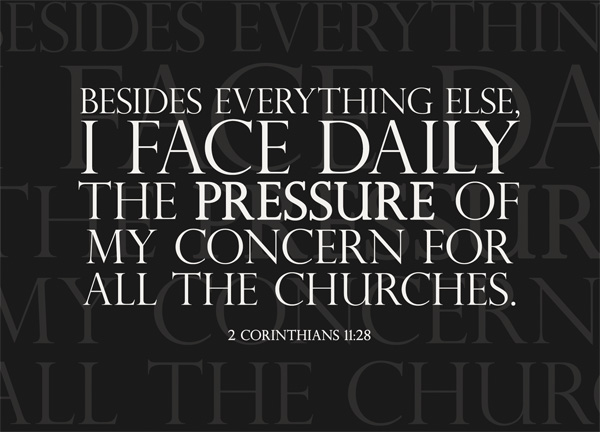
“Besides everything else, I face daily the pressure of my concern for all the
churches.” (2 Cor. 11:28)

That’s how the apostle Paul capped off a long list of afflictions suffered in service to Christ. He spoke of his hard work, imprisonments, floggings, exposure to death, stonings, shipwrecks, natural disasters, bandits, betrayals, sleeplessness, hunger and thirst, and physical need. That’s a partial listing of the “everything else.” Yet, there’s a “besides” that’s always intrigued me. Besides, in addition to, over and beyond, on top of the many sacrifices and afflictions, there’s one more thing. We get the sense that this one thing stresses Paul more than all the other things. We have the sense that this additional thing nearly breaks Paul. Perhaps it’s his wording. Or perhaps it’s the placement at the end of the list. Or, maybe it’s the opening clause, “Besides everything else,” that sets this apart to the reader. Maybe it’s all three.

What is it?

Paul writes, “I face daily the pressure of my concern for all the churches.” We might say the great apostle was “burdened” for the local churches. He carried that concern or burden for “all the churches”–not just the churches he knew or served. We witness him writing letters to congregations he never visited or saw personally. We read of his concern for churches that were rejecting his ministry and teaching, even questioning his apostolic authority. And we have the privilege of eavesdropping on his love for the churches he nursed like a mother and guided like a father, even if only for a matter of weeks. Wherever Christ’s bride was found or known, Paul cared. “All” magnified his concern.   Continue at Thabiti Anyabwile

Tuesday, April 16, 2013

CHH: “Christian Hip Hop” or “Controversial Hip Hop”

I’m just back from a refreshing and edifying time with saints at New Word Alive. New Word Alive is a family Bible conference held each year in North Wales. If you’re in the U.K.,  I can’t recommend it enough for its focus on the word of God, evangelism, and Christian fellowship. It was a joy to take part.

Of course, spending a week at a largely internet-free campground in North Wales means you’re a little out of the loop when it comes to the goings ons of the Christian world. And when it’s the world of Christian hip hop, the cultural black hole is even more pronounced. I loved the saints at New Word Alive, and the worship was wonderful, but there wasn’t much boom-bap happening.

So, I was a little surprised to see some of the internet brouhaha over shai linne’s new single, “Fal$e Teacher$.” In the single, shai takes aim at a host of prosperity gospel and word-faith teachers. It’s not the first time he (or others for that matter) has critiqued such teaching in his music. In response to the single, Bradley Knight, son of Paula White, posted an open letter to shai in defense of his mother’s ministry. Christianity Today picked up on the issue. Lisa Robinson at Parchment and Pen offered reflections based on her years inside prosperity congregations. Mark at Here I Blog added some source support for the song’s denunciations. Those were the first 4-5 entries in my quick google search. I’m sure there’s tons more opinion out there!

The back and forth has conjured the usual questions about whether private conversation should have happened first, whether public criticism and naming names is appropriate and under what circumstances, and whether Christian unity and charity ought to rule out polemics.   Continue at  Thabiti Anyabwile

Tuesday, January 8, 2013

Lay Elders: A User’s Guide, Part 2

9Marks has just released its latest edition of the eJournal. This edition focuses on lay elders and raises some very helpful discussion on the relationship (sometimes delicate) between staff and lay elders. See here. You can find part 1 of this issue here.

Here’s an introductory note from Jonathan Leeman:
You don’t become a “band of brothers” just by showing up. You need to face battle together, as well as work through all the disagreements and sins that arise along the way. My friend Matt Schmucker often observes that more apologizing happens during our elder meeting bathroom breaks than at any other time he knows. It is a consecrated commode.
An elder’s first priority is the sheep, but shepherds who don’t know how to love one another compromise their ability to serve the sheep.
A good word there! Check out the table of contents:

Elder Relationships

 
How elders relate to each other will impact how they relate to the flock, for good or ill. Here are a few ideas for helping elders build deep friendships and sturdy unity.   Continue at Thabiti Anyabwile

Wednesday, December 19, 2012

Challenges Pastors and People Face During the Holidays

Tis’ the season to be jolly, right? Well, for some of us, but not all of us. While the entire world seems to glitter in tinsel, some people sit caves of gloom during the holidays. It’s easy to forget that suffering takes no vacation at Christmas. So, not to be a killjoy, but perhaps to awaken us to some opportunities around us, here’s five challenges that pastors and people face during the holidays.

1. Fatigue
Let’s face it, the holidays can be devoid of both holiness and rest. Many of us face an onslaught of office parties, children’s performances, church programs, and travel. For all of us–especially pastors expected to attend or officiate every event–the pace and activity can be exhausting. Chances are we were tired coming into the season, so it can feel as if the season of cheer is about to do us in. How can we make Christmas and New Year’s a real period of rest?

2. Resentment
One effect of fatigue is resentment. Rather than participate in the season’s rituals, we can develop a “Bah! Humbug!” attitude. The recital looms over the horizon and dark clouds begin to brew. Another sermon needs to be written and the heart fights in resistance.

3. Loss and Grief
Chances are some of us have lost loved ones in the past year and this Christmas will be the first one since their death. Everything will be different. All the celebrations will actually prompt mourning. And the family gathering won’t quite be complete. It’s a challenge to muster up seasonal vibes when all you can think about or feel is that real loss and grief from the past year or more. It’s a challenge to make sure that we mourn with those who mourn–even during holidays.    Continue at Thabiti Anyabwile

Friday, September 28, 2012

Does Your Church Have Policies and Practices to Protect Against Pastoral Failures?


Remember the names Ted Haggard, Eddie Long, and Jack Schaap?  Scandal among evangelical pastors has been so steady that wikipedia has a list of evangelical scandals.

While working on a chapter for an upcoming book, I had the blessing of researching the moral failures of several prominent church pastors.  I say “blessing” because it was enlightening to observe some common dynamics and failures in the scandals.  In most cases, men who should have been disqualified were back in their pulpits or establishing new ministries within months.  In most cases, churches were seriously injured by the transgressions and hurt further by the inadequate efforts at redress.  In all the cases, the offending pastor received more attention and support than the victims of his abuse or deceit.  It was a sobering exercise.

The effects are devastating.  Two researchers at Baylor University have summarized the social and psychological effects of clergy sexual misconduct on congregations .  Studies:
suggest that the results for the offended include self-blame; shame; loss of community and friends if forced to relocate either to escape the community’s judgment or to escape an angry offender who has been discovered or reported; spiritual crisis and loss of faith; family crisis and divorce; psychological distress, including depression and post-traumatic stress disorder; physiological illness; and failed or successful suicide attempts.[1]
All of this carnage begins with a process researchers call “grooming.”
Grooming includes expressions of admiration and concern, affectionate gestures and touching, talking about a shared project, and sharing of personal information (Carnes, 1997; see also Garland, 2006). Grooming may be gradual and subtle, desensitizing the congregant to increasingly inappropriate behavior while rewarding her for tolerance of that behavior. Offenders may use religious language to frame the relationship, such as “You are an answer to my prayer; I asked God for someone who can share my deepest thoughts, prayers, and needs and he sent me you” (Liberty, 2001, p. 85). Grooming is essentially seduction in a relationship in which a religious leader holds spiritual power over the congregant.[2]   Continue at Thabiti Anyabwile

Thursday, August 23, 2012

Meeting Muslims and Islam: On Love and Discernment


Eboo Patel is the author of  Sacred Ground: Pluralism, Prejudice and the Promise of America and founder and president of Interfaith Youth Core.  He recently penned an opinion piece for CNN entitled “How Evangelicals Can Learn to Love Muslims.”  Caught my eye.  Patel marvels at the evangelical political embrace of conservative Roman Catholics, a group that just 60 years ago would have faced the same kind of suspicion and scrutiny that Mormon presidential candidates deal with.  In the piece, Patel describes Islam as “the new Catholicism.”  To make his point, Patel quotes no less an “evangelical” authority than Norman Vincent Peale:
“Our freedom, our religious freedom, is at stake if we elect a member of the Roman Catholic order as president of the United States,” Norman Vincent Peale told a conference of evangelical leaders in September 1960.
Materials handed out at the Peale conference claimed ‘Universal Roman Catholicism’ was both a religion and a political force whose doctrines were ultimately incompatible with the American ideals of freedom, equality and democracy.
Then Patel makes his analogy:

Replace “Roman Catholic” with “Muslim” and “Church hierarchy” with “caliphate” in those pronouncements and today we are witnessing a similar energy directed against a different faith community using largely the same categories.

In today’s parlance, Kennedy was part of a stealth jihad meant to replace the U.S. Constitution with sharia law and practicing taqqiyya to mask this dawa offensive.  Continue at Thabiti Anyabwile

See also: Christ & Islam

Saturday, May 12, 2012

Lust & Chastity

We often think that “our day and age” differs significantly from previous eras. We tend to think that our day presents more dangerous and stubborn problems, requiring more complex and sophisticated solutions, from wiser and nobler people, namely ourselves. Someone has dubbed this attitude “chronological snobbery.” 

But one thing puts the lie to this self deception — the continuing existence and destruction of lust.

Earlier Christians wisely included lust among the deadliest sins. For lust is the impregnated parent of all forms of sin. James explained that “each person is tempted when he is lured and enticed by his own desire. Then desire when it has conceived gives birth to sin, and sin when it is fully grown brings forth death” (James 1:14–15).

From the first stolen bite of forbidden fruit to the avaricious gaze of mall-bound window shoppers, lust has coursed through the hearts of men like the most poisonous venom. 

Lust involves any strong desire, craving, or want that opposes the holy will and command of God. Lust perverts, twists, and defiles all that is good and beautiful, and this is particularly true with sexual or carnal lust.

For example, some people today tout homosexuality as an “orientation” equal in virtue to heterosexuality. They appeal to the “love” shared between two persons of the same gender, and on that basis, contend that equality and public acceptance must be guaranteed. To some, these sexual passions are so strong as to appear innate. Moreover, we are told that homosexual desires are private, harmless to others, and beyond the censure of society.   Continue at Thabiti Anyabwile

Friday, April 6, 2012

The Death of Death in the Death of Christ Means Victory Over Death for Those Who Believe

All the gospel writers tell us that Jesus died on the cross.

Jesus died.  The fact is so commonplace it seems strange to even mention it.  Almost hollow.  Almost as if we’ve said nothing new or meaningful.  But “new” and “meaningful” are two very different things. We’re sometimes too accustomed to thinking that meaning comes from newness.  Old truths are still true, and therefore still very meaningful.  Because a thing is familiar, because we’ve heard it before, does not mean we can pass it by without reflecting on its meaning.

Jesus died.  What can it mean to say the Son of God died?  And how should the Christian respond to that news?

The death of Jesus Christ means the death of death itself.  The death of death in the death of Jesus Christ also means victory over death for those who trust in Christ as their God and Savior.

What Exactly Is ‘Death’?

Six things.

First, death is a curse.
15 The LORD God took the man and put him in the Garden of Eden to work it and take care of it. 16 And the LORD God commanded the man, “You are free to eat from any tree in the garden; 17 but you must not eat from the tree of the knowledge of good and evil, for when you eat of it you will surely die.” (Gen. 2:15-17)
Second, death is a wage.
“For the wages of sin is death….”  (Rom. 6:23)
Third, the Bible calls death an enemy
“Death has climbed through the windows and has entered our fortress; it has cut off the children from the streets and the young men from the public squares.”  (Jer. 9:21) Death is an enemy that stalks us and threatens us.  This is why we hate it so.  We deserve death because of our sin, but we hate it “The last enemy to be destroyed is death.” (1 Cor. 15:26)
Fourth, death is agony.
“In hell, where he saw he was in torment, he looked up and saw Abraham far away, with Lazarus by his side.  So he called to him, ‘Father Abraham, have pity on me and send Lazarus to dip the tip of his finger in water and cool my tongue, because I am in agony in this fire’.” (Luke 16:23-24) “But God raised him from the dead, freeing him from the agony of death, because it was impossible for death to keep its hold on him.” (Acts 2:24)
Fifth, we can speak of both a physical death and a spiritual death.
“As for you, you were dead in your trespasses and sins, in which you used to live when you followed the ways of this world and of the ruler of the kingdom of the air…. We were dead in transgressions…” (Eph. 2:1-2, 5)    Continue at Thabiti Anyabwile

Wednesday, April 4, 2012

What Does It Mean for the Father to Forsake the Son? (Part 1)

Someone has described the four Gospels as “passion narratives with extended introductions.”  Indeed.  All the action and teaching prior to the passion of Christ serves as harbinger to the suffering to come.  The scenes grow more affecting from Gethsemane.  The intensity swells until the heart nearly bursts. 

 Consider Matthew 27:
32 As they were going out, they met a man from Cyrene, named Simon, and they forced him to carry the cross. 33 They came to a place called Golgotha (which means The Place of the Skull). 34 There they offered Jesus wine to drink, mixed with gall; but after tasting it, he refused to drink it. 35 When they had crucified him, they divided up his clothes by casting lots. 36 And sitting down, they kept watch over him there. 37 Above his head they placed the written charge against him: THIS IS JESUS, THE KING OF THE JEWS. 38 Two robbers were crucified with him, one on his right and one on his left. 39 Those who passed by hurled insults at him, shaking their heads 40 and saying, “You who are going to destroy the temple and build it in three days, save yourself! Come down from the cross, if you are the Son of God!”
 41 In the same way the chief priests, the teachers of the law and the elders mocked him. 42 ”He saved others,” they said, “but he can’t save himself! He’s the King of Israel! Let him come down now from the cross, and we will believe in him. 43 He trusts in God. Let God rescue him now if he wants him, for he said, ‘I am the Son of God.’” 44 In the same way the robbers who were crucified with him also heaped insults on him.
45 From the sixth hour until the ninth hour darkness came over all the land. 46 About the ninth hour Jesus cried out in a loud voice, “Eloi, Eloi, lama sabachthani?”—which means, “My God, my God, why have you forsaken me?”   Continue at Thabiti Anyabwile

 What Does It Mean for the Father to Forsake the Son? (Part 2)

Tuesday, April 3, 2012

What Does It Mean for the Father to Forsake the Son? (Part 1)

Someone has described the four Gospels as “passion narratives with extended introductions.”  Indeed.  All the action and teaching prior to the passion of Christ serves as harbinger to the suffering to come.  The scenes grow more affecting from Gethsemane.  The intensity swells until the heart nearly bursts. 

Consider Matthew 27:
32 As they were going out, they met a man from Cyrene, named Simon, and they forced him to carry the cross. 33 They came to a place called Golgotha (which means The Place of the Skull). 34 There they offered Jesus wine to drink, mixed with gall; but after tasting it, he refused to drink it. 35 When they had crucified him, they divided up his clothes by casting lots. 36 And sitting down, they kept watch over him there. 37 Above his head they placed the written charge against him: THIS IS JESUS, THE KING OF THE JEWS. 38 Two robbers were crucified with him, one on his right and one on his left. 39 Those who passed by hurled insults at him, shaking their heads 40 and saying, “You who are going to destroy the temple and build it in three days, save yourself! Come down from the cross, if you are the Son of God!”
 41 In the same way the chief priests, the teachers of the law and the elders mocked him. 42 ”He saved others,” they said, “but he can’t save himself! He’s the King of Israel! Let him come down now from the cross, and we will believe in him. 43 He trusts in God. Let God rescue him now if he wants him, for he said, ‘I am the Son of God.’” 44 In the same way the robbers who were crucified with him also heaped insults on him.
45 From the sixth hour until the ninth hour darkness came over all the land. 46 About the ninth hour Jesus cried out in a loud voice, “Eloi, Eloi, lama sabachthani?”—which means, “My God, my God, why have you forsaken me?”   Continue at Thabiti Anyabwile

Friday, February 24, 2012

Should We Drop “Son of God” in Bible Translations for the Sake of Reaching Muslims?

No.  Honestly, I can’t think of a more damaging action than the translation attempts some groups are making in predominantly Muslim countries. 
 
 Dropping the familial language “Son of God” or “God the Father”:

1. Undermines the perceived integrity and reliability of the Scriptures;

2. Robs the Church of centuries of theological reflection and meaning, including Trinitarian orthodoxy, Christology, and more;

3. Betrays the radical sacrifices that believers are making in these lands for these truths; and,

4. Tends toward a denial of the uniqueness of the gospel witness itself.

World Magazine’s current article, “The Battle for Accurate Bible Translation in Asia,” hits all the issues on the head.  I heartily commend it.  Here’s the opening paragraphs:

Fikret Bocek says that Turkish quince, a fruit like a pear, takes a long time to grow and ripen, but it’s delicious. Patience is key for good quince, he says, and also for the salvation of his fellow Turks, most of whom are Muslim like he once was.

Patience was key when the Turkish police arrested and imprisoned him for 10 days in 1988, when he was beaten, verbally abused, and tortured with electrical shocks. The police ordered Bocek, then a teenager and a new convert to Christianity, to recite the shahada, “There is no God but Allah.” Despite a crippling fear, he found he could not physically open his mouth to say it, which he attributes to divine intervention.  Continue at Thabiti Anyabwile

Wednesday, February 8, 2012

Putting a Face on Destruction

In all of our discussions, we might forget that the theology we’re debating has a human face.  On the other end of our words, our blogs, and our preaching are people.  Listening people.  People who believe and trust us.  People who–tremble at this–take our teaching seriously and act on it.  There may be only a few people in our homes that listen to us, or there may be several dozen in our churches, or there may be an untold number across the globe tuning in through some electronic media. 

But make no mistake about it, if a tree falls in the woods it does make a sound even if you don’t immediately see anyone around to hear it.  They’re there and they’re listening.

A couple of days ago my wife posed a question to me.  Standing over the kitchen counter she asked, “Do you think anyone has really illustrated what the problem is with Jakes’ teaching?”  She explained that she was quite aware of the many theological discussions at work.  But she was looking for someone to actually illustrate the problems stemming from the teaching of Jakes and others like him.  I pondered that for a moment and realized she was correct.  We didn’t have a picture of Jakes’ effect on real lives.  That’s why I call her “Kristie the Wise.”

So, perhaps it would be wise for us to stop for a moment to remember the very real people who sit under the false teaching of people like T.D. Jakes.  We need to put a face on the destruction caused by heterodoxy (“prosperity gospel”) and heresy (modalism).  To that end, I want to share with you an email I received from a brother after ER2.  He wrote with a concern very similar to my wife’s.  He wanted to share his story as an illustration.  I offered to share it anonymously, but he wanted to leave his name in it–Sean.  In his words, he wanted to “put a face to it.”

Here’s Sean’s brief account:  Read it all at Thabiti Anyabwile

Tuesday, October 11, 2011

Let’s Talk about “Celebrity” and “Rock Star” Pastors

Increasingly we’re seeing the terms “rock star pastor” and “celebrity pastor” tossed about. Even though most people acceptably follow and patronize their favorite celebrity actors and performers, and a good number of us grew up idolizing “rock stars” (although, for me, it would have been rap–not rock), the terms in an Evangelical context are pejoratives, derogatory terms of abuse, expressions of contempt. In fact, there’s a good case to be made that most uses of the terms “celebrity pastors” or “rock star pastor” amount to uncharitable slurs.

I hate the terms.  I really do.  They tar and feather good men.

The increasing use of the terms does suggest a need to address an increasing problem.  Now, please don’t rush in judgment to conclude that the problem is the “celebrification” of pastors.  That’s only one potential problem.  The other potential problems have to do with the hearts of those who would use expressions of contempt and uncharitable slurs in the first place–particularly without knowledge of the person they’re so labeling.
 
So, it seems a good review of these terms is in order.  I’m feeling particularly interested in taking up this issue because in the last week the terms have come home to roost.  Following my post on multi-site churches, a couple dear brothers wrote to me privately to push back on the rhetoric, tone, and substance of the post.  Those were wounds of friends.  Both brothers in some way intimated that I might be a “celebrity pastor,” or at least face some of the same challenges as those I criticized in the post.  That was alarming, and the suggestion has by God’s grace been working good fruit of reflection in my own soul.  It immediately revealed that my own sinful pride came to the foreground in that post.  At the very least, I should have confessed more fully that everything in the post regarding pride and the temptation to idolizing self or others is true of my own heart.  I don’t need to leave the bed in the morning before I’m confronted with the corruptions of my own heart.  While I do think there’s a difference of degree created by some forms of the multi-site strategy, I should have made it more clearly known in the post itself (not just in the comments) that there is no difference in kindall of our hearts are idol factories–beginning with my own heart.   Keep Reading...

Monday, October 3, 2011

Collateral Damage in the Invitation of T.D. Jakes to the Elephant Room

In 2007, the Lord granted me the privilege of publishing The Decline of African-American Theology: From Biblical Faith to Cultural Captivity (IVP).  The book was a labor of sorrow and love–sorrow because of how sharp and deep theological decline has been since the first writing African Americans of the late 1700s and early 1800s, and love because I ache to see my kinsmen according to the flesh brought into the gracious realms of God’s salvation.  For me, the book was an attempt to (a) accurately trace the history of African-American theology using available primary source material, and (b) fulfill a pastoral obligation to advance the gospel and refute error (Titus 1:9).

Because the book “breaks rank” and “the party line,” I expected to be alone against an avalanche of criticism and angry protest.  But the Lord has a people who have not bowed the knee to the baals of theological heresy, a people who want to know the truth and who instinctively if not explicitly knew something had gone wrong in the African-American church.  Jesus’ sheep hear and know His voice, and they follow Him.  Instead of an avalanche of criticism, I’ve pretty much heard a chorus of “Finally” and “It’s about time!”

When theologically conservative, Evangelical or Reformed African Americans call for reform in the African-American church, they feel like midgets facing the titans and juggernauts of a word-faith, charismatic pantheon.  The task can seem so daunting and isolating.  Internally, there’s the constant fight with unbelief and resignation.  There’s wrestling with questions like “Can the African-American church be reformed?”  ”Is the church essentially apostate?”  Sometimes these questions have more to do with us than they have to do with the church.  But the questions illustrate how intense and serious a battle this is.   Keep Reading...

Wednesday, September 28, 2011

Multi-Site Churches Are from the Devil

Okay, that title is homage to James MacDonald, who says congregationalism is from Satan and whom I had the privilege of spending a couple days with at the recent 9marks @ Southeastern Conference.  During the Baptist21 Panel, our moderator stirred up a bit of a hornet’s nest by asking me what I thought about multi-site churches.  Why me? I thought.  Mark Dever is sitting right there.  He loves talking about this stuff.  Aww… man.  Ask me about basketball.

So, after I finished my pity party, I answered my brother’s question, stated something like: “Thabiti, what arguments for multi-site have you found persuasive?”  My articulate response: “Uh, none.”

Okay, this should be the end of the post.  But because I’m in the Miami airport and the people-watching has become a bit weird, I think I’d rather invite you all to my misery and discovery.

Idolatry
At bottom, I think the kind of multi-site churches (realizing there are a few different approaches) that feature one pastor being beamed into several sites around a region—and in some cases around the country or world—is simply idolatry.  It’s certainly cult of personality multiplied and digitized for a consumer audience.  As a brilliant young man remarked to me this morning, “The pastor now becomes the new icon in the midst of the Protestant worship service.”  I think that’s well said.  Video multi-site tends to idolatry, pride, and self-promotion—even where the ambition of spreading the gospel is genuine.  In other words, the ends do not justify the means because some of the ends produced will undoubtedly be odious in God’s sight.   Keep Reading...

Tuesday, September 27, 2011

Galatians, Gospel Indicatives, and Gospel Imperatives

At last week’s 9Marks @Southeastern conference, our conference host and seminary president Dr. Danny Akin delivered an overview sermon on the entire book of Galatians.  Get this: the sermon had two major divisions with 42 subpoints!  Don’t try this at home kids!

Essentially, Akin walked us through the book of Galatians commenting on the 29 indicative statements Paul makes about the gospel and the 13 imperatives that flow from them.  If you’ve been following the blog discussion of the relationship between indicatives and imperatives then you might be interested in this talk and the panel that followed.  Akin makes it plain that out of the “done” (indicatives) there flows a “do” (imperatives).

For those that are curious, here are the 29 gospel indicatives and 13 gospel imperatives Akin highlighted:

29 Indicatives
1. The gospel is rooted in the death and resurrection of Jesus Christ (Gal. 1:1).

2. The gospel delivers us from the present evil age to the glory of Christ (1:3-5).

3. There is only one gospel and to desert it is to be damned (1:6-9).

4. The gospel is ours by divine revelation and not human imagination (1:10-12).

5. The gospel is grounded in a gracious election (1:15).

6. The gospel is constantly in danger of being lost and needs to be defended (2:4-5).

7. The gospel that saves Gentiles is the same gospel that saves Jews (2:7-9).

8. There are ethical imperatives that follow the gospel (2:11) and no ethnic distinctions in the gospel (2:12-14).

9. The gospel is good news that we are justified by faith in Jesus Christ and not by works of the Law (2:15-16).

10. Through the gospel, we are identified with Christ and His work on the cross (2:20).   Read the all HERE

Wednesday, August 31, 2011

Spiritual Depression: Its Causes and Cures

I’ve begun reading the book I most wanted to read during vacation, D. Martyn Lloyd-Jones’ Spiritual Depression: Its Causes and Cures.  Recently a new friend gave me a hardback copy published by Granted Ministries.  It’s a handsome volume with an insightful foreword by Geoffrey Thomas.

I know, I’m late to the Spiritual Depression party.  I’ve heard it quoted often.  Many people have shared personal testimonies about how much it’s helped them.  

And on the strength of the quotes (often extended), the personal recommendation of friends, and my general love and trust for Lloyd-Jones, I’ve recommended the book a number of times myself.  But until now, I’ve actually never read it.  I’m excited to be correcting that omission over the next couple days.  And along the way, I’m equally excited to hear the good Doctor’s original sermons that became this classic treatise on the Christian life.

So, over the next few days, Lord willing, I hope to post some reflections and thoughts as I read through the book.  Today, I want to offer a brief summary of Thomas’ biographical foreword and Lloyd-Jones’ brief preface.

Spiritual Depression: Its Causes and Cures, 1

Spiritual Depression, 2

Spiritual Depression, 3