The purpose of this Blog is to introduce men and women all over the World to the Doctrines of Grace; the 5 Solas; Reformation Theology and the Lord and Savior Jesus Christ.
Showing posts with label Son of God. Show all posts

Wednesday, February 26, 2014

Son of God Will Show Crucifixion, Not the Cross


Last week I compared The Passion of the Christ to the forthcoming Son of God, a film set to release later this week. I meant to point out that we can’t expect a movie to do what God promises only the Word will do. I also wanted to suggest similarities between the two movies and to draw attention to the obvious attempts from the marketing team behind Son of God to apply lessons learned during the brouhaha surrounding The Passion of the Christ. Today I want to dig in just a little bit more. I suppose I am going to be a tad contrary here, but I want to give us something to think about before we buy our tickets.

Now listen: I know many people who read this site have thought about the movie, will go to see it, and will enjoy it. I also know many people who read this site will not go to see the movie because they too have thought about it and are convicted it would be wrong for them to go. I believe this is one of those areas in which Christians need to acknowledge that some will believe the very opposite of what they themselves believe. Convictions will vary, even among Christians of the same theological stripe, which makes it an ideal time to obey Romans 14 and to refuse to pass judgment on one another.  Continue at Tim Challies

Wednesday, April 4, 2012

What Does It Mean for the Father to Forsake the Son? (Part 1)

Someone has described the four Gospels as “passion narratives with extended introductions.”  Indeed.  All the action and teaching prior to the passion of Christ serves as harbinger to the suffering to come.  The scenes grow more affecting from Gethsemane.  The intensity swells until the heart nearly bursts. 

 Consider Matthew 27:
32 As they were going out, they met a man from Cyrene, named Simon, and they forced him to carry the cross. 33 They came to a place called Golgotha (which means The Place of the Skull). 34 There they offered Jesus wine to drink, mixed with gall; but after tasting it, he refused to drink it. 35 When they had crucified him, they divided up his clothes by casting lots. 36 And sitting down, they kept watch over him there. 37 Above his head they placed the written charge against him: THIS IS JESUS, THE KING OF THE JEWS. 38 Two robbers were crucified with him, one on his right and one on his left. 39 Those who passed by hurled insults at him, shaking their heads 40 and saying, “You who are going to destroy the temple and build it in three days, save yourself! Come down from the cross, if you are the Son of God!”
 41 In the same way the chief priests, the teachers of the law and the elders mocked him. 42 ”He saved others,” they said, “but he can’t save himself! He’s the King of Israel! Let him come down now from the cross, and we will believe in him. 43 He trusts in God. Let God rescue him now if he wants him, for he said, ‘I am the Son of God.’” 44 In the same way the robbers who were crucified with him also heaped insults on him.
45 From the sixth hour until the ninth hour darkness came over all the land. 46 About the ninth hour Jesus cried out in a loud voice, “Eloi, Eloi, lama sabachthani?”—which means, “My God, my God, why have you forsaken me?”   Continue at Thabiti Anyabwile

 What Does It Mean for the Father to Forsake the Son? (Part 2)

Tuesday, April 3, 2012

What Does It Mean for the Father to Forsake the Son? (Part 1)

Someone has described the four Gospels as “passion narratives with extended introductions.”  Indeed.  All the action and teaching prior to the passion of Christ serves as harbinger to the suffering to come.  The scenes grow more affecting from Gethsemane.  The intensity swells until the heart nearly bursts. 

Consider Matthew 27:
32 As they were going out, they met a man from Cyrene, named Simon, and they forced him to carry the cross. 33 They came to a place called Golgotha (which means The Place of the Skull). 34 There they offered Jesus wine to drink, mixed with gall; but after tasting it, he refused to drink it. 35 When they had crucified him, they divided up his clothes by casting lots. 36 And sitting down, they kept watch over him there. 37 Above his head they placed the written charge against him: THIS IS JESUS, THE KING OF THE JEWS. 38 Two robbers were crucified with him, one on his right and one on his left. 39 Those who passed by hurled insults at him, shaking their heads 40 and saying, “You who are going to destroy the temple and build it in three days, save yourself! Come down from the cross, if you are the Son of God!”
 41 In the same way the chief priests, the teachers of the law and the elders mocked him. 42 ”He saved others,” they said, “but he can’t save himself! He’s the King of Israel! Let him come down now from the cross, and we will believe in him. 43 He trusts in God. Let God rescue him now if he wants him, for he said, ‘I am the Son of God.’” 44 In the same way the robbers who were crucified with him also heaped insults on him.
45 From the sixth hour until the ninth hour darkness came over all the land. 46 About the ninth hour Jesus cried out in a loud voice, “Eloi, Eloi, lama sabachthani?”—which means, “My God, my God, why have you forsaken me?”   Continue at Thabiti Anyabwile

Friday, February 24, 2012

Should We Drop “Son of God” in Bible Translations for the Sake of Reaching Muslims?

No.  Honestly, I can’t think of a more damaging action than the translation attempts some groups are making in predominantly Muslim countries. 
 
 Dropping the familial language “Son of God” or “God the Father”:

1. Undermines the perceived integrity and reliability of the Scriptures;

2. Robs the Church of centuries of theological reflection and meaning, including Trinitarian orthodoxy, Christology, and more;

3. Betrays the radical sacrifices that believers are making in these lands for these truths; and,

4. Tends toward a denial of the uniqueness of the gospel witness itself.

World Magazine’s current article, “The Battle for Accurate Bible Translation in Asia,” hits all the issues on the head.  I heartily commend it.  Here’s the opening paragraphs:

Fikret Bocek says that Turkish quince, a fruit like a pear, takes a long time to grow and ripen, but it’s delicious. Patience is key for good quince, he says, and also for the salvation of his fellow Turks, most of whom are Muslim like he once was.

Patience was key when the Turkish police arrested and imprisoned him for 10 days in 1988, when he was beaten, verbally abused, and tortured with electrical shocks. The police ordered Bocek, then a teenager and a new convert to Christianity, to recite the shahada, “There is no God but Allah.” Despite a crippling fear, he found he could not physically open his mouth to say it, which he attributes to divine intervention.  Continue at Thabiti Anyabwile

Wednesday, February 9, 2011

Why Should we Believe in Jesus?

“The reason Jesus is essential to believe in is because there is a holy God who is infinitely just and infinitely loving. And in his justice he is angry at us because we have sinned against him. We have rejected him, we haven’t trusted him, we haven’t loved him as we ought, we have broken his commandments. All we have to do is list out, “Thou shall not steal, thou shall not lie, thou shall not lust or covet and shall love him only above all things.” 

And we’ve broken those and so wrath rests upon us.

Jesus is the Son of God sent into the world as the atonement, the sacrifice that bears our sins and that provides our righteousness. So that if there were no Christ we would only have guilt and judgment and condemnation and Hell from God.

But because Christ came and God sent him, in his love we can look away from ourselves. This is what faith means: we look away from ourselves, we cast ourselves on Christ for his mercy and we trust his death to be our punishment.

And we trust his righteousness to be imputed to us so that now in Christ, that is in relation to Christ, by faith, God looks upon us as having fulfilled his whole law, as having all of our sins forgiven, and being acceptable in the beloved Jesus Christ. So that now we have eternal joy, eternal glory.

So the practical answer, “Why believe in Jesus?” is because it’s the only way to escape Hell, to know God, to have everlasting joy in the presence of God.

And we believe it because it’s true.” – John Piper

Friday, December 10, 2010

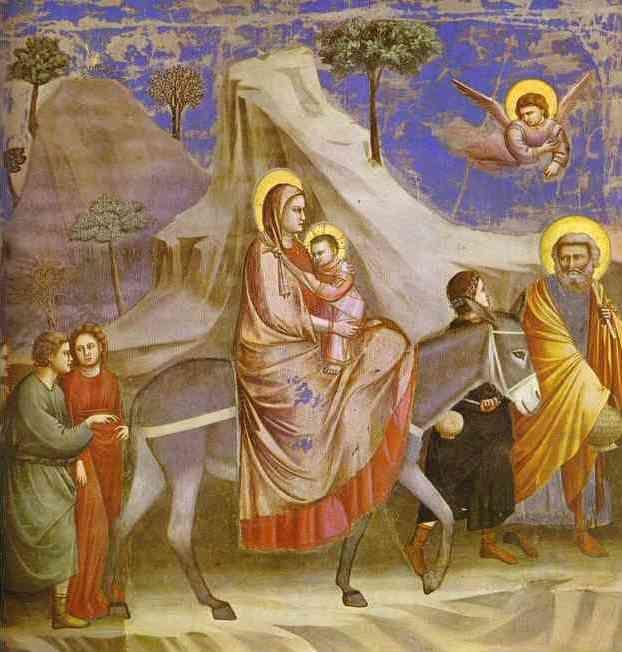
Out of Egypt I Called My Son

Now when they had departed, behold, an angel of the Lord appeared to Joseph in a dream and said, “Rise, take the child and his mother, and flee to Egypt, and remain there until I tell you, for Herod is about to search for the child, to destroy him.” And he rose and took the child and his mother by night and departed to Egypt and remained there until the death of Herod. This was to fulfill what the Lord had spoken by the prophet, “Out of Egypt I called my son.” (Matthew 2:13-15) That last verse has caused lots of consternation.  The Holy Family goes to Egypt, and this somehow fulfills Hosea’s reference to Israel’s exodus? As I mentioned last week, at first glance it looks like Matthew is connecting the dots by the slimmest of connections. Continue Reading>>>