The purpose of this Blog is to introduce men and women all over the World to the Doctrines of Grace; the 5 Solas; Reformation Theology and the Lord and Savior Jesus Christ.
Showing posts with label Public Invitation. Show all posts

Tuesday, March 25, 2014

“Ask Jesus into Your Heart”: A History of the Sinner’s Prayer

Many an evangelical pastor has concluded a sermon by asking non-Christians to “ask [or receive, or invite] Jesus into their heart,” or to pray a version of what some call the “sinner’s prayer.” But some evangelicals, including Baptist pastor David Platt of Birmingham, Alabama, have in recent years criticized the sinner’s prayer as unbiblical and superstitious. Surely, Platt argued in a controversial March 2012 sermon, there must be more to salvation than saying a formulaic prayer.

Platt’s comments helped precipitate a debate at the 2012 Southern Baptist Convention meeting in New Orleans. In a voice vote, a majority of delegates, including Platt, affirmed the sinner’s prayer as “a biblical expression of repentance and faith.”

The phrase “ask Jesus into your heart” is not in the Bible, although there are similar phrases there (“ye have received Christ Jesus the Lord,” Col. 2.6 KJV). So where did this prayer come from?   Continue at Thomas Kidd

Tuesday, May 8, 2012

Getting John 1:12 Right: Should You Invite Jesus Into Your Heart?

Author: Jim Elliff from an article found here

Is it useful to critique any person’s or ministry’s method of evangelism? For one thing, there are not enough people calling on others to follow Christ. Should I attempt to cripple their efforts in the slightest way, even for the few who might listen to me? I hope I will not. I would rather think that I’m improving our evangelism. And it does need improving. 

The apparent results of the method of evangelistic appeal built upon the verse in question (John 1:12, along with Rev. 3:20) surely cannot be argued with. I think I could say with ease that almost all the evangelistic results coming out of America are rooted in a method that emerges from the problematic view of John 1:12 which I will unfold. One campus organization whose workers almost always use this verse, with what I believe is an errant understanding of it, claims that tens of thousands are won to Christ each year through their multiple worldwide ministries. I’ve known many involved in this ministry, and can attest to the sincerity of these workers, and their willingness to be bold for Christ. Surely the majority of evangelistic workers cannot be wrong. Surely pastors who have taught this particular view cannot be in error. At least from the ad hominem side of the argument, I’m going to look pretty silly if I’m opposing such faithful people and am in error myself. So, I’ll tread gently. I’m talking to friends who care as strongly as I do about good evangelism.    Continue at John Samson

Saturday, April 28, 2012

The Centrality of Preaching


Preaching has fallen on hard times. The great Protestant Reformer, John Calvin, wrote: “At the present day there are many who are well-nigh sickened by the very name of preaching, because there are so many stupid, ignorant men who blurt out their worthless brain waves from the pulpit.” That was 450 years ago! Today not only has preaching been decentralized, but the greater part of what is called “preaching” no longer deserves to be at the center. This has created a vacuum and few have raised a voice while a Pandora’s Box of replacements has rushed in to fill the void.”

A.W. Tozer said of the danger: “One of the most popular current errors, and the one out of which springs most of the noisy, blustering religious activity in evangelical circles, is the notion that as times change the church must change with them…That mentality which mistakes Hollywood for the Holy City is too gravely astray to be explained otherwise than as a judicial madness visited upon professing Christians for affronts committed against the Spirit of God.”

And John MacArthur aptly described it: “Worship services in many churches today are like a merry-go-round. You drop a token in the collection box; it is a good ride. There’s music and lots of motion up and down. The ride is carefully timed and seldom varies in length. Lots of good feelings are generated, and it is the one ride you can be sure will never be the least bit threatening or challenging. But though you spend the whole time feeling as if you’re moving forward, you get off exactly where you got on.”

A BRIEF HISTORY OF PREACHING

The 16th century Reformation, 17th century Puritanism, and the 18th century “Great Awakening” were all revivals of preaching! Whatever else they were, they brought preaching back to the center. Similarly, periods of decline were marked by a corresponding decline in preaching. The 19th century languished under the influence of Charles Finney’s “new measures.” Preaching was reduced to “moral suasion.” This is reflected in modern “crusade evangelism” in which the sermon has become a mere prelude to the “invitation.” The 20th century dawned with the pulpit histrionics of Billy Sunday. Preaching had become “pulpiteerism.” A more sophisticated retreat was found in the “quiet talks” of inspirational liberalism. “Sharing” rather than preaching marked the advent of a “kinder, gentler” Christianity.”

“The miserable phrase, sharing Christ, which so sickens those of us who believe that the work of preaching not that of sharing an experience but of proclaiming a message.” (J. Gresham Machen)  Continue at Tom Lyon

Wednesday, October 5, 2011

How to Manipulate People to Make (Fake) Professions of Faith

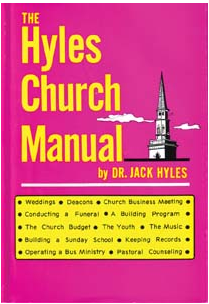
Jack Hyles, “The Invitation Time,” chapter 27 in The Hyles Church Manual (Murfreesboro, TN: Sword of the Lord, 1968), 279–82 (numbering added; this chapter reprints most of ch. 7 in Hyles’s Let’s Build an Evangelistic Church):

After observing for nearly twenty-two years the preaching of hundreds of preachers across America, I have come to the conclusion that many of us need intensive help in the conducting of a public invitation. Many wonderful gospel messages can be rendered ineffective by a weak invitation.

On the other hand, many average preachers can be rewarded greatly with the use of an effective, pungent, public invitation. Though in many places a public invitation is seldom used and even considered out of date, it is still true that the greatest soul-winning churches utilize an effective, spiritual, Spirit-filled, powerful invitation as their greatest means of evangelism. May we look at a few practical pointers concerning the invitation.

1. Starting the Invitation


Do not reveal the closing of the sermon. When the sermon reaches a high point or a climax, then would be a good time to close abruptly. Even if the sermon is not completed, sometimes God may lead one to close prematurely in order to start the invitation from a high spiritual plane. This also prevents the unsaved from “digging in,” so to speak, before the invitation is given.    Keep Reading...