The purpose of this Blog is to introduce men and women all over the World to the Doctrines of Grace; the 5 Solas; Reformation Theology and the Lord and Savior Jesus Christ.
Showing posts with label Limited Atonement. Show all posts

Saturday, December 7, 2013

Did Jesus Die to Save Everyone?

The doctrine of definite atonement is nothing if not controversial. That Jesus died to rescue his bride is a precious truth, one all Christians embrace. But the suggestion he didn't die to rescue everyone—well, that doesn't prompt so many hugs. TULIP's middle petal has a particular tendency to provoke muted embarrassment or yawning indifference, if not visceral rejection. Some say it's more logical than biblical. Others say it's too esoteric to be important, or too unloving to be true.

But what if, when properly understood, this difficult doctrine turns out to be not a source of embarrassment but a resource for joy? From Heaven He Came and Sought Her: Definite Atonement in Historical, Biblical, Theological, and Pastoral Perspective (Crossway) [Website | Twitter] is a towering new tome making the case that definite atonement is not only historically reputable and biblically faithful, but also practically and pastorally glorious. With contributions (and endorsements) from a sterling array of pastors and scholars, this is a volume that deserves serious engagement—regardless of where you lean or land.

I talked with editors David and Jonathan Gibson about "4-pointers," evangelism, whether they oversell their case, and more. Also, be on the lookout for reviews from Jason Duesing (tomorrow) and Robert Yarbrough (Monday).    Continue at Matt Smethurst

Thursday, May 9, 2013

Who Limits the Atonement: Calvinists or Arminians?


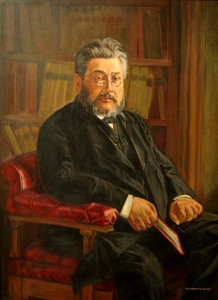
C.H. Spurgeon drawing in color

“Even as the Son of man came not to be ministered unto, but to minister, and to give His life a ransom for many.” — Matthew 20:28
[Calvinists] are often told that we limit the atonement of Christ, because we say that Christ has not made a satisfaction for all men, or all men would be saved. Now, our reply to this is, that, on the other hand, our opponents limit it: we do not. The Arminians say, Christ died for all men. Ask them what they mean by it. Did Christ die so as to secure the salvation of all men? They say, “No, certainly not.” We ask them the next question—Did Christ die so as to secure the salvation of any man in particular? They answer “No.” They are obliged to admit this, if they are consistent. They say, “No; Christ has died that any man may be saved if”—and then follow certain conditions of salvation. We say, then, we will go back to the old statement—Christ did not die so as beyond a doubt to secure the salvation of anybody, did He? You must say “No;” you are obliged to say so, for you believe that even after a man has been pardoned, he may yet fall from grace, and perish. Now, who is it that limits the death of Christ? Why, you. You say that Christ did not die so as to infallibly secure the salvation of anybody. We beg your pardon, when you say we limit Christ’s death; we say, “No, my dear sir, it is you that do it.” We say Christ so died that He infallibly secured the salvation of a multitude that no man can number, who through Christ’s death not only may be saved but are saved, must be saved, and cannot by any possibility run the hazard of being anything but saved. You are welcome to your atonement; you may keep it. We will never renounce ours for the sake of it.   Continue at Eric T. Young

Saturday, October 13, 2012

Definite Atonement in John: World & All

Of all the Gospels, John’s gospel is the most theological, and presents the doctrines of grace in stark relief. John also poses a challenge to interpreters with his extensive use of the word world (kosmos), which appears in his gospel seventy-eight times, compared to fourteen times in the synoptics combined. John uses world in several different ways, and the student must be careful to understand each use correctly in its context. Steve Lawson lists ten different uses:*
  1. Entire Universe (John 1:9, 10; 17:5).
  2. Physical Earth (John 13:1; 16:33; 21:25).
  3. World System (John 1:10; 12:31; 14:30; 15:18–21; 16:11; 17:14).
  4. Humanity Minus Believers (John 7:7; 15:18).
  5. Large Group (John 12:19).
  6. General Public (John 7:4; 14:22).
  7. Jews and Gentiles, all groups of people, as opposed to the Jewish people only (John 1:29; 4:42).
  8. Human Realm, contrasted with the realm of heaven and angelic beings (John 1:10; 3:12–16).
  9. Non-Elect (John 17:9).
  10. Elect Only (John 3:17; 6:33; 12:47).
Lawson summarizes:  Continue at Thirsty Theologian

Saturday, May 19, 2012

A Bridge Not Far Enough…

“We are often told (I mean those of us who are commonly nicknamed by the title of Calvinists—and we are not very much ashamed of that; we think that Calvin, after all, knew more about the Gospel than almost any man who has ever lived, uninspired), we are often told that we limit the atonement of Christ, because we say that Christ has not made a satisfaction for all men, or all men would be saved. Now, our reply to this is, that, on the other hand, our opponents limit it: we do not. 

The Arminians say, Christ died for all men. Ask them what they mean by it. Did Christ die so as to secure the salvation of all men? 

They say, “No, certainly not.” We ask them the next question—Did Christ die so as to secure the salvation of any man in particular? 

They answer “No.” They are obliged to admit this, if they are consistent. They say, “No; Christ has died that any man may be saved if”—and then follow certain conditions of salvation. 

We say, then, we will go back to the old statement—Christ did not die so as beyond a doubt to secure the salvation of anybody, did He?  Continue at John Samson

Wednesday, March 14, 2012

The Atonement in Hebrews

“Out of the anguish of his soul he shall see and be satisfied; by his knowledge shall the righteous one, my servant, make many to be accounted righteous, and he shall bear their iniquities.” – Isaiah 53:11

What was God’s intention from all eternity in the atonement? What did He intend for Christ to accomplish by His death on the cross?

Orthodox Christians are not universalists (universalism is the ancient heresy that teaches that all people will eventually be redeemed). Instead, we are particularists, believing that only some (and not all) will be saved. The Bible makes it clear that some people will in fact be lost, ultimately lost, in a place of weeping, darkness and gnashing of teeth. Some people will in fact spend eternity in hell. 

Knowing this, all of us as Christians limit the atonement in some sense because we agree that not everyone will be saved by the work of Christ. Amongst particularists then there are two main views; the first being what is called “universal redemption” (the view that Christ died to try to save everybody in human history, past, present and future, though His work by itself did not actually accomplish this unless man does something to cooperate). 

JESUS THE PERFECT AND POWERFUL SAVIOR

The second and I believe biblical view is called “particular redemption” (Christ actually propitiated the Father’s wrath for a specific group of people – securing redemption for them and providing even the faith that will call upon Him to save them – Jesus being the author and perfector of our faith. The Good Shepherd laid down His life for the sheep, Christ loved the church and gave himself up for her (Eph 5:25).  Continue at John Samsom

Saturday, February 11, 2012

Evangelism and the Extent of the Atonement

At the time in my spiritual life when I began to embrace the doctrines of grace, the one that was hardest to swallow was the L in our beloved TULIP acronym: limited atonement—or perhaps better stated (though ruining the acronym): particular redemption, or definite atonement. To make a long story short, I eventually came to see that the doctrine was biblical. Both the intent and extent of the atonement was divinely ordained to infallibly secure the salvation of all those whom the Father had chosen from before the foundation of the world (John 6:39; 10:11, 14–15; Ac 20:28; Eph 5:25). Jesus’ death didn’t simply make salvation possible, and then leave the appropriation of the cross’s benefits to the sovereign will of the sinner. No, it actually purchased the salvation of God’s elect (1Pet 2:24; Rev 5:9).

Interestingly, one of my chief objections to the doctrine wasn’t so much on textual or exegetical grounds. It was that it contradicted the way I had always heard the Gospel preached in evangelism. All around me, I heard the Gospel preached as if it was merely: “Jesus died for you, so you should believe in Him.” Evangelism boiled down to telling people that Jesus died specifically for them, and that, if He loved them so much that He would die for them, the least they could do was live for Him.  Continue at Mike Riccardi

Tuesday, January 4, 2011

The Doctrines of Grace

After a short back and forth on our Facebook page concerning the subject of limited atonement, I felt a need to make a clear statement why I embrace the doctrines of grace.

Firstly I have to point out that in all honesty I’m not inclined to bang on about T.U.L.I.P. as I so often think of these points totally differently than their names suggest. What I also want to make clear, is that the truth of these points is far more for the benefit of personal assurance, rather than something that needs to be forced upon others point by point.
I have never been discipled as a calvinist, nor even attended a church where the pastor or teaching staff are of that persuasion intentionally. However when I first became aware of these points, and began examining these things against the Bible itself, I found that in all honesty I couldn’t dispute them. They are not points I was quick to accept by any means, especially because of the stigma that those who oppose them attach, but when taken point by point sanely in the light of Scripture, I honestly believe they all stand up.

There is a caveat to this however, and that is to ask oneself what benefit is it should these points be true. This is why I state that they are far more useful for personal assurance than anything else. In fact, if all we do is spend our time trying to prove them right to those who oppose, they become little more than stumbling blocks in my opinion. I believe it is sufficient to quietly and personally agree with them, and allow the words of Scripture they are drawn from to speak for itself. This is the very thing that convinced me personally; not that Calvin was right, but rather these things are clearly outlined in Scripture. Continue Reading>>>

Friday, January 29, 2010

Why Calvin is More Biblical Than Some Calvinists

I am not going to debate Calvin’s view of limited atonement. Instead, I’d like to point out what I find most fascinating about Calvin on this subject: his willingness to speak in ways that the Bible itself speaks when it comes to these matters.

Take this Trinitarian prayer for example:

We offer up our prayers unto Thee, O most gracious God and most merciful Father, for all men in general, that as Thou art pleased to be acknowledged the Savior of the whole human race by the redemption accomplished by Jesus Christ Thy Son…

Or consider his thoughts on the pardoned thief:

Our Lord made effective for the thief his death and passion which he suffered and endured for all mankind.

Or his thoughts on Christ’s suffering:

Indeed, our Lord Jesus was offered to all the world… Our Lord Jesus suffered for all and there is neither great nor small who is not inexcusable today, for we can obtain salvation in him. Read the rest HERE

Thursday, May 28, 2009

JOHN OWEN ON LIMITED ATONEMENT

FOR WHOM DID CHRIST DIE?
by John Owen

The Father imposed His wrath due unto, and the Son underwent punishment for, either:
1. All the sins of all men;
2. All the sins of some men, or;
3. Some of the sins of all men.

In which case it may be said:
1. That if the last be true, all men have some sins to answer for, and so, none are saved;
2. That if the second be true, then Christ, in their stead suffered for all the sins of all the elect in the whole world, and this is the truth;
3. But if the first be the case, why are not all men free from the punishment due unto their sins?

You answer, "Because of unbelief."
I ask, Is this unbelief a sin, or is it not? If it be, then Christ suffered the punishment due unto it, or He did not. If He did, why must that hinder them more than their other sins for which He died? If He did not, He did not die for all their sins!"

HT: Steve Camp