The purpose of this Blog is to introduce men and women all over the World to the Doctrines of Grace; the 5 Solas; Reformation Theology and the Lord and Savior Jesus Christ.
Showing posts with label Particular Redemption. Show all posts

Thursday, March 15, 2012

Particular Redemption by C.H. Spurgeon

“Even as the Son of man came not to be ministered unto, but to minister, and to give His life a ransom for many.”—Matthew 20:28.
 
 I begin this morning with the doctrine of Redemption. “He gave his life a ransom for many.”

The doctrine of Redemption is one of the most important doctrines of the system of faith. A mistake on this point will inevitably lead to a mistake through the entire system of our belief.

Now, you are aware that there are different theories of Redemption. All Christians hold that Christ died to redeem, but all Christians do not teach the same redemption. We differ as to the nature of atonement, and as to the design of redemption. For instance, the Arminian holds that Christ, when He died, did not die with an intent to save any particular person; and they teach that Christ’s death does not in itself secure, beyond doubt, the salvation of any one man living. They believe that Christ died to make the salvation of all men possible, or that by the doing of something else, any man who pleases may attain unto eternal life; consequently, they are obliged to hold that if man’s will would not give way and voluntarily surrender to grace, then Christ’s atonement would be unavailing. They hold that there was no particularity and speciality in the death of Christ. Christ died, according to them, as much for Judas in Hell as for Peter who mounted to Heaven. They believe that for those who are consigned to eternal fire, there was a true and real a redemption made as for those who now stand before the throne of the Most High. Now, we believe no such thing. We hold that Christ, when He died, had an object in view, and that object will most assuredly, and beyond a doubt, be accomplished. We measure the design of Christ’s death by the effect of it. If any one asks us, “What did Christ design to do by His death?” we answer that question by asking him another—”What has Christ done, or what will Christ do by His death?” For we declare that the measure of the effect of Christ’s love, is the measure of the design of it. We cannot so belie our reason as to think that the intention of Almighty God could be frustrated, or that the design of so great a thing as the atonement, can by any way whatever, be missed of. We hold—we are not afraid to say that we believe—that Christ came into this world with the intention of saving “a multitude which no man can number;” and we believe that as the result of this, every person for whom He died must, beyond the shadow of a doubt, be cleansed from sin, and stand, washed in blood, before the Father’s throne. We do not believe that Christ made any effectual atonement for those who are for ever damned; we dare not think that the blood of Christ was ever shed with the intention of saving those whom God foreknew never could be saved, and some of whom were even in Hell when Christ, according to some men’s account, died to save them.  Continue at Refocusing Our Eyes

See Also:


Wednesday, March 14, 2012

The Atonement in Hebrews

“Out of the anguish of his soul he shall see and be satisfied; by his knowledge shall the righteous one, my servant, make many to be accounted righteous, and he shall bear their iniquities.” – Isaiah 53:11

What was God’s intention from all eternity in the atonement? What did He intend for Christ to accomplish by His death on the cross?

Orthodox Christians are not universalists (universalism is the ancient heresy that teaches that all people will eventually be redeemed). Instead, we are particularists, believing that only some (and not all) will be saved. The Bible makes it clear that some people will in fact be lost, ultimately lost, in a place of weeping, darkness and gnashing of teeth. Some people will in fact spend eternity in hell. 

Knowing this, all of us as Christians limit the atonement in some sense because we agree that not everyone will be saved by the work of Christ. Amongst particularists then there are two main views; the first being what is called “universal redemption” (the view that Christ died to try to save everybody in human history, past, present and future, though His work by itself did not actually accomplish this unless man does something to cooperate). 

JESUS THE PERFECT AND POWERFUL SAVIOR

The second and I believe biblical view is called “particular redemption” (Christ actually propitiated the Father’s wrath for a specific group of people – securing redemption for them and providing even the faith that will call upon Him to save them – Jesus being the author and perfector of our faith. The Good Shepherd laid down His life for the sheep, Christ loved the church and gave himself up for her (Eph 5:25).  Continue at John Samsom

Saturday, February 11, 2012

Evangelism and the Extent of the Atonement

At the time in my spiritual life when I began to embrace the doctrines of grace, the one that was hardest to swallow was the L in our beloved TULIP acronym: limited atonement—or perhaps better stated (though ruining the acronym): particular redemption, or definite atonement. To make a long story short, I eventually came to see that the doctrine was biblical. Both the intent and extent of the atonement was divinely ordained to infallibly secure the salvation of all those whom the Father had chosen from before the foundation of the world (John 6:39; 10:11, 14–15; Ac 20:28; Eph 5:25). Jesus’ death didn’t simply make salvation possible, and then leave the appropriation of the cross’s benefits to the sovereign will of the sinner. No, it actually purchased the salvation of God’s elect (1Pet 2:24; Rev 5:9).

Interestingly, one of my chief objections to the doctrine wasn’t so much on textual or exegetical grounds. It was that it contradicted the way I had always heard the Gospel preached in evangelism. All around me, I heard the Gospel preached as if it was merely: “Jesus died for you, so you should believe in Him.” Evangelism boiled down to telling people that Jesus died specifically for them, and that, if He loved them so much that He would die for them, the least they could do was live for Him.  Continue at Mike Riccardi

Saturday, June 25, 2011

The Intercession and Sacrifice of Christ

What was God’s intention from all eternity in the atonement? What did He intend for Christ to accomplish by His death on the cross?


Orthodox Christians are not universalists (universalism is the ancient heresy that teaches that all people will eventually be redeemed). Instead, we are particularists, believing that only some (and not all) will be saved. The Bible makes it clear that some people will in fact be lost, ultimately lost, in a place of weeping, darkness and gnashing of teeth. Some people will in fact spend eternity in hell. 

Knowing this, all of us as Christians limit the atonement in some sense because we agree that not everyone will be saved by the work of Christ. Amongst particularists then there are two main views; the first being what is called “universal redemption” (the view that Christ died to try to save everybody in human history, past, present and future, though His work by itself did not actually accomplish this unless man does something to cooperate). Keep Reading...

Saturday, June 11, 2011

1 John 2:2 (Revisited)


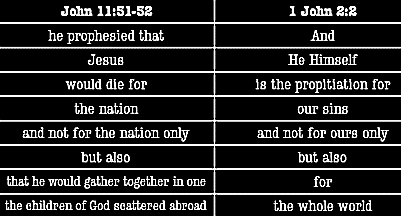
You say that Christ died for His people, His sheep, His friends, for His Church and yet 1 John 2:2, speaking of Jesus, states, “He is the propitiation for our sins, and not for ours only but also for the sins of the whole world.” How do you explain that?
I can certainly see how someone would use this verse to undermine the reformed doctrine of Particular Redemption, yet Scripture, I believe, is not contradictory to itself. There is one Divine Author of Scripture and He does not contradict Himself. So how are we to understand 1 John 2:2?
I have written elsewhere about the principles of correct interpretation of scripture. There is only one correct interpretation of scripture. Though there may be many applications of a verse, it only means what it was intended to mean when it was written.
In my article entitled “Playing Marbles with Diamonds” I refer to a number of principles of biblical interpretation (hermeneutics), three of which would apply here:
1. Consider the Author – who wrote the book? (what was his background, language, culture, vocation, concerns, education, circumstance, what stage of life?) Keep Reading...

Tuesday, January 18, 2011

Understanding 1 John 2:2

You say that Christ died for His people, His sheep, His friends, for His Church and yet 1 John 2:2, speaking of Jesus, states, “He is the propitiation for our sins, and not for ours only but also for the sins of the whole world.” How do you explain that?
 
I can certainly see how someone would use this verse to undermine the reformed doctrine of Particular Redemption, yet Scripture, I believe, is not contradictory to itself. There is one Divine Author of Scripture and He does not contradict Himself. So how are we to understand 1 John 2:2? 

I have written elsewhere about the principles of correct interpretation of scripture. There is only one correct interpretation of scripture. Though there may be many applications of a verse, it only means what it was intended to mean when it was written. 

In my article entitled “Playing Marbles with Diamonds” I refer to a number of principles of biblical interpretation (hermeneutics), three of which would apply here: Continue Reading>>>

See also - 1 John 2:2 – Karate Exegesis