The purpose of this Blog is to introduce men and women all over the World to the Doctrines of Grace; the 5 Solas; Reformation Theology and the Lord and Savior Jesus Christ.
Showing posts with label Compromise. Show all posts

Saturday, December 7, 2013

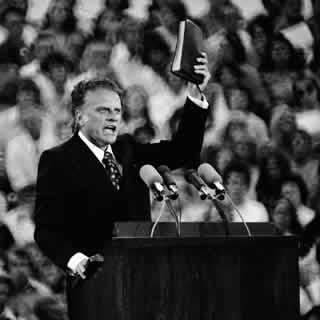
The Long History of Billy Graham’s Ecumenism

The following was first published in the out-of-print book Evangelicals and Rome in 1999:

When Did Graham’s Compromise Begin?

billyBilly Graham’s compromise and disobedience began very early in his ministry. He was born in 1918 into a Presbyterian home and traces his conversion to the preaching of evangelist Mordecai Ham in 1934. He graduated from high school in May 1936 and attended Bob Jones College (which later became Bob Jones University) in the fall but switched to Florida Bible Institute after only one semester because he did not like the strict discipline at Bob Jones. 

He notes in his biography that “one thing that thrilled me [about Florida Bible Institute] was the diversity of viewpoints we were exposed to in the classroom, a wondrous blend of ecumenical and evangelical thought that was really ahead of its time” (Graham, Just As I Am , p. 46). 

It was during his time in Florida that Graham felt the call to preach. In late 1938, he was baptized by immersion in a Baptist church, and in early 1939, he was ordained to preach by a Southern Baptist congregation.   Continue at John Samson

Thursday, October 31, 2013

A Call to Resurgence

Mark Driscoll. A Call to Resurgence: Will Christianity Have a Funeral or a Future? Carol Stream, IL: Tyndale House, 2013. 336 pp. $19.99.

Mark Driscoll’s new book, A Call to Resurgence: Will Christianity Have a Funeral or a Future?, is sometimes insightful, sometimes amusing, sometimes stirring, and sometimes exasperating. In places, particularly at the beginning and the end of the book, it represents the best of Driscoll: an uncompromising assessment of the scale of the mission, a robust call to courage and obedience, and an impassioned plea for sound doctrine, spiritual power, and sacrificial mission. At the book’s heart, however, is an internal tension so significant that large parts of it are likely to be ineffective, or even counterproductive, in persuading those who do not already share Driscoll’s view. Consequently—and I say this as a broadly Reformed, complementarian, charismatic, missional pastor—A Call to Resurgence is somewhat frustrating to read.

The book is clearly laid out, and its contents can be easily summarized. American society is in a terrible mess: Christendom is over, and the results aren’t pretty (chapter one). The American church is also in a terrible mess, with weird spiritualities, sexual sin, fluffy pluralism, immature masculinity, and financial stinginess creeping into her through the surrounding culture (chapter two). Not only that, but the church is also divided into tribes that may barely know each other: Reformed and Arminian, complementarian and egalitarian, continuationist and cessationist, fundamentalist and missional (chapter three).   Continue at Andrew Wilson

Wednesday, July 17, 2013

Theistic Evolution: A Sinful Compromise

John Otis, pastor of an RPCUS church in Burlington, North Carolina, has written a book on theistic evolution, Theistic Evolution: A Sinful Compromise, based on a series of lectures. His purpose in writing the book was to alert believers, and especially elders, to the danger that theistic evolution (TE) poses to the church:

A word of exhortation is needed to my fellow ruling and teaching elders: 

What is one of our foremost duties as elders? It is to protect God’s precious sheep from the wolves in sheep’s clothing that will devour the flock if they could. … Do I lump all those together as wolves who are not advocating a view of creation as presented in our Confessional Standards? Not exactly, some are far worse than others. … Those that I am really addressing are those who do advocate an evolutionary view, who do believe that man did evolve from lower forms of life, who do teach that God used this means to “create.” These men are the ones who must be silenced; they are disturbing families. In obeying Jude 3, we elders must earnestly contend for the Faith once for all delivered to the saints. This is my purpose (5-6).

Pastor Otis begins his book by considering what Scripture teaches regarding creation, creation days, and the chronologies. From there he moves on to a history of Darwin and evolutionary thought. Lastly, he spends several chapters on what he calls “Compromisers.” He takes time throughout those chapters to address specific concerns about the teachings of specific organizations and individuals.   Continue at Rachel Miller

Friday, May 17, 2013

Warning! Rampant Compromise - But Isn't it Really Heresy?

“Pay careful attention to yourselves and to all the flock, in which the Holy Spirit has made you overseers, to care for the church of God, which he obtained with his own blood. I know that after my departure fierce wolves will come in among you, not sparing the flock; and from among your own selves will arise men speaking twisted things, to draw away disciples after them.” (Acts 20:28–30)
The article I link to below is an extension of what has been going on at Calvin College in Michigan. In previous blog posts and articles I have quoted professors from Calvin College who no longer believe in a literal Adam and literal Eve—or a literal Fall. Calvin professors have been teaching evolution as fact for years. Now, why would any Christian parent spend thousands of dollars to send their kids to a college that attacks and undermines the authority of God’s Word? Calvin College, by the way, is a college of the Christian Reformed Church of North America.

The Banner is the magazine of the Christian Reformed Church and is also located in Grand Rapids. The article I link to below references a 1991 Agenda for Synod document by the Committee on Creation and Science. This was a response to Howard Van Till’s The Fourth Day (1986) and the teachings of Clarence Mennigna and Davis Young, which kicked open the door all the way (partly opened by others) to accepting theistic evolution in the CRC denomination. (Van Till, Mennigna, and Davis were professors at Calvin College.)    Continue at Ken Ham

Saturday, May 4, 2013

New Wave Complementarianism: A Question and a Concern

I’ve watched with great interest over the past few weeks as a constellation of blog posts have come out calling for a fresh complementarianism. The articles seem to be advocating for a third way between complementarianism and egalitarianism, or at least for an awareness that traditional complementarians have many weaknesses and egalitarians are asking a lot of good questions. The message often has an apologetic edge: we are complementarians, but not the ones you’re used to.  
The most explicit post along these lines is Wendy Alsup’s article on new wave complementarianism. The piece struck a nerve, prompting many women to write comments to the effect, “I agree with everything you’ve said. I’ve been wanting someone to say this for years.” Alsup’s article, and others like it, have been recommended and retweeted by some of my good friends. There is something about the idea of a “new wave” of complementarianism that some—I’m not sure if it’s few, several, or many, so I’ll stick with some—find attractive. 

I’ve been wrestling for a couple weeks now about how to respond to Alsup’s post (or if I should respond at all). I don’t want to turn something small into something bigger than it needs to be, and I don’t want to discourage new complementarian voices (often women) from being heard. And yet, something about these posts, and Alsup’s in particular, leaves me unsettled. With that in mind, I’d like to ask one specific question and raise one general caution.

One Specific Question   Continue at Kevin DeYoung

See also: 


Monday, April 15, 2013

eHarmony Compromises on Same Sex “Marriage”

Many of you have probably heard of the online dating site eHarmony. The cofounder, Neil Clark Warren, describes himself as a “passionate follower of Jesus,” and eHarmony initially only provided its services to heterosexual people. After a legal battle, eHarmony included homosexuals, first in a separate site and later in its main site.

In a recent interview, Warren said that his company has been damaged by the same-sex marriage debate. What does Warren mean by this? Well, according to the Christian Post, he said “that he hopes America can ‘be more harmonious’ on the issue.”

Now, Warren’s view on same-sex marriage is just not biblical.  He states, “I think this issue of same-sex marriage within the next five to 15 years will be no issue anymore. We’ve made too much of it. I’m tired of it. It has really damaged our company.” Anyone who knows their Bible and what God’s Word teaches about marriage (e.g.,  Matthew 19) understands that what Warren is saying here isn’t biblical—we can never “make too much” of standing up for the truth of God’s Word and standing against sinful behavior.  The same-sex marriage debate has hurt the business of a professing Christian, but God tells us in His Word that we will face persecution for Christ’s sake (Matthew 10:22; 2 Timothy 3:12). And you know, standing up for the Bible’s definition of marriage and its restrictions on sexuality will bring just such persecution from the world.   Continue at Ken Ham

Friday, February 8, 2013

Will the Boy Scouts Pitch Their Tents Toward Sodom?

The Boy Scouts of America (B.S.A.), which only last summer confirmed its policy that kept homosexuals from joining, has now been debating the possibility of ending its ban on gay membership in the organization. On Wednesday, the organization announced that it is delaying its vote on the issue until May.1 The proposal, if passed in May as it is currently written, would take a sort of “middle ground” on the issue: the decision to admit openly gay members to the Boy Scouts would be left to individual troop leaders.

Of course, leaving the decision up to individual troops would essentially be a non-answer from the Boy Scouts of America. What’s more, it would essentially serve as an affirmation of homosexual behavior as much as it would be if scout troops were forced to admit gay members. The organization, if it chooses the route of simply leaving the decision up to individual troops, will have given in to a false idea of neutrality. The B.S.A. will have bought into the idea that by not voicing its opposition to or support for homosexual behavior, it can avoid conflict and not force anyone to violate his beliefs.

There really is no such thing as neutrality on the issue of homosexual behavior. The B.S.A.’s initial desire to hurry the vote is likely because the organization has been under tremendous pressure in the political climate of the past few years to give in to the demands of homosexual activists, while the delay is more likely due to the B.S.A.’s realization that it will lose a significant number of participants if the ban on gay members is lifted. If the proposal to pass the decision on to individual troops is adopted, the Boy Scouts of America will have at least partially capitulated to the schemes of the homosexual agenda—and its capitulation will be indicative of where the American culture as a whole is headed. A non-theistic, secular worldview is increasingly being imposed on society, and because it is antagonistic to the biblical worldview, it could hardly be neutral.    Continue at Steve Golden

Monday, October 22, 2012

The Exploitation of Billy Graham

My previous blog was a warning against mixing pulpits and politics. I feel even more strongly so this week. A few days ago an aged Billy Graham allegedly came out in support of (Mormon) presidential hopeful Mitt Romney, calling all Christians (read evangelicals) to vote for him in the upcoming election. There are so many things wrong about this. Frankly, it just doesn’t sound like something the Billy Graham we have come to know and admire would do or say, especially in this final season of his very long life. I’m guessing that the 93-year old evangelist and his reputation are being exploited by right-wing politicos and certain key family members. Whatever is really going on in the backrooms, it is further proof of the Republican captivity of the contemporary evangelical church.

For decades Billy Graham has been the quintessential hero of a trans-partisan evangelicalism. He has stood on an ecumenical platform to proclaim a biblically-faithful and Christ-centered Gospel worldwide, and backed up his message with a life of exemplary morality and gracious statesmanship. In recognition of his achievements and personal charisma, he has been catapulted up into the role of spiritual confidante to numerous United States presidents since the 1940s. 

For the most part he has conducted himself as a religious statesman through these years, lending a spiritual tone to many American administrations. His one horrible stumble was to be discovered on tape affirming some of the anti-Semitic prejudices of then-president Richard Nixon. Duly chastened by this egregious gaffe and the lack of moral courage it seemed to display, Graham distanced himself thereafter from alignment with politicians and their agendas. This is the image of a chastened Graham that emerges in his official biography, Just as I Am (1997). In his latest and possibly last book, Nearing Home (2011), which won the Evangelical Christian Publishers Association 2012 Book of the Year award, we discover an irenic spiritual giant at peace with his own soul and looking forward to eternity.  Continue at Glen G. Scorgie

Tuesday, September 18, 2012

Compromising God's Standards for Sexuality

As Christians we are adept at looking at the culture around us and seeing how it is violating God’s good standards when it comes to sexuality. Not too long ago, though, I was asked to reflect on the ways in which Christians may compromise God’s standards for sexuality—some of those hidden or sanctified sins in which we allow compromise in our lives, our marriages, our churches. I came up with five ways that Christians may compromise God’s standards for sexuality.

We compromise God’s standard for sexuality when we leave the gospel out of the marriage bed


Christians consistently have trouble extending the reach of the gospel from salvation all the way to sex. Yet the gospel isn’t just about that one-time commitment; it’s about how we live today and every day. It extends through every part of life.

The gospel says, Whatever my marriage is to be and whatever our sexual relationship is to be, it is to be a part of that portrait of Christ and the church. When I am considering sex in this way, I’m first asking, Would this look like an accurate portrait of Christ and the church? What reflects Christ giving up his life for his bride? What reflects the church joyfully submitting to Christ? This completely reorients us away from self, from self-love and self-service, and orients me toward my spouse. This portrait of marriage does not come to an end when we close the bedroom door.

When we compromise this standard we become bound by law instead of freed by the gospel; we have become self-focused instead of other-focused. Law is always focused toward self, gospel is always focused toward the other and, ultimately, toward God. If we allow ourselves to fall back into that age-old temptation of law, we will inevitably harm our relationship with the one we love most.  Continue at Tim Challies

Tuesday, April 3, 2012

Thoughts on The Purpose-Driven Church (18 years later)

Rick Warren's The Purpose Driven® Church is now 18 years old. It is the best-selling book on church ministry philosophy ever.

Warren is sensitive about complaints that his overtly pragmatic strategy for church growth leads to doctrinal compromise, so he subtitled his book, "Growth Without Compromising your Message & Mission." He insists throughout the book that you can follow his "seeker-sensitive" model of ministry without compromising or watering down your message. On page 244, he writes, "A worship service does not have to be shallow to be seeker sensitive. The message doesn't have to be compromised, just understandable."

But then, just a few sentences later, he writes, "The unchurched . . . do want to hear how the Bible relates to their lives in terms they understand and in a tone that shows you respect and care about them. They are looking for solutions, not a scolding."

Notice how quickly Warren undermines his own commitment not to compromise the message. People don't want to be scolded, he tells us. And yet Paul told Timothy that Scripture is "profitable for doctrine, for reproof, for correction, for instruction in righteousness" (2 Timothy 3:16). How do you preach reproof and correction—not to mention instruction in righteousness—without someone feeling scolded?

I frankly don't think it's the business of the preacher to trouble himself with whether people feel scolded. The preacher's task is to unfold the meaning of Scripture in a clear, authoritative, and persuasive manner—and if people feel scolded when Scripture rebukes them (as they inevitably will), then that is between them and the Lord. As a matter of fact, as preachers, we are instructed to reprove and rebuke, as well as exhort—with all longsuffering and doctrine (2 Timothy 4:2).

Doctrine?

Doctrinal preaching also takes a hit from Rick Warren. Notice in that quote that I cited above, he says, "The unchurched . . . want to hear how the Bible relates to their lives." He makes clear throughout the remainder of the book what he means by this. He is arguing for an emphasis in our preaching that is practical rather than doctrinal—more "emotional, experiential, and relational" than didactic. He is dismissively critical of what he calls "classroom churches." In Warren's words: "Classroom churches tend to be left-brain oriented and cognitive focused. They stress the teaching of Bible content and doctrine, but give little, if any, emphasis to believers' emotional, experiential, and relational development" (p. 340).

Now I happen to believe that all doctrine is inherently practical—or at least I would say that there is inherent practical value in understanding and defending sound doctrine. Furthermore, all legitimate religious emotions, experiences, and relationships are a believing heart's response to biblical truth soundly taught: doctrine.  Continue at Phil Johnson
Friday, March 2, 2012

The Danger of Worldly Compromise

“Be ye not unequally yoked together with unbelievers: for what fellowship hath righteousness with unrighteousness? and what communion hath light with darkness? And what concord hath Christ with Belial? or what part hath he that believeth with an infidel? And what agreement hath the temple of God with idols? for ye are the temple of the living God; as God hath said, I will dwell in them, and walk in them; and I will be their God, and they shall be my people. Wherefore come out from among them, and be ye separate, saith the Lord, and touch not the unclean thing; and I will receive you. And will be a Father unto you, and ye shall be my sons and daughters, saith the Lord Almighty.” — 2 Corinthians 6:14-18

B.B. Warfield (1851-1921)

Commenting on the above passage, Warfield writes,

If we will scrutinize our present passage closely we shall quickly see that the separation which the Apostle is urging here, too, is not separation from men but from evil – applying, in deed, to the Corinthians in the way of exhortation what our Lord prayed for in behalf of His followers, not that they should be taken out of the world, but that they should be kept from the evil of the world. The exhortation: ‘Come ye out from among them and be ye separate, saith the Lord,’ is immediately followed by the explanation, ‘And touch no unclean thing.’ And the whole exhortation closes with a poignant prayer that they may ‘cleanse themselves from every defilement.’ It is not from their fellow-men that the Apostle would have Christians hold themselves aloof; it is from the sin and shame, the evil and iniquity, which stains and soils the lives of so many of their fellow-men. This is the Apostolic variety of Puritanism.  Continue at Eric. T. Young

Saturday, January 7, 2012

The Rise of Extreme Tolerance

The world may value compromise and tolerance as supreme virtues, but they have a devastating effect on preaching. As more and more evangelical pulpits reflect the surrounding culture, it’s time for Christians to proclaim a distinctively biblical worldview.

Many evangelicals (once known for a very prudent and biblical approach to doctrine) are fast becoming as doctrinally clueless as the unchurched people they are so keen to please. At least three decades of deliberately downplaying doctrine and discernment in order to attract the unchurched has filled many once-sound churches with people who utterly lack any ability to differentiate the very worst fast doctrines from truth. I constantly encounter evangelical church members who are at a loss to answer the most profound errors they hear from cultists, unorthodox media preachers, or other sources of false doctrine.

In the church today, there is a growing reluctance to take a definitive stand on any issue. Discernment is frankly not very welcome in a culture like ours. In fact, the postmodern perspective is more than merely hostile to discernment; it is practically the polar opposite. Think about it: pronouncing anything “true” and calling its antithesis “error” is a breach of postmodernism’s one last impregnable dogma. That is why to a postmodernist nothing is more uncouth than voicing strong opinions on spiritual, moral, or ethical matters. People are expected to hold their most important convictions with as much slack as possible. Certainty about anything is out of the question, and all who refuse to equivocate on any point of principle or doctrine are therefore automatically labeled too narrow. Zeal for the truth has become politically incorrect. There is actually zero tolerance for biblical discernment in a “tolerant” climate like that. 
Keep Reading >>>

Monday, November 7, 2011

Partnership or Compromise?

As discussed in last year’s MB Herald, it looks like some influential Canadian Mennonites have decided to go ahead and partner together to educate the next generation of church leaders…
WCMS is an inter-Mennonite partnership that facilitates the offering of graduate and professional theological education in Winnipeg, Manitoba. The primary role of WCMS is to link the church constituency with the resources of various Mennonite educational institutions. At this time, students can gain graduate theological education by seeking admission to the MA Theological Studies offered by the Canadian Mennonite University or the Certificate of Christian Ministry offered through Mennonite Brethren Biblical Seminary (MBBS) of Fresno, CA or Associated Mennonite Biblical Seminary (AMBS) of Elkhart, Indiana. WCMS can also facilitate academic advising and coaching for those who train for vocational ministry. WCMS seeks to provide continued professional education for pastors and pastoral candidates through pastoral round tables, workshops and other special events.
[www.cmu.ca]
The WCMS centre, located on the Canadian Mennonite University campus in Winnipeg, Manitoba, is supported by the following Mennonite organizations:  Keep Reading >>>

Tuesday, October 18, 2011

A Christian's Danger in the World

In a shameless knock-off of the Pyromaniacs' practice of providing a weekly dose of Spurgeon, here we start a new feature: Presbyterian Profundity, featuring quotations from a bunch of old, dead guys who lived, to quote Spinal Tap on Stonehenge, hundreds of years before the beginning of history.

First out of the blocks is B B Warfield.  There is fine picture of him as a young man which owned by the PCA Historical Center, fronting their webpage,which is, by the way, an excellent source for information and documents not just on the PCA but on American confessional Presbyterianism in general.

Here is what he has to say about worldliness in his essay `New Testament Puritanism' in Faith and Life:

We see, then, that the Apostle's urgency here [2 Cor. 6:11 - 7:1] is against not association with the world, but compromise with the worldly. Compromise! In that one word is expressed a very large part of a Christian's danger in the world. We see it on all sides of us and in every sphere of life. We must be all things to all men, we say, perverting the Apostle's prescription for a working ministry; for there was one thing he would on no account and in no way have us be, even that we may, as we foolishly fancy, win the more; and that is, evil. From evil in all its forms and in all its manifestations he would have us absolutely to separate ourselves; the unclean thing is the thing he would in no circumstances have us handle. Associate with the world, yes! There is no man in it so vile that he has not claims upon us for our association and for our aid. But adopt the standards of the world? No! Not in the least particular. Here our motto must be and that unfailingly: No compromise!     Keep Reading...

Saturday, October 1, 2011

Playing Nice With Heretics


Today Tim Challies has an item about James MacDonald's decision to invite T. D. Jakes to participate at Elephant Room 2. Some of Tim's commenters think it's a fine idea for MacDonald to extend a cordial welcome to someone whose teaching is highly suspect so that he can define and defend himself.

Mark Driscoll expressed a similar opinion in his blogpost yesterday. He sees the Jakes invitation as an opportunity for men who differ on fundamental doctrines to "speak to one another face-to-face rather than about one another blog-to-blog and tweet-to-tweet."

That all sounds very nice and cordial, and it appeals to values that are highly prized nowadays, but is it a biblical way to respond to heresy? Can you imagine Paul proposing a friendly sharing of the platform with the heretics who were troubling the Galatian churches? How different would the apostle John's advice in his second epistle have been (not to mention his legendary encounter with Cerinthus) if he had embraced the values of our more "enlightened" age.

Anyway, here are my thoughts, as posted in the combox over at Challies:   Read it HERE