The purpose of this Blog is to introduce men and women all over the World to the Doctrines of Grace; the 5 Solas; Reformation Theology and the Lord and Savior Jesus Christ.
Showing posts with label Ecumenism. Show all posts

Saturday, December 7, 2013

The Long History of Billy Graham’s Ecumenism

The following was first published in the out-of-print book Evangelicals and Rome in 1999:

When Did Graham’s Compromise Begin?

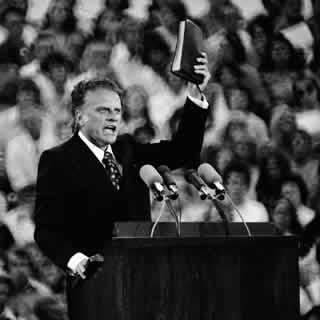
billyBilly Graham’s compromise and disobedience began very early in his ministry. He was born in 1918 into a Presbyterian home and traces his conversion to the preaching of evangelist Mordecai Ham in 1934. He graduated from high school in May 1936 and attended Bob Jones College (which later became Bob Jones University) in the fall but switched to Florida Bible Institute after only one semester because he did not like the strict discipline at Bob Jones. 

He notes in his biography that “one thing that thrilled me [about Florida Bible Institute] was the diversity of viewpoints we were exposed to in the classroom, a wondrous blend of ecumenical and evangelical thought that was really ahead of its time” (Graham, Just As I Am , p. 46). 

It was during his time in Florida that Graham felt the call to preach. In late 1938, he was baptized by immersion in a Baptist church, and in early 1939, he was ordained to preach by a Southern Baptist congregation.   Continue at John Samson

Thursday, October 31, 2013

A Call to Resurgence

Mark Driscoll. A Call to Resurgence: Will Christianity Have a Funeral or a Future? Carol Stream, IL: Tyndale House, 2013. 336 pp. $19.99.

Mark Driscoll’s new book, A Call to Resurgence: Will Christianity Have a Funeral or a Future?, is sometimes insightful, sometimes amusing, sometimes stirring, and sometimes exasperating. In places, particularly at the beginning and the end of the book, it represents the best of Driscoll: an uncompromising assessment of the scale of the mission, a robust call to courage and obedience, and an impassioned plea for sound doctrine, spiritual power, and sacrificial mission. At the book’s heart, however, is an internal tension so significant that large parts of it are likely to be ineffective, or even counterproductive, in persuading those who do not already share Driscoll’s view. Consequently—and I say this as a broadly Reformed, complementarian, charismatic, missional pastor—A Call to Resurgence is somewhat frustrating to read.

The book is clearly laid out, and its contents can be easily summarized. American society is in a terrible mess: Christendom is over, and the results aren’t pretty (chapter one). The American church is also in a terrible mess, with weird spiritualities, sexual sin, fluffy pluralism, immature masculinity, and financial stinginess creeping into her through the surrounding culture (chapter two). Not only that, but the church is also divided into tribes that may barely know each other: Reformed and Arminian, complementarian and egalitarian, continuationist and cessationist, fundamentalist and missional (chapter three).   Continue at Andrew Wilson

Friday, October 4, 2013

Sham Unity is Not Worth Working For

A couple years back, while at a big leadership conference for church leaders, I was listening to a statistician discussing the state of the church in Canada. He explained that he believes Roman Catholics and Protestants need to come together if we’re going to find any success in turning Canadians back toward Christ. After all, he said, the more discussions he had with Catholics, mainline Protestants and Evangelicals, the more he found we had in common (which, basically amounted to “all of them pray and take their faith seriously”).

Sitting in this session, I was kind of annoyed, and more than a little depressed. I mean, seriously? This is the best advice that could be offered to church leaders wanting to impact their communities? Hook up your carts to the United Church and Mainline Presbyterianism (both of which are haemorrhaging members) and bury the hatchet with the Roman church?

Sadly, this is the same advice that’s been given to Evangelicals for decades—dating back to the 1940s and earlier. J.I. Packer addresses how we should respond to this sort of thinking well in his 1958 release, “Fundamentalism” and the Word of God. He writes:   Continue at Aaron Armgstrong

Saturday, September 7, 2013

Contending for the Faith Against the Heresies of our Times

In addition to preaching the Gospel to the lost (Mk.16:15), and teaching all the Word of God to the saved (Matt.28:20), it is also the solemn duty of the Lord’s servants to “earnestly contend for the faith which was once delivered unto the saints” (Jude 3); for they are “set for the defence of the gospel” (Phil.1:17). Thus, not only are they to be “holding forth the word of life” (Phil.2:16), but also, they are to be “holding fast the faithful word” as they have been taught, that they “may be able by sound doctrine both to exhort and to convince the gainsayers” (Tit.1:9). They are to actively and vociferously stand against the heretical errors of the age. When a servant of the Lord does this, then only will it be truly said of him, as it was of David of old, that he “served his own generation by the will of God” (Acts 13:36).

Every age has its heresies with which the Church must contend. Some are perennial — they are faced by the Church in almost every age. Romanism, for example, and Arminianism, are evils against which the Church of Christ has had to contend for centuries. Others, however, are peculiar to certain periods in the Church’s history.   Continue at Shaun Willcock

Wednesday, February 13, 2013

Coexist: Today’s Tower of Babel

Liberal denominations keep pushing for ecumenism. They see it as a beautiful thing. It’s not.  

Meltdown Mondays are about issues in the church. Basically it is a rant about the heretical teachings and worldly concepts being perpetrated in the visible church these days.
 
The church has been flooded with postmodern, liberal philosophy. Things that are in contradiction to the Word of God. Things that do not line up with the Christian worldview. Does that stop it? No. Just get rid of the Bible and push those narrow minded ‘fundies’ to the fringes. Denounce them as stupid. As unenlightened. That’s what happens when the church is full of false converts. 

In my emergent days, I was a huge U2 fan. I have a live concert of theirs on DVD. In this concert, Bono (the lead singer) puts on a head band that says coexist on it. The letters are made up of various religious symbols, basically saying that all the world’s religions need to be in unity.  

Emergent authors like Brian McLaren keep calling the Christians the aggressors, the ones causing all the problems. How we are all about exclusion and how that is bad.

The thing is, the truth is exclusive. If you don’t believe it, you don’t get to be a part of it. Simple math.

If you do not believe the gospel, you don’t get to be a part of it.

If you don’t believe in Jesus, you don’t get to be a part of Him.

You see, to be in God’s kingdom, you enter on His terms. You don’t get to jump the fence and disregard Him.   Continue at Such Was I

Wednesday, October 17, 2012

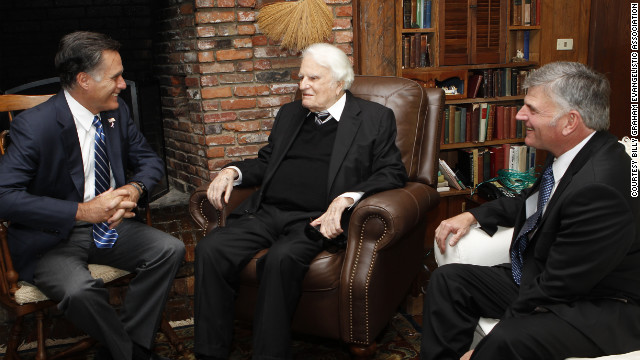
Billy Graham site Removes Mormon 'cult' Reference after Romney meeting

(CNN) - Shortly after Republican presidential candidate Mitt Romney enjoyed cookies and soft drinks with the Rev.  Billy Graham and his son Franklin Graham on Thursday at the elder Graham's mountaintop retreat, a reference to Mormonism as a cult was scrubbed from the website of the Billy Graham Evangelistic Association.
 
In a section of the website called Billy Graham's My Answer there had been the question "What is a cult?"

Answer: "A cult is any group which teaches doctrines or beliefs that deviate from the biblical message of the Christian faith."

"Some of these groups are Jehovah's Witnesess, Mormons, the Unification Church, Unitarians, Spritualists, Scientologists, and others," the site continued.

No longer. On Tuesday, the Billy Graham Evangelistic Association confirmed that page has recently been removed from the site.

“Our primary focus at the Billy Graham Evangelistic Association has always been promoting the Gospel of Jesus Christ," Ken Barun, chief of staff for the association, told CNN in a statement. "We removed the information from the website because we do not wish to participate in a theological debate about something that has become politicized during this campaign."   Continue at CNN


Tuesday, October 9, 2012

Is Roman Catholicism Biblical?


In today’s spirit of ecumenism, many evangelicals have called for the Protestant Church to lay aside its differences with Rome and pursue unity with the Catholic Church. Is that possible? Is Roman Catholicism simply another facet of the body of Christ that should be brought into union with its Protestant counterpart? Is Roman Catholicism simply another Christian denomination?

While there are many errors in the teaching of the Catholic Church (for example its belief in the transubstantiation of the communion wafer and its view of Mary), two rise to the forefront and call for special attention: its denial of the doctrine of sola Scriptura and its denial of the biblical teaching on justification. To put it simply, because the Roman Catholic Church has refused to submit itself to the authority of God’s Word and to embrace the gospel of justification taught in Scripture, it has set itself apart from the true body of Christ. It is a false and deceptive form of Christianity.

The Doctrine of Sola Scriptura

In the words of reformer Martin Luther, the doctrine of sola Scriptura means that “what is asserted without the Scriptures or proven revelation may be held as an opinion, but need not be believed.” Roman Catholicism flatly rejects this principle, adding a host of traditions and Church teachings and declaring them binding on all true believers–with the threat of eternal damnation to those who hold contradictory opinions.   Continue at CRS

Saturday, March 24, 2012

Bounderies

We're often told by gurus of church-growth and guardians of postmodern values in the evangelical community that we mustn't erect "boundaries."

I gather from the way such comments are often bandied about that the word boundaries is supposed to have totally negative connotations. Honestly: I don't see why. I can understand how worldly people whose minds are enslaved to earthbound, man-centered, self-indulgent thoughts might wish for a world without any lines or borders. But candidly, it's an attitude that's hard to reconcile with the whole tenor of the New Testament.

Contemporary evangelicals' resistance to boundaries is especially hard to reconcile with the fact that pastors (the word means shepherds) are expressly charged with guarding the flock and keeping predators out of the fold. And there simply is no realistic way to keep sheep in the sheepfold and wolves out if you refuse to observe any boundaries. In John 10:7, Jesus famously said: "Truly, truly, I say to you, I am the door of the sheep." I cannot envision any useful purpose for having a "door [for] the sheep" if there is no sheep-pen or enclosure of some kind with well-defined, secure barricades, sturdy fences, or a protected perimeter of some kind.

But mainstream evangelicals have been indoctrinated along with the rest of postmodern society to think walls and borders are inherently sinister. We're conditioned to favor a whole different set of more stylish and more politically-correct values: tolerance, openness, diversity, mystery, indecision, broad-mindedness, and liberality. It's considered humble and generous to entertain perpetual qualms about what we believe. We're not supposed to think any single perspective can righteously claim to be true to the exclusion of all others.  Continue at Phil Johnson

Tuesday, January 10, 2012

The Church in Rome

Rome, caput mundi: A PROJECT FOR ROME, A VISION FOR ITALY
 
After visiting my friend Leonardo De Chirico in Rome, I couldn’t stop telling people about the multiple ways in which God is working through him and the church he serves—cultivating a city-wide church planting initiative, caring for refugees, and offering a compelling example of warm-hearted gospel service. I asked Leo if he would provide an overview of the ministry, which he has done in the following. When you think of Rome, please pray for the De Chirico’s.
Rome is known as Caput Mundi (Capital of the world), la Città Eterna (The Eternal City), Limen Apostolorum (Threshold of the Apostles), the city of the seven hills or simply l’Urbe (The City). Ancient Rome was a major center of Western civilization, and Rome is still the seat of the Roman Catholic Church which controls the Vatican City as its sovereign territory, an enclave of Rome.
Today, Rome is modern and cosmopolitan with more than 2.7 million residents. The metropolitan area has a population of about 4 million. It is the third most-visited tourist destination in the EU and a city of cultural and political importance. It hosts the head offices of the vast majority of the major Italian companies, as well as the headquarters of three of the world’s 100 largest companies. 

Tourism is inevitably one of Rome’s chief industries, with numerous notable museums. Rome is also the hub of the Italian film industry, thanks to the Cinecittà studios. The city is also a center for banking as well as electronics and aerospace industries. Numerous international headquarters, university campuses, government ministries, conference centers, sports venues and museums are located in Rome’s principal business districts.  Keep Reading >>>

See Also: The Vatican’s Current Flight with Evangelicals

Saturday, December 17, 2011

The Coming Catholic Ad Blitz

It is coming. Among the largest religious media blitzes in U.S. history---scheduled to air more than 400 times during a three-week run---these commercials will depict humanity's experience of hopelessness before presenting redemption in Jesus Christ as the answer. Millions will view them on major television networks from December 16 through January 8. The program is called Catholics Come Home.
The primary audience---men and women who grew up Catholic, and are now inactive or "lapsed"---is 27.5 million strong, according to the Pew Forum. They constitute roughly 10 percent of the U.S. population, making them the second-largest religious demographic in America behind Roman Catholics at 77.7 million and ahead of the Southern Baptist Convention (at 16 million plus). These former Catholics are among your church's elders, nursery workers, and often compose a sizable portion of your congregation.

The Message of Catholics Come Home

If you have watched one of the commercials or visited the website, you were probably impressed by the "evangelical" tone. It is unmistakably warm and inviting with a refreshingly clear focus on the person of Jesus. These programs are the fruit of the Second Vatican Council's vision for mobilizing the laity for outreach (see the encyclical, Evangelii Nuntiandi, by Pope Paul VI), along with recent statements such as John Paul II's Redemptoris missio and the current agency dedicated to evangelism.  Keep Reading >>>

Saturday, November 12, 2011

James MacDonald and T. D. Jakes - the Elephant Room

There's a distinct change in volume, tone, and attitude between James MacDonald's "Humble Pie" blogpost and yesterday's "Not for the Faint of Heart" addendum.

In the earlier post, MacDonald acknowledged his own inconsistency: he knew he should not have "used strong language" to scold others for being harsh in their criticism of the Elephant Room strategy. But in yesterday's post and video, MacDonald casts off restraint and reverts to angry-sounding rhetoric.

Despite their starkly contrasting styles, both statements have one thing in common: MacDonald wishes those with concerns about what he is doing would just shut up. He says it euphemistically: "We are asking that those interested in what we are doing allow the conversations to take place before making final conclusions about their wisdom or helpfulness." But clearly, that plea applies to critics, not to MacDonald himself or to those who support his strategy.

 There are multiple layers of irony in that. MacDonald purports to be championing fearless dialogue with people he says he doesn't necessarily agree with. But there's a distinct and clearly discernible direction to the drift of the "dialogue." It is painfully obvious that MacDonald is not so keen to listen and learn when someone more conservative than he wants to share a perspective.   Keep Reading  >>>

Monday, November 7, 2011

Partnership or Compromise?

As discussed in last year’s MB Herald, it looks like some influential Canadian Mennonites have decided to go ahead and partner together to educate the next generation of church leaders…
WCMS is an inter-Mennonite partnership that facilitates the offering of graduate and professional theological education in Winnipeg, Manitoba. The primary role of WCMS is to link the church constituency with the resources of various Mennonite educational institutions. At this time, students can gain graduate theological education by seeking admission to the MA Theological Studies offered by the Canadian Mennonite University or the Certificate of Christian Ministry offered through Mennonite Brethren Biblical Seminary (MBBS) of Fresno, CA or Associated Mennonite Biblical Seminary (AMBS) of Elkhart, Indiana. WCMS can also facilitate academic advising and coaching for those who train for vocational ministry. WCMS seeks to provide continued professional education for pastors and pastoral candidates through pastoral round tables, workshops and other special events.
[www.cmu.ca]
The WCMS centre, located on the Canadian Mennonite University campus in Winnipeg, Manitoba, is supported by the following Mennonite organizations:  Keep Reading >>>

Monday, August 29, 2011

Infectious Disease Appears Among the Mennonites

Blight is a symptom that affects plants which have become infected by a disease causing organism. 

It begins with a browning, then death of the leaves, branches, twigs, and eventually the fruit. 

Today a similar infectious disease appears to be rampant among the Mennonites. It is a spiritual disease, with a spiritual result. It begins with an undetected ‘infection’ by a disease causing ‘organism’ which rapidly spreads, until it creeps into the fruit. This disease is called Menno-blight. 

A Menno-blight infection begins in the dark where Truth and Light are not present; in dark sanctuaries or contemplative retreats in the silence, during the repetition of Christian mantras, while using imagery and visualization practices, listening prayer, Jesuit spirituality or breathing and relaxation exercises, combined with the stilling and emptying of the mind. This disease causing ‘organsim’ of contemplative spirituality blows in on the winds of strange doctrine, often disguised as part of a healthy DNA and recommended by church growth experts. It spreads unnoticed at first, from a trained spiritual director to a few individuals at a silent contemplative retreat. Then it quickly finds its way through the church body like leaven in the dough, through unsuspecting cell groups and classroom settings. Soon it is transmitted from the pulpit, and diffused into new contemplative church plants and retreat centers, further advancing this ancient spiritual epidemic from the dark ages. Before anyone even realizes it, Menno-blight reaches the fruit.   Keep Reading...


Related:

“What is contemplative prayer?”

Do Christian Leaders Understand The Contemplative Prayer Movement?

Meditation and Contemplative Prayer: Test the Spirits

CONTEMPLATIVE PRAYER VS BIBLICAL PRAYER

CONTEMPLATING CONTEMPLATIVE PRAYER: IS IT REALLY PRAYER?

Centering Prayer


Lucifer Emerging

Is the MB Conference Knowingly Condoning Ecumencial Inter-spiritual Practices?


Thursday, August 4, 2011

When Love Divorces Doctrine and Unity Rejects Truth: A Response to End-Time Ecumenism

It is evident that leading neo-evangelicals believe that our main goal is to eliminate doctrinal distinctives and to emphasize unity among those claiming to be believers.


One of the basic ideas of today’s philosophy of ecumenical evangelism is that love is more important than doctrine. Ecumenical evangelists say that doctrine divides, whereas love unifies. What does the Bible say? Is it true that in the New Testament love is more important than doctrine, or truth?

In the so-called “love chapter,” we are told: “Now abide faith, hope, love, these three; but the greatest of these is love [agape]” (NKJV, 1 Cor. 13:13). Some say—“That settles it: love is supreme!” But when we examine this chapter more carefully, we discover that truth is also mentioned. In v. 6 we are told that love “rejoices in the truth.” In other words, faith, hope and love are virtues, but truth has an altogether different status. It is the frame of reference, the foundation, the atmosphere without which virtues such as love cannot exist at all.

Love “rejoices in the truth.” Why? Because without truth to define, interpret, protect, guide and channel it, love can become a total disaster. We dare not place truth on the same level as virtues. Virtues would shrivel up and die if it were not for truth.

Here is an example from the natural world. We cannot imagine life on this planet without water. Water is absolutely essential for life—as long as it stays within proper channels, such as canals, aqueduct and pipes. But when water gets out of control, it is the second greatest catastrophe that can happen to this planet—second only to fire. On the one hand, it is an absolute blessing, but on the other hand it can be a total disaster. So it is with love.   Keep Reading...

Saturday, July 16, 2011

Christian Witness in a Multi-Religious World?

Another silly manifesto has been issued by some "top evangelical, Catholic, and mainline" officials, outlining new rules of engagement for missionary and evangelistic work. The document is full of ecumenical argot and liberal gobbledegook. It employs the most passionate special pleading for pluralistic, postmodern, and politically correct values—urging Christians to "cooperate with other religious communities engaging in interreligious advocacy towards justice and the common good and, wherever possible, standing together in solidarity with people who are in situations of conflict."
 
But the document never once shows the slightest concern for getting the content of the gospel message correct. It is, in fact, a denunciation of evangelical principles; it is by no means a valid statement of evangelical mission. Keep Reading...
 
Christian Witness in a Multi-Religious World
 

Tuesday, February 15, 2011

Focusing On Truth

“I’m always amazed by the people who, despite God’s clear and emphatic commands through the Apostle Paul, say things like, “Ah, we need to forget about the differences in our doctrines, and we just need to love one another.” as though those two are consistent goals. Surely they haven’t come to realize that the only way we can love right is to live right, and the only way we can live right is to believe right.”~ Mark Kielar

“As the apostle says to Timothy, so also he says to everyone, ‘Give yourself to reading.’ He who will not use the thoughts of other men’s brains (inspired by the Holy Spirit) proves that he has no brains of his own. You need to read. Renounce as much as you will all light literature, but study as much as possible sound theological works, especially the Puritanic writers and expositions of the Bible. The best way for you to spend your leisure is to be either reading or praying.”~C. H. Spurgeon

“We should aim to speak as in the sight of God. We are to ask ourselves not, ‘what did the people think of me?’, but, ‘what was I in the sight of God?’”~J. C. Ryle

“There are many today who regard truth and error as matters of small consequence; if a man lives rightly, they say, it matters not much what his beliefs and opinions are. Such statements do not surprise us. Night and day are all one to a blind man. Truth and error are all one to an ignorant man.”~ Martyn Lloyd Jones

“The promotion of unity at the expense of truth is satanic; it is demonic; it is not true unity. It is not the unity of the Holy Spirit for He is the Spirit of Truth. The Scriptural command which we have in Ephesians to promote the unity of the Spirit and the bond of peace is given to those who have a common foundation of truth. Truth by its very nature divides.Where you have appeal to unity at the expense of truth all you can produce is uniformity.”~William Webster

“Do you imagine that the Gospel is magnified or God glorified by going to worldlings and telling them that they “may be saved at this moment by simply accepting Christ as their personal Savior” while they are wedded to their idols and their hearts are still in love with sin? If I do so, I tell them a lie, pervert the Gospel, insult Christ, and turn the grace of God into lasciviousness.”~A.W. Pink
Friday, November 12, 2010

Has Rome Changed? The Romish Spider and Ecumenical Flies

Many ecumenists have been duped by Rome’s modern window-dressing into believing that Roman Catholicism has changed for the better, post-Vatican II. The question is, in what way has Rome changed? The question is, has Rome changed for the better, or for the worse? The question is, has Rome moved towards a more Biblical position? Or, as will become clear from reading Rome’s own official statements and documents, has she simply adopted a more alluring pose to attract ecumenists into her fold, in a way that the spider seeks to allure the fly into her web. Continue Reading>>>

Saturday, October 16, 2010

Three Levels of Fellowship and Cooperation

…Dr. Albert Mohler has suggested three levels of fellowship and cooperation that might be helpful in this regard...John MacArthur’s Personal Assistant, Nathan Busenitz, did an excellent job in summarizing Dr. Mohler’s article referenced above:
Level 1: Doctrines necessary in order to recognize someone as a true Christian.

Level 2: Doctrines important in how a church functions and is organized, or doctrines important for the formation and operation of a seminary. 
Level 3: Doctrines that we can disagree on and yet still function in the same local church together. Read the rest HERE