The purpose of this Blog is to introduce men and women all over the World to the Doctrines of Grace; the 5 Solas; Reformation Theology and the Lord and Savior Jesus Christ.
Showing posts with label The Incarnation. Show all posts

Monday, December 17, 2012

The Importance of Jesus' Fulfilling All Righeousness For Us

Then Jesus came from Galilee to the Jordan to John, to be baptized by him. John would have prevented him, saying, "I need to be baptized by you, and do you come to me?" But Jesus answered him, "Let it be so now, for thus it is fitting for us to fulfill all righteousness." - Matthew 3:13-15
What an odd passage. Jesus comes to John to be baptized. John, knowing Jesus' identity, tries to stop Him and tells him it should be the other way around. Jesus tells him to do it anyway in order to' fulfill all righteousness'. Huh? What righteousness? Isn't Jesus already righteous, we ask? What actual need would there be to fulfill any more righteousness? While we all acknowledge that Jesus is indeed righteous in His essence, but I propose to demonstrate from the text of Scripture that, in order to become a perfect substitute for us, Jesus also needed to fulfill all righteousness as a man from our side, a man who is 'born under the law' who needed to perfectly keep it in order to be able to impute righteousness to us. Yes we must be quick to acknowledge that our Lord’s atoning death removes sin. Clearly, the curse of the law is removed because Jesus endured the penalty for us. “For our sake he made him to be sin who knew no sin, so that in him we might become the righteousness of God.” (2 Cor. 5:21). “Christ redeemed us from the curse of the law by becoming a curse for us—for it is written, "Cursed is everyone who is hanged on a tree” (Gal. 3:13). Indeed, as the text of Scripture declares, in order for human beings, who are sinners, to have eternal life the guilt and penalty of sin must be removed. But Jesus does this not only by dying the death we justly deserve but by living the life we should have lived. This means, along with punishment for sins, that we must also have a perfect record of obedience to God’s law. When these two conditions are fulfilled people can be justified or declared righteous, before God. Therefore, justification contains one negative and one positive element.

The fact is, if Jesus simply needed to impute the righteousness of God from His essence, there would have been no need for him to live for 33 years. Instead when Herod went to go massacre the infants in Bethlehem, Jesus death as an infant would have sufficed for our justification. But this was not the plan of God because to become a perfect high priest and lamb without blemish, Jesus not only had to die for us but he had to live for us. It is clear then that the Scriptures speak of God's people not only being justified by His death (Rom. 3:25; 5:9) but also as being saved by His life or obedience (Rom. 5:10, 19). Aside from the above obvious passages, where else do the Scriptures teach this? Well if you turn with me to Hebrews chapters 4 and 5 we will find a very precise passage on this very topic:   Continue at Reformation Theology

Friday, December 14, 2012

Joseph of Nazareth Meets Planned Parenthood


A few years ago the Planned Parenthood Federation of America got my attention by pioneering a Christmas card. The group sent a holiday greeting — complete with sentimental snowflakes and stars — with the caption “Choice on Earth.”

Evangelicals and Roman Catholics rightly noted the incongruity of the nation’s largest abortion provider using an ancient Christian holiday to promote abortion rights. The give-and-take over this card was a quick controversy, forgotten once all the wrapping paper and tinsel were put away for the season.

But the card made me think of Joseph, and how this obscure Middle Eastern laborer could show 21st-century Christians how to celebrate Christmas in a culture of death?

For too long, Christians have concentrated almost exclusively on what we do not believe about Joseph.

We rightly insist that he was not the birth-father of Jesus. Mary, a virgin, conceived the Messiah through the power of the Holy Spirit, with no biological contribution from a man (Luke 1:34-35). And yet, there is so much more that Scripture has to say about Joseph.  Continue at Russell D. Moore

Thursday, December 13, 2012

What Does the X in Xmas Mean?


The X in Christmas is used like the R in R.C. My given name at birth was Robert Charles, although before I was even taken home from the hospital my parents called me by my initials, R.C., and nobody seems to be too scandalized by that.

X can mean so many things. For example, when we want to denote an unknown quantity, we use the symbol X. It can refer to an obscene level of films, something that is X-rated. People seem to express chagrin about seeing Christ’s name dropped and replaced by this symbol for an unknown quantity X. Every year you see the signs and the bumper stickers saying, “Put Christ back into Christmas” as a response to this substitution of the letter X for the name of Christ.

There’s no X in Christmas

First of all, you have to understand that it is not the letter X that is put into Christmas. We see the English letter X there, but actually what it involves is the first letter of the Greek name for Christ. Christos is the New Testament Greek for Christ. The first letter of the Greek word Christos is transliterated into our alphabet as an X. That X has come through church history to be a shorthand symbol for the name of Christ.   Continue at Robert Charles Sproul

The People Who Missed Christmas: The Innkeeper

No room.” Those shameful words describe more than the inn in Bethlehem. They apply just as aptly to today’s world. Sadly, in all the busyness of our Christmas celebrations, people still make no room for Jesus. Without even realizing it, they miss Christmas, just like most of the people in and around Bethlehem on the night Jesus was born.

Did you know most people miss Christmas every year? That may sound rather silly, especially in North America, where we drown during the holidays in a sea of Christmas advertising. Still, I’m convinced that most people miss Christmas. They observe the season because culture says it’s the thing to do, but the masses are utterly oblivious to the reality of what they are celebrating. So much fantasy and myth have been imposed on the holiday that people are numb to the real miracle of Christ’s birth. The legitimate emotion of the holiday has given way to a maudlin and insincere self-indulgence.

A newspaper I saw had a two-page spread featuring some man-on-the-street interviews where people offered their opinions of the real meaning of Christmas. The views ranged from mawkish to irreverent. Some were sentimental, saying Christmas is a family time, a time for children, and so on. Others were humanistic, seeing Christmas as a time to celebrate love for one’s fellow man, the spirit of giving, and that sort of thing. Others were crassly hedonistic, viewing Christmas as just another excuse to party. Not one person made mention of the incomprehensible miracle of God’s birth as a human baby.

What a mess Christmas is! We have compounded the holiday with so many traditions and so much hype and hysteria that we miss the utter simplicity of Christ's birth. It is ironic that of all holidays, this one has become the most complex. It is no wonder so many people miss Christmas.

Yet one thing hasn’t changed since the time of Joseph and Mary: nearly everyone missed that first Christmas, too. Like people today, they were busy, consumed with all kinds of things—some important, some not—but nearly everyone missed Christ. The similarities between their world and ours are striking. Every one of these people has a counterpart in modern society.    Continue at John F. MacArthur

Tuesday, December 11, 2012

Christmas Carols: Hark! The Herald Angels Sing


My all-time favorite Christmas carol is Charles Wesley’s, Hark! the Herald Angels Sing. I trust you will see why as we move through its stanzas and consider its message. While you may be used to the three-stanza version found in most hymnals (e.g., Psalter Hymnal #339; Trinity Hymnal #203), I will use a five-stanza version my congregation sings every Christmas Eve at our service of lessons and carols.

Invitation

The fact of the Incarnation of the Son of God is for us a powerful invitation to worship him. This is what the first stanza is all about. The angels sing, “Hark! The herald angels sing, glory to the newborn King; peace on earth, and mercy mild, God and sinners reconciled!” Because of their cry, we are invited to echo back: “Joyful, all ye nations rise, join the triumph of the skies; with th’angelic host proclaim, Christ is born in Bethlehem!”

Meditation: The Incarnate Lord

The second stanza is a meditation on why the angels and the nations sing every Advent and Christmas. We sing because Jesus is eternal God: “Christ, by highest Heav’n adored; Christ the everlasting Lord.” We sing because this eternal Son has become man, in what we call the incarnation. It is always amazing to sing the doctrine that the Son of God added to himself a human nature, what we call the hypostatic union:   Continue at Daniel Hyde

Monday, December 10, 2012

Is Christmas a Pagan Holiday?


That question comes up every year at Christmastime. In the first place, there’s no direct biblical commandment to celebrate the birth of Jesus on December 25. There’s nothing in the Bible that would even indicate that Jesus was born on December 25. In fact, there’s much in the New Testament narratives that would indicate that it didn’t occur during that time of year. It just so happens that on the twenty-fifth of December in the Roman Empire there was a pagan holiday that was linked to mystery religions; the pagans celebrated their festival on December 25. The Christians didn’t want to participate in that, and so they said, “While everybody else is celebrating this pagan thing, we’re going to have our own celebration. We’re going to celebrate the thing that’s most important in our lives, the incarnation of God, the birth of Jesus Christ. So this is going to be a time of joyous festivities, of celebration and worship of our God and King.”
Tweet thisI can’t think of anything more pleasing to Christ than the church celebrating his birthday every year.—R.C. Sproul
I can’t think of anything more pleasing to Christ than the church celebrating his birthday every year. Keep in mind that the whole principle of annual festival and celebration is deeply rooted in ancient Jewish tradition.   Continue at R. C. Sproul

What Child Is This?

On Saturdays, in December, we will take a look at some time-proven Christmas carols and reflect on the God-centered theology they contain. I hope these will encourage your heart’s worship of Christ this Advent season and perhaps provide a helpful tool for your personal or family devotional times. Today, we begin with What Child Is This?, which was written around 1865 by the Englishman William Chatterton Dix (1837-1898).
What child is this, who, laid to rest, on Mary’s lap is sleeping?
Whom angels greet with anthems sweet, while shepherd’s watch are keeping?
This, this is Christ the King, whom shepherds guard and angels sing:
Haste, haste to bring Him laud—the babe, the son of Mary!

Why lies He in such mean estate where ox and ass are feeding?
Good Christian, fear—for sinners here the silent Word is pleading.
Nails, spear shall pierce Him thru, the cross be borne for me, for you:
Hail, hail the Word made flesh—the babe, the son of Mary!

So bring Him incense, gold and myrrh—come, rich and poor, to own Him:
The King of kings salvation brings—let loving hearts enthrone Him.
Raise, raise the song on high—the virgin sings her lullaby:
Joy, joy, for Christ is born—the babe, the son of Mary!
The carol’s major theme is the humanity of Christ as the lyrics turn our attention to the child who is sleeping on Mary’s lap. Who is this child?   Continue at Paul Tautges

Friday, December 7, 2012

The Gospel According to Christmas Carols


Latin_CarolIt’s that time of year. Turn on the radio, take a trip to the mall, or simply stroll down the aisles of the local grocery store, and you’re likely to hear songs about Jesus’ birth playing in the background. Though we call them “Christmas carols,” they are really just Christian hymns celebrating the incarnation of our Lord and Savior. For a few weeks each December, these profound songs of worship become a ubiquitous part of the holiday atmosphere. And our society’s pervasive interest in them provides us with a unique opportunity to share the gospel. After all, it’s the perfect time to explain the meaning of these songs to those who don’t know Christ.

Today’s blog post is just one example of how the content of Christmas carols can be used to share the good news of the gospel. It is adapted from an evangelistic message I put together a couple holiday seasons ago. Whether you follow a format like this or not, be sure to make the most of this Christmas season — sharing the truth of God’s grace with unbelieving friends and family.
* * * * *
The carols that we sing each year do such a magnificent job of underscoring who Jesus is and why He came. It makes me sad, really, when I hear secular musicians singing Christmas carols; the irony strikes me about how these musicians, who make no claim to believe in Jesus, sing these beautiful songs about His birth. And the reality is that they have no idea what they are singing about. Perhaps you are in a similar place, familiar with the tunes of the great Christmas carols because you’ve heard them every winter season. But you’ve never stopped to consider their lyrics. Let’s consider some of these great songs and the profound truths they proclaim.  Continue at Nathan Busenitz

Wednesday, August 15, 2012

Incarnational Ministry

Our good friend, J. Todd Billings, was recently featured in Christianity Today. His critique of “incarnational ministry” continues to ring true for many people. We were proud to feature that critique back in 2009, Incarnational Ministry and the Unique, Incarnate Christ.

Here’s a brief preview of Billings’ article in Christianity Today.

In recent decades, scores of books, manuals, and websites advocating “incarnational ministry” have encouraged Christians to move beyond ministry at a distance and to “incarnate” and immerse themselves into local cultures. Some give a step-by-step “incarnation process” for Christians crossing cultures. Some call us to become incarnate by “being Jesus” to those around us. Indeed, many of these resources display valuable insights into relational and cross-cultural ministry. But there are serious problems at the core of most approaches to “incarnational ministry”—problems with biblical, theological, and practical implications.

I encountered these problems myself as a practitioner of “incarnational ministry.” At a Christian college, I was told that just as God became flesh in a particular culture 2,000 years ago, my job was to become “incarnate” in another culture. Eight months later, equipped with training in cultural anthropology, I set about learning the language and culture in Uganda. But I quickly ran into doubts about the “incarnational” method. Would the Ugandans necessarily “see Jesus” as a result of my efforts at cultural identification? Was I assuming that my own presence—rather than that of Christ—was redemptive? Is the eternal Word’s act of incarnation really an appropriate model for ministry?   Continue at Eric Landry

Saturday, December 31, 2011

An Open Letter to You in 2012: The Same Old Message for a Brand New Year

As we approach the beginning of the New Year, many people are reflecting on the previous year and how they’ve lived their lives, and are making resolutions and determinations to live better in the coming year, whatever that may mean. The process seems to involve a kind of refocusing on things that are important to us so that when we will have come to the end of this next year we will look even more favorably on it than the previous one.

Though I’m a few days early, as we anticipate the coming of 2012 I want to write an open letter of sorts that focuses on the most important realities in the world. And the addressee of my open letter is you. No matter who you are—whether young in the faith, a seasoned saint, or not a believer in Jesus at all; whether we’re good friends, have only spoken a few times, or if I don’t know you from Adam—I can think of nothing more profitable that I’d like to say directly to you. And perhaps the most interesting distinctive about this open letter for 2012 is that it’s nothing new. It’s the same old message for a brand new year, because it’s the only message that is sufficient to transcend all times and cultures. It is the Gospel of Jesus Christ. I hope you’ll read carefully.

God is Holy
The Bible teaches that the entire universe was created by God. And that God who has created everything has spoken to humanity in the Bible. And the Bible tells us that a fundamental characteristic of God is that He is holy. 1 John 1:5 says, “God is Light, and in Him there is no darkness at all.” That’s a way of saying that He’s entirely pure. God’s character is one of perfect moral uprightness. He is the essence of all that is good—so much so that, as the verse says, He can have absolutely no fellowship with “darkness”—no fellowship with that which is not perfectly holy, righteous, and pure.  Keep Reading >>>

Wednesday, December 28, 2011

At Last! Someone With a Backbone!

I needed some post-Christmas cheer, and I have an Air Force Base commander to thank for giving it to me.

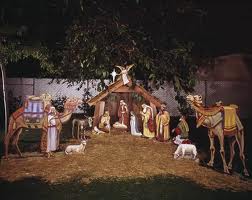
As you'll see from this Christian Post article, the commander in question basically told a group of militant atheists to go pound sand when they demanded he take down a Nativity scene erected at the base.

I'm glad, and three cheers to the Air Force. I agree with his assessment of the Constitution, and I would even go farther than him.

It never ceases to irritate me when I consider how the courts and modern politicians have distorted the so-called Establishment Clause beyond recognition. All this provision of the Constitution was intended to do was to prevent Congress from establishing a state religion, with the Church of England as a comparative example. Congress shall not "establish a religion, nor PREVENT THE FREE EXERCISE THEREOF." That's all it means. No more, no less. It was never intended to ban Nativity scenes or anything of the sort. A Nativity scene is not establishing a state church.

If our Founding Fathers were still alive—men who might actually know a little something about the Constitution because they wrote it—they would be aghast at what today's courts and politicians have done. And someone would get quite the lecture.

As a final aside, I can't help but be amused a bit with militant atheists. They're so threatened by something in which they claim not to believe. Some atheists I know personally actually share my opinion, finding it amusing as well. 

HT: 7thsola

Sunday, December 25, 2011

The Christmas Story by John MacArthur


The Real Meaning of Christmas


Luke 2:1-21 (NKJV) 1 And it came to pass in those days that a decree went out from Caesar Augustus that all the world should be registered. 2 This census first took place while Quirinius was governing Syria. 3 So all went to be registered, everyone to his own city. 4 Joseph also went up from Galilee, out of the city of Nazareth, into Judea, to the city of David, which is called Bethlehem, because he was of the house and lineage of David, 5 to be registered with Mary, his betrothed wife, who was with child. 6 So it was, that while they were there, the days were completed for her to be delivered. 7 And she brought forth her firstborn Son, and wrapped Him in swaddling cloths, and laid Him in a manger, because there was no room for them in the inn. 8 Now there were in the same country shepherds living out in the fields, keeping watch over their flock by night. 9 And behold, an angel of the Lord stood before them, and the glory of the Lord shone around them, and they were greatly afraid. 10 Then the angel said to them, "Do not be afraid, for behold, I bring you good tidings of great joy which will be to all people. 11 For there is born to you this day in the city of David a Savior, who is Christ the Lord. 12 And this will be the sign to you: You will find a Babe wrapped in swaddling cloths, lying in a manger." 13 And suddenly there was with the angel a multitude of the heavenly host praising God and saying: 14 "Glory to God in the highest, And on earth peace, goodwill toward men!" 15 So it was, when the angels had gone away from them into heaven, that the shepherds said to one another, "Let us now go to Bethlehem and see this thing that has come to pass, which the Lord has made known to us." 16 And they came with haste and found Mary and Joseph, and the Babe lying in a manger. 17 Now when they had seen Him, they made widely known the saying which was told them concerning this Child. 18 And all those who heard it marveled at those things which were told them by the shepherds. 19 But Mary kept all these things and pondered them in her heart. 20 Then the shepherds returned, glorifying and praising God for all the things that they had heard and seen, as it was told them. 21 And when eight days were completed for the circumcision of the Child, His name was called Jesus, the name given by the angel before He was conceived in the womb.

Wednesday, December 21, 2011

Have a Merry Christmas

This is a season when all men expect us to be joyous. We compliment each other with the desire that we may have a "Merry Christmas."

Some Christians who are a little squeamish, do not like the word "merry." It is a right good old Saxon word, having the joy of childhood and the mirth of manhood in it, it brings before one's mind the old song of the waits, and the midnight peal of bells, the holly and the blazing log. I love it for its place in that most tender of all parables, where it is written, that, when the long-lost prodigal returned to his father safe and sound, "They began to be merry."

This is the season when we are expected to be happy; and my heart's desire is, that in the highest and best sense, you who are believers may be "merry."

Mary's heart was merry within her; but here was the mark of her joy, it was all holy merriment, it was every drop of it sacred mirth. It was not such merriment as worldlings will revel in to-day and to-morrow, but such merriment as the angels have around the throne, where they sing, "Glory to God in the highest," while we sing "On earth peace, goodwill towards men."   Keep Reading >>>

7 Questions from Christmas Haters

Every year, Grace Church gets a handful of letters from people asking why our church celebrates Christmas. In fact, it is not unusual for some people to actually picket our church’s Christmas concerts (picture a hippi-esque anti-war ensemble replete with protest signs), and those people would probably keel over if they saw the giant Christmas trees we have in our plaza.

Today, for the Christian haters of Christmas, I give as my gift my answers to the most common questions from those that object to the celebration of Christmas:

1. What is Christmas?

Christmas is the celebration of Jesus’ incarnation. This is actually the most critical of all the questions. When Christmas is simply seen as the celebration of God becoming man, the rest of the questions should grow wings and take flight. Continue Reading >>>

Monday, December 19, 2011

The Simple Announcement

If you didn’t pay careful attention, you might pass right over one of the most important announcements in the New Testament: the miraculous birth of Jesus Christ. Matthew took only one verse to announce it. Such a concise statement, though it doesn’t all by itself prove the point, strongly suggests that our Lord and Savior’s virgin birth was not simply a man-made story.

A human author, writing strictly on his own initiative, would tend to describe such an amazing event in an expansive, detailed, and elaborate manner. But not the apostle Matthew. He does relate additional circumstances surrounding the virgin birth, but the basic fact is stated in one simple sentence: “After His mother Mary was betrothed to Joseph, before they came together, she was found with child of the Holy Spirit.”

Matthew devotes the previous seventeen verses to Jesus’ human genealogy but just this part of one verse to His divine genealogy. As the Son of God, Jesus “descended” from His heavenly Father by a miraculous and never-repeated act of the Holy Spirit; even so, the Holy Spirit chose to announce that astounding truth by just one brief, declarative sentence. As all God’s Word does, Matthew’s simple statement contains the solemn tone of authenticity. By contrast, a human fabrication would tend to have that false ring of exaggeration to it, being filled out with much more “convincing” material than what this inspired version needed.

Scripture gives us little information about Mary and even less about Joseph. Mary was undoubtedly a godly young woman, probably a native of Nazareth who came from a relatively poor family. Joseph was the son of Jacob (Matt. 1:16) and was a craftsman, probably a carpenter (13:55). Most significant, he was a “just man” (1:19), one who placed saving trust in the coming Messiah.  Keep Reading >>>

Saturday, December 17, 2011

The Controversy of Christmas

Mention “Christmas” and “controversy” together in the same sentence, and most evangelicals will assume you’re talking about Santa Claus, Christmas trees, or the secularization of the winter holiday season.

But, from a historical perspective, a much more significant controversy surrounded Christmas for the first five centuries of church history; and its effects still linger in some circles today. It centered on the very essence of Jesus’ birth  – the doctrine of His incarnation.

There is, of course, an element of mystery in the incarnation. After all, how can one person be both fully God and fully man at the same time? Yet, that is precisely the miraculous truth that the Scriptures affirm regarding the Person of Jesus Christ.

Nonetheless, despite the clarity of biblical revelation, the doctrine of Christ’s incarnation came under attack from the very beginning. 

The Ebionites, a legalistic first- and second-century cult, denied the Virgin Birth and the very idea of the incarnation. They accepted the fact that Jesus was a man, but utterly rejected the notion that He was God in human flesh.

In the second and third centuries, the Gnostics likewise denied the incarnation. Not only did they teach that Christ was one of many gods, they also rejected the idea that His humanity was real. In Gnostic teaching, Christ’s humanity was merely an illusion. Thus, the incarnation did not really occur; it was only a mirage.

In the fourth century, the Arians affirmed the humanity of Christ, but denied His full deity. In particular, they denied Christ’s equality with the Father.  Thus, while His manhood was upheld, His place as the Second Member of the Trinity was rejected.  Keep Reading >>>

Wednesday, December 14, 2011

Christ the Desire of All Nations by John Flavel (1628-1691)

“And the desire of all nations shall come.” Haggai 2:7.


The first chapter of Haggai is mainly spent in reproving the negligence of the Jews, who, being discouraged from time to time, had delayed the rebuilding of the temple. In the meantime they employed their care and cost in building and adorning their own houses: but, at last, being persuaded to set about the work, they met with this discouragement, that such was the poverty of the present time, that the second structure would not match the magnificence and splendor of the first. In Solomon’s days the nation was wealthy, but now it was drained; so that there would be no comparison between the second and the first. To this great discouragement the prophet applies this relief: that whatsoever should be lacking in external pomp and glory, should be more than recompensed by the presence of Jesus Christ in this second temple. For Christ, “the desire of all nations,” he says, shall come into it. Which, by the way, may give us this useful note: The presence of Jesus Christ gives a more real and excellent glory to the places of his worship, than any external beauty or outward ornaments whatsoever can bestow upon them. Our eyes, like the disciples, are apt to be dazzled with the sparkling stones of the temple, and, in the meantime, to neglect and overlook that which gives it the greatest honour and beauty.

But to return. In these words we have both the description of Christ, and an arrow pointing at the time of his incarnation: he is called “the desire of all nations,” and the time of his coming in the flesh is clearly implied to be during the time of the second temple. Where, by the way, we find a valid reason to stand amazed at and bemoan the blindness of the Jews. They admit the truth of this prophecy and are not able to deny the destruction of the second temple, many hundred years past, yet will not be brought to acknowledge the incarnation of the true Messiah.  Keep Reading >>>

Friday, December 9, 2011

The Gospel According to Peanuts

Click here to read more of The Gospel According to Peanuts:

What people don’t know is that the Christmas special almost didn’t happen, because some not-so-smart television executives almost didn’t let it air. You see, Charles Schulz had some ideas that challenged the way of thinking of those executives 46 years ago, and one of them had to do with the inclusion in his Christmas cartoon of a reading from the King James Bible’s version of the Gospel of Luke.

The more things change, the more things stay the same.

As far back as 1965 — just a few years before Time magazine asked “Is God Dead?” — CBS executives thought a Bible reading might turn off a nation populated with Christians. And during a Christmas special, no less! Ah, the perils of living on an island in the northeast called Manhattan.

“A Charlie Brown Christmas” was a groundbreaking program in so many ways, as we learned watching the great PBS American Masters series on Charles Schulz, known by his friends and colleagues as “Sparky.” It was based on the comic strip Peanuts, and was produced and directed by former Warner Brothers animator Bill Melendez, who also supplied the voice for Snoopy. . . .

There was a standoff of sorts, but Schulz did not back down, and because of the tight production schedule and CBS’s prior promotion, the network executives aired the special as Schulz intended it. But they were certain they had a flop on their hands.  Keep Reading >>>