The purpose of this Blog is to introduce men and women all over the World to the Doctrines of Grace; the 5 Solas; Reformation Theology and the Lord and Savior Jesus Christ.
Showing posts with label History. Show all posts

Monday, April 1, 2013

History & Faith

The student of the New Testament should be primarily an historian. The center and core of all the Bible is history. Everything else that the Bible contains is fitted into an historical framework and leads up to an historical climax. The Bible is primarily a record of events. 

That assertion will not pass unchallenged. The modern Church is impatient of history. History, we are told, is a dead thing. Let us forget the Amalekites, and fight the enemies that are at our doors. The true essence of the Bible is to be found in eternal ideas; history is merely the form in which those ideas are expressed. It makes no difference whether the history is real or fictitious; in either case, the ideas are the same. It makes no difference whether Abraham was an historical personage or a myth; in either case his life is an inspiring example of faith. It makes no difference whether Moses was really a mediator between God and Israel; in any case the record of Sinai embodies the idea of a covenant between God and his people. It makes no difference whether Jesus really lived and died and rose again as he is declared to have done in the Gospels; in any case the Gospel picture, be it ideal or be it history, is an encouragement to filial piety. In this way, religion has been made independent, as is thought, of the uncertainties of historical research. The separation of Christianity from history has been a great concern of modern theology. It has been an insping attempt. But it has been a failure.

Give up history, and you can retain some things. You can retain a belief in God. But philosophical theism has never been a powerful force in the world. You can retain a lofty ethical ideal. But be perfectly clear about one point-you can never retain a gospel. For gospel means "good news," tidings, information about something that has happened. In other words, it means history. A gospel independent of history is simply a contradiction in terms.    Continue at J. Gresham Machen

Wednesday, December 26, 2012

God Is the Lord of History

I never cease to be amazed at how many surprises remain in familiar passages of Scripture, if we stare long enough. I hope I have come to the point of entirely distrusting any presumption that I have exhausted any portion of God’s Word. This has particularly been the recurring lesson from the Gospel of Luke, as I have been teaching it to the college-group in our congregation. Though familiar territory, the announcements and births of both John the Baptist and the Lord Jesus (Luke 1-2) are filled with many sanctifying surprises.

For example, when we reflect on Jesus’ birth in Luke 2:1-21, we garner much comfort in how God sovereignly rules over all human government to accomplish His purposes in Christ. Perhaps this a tad relevant to our present day?

Why Was Jesus Born in Bethlehem?

Of course, Micah prophesied the birth of our Lord Jesus over 6 centuries before it was fulfilled (Micah 5:2). The Son of David, whose throne God would establish forever (2 Sam 7:13; cf. Luke 1:32-33), was to be born in David’s hometown (cf. 1 Sam 16:1-4). If He actually is the Messiah of David’s line, then Jesus had to be born in Bethlehem and fulfill God’s very old promises. But that’s not the only reason Jesus was born in Bethlehem.  Continue at Steve Meister

Thursday, August 2, 2012

William Lane Craig Lectures on the Evidence for the Resurrection of Jesus

This is a long form explanation of the resurrection argument that Dr. Craig makes in all of his debates on the existence of God. The speaker introduction goes for 6 minutes, then Dr. Craig speaks for 35 minutes, then it’s a period of questions and answers with the audience. The total length is 93 minutes, so quite a long period of Q&A. The questions in the Q&A period are quite good.

Introduction:
  • Many people who are willing to accept God’s existence are not willing to accept the God of Christianity
  • Christians need to be ready to show that Jesus rose from the dead as a historical event
  • Private faith is fine for individuals, but when dealing with the public you have to have evidence
  • When making the case, you cannot assume that your audience accepts the Bible as inerrant
  • You must use the New Testament like any other ancient historical document
  • Most historians, Christian and not, accept the basic minimal facts supporting the resurrection of Jesus
Fact #1: the burial of Jesus following his crucifixion
  • Fact #1 is supported by the early creed found in Paul’s first letter to the Corinthians (1 Cor 15)
  • Fact #1 is supported by the early Passion narrative which was a source for Mark’s gospel
  • Fact #1 passes the criterion of enemy attestation, since it praises one of the Sanhedrin
  • Fact #1 is not opposed by any competing burial narratives  
Continue at  William Lane Craig

Thursday, May 17, 2012

Signs of the Times: Revelation 6:1-17

Revelation 6:1-17 teaches us that our God is the Lord of history. He is the final judge.
"Now I watched when the Lamb opened one of the seven seals, and I heard one of the four living creatures say with a voice like thunder, “Come!” And I looked, and behold, a white horse! And its rider had a bow, and a crown was given to him, and he came out conquering, and to conquer. When he opened the second seal, I heard the second living creature say, “Come!” And out came another horse, bright red. Its rider was permitted to take peace from the earth, so that people should slay one another, and he was given a great sword. When he opened the third seal, I heard the third living creature say, “Come!” And I looked, and behold, a black horse! And its rider had a pair of scales in his hand. And I heard what seemed to be a voice in the midst of the four living creatures, saying, “A quart of wheat for a denarius, and three quarts of barley for a denarius, and do not harm the oil and wine!” When he opened the fourth seal, I heard the voice of the fourth living creature say, “Come!”
 And I looked, and behold, a pale horse! And its rider’s name was Death, and Hades followed him. And they were given authority over a fourth of the earth, to kill with sword and with famine and with pestilence and by wild beasts of the earth.
When he opened the fifth seal, I saw under the altar the souls of those who had been slain for the word of God and for the witness they had borne. They cried out with a loud voice, “O Sovereign Lord, holy and true, how long before you will judge and avenge our blood on those who dwell on the earth?” Then they were each given a white robe and told to rest a little longer, until the number of their fellow servants and their brothers should be complete, who were to be killed as they themselves had been.
When he opened the sixth seal, I looked, and behold, there was a great earthquake, and the sun became black as sackcloth, the full moon became like blood, and the stars of the sky fell to the earth as the fig tree sheds its winter fruit when shaken by a gale. The sky vanished like a scroll that is being rolled up, and every mountain and island was removed from its place. Then the kings of the earth and the great ones and the generals and the rich and the powerful, and everyone, slave and free, hid themselves in the caves and among the rocks of the mountains, calling to the mountains and rocks, “Fall on us and hide us from the face of him who is seated on the throne, and from the wrath of the Lamb, for the great day of their wrath has come, and who can stand?”
Now that we have come to chapter six my own interpretation of Revelation will become clearer. Obviously there are many different views of what Revelation means. I don’t have time to critique other viewpoints in detail. I certainly don’t claim inspiration or infallibility for my reading, and you are called upon to test all things and to hold fast what is good.   Continue at Thomas Schreiner

Tuesday, January 3, 2012

What Nazis & the Bible Agree is the Worst Resolution You Can Make

I plant my flag firmly on the side of those who believe Christians may make resolutions. As a tadpole seminoid I was inspired by the audacity and convictions of Jonathan Edwards’ famed 70 Resolutions. My heart thumps in time with over-the-top commitments like #22:
“Resolved: to endeavor to obtain for myself as much happiness, in the other world, as I possibly can, with all the power, might, vigor, and vehemence, yea violence, I am capable of, or can bring myself to exert, in any way that can be thought of.”
But there is something I have learned from the Bible, history, research, and experience: the absolute worst resolution you could ever make at any time in your life.  It’s a truth the Nazis and the Bible agree on. And the sting in the tail is that it is probably the resolution you made this very New Year’s Day.

The only resolution you should never make is one that you won’t keep.

Let’s call resolutions what the Bible calls them: vows. And if there is one thing we know from the Bible about vows is they aren’t to be taken lightly. Just ask Jephthah’s daughter. Solomon’s ominous wisdom hangs over New Year’s day: Keep Reading >>>

Saturday, November 26, 2011

'Tis the Season in Which We Celebrate America's Christian Heritage

One of our local radio stations is already playing Christmas music full-time. It’s amazing how many songs have been written about Christmas. Most of them are secular, but the most common message they convey is one of family joy, of children and Santa Claus, of remembrance of all the Christmases we enjoyed in the past with loved ones who are no longer with us.

So despite the attempts by atheists to ban Christianity from American public life, particularly in the public schools, they cannot eradicate Christmas from family life, let alone the shopping malls. As anyone can see, Christmas has acquired great economic power. And that is because Christianity is at the foundation of our spiritual life and political system.

Secular humanism tries to give the impression that Christianity was just a passing phase in American history, and that our culture is advancing into a new secular religion more in keeping with modern values. But the humanist movement cannot remove the need in people’s lives for attachment to their Creator. In recent years we’ve seen a revival of religious fervor in America, particularly in the South where mega-churches have been built to accommodate the large numbers of people who need all the spiritual nourishment they can get.

Everybody seems to recognize that our modern civilization is in very big trouble. We have a national debt in the trillions of dollars. We are at war with radical Islam. We have a socialist regime in Washington at odds with our constitutional form of government. Our technological advances are astounding, yet we have mobs in the streets calling for the end of capitalism, the very system that created all of these goodies.

Perhaps a refresher course in American history and our Christian roots is needed to strengthen our convictions of how the American people should go about reconstructing their future. Getting people to live in obedience to the Ten Commandments has always been an uphill battle, even in colonial times.

Paul Johnson, a great admirer of the American system of political and religious freedom, wrote in his book, A History of the American People: "There was a spiritual event in the first half of the 18th century in America, and it proved to be of vast significance, both in religion and in politics."

He is referring to the Great Awakening, a religious revival started by impassioned preachers determined to bring as many souls as possible to the saving grace of Jesus Christ.  Keep Reading >>>

Friday, November 11, 2011

Are We Too Healthy?


I love to read biographies. I find history and particularly the lives of those who have walked before us fascinating. One of the things I cherish most about a good biography is learning valuable lessons from another’s experience. It’s important to learn from the past and to recognize that most problems have a way of coming full circle. This seems to be the case when it comes to the health of the church and of individual believers.

Dr. David Martyn Lloyd-Jones was a Welsh preacher who lived and preached in London England during the twentieth century. He was a fascinating man who was on the verge of becoming a world-renowned physician before abandoning medicine to pursue his divine calling to proclaim the Word of God and the gospel of Jesus Christ. Throughout his life he proved to be a stalwart for the faith, defending it against the liberal thinking of the day. His uncanny ability to carefully diagnose problems and to remedy them with sound biblical logic and principles was unrivalled. When the “evangelical” church was caving to the currents of the culture, Lloyd-Jones stood boldly to “preach the Word… in season and out of season (2 Tim. 4:2).

His concern for the superficiality that seemed to characterize the evangelical church caused him to reflect upon the reasons and solution for such a plight. He believed that the hallmark of a true experience of God was a sense of awe, and accompanying it, a sense of unworthiness. While he strongly warned against the dangers of morbid introspection, self condemnation and professions of constant failure, he did not shy away from stating that the weakened state of the church was a result of a defective sense of sin and a defective doctrine of sin. Consider the following quote:   Keep Reading >>>

Saturday, November 5, 2011

Peter Enns on Paul, Adam, and Evolution

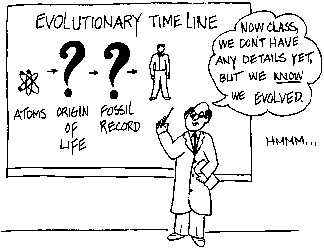
For Peter Enns, evolution denies the historical Adam and Eve, and that gives rise to the questions he’s trying to answer. The fact that Paul viewed Adam as the first human being has, for Enns, been shown to be wrong scientifically. Enns asserts that Paul is theologically right on the point that Jesus defeated sin and death, but that he “may be wrong” on what caused the problem–Adam’s sin. Though he “may be wrong” on that, Enns asserts, Paul is right about sin and death and the solution. Enns says that even if Adam and Eve didn’t bit an apple, sin and death are real.

Enns seems to want to keep the theology while discarding the history as he explains: “I don’t need a historical Adam to make all that happen… I understand why Paul says what he says, cause he’s an ancient man, cause he’s a Jew.”

For Enns, the theory of evolution carries as much authority as Scripture, and it shows that Paul was wrong about Adam being the first human. Moreover, the interpretations that Paul and the other biblical authors provide of earlier Scripture are just possibilities, not necessarily correct readings that function as controls on how those earlier texts should be read.

Peter Enns is trying to combine two different religions, evolution and Christianity...  Read the rest HERE

Friday, August 26, 2011

The Death of History’s Worst Heretic

Who is church history’s most notorious false teacher?
 
It might not be possible to answer that question definitively. But if we were to create a top-ten “most wanted” list, the name Arius would undoubtedly be near the top.

In ancient times, Arius’s teachings presented the foremost threat to orthodox Christianity — which is why historians like Alexander Mackay have labeled him “the greatest heretic of antiquity.” None other than Martin Luther said this about Arius:
The heretic Arius [denied] that Christ is true God. He did much harm with his false doctrine throughout Christendom, and it took four hundred years after his death to combat its injurious influence, yea, it is not even yet fully eradicated. In the death of this man the Lord God exalted His honor in a marvelous manner.
In case his name doesn’t sound familiar, Arius was a famous fourth-century false teacher who taught that the Son of God was a created being. Consequently, Arius denied Christ’s equality with God the Father, and along with it, the doctrine of the Trinity. Essentially, he was the original Jehovah’s Witness. His views were very popular during his lifetime and for many years afterward, even though they were denounced at the Council of Nicaea in 325 (and again at the Council of Constantinople in 381).    Keep Reading...

Saturday, July 23, 2011

Perspective: What Impact Did Adam's Sin Have on the Rest of Humankind?

Why am I writing this post? See Theology (is) for Girls. And you can read another perspective via the link at the end of this post.

Before answering the title question, let me emphasize: Adam and Eve were actual, historical individuals, specially created by God in His image at the beginning of the world. I don’t have space to defend it here, but Adam’s actual existence is assumed in my answer.

Adam’s sin, eating fruit from the tree that God commanded him not to eat, is briefly described (Genesis 3:5b), but his one act had implications for every person throughout the rest of human history. In the same way that children of alcoholic parents may suffer from Fetal Alcohol Syndrome, poverty, and emotional scarring, the children of Adam suffer the consequences of his sin.

First, we now live in a sin-bruised world. As I tell my kids: It’s a fallen world; stuff breaks. We see the consequence appearing almost immediately after the sin. The previously pleasant callings of subduing the earth and multiplying (Genesis 1:28) now result in thorns (3:18) and heartache (3:16). We get the flu, our pets run away from home. Stuff breaks.

Second, we are sin-filled people. This consequence rears its head pretty quickly, too, “the wickedness of man was great on the earth. . .every intention of the thoughts of his heart was only evil continually” (Genesis 6:5). And our native sinfulness is emphasized throughout Scripture: “I was brought forth in iniquity” (Psalm 51:5), “the heart is deceitful above all things and desperately sick” (Jeremiah 17:9) and “none is righteous, no, not one” (Romans 3:10). We tell lies, we fight with our spouses. We love to sin.     Keep Reading...

Thursday, May 19, 2011

Heresy: A History of Defending the Truth by Alister McGrath

Somehow the notion has gotten around that ideas condemned by the church as heretical are a lot more interesting and attractive than stodgy old orthodoxy. In fact some scholars to try to suggest that what are now regarded as heretical versions of the faith were in fact more authentically Christian than orthodox teaching. To make things worse, it is claimed that orthodox Christians were the big bullies of church history. They were not above using the dark arts of political manipulation to impose their will on the church at the expense of poor, downtrodden heretics. On a popular level Dan Brown's The Da Vinci Code perpetuates the idea that the development of orthodox Christian faith was little better than a grand theo-political conspiracy. Keep Reading...

Saturday, February 12, 2011

The Idol of Relevance

Here is a piercing critique of the church’s uncritical pursuit of relevance for the sake of relevance. His argument: “Never have Christians pursued relevance more strenuously; never have Christians been more irrelevant” (p. 12). Guinness explains it like this:
By our uncritical pursuit of relevance we have actually courted irrelevance; by our breathless chase after relevance without a matching commitment to faithfulness, we have become not only unfaithful but irrelevant; by our determined efforts to redefine ourselves in ways that are more compelling to the modern world than are faithful to Christ, we have lost not only our identity but our authority and our relevance. Our crying need is to be faithful as well as relevant. (p. 11)
This is because, as Guinness writes, faithfulness to eternal truth is the means to genuine cultural relevance. In every generation, our goal is centered on the proclamation and advance of the gospel of Jesus Christ through the local church. Only because of the gospel’s continued relevance is it rightfully called the “good news.” Keep Reading>>>

Friday, June 25, 2010

Amazing Grace: The History and Theology of Calvinism

Any mention of the word “Calvinism” provokes a number of questions, discussions, objections, and realizations. What is “Calvinism?” Does this teaching make man a deterministic robot and God the author of sin? What about free will? If the church accepts Calvinism, won’t evangelism be stifled, perhaps even extinguished? How can we balance God’s sovereignty and man’s responsibility? Why did the Roman Catholic Church condemn the Reformed teaching of predestination and election and embrace free will theology? And why do so many Protestants, perhaps unwittingly, agree with Rome on this issue?

Amazing Grace: The History and Theology of Calvinism, a DVD and study guide produced by The Apologetics Group, is the first video documentary that answers these and other related questions. This two-disc, three-part, four-hour presentation is detailed enough so as to not gloss over the controversy. At the same time, it is broken up into ten “Sunday-school-sized” sections to make the rich content manageable and accessible for the average viewer. Read the rest HERE