The purpose of this Blog is to introduce men and women all over the World to the Doctrines of Grace; the 5 Solas; Reformation Theology and the Lord and Savior Jesus Christ.
Showing posts with label Questions. Show all posts

Friday, November 9, 2012

5 Questions Wives Should Not Ask Their Husbands

Recently  there was a great little post about 5 questions husbands should ask their wives. Good questions.

Of course I starting thinking about what kind of questions we wives should ask our husbands, but more than that, I immediately thought of questions we should not ask them. Here are five questions a wife should never, in my opinion anyway, ask her husband. (And if you already have, I hope you just laugh at yourself now that I bring it up and not get mad at me.)

#1 Do you think I am fat?

What a terrible question! You should figure out the answer yourself by looking in the mirror or checking the scale, because if he says, ” Yes, dear, you are a little pudgy,” he’s automatically in the doghouse. How insensitive! If he says,”No” (like a good husband should), he may still be in trouble if you think he might be  fudging. Other questions in this category include, “Do I look old? Am I ugly?” Ugly? No. Stupid? Yes.

#2 Do you think Susie (or Sandy or Sally) is attractive?

If he says, “Yes, she’s gorgeous,” then what? Most of the time the next question is, “Do you think she’s prettier than I am?” Now we have gone from bad to worse! Now he’s in an impossible situation, and you are being way too self-absorbed. But if he hems and haws (“Well, I’m not really sure. She’s kind of pretty I think…”) then you’ll be tempted to think he’s not being honest. What possible good can come from having this conversation?   Continue at Nancy Ann

Saturday, June 2, 2012

20 Questions that Atheists Need to be Able to Answer

Here are some puzzling phenomena that every person should try to struggle with, and find the answers. (H/T Justin Brierley)

Here’s the full list:
1.What caused the universe to exist?
2.What explains the fine tuning of the universe?
3.Why is the universe rational?
4.How did DNA and amino acids arise?
5.Where did the genetic code come from?
6.How do irreducibly complex enzyme chains evolve?
I’m leaving out numbers 7 and 8 because they lack specificity.

9.How is independent thought possible in a world ruled by chance and necessity?
10.How do we account for self-awareness?
11.How is free will possible in a material universe?
12.How do we account for conscience?
13.On what basis can we make moral judgements?
14.Why does suffering matter?   Continue at WinteryKnight

Thursday, February 23, 2012

Go Beyond the Sex Questions

Evangelicals appear to be preoccupied with sex. One megachurch pastor and his wife have written a book challenging married couples to a “sexperiment” of making love for seven days straight. Mark Driscoll’s controversial new book on marriage contains a chapter titled “Can We?” in which he and his wife answer questions they are typically asked in counseling situations, questions related to different sex acts.

This post is not meant to be a critique of Driscoll’s book (I haven’t read it and don’t plan to). Nor do I want the comments section to degenerate into a fiery back-and-forth about what activities are appropriate for married couples.

Instead, I want to offer a pastoral look at the underlying issues that prompt these questions and encourage pastors to go for the heart, not merely the surface, when approached with questions of this kind.

1. Recognize the legitimacy of the questions.

First, we should not be surprised that new converts are asking pointed questions about what activities are appropriate for a married couple. We live in a pornified culture.  Continue at Trevin Wax

Friday, February 10, 2012

Asking Better Questions

So how many people go to your church?” That’s a question just about every pastor faces at just about every conference he attends. It usually doesn’t take long for a conversation to progress to that point. For the pastor this can be a moment of great pride or great humility, great freedom or great shame. 

Regardless, it is a question that always seems to come up. And it comes up for those who are not pastors as well; you begin to talk about your church and your friend inevitably asks that same question.

Today I’d like to make a two-part proposal: Let’s stop asking, “How many people go to your church?” And when someone asks us that question, let’s stop providing a direct answer.

We all pay lip service to the reality that we cannot necessarily measure the health of a church by its size. We all know that some of the biggest churches in the world are also some of the worst churches in the world. After all, the history of the church has long-since shown that it is not all that difficult to fill a building with unbelievers by just tickling their ears with what they want to hear. 

We also know that the Lord is sovereign and that he determines how big each church should be and we know that in some areas even a very small church is an absolute triumph of light over darkness. And yet “How big is your church?” is one of the first questions we ask.  Continue at Tim Challies

Wednesday, November 30, 2011

Revealed Ethics

At the heart of Christian ethics is the conviction that our firm basis for knowing the true, the good, and the right is divine revelation. Christianity is not a life system that operates on the basis of speculative reason or pragmatic expediency. We assert boldly that God has revealed to us who He is, who we are, and how we are expected to relate to Him. He has revealed for us that which is pleasing to Him and commanded by Him. Revelation provides a supernatural aid in understanding the good. This point is so basic and so obvious that it has often been overlooked and obscured as we search for answers to particular questions.

The departure from divine revelation has brought our culture to chaos in the area of ethics. We have lost our basis of knowledge, our epistemological foundation, for discovering the good. This is not to suggest that God has given us a codebook that is so detailed in its precepts that all ethical decisions are easy. That would be a vast oversimplification of the truth. God has not given us specific instructions for each and every possible ethical issue we face, but neither are we left to grope in the dark and to make our decisions on the basis of mere opinion. This is an important comfort to the Christian because it assures us that in dealing with ethical questions, we are never working in a vacuum. The ethical decisions that we make touch the lives of people, and mold and shape human personality and character. It is precisely at this point that we need the assistance of God’s superior wisdom.  Keep Reading >>>

Friday, October 21, 2011

How Do I Make Decisions That Please God?

Today we come to the fourth and final part of this short series on knowing and doing the will of God. In the first part of the series I laid a foundation of God’s complete sovereignty over the universe and in the second part I sought to show that God is speaking to us today and how God is speaking to us today. In the third part I wanted showed that God is speaking to you and revealing his will for your life. In this final installment I want to ask the big question: When it comes right down to it, how do I make decisions that please God?

I want to give you 3 questions that will guide you as you think about any decision or any situation and that will help you have confidence that you are doing God’s will for your life. As you consider that big decision, you need to ask these three questions in order.

Question #1

What does the Bible say about it? That’s a rather obvious question, but it’s one we sometimes miss. What does the Bible say about it? Is there a passage in the Bible that speaks directly to this issue or is there a principle that applies to it?   Keep Reading>>>

Wednesday, October 5, 2011

Questions Steve Ray Thinks "Bible Chrisians" Can't Answer - Answered

Steve Ray seems to think that there are questions that we Bible Christians cannot answer. (Link to his post)

Not only can we answer them, we have answered them. For the most part, they are a bunch of loaded questions that are actually not that hard to unload and answer. The answers I provided below may not even be the only or best answers. Nevertheless, so as to bring to Mr. Ray's attention the answers that were provided over a year ago, the following provides an easy index of the responses.

Just click on the question for the answer. 
  1. "Where did Jesus give instructions that the Christian faith should be based exclusively on a book?" 
  2. "Other than the specific command to John to pen the Revelation, where did Jesus tell His apostles to write anything down and compile it into an authoritative book?" 
  3. "Where in the New Testament do the apostles tell future generations that the Christian faith will be based solely on a book?" 
  4. "some Protestants claim that Jesus condemned all oral tradition (e.g., Matt 15:3, 6; Mark 7:813). If so, why does He bind His listeners to oral tradition by telling them to obey the scribes and Pharisees when they “sit on Moses’ seat” (Matt 23:2)?" 
  5. "Some Protestants claim that St. Paul condemned all oral tradition (Col 2:8). If so, why does he tell the Thessalonians to “stand firm and hold to the traditions which you were taught, whether by word of mouth or by letter” (2 Thes 2:15) and praises the Corinthians because they “hold firmly to the traditions” (1 Cor 11:2)? (And why does the Protestant NIV change the word “tradition” to “teaching”?)" 
  6. "If the authors of the New Testament believed in sola Scriptura, why did they sometimes draw on oral Tradition as authoritative and as God’s Word (Matt 2:23; 23:2; 1 Cor 10:4; 1 Pet 3:19; Jude 9, 14 15)?" 
  7. "Where in the Bible is God’s Word restricted only to what is written down?" 
  8. "How do we know who wrote the books that we call Matthew, Mark, Luke, John, Acts, Hebrews, and 1, 2, and 3 John?" 
  9. "On what authority, or on what principle, would we accept as Scripture books that we know were not written by one of the twelve apostles?" 
  10. "Where in the Bible do we find an inspired and infallible list of books that should belong in the Bible? (e.g., Is the Bible’s Table of Contents inspired?)" 
  11. "How do we know, from the Bible alone, that the individual books of the New Testament are inspired, even when they make no claim to be inspired?" 
  12. "How do we know, from the Bible alone, that the letters of St. Paul, who wrote to first-century congregations and individuals, are meant to be read by us as Scripture 2000 years later?"    Keep Reading...
IMAGE

Tuesday, August 30, 2011

Essential vs. Peripheral Doctrine

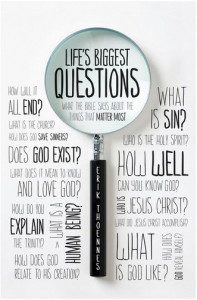
Erik Thoennes, Life’s Biggest Questions: What the Bible Says About the Things That Matter Most, (Wheaton: Crossway, 2011), 35–37 (formatting added):

Essential vs. Peripheral Doctrine
The ability to discern the relative importance of theological beliefs is vital for effective Christian life and ministry. Both the purity and unity of the church are at stake in this matter. The relative importance of theological issues can fall within four categories:
  1. absolutes define the core beliefs of the Christian faith;
  2. convictions, while not core beliefs, may have significant impact on the health and effectiveness of the church;
  3. opinions are views or personal judgments that generally are not worth dividing over; and
  4. questions are currently unsettled issues.
These categories can be best visualized as concentric circles, similar to those on a dart board, with the absolutes as the “bull’s eye” (see fig. 3.4).   Keep Reading...

Wednesday, March 23, 2011

The New Evangelical Virtues

Asking questions is in, answering them in a clear and compelling way is out. Here is how Greg Boyd praises Bell in this regard: “Rob is first and foremost a poet/artist/dramatist who has a fantastic gift for communicating in ways that inspire creativity and provoke thought. Rob is far more comfortable (and far better at) questioning established beliefs and creatively hinting at possible answers than he is at constructing a logically rigorous case defending a definitive conclusion.” As just one example, the strength of the Emerging Church and its draw was far more in asking questions than in answering them. In fact, the New Calvinism and the Emerging Church arose by asking many of the same questions—questions that came out of the Church Growth Movement and the slow erosion of significant, weighty doctrine. Right teaching and right living were being replaced by mindless entertainment and those who became Emergent leaders asked many good questions. But their answers, when they were willing to give them, were lousy. Read it all HERE

Monday, March 14, 2011

Some Questions For The Pastor

Article by W. J. Mencarow Pastor of Reformation Church Boerne, TX
 
Here are some questions you should ask the pastor. All questions anticipate a “yes” answer. If he cannot give you a flat “yes,” and instead talks around the question, or says that the question is too complicated for a yes or no answer, or some other such evasive nonsense, find another church.

Warning: You will find very few churches in which the pastor will answer “yes” to every one of these questions. Even if he answers “yes” to all the others, the question with which he will most likely take issue is the one about worship. Sadly, there are very few churches that conform to virtually all elements of Biblical worship. And of course there is no perfect church on this earth, because they are administered by imperfect men.

However, that does not mean one has to avoid a church simply because there are elements of its worship that are lacking. For example, it is very difficult to find a church that sings out of the Lord’s songbook, the Psalms, exclusively. (most Christians are unaware that the opposite has almost always been true — there were no churches that sang hymns composed by men until relatively recently in church history. Our Christian forefathers would ask us, “Why do you want to sing words written by uninspired men and women when you have 150 songs written by God and given by Him for us to sing?”) Keep Reading>>>

Thursday, March 3, 2011

The Satanic Power of a Question

The first attack on the human race did not come from outer space. No alien fleet of space ships. No downloaded virus into a vein to ultimately kill, steal and destroy. It was not even a physical attack; no swords, clubs, guns or bombs. But O, the devastation it caused.

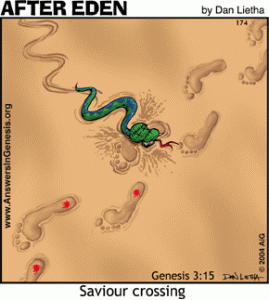
For those who know their Bibles, you will know I am referring to the attack on the first parents of mankind in a Garden called Eden, when the serpent attacked Adam and Eve… with a question. That was all it was. A simple question. 

Oh it was a loaded question. The question spoke volumes about how God could not be trusted – how His word was not to be believed. It spoke of how God did not really have their best interests at heart – that He was holding out on them – that if God really did love them, then things would be different. Built into the question was an undermining of God, His word and His love; and more than that, an insinuation that God did not want them to achieve the most beautiful thing possible – the ability to be like God.

Think of it from the devil’s perspective (and I mention the devil because there are passages in Scripture which tells us clearly that it was the devil who entered into the serpent in the garden). If you were the devil, how would you tempt a perfect man and woman who were living in a perfect environment? Keep Reading>>>

Thursday, February 17, 2011

Questions of Conviction on Eternal Security

Because "eternal life" is integral to the gospel's promise, I believe eternal security is an integral blessing of the gospel, and to deny it is to embrace a truncated gospel. Eternal security is near and dear to my heart, and I have been grateful and sobered by the many opportunities I have had to teach it to others in counseling situations over the last several years. Eternal insecurity, the doubting of grace for me, has been the number one counseling issue I have encountered in both Bible Belt Nashville and the traditionalist wasteland of rural Vermont.

When I reflect on God's promise of eternal security for those in Christ, I go to these common Scriptures and posit these questions of conviction. Keep Reading>>>

Friday, February 11, 2011

5 More Questions with John MacArthur

Yesterday I shared the first part of a two-part interview with John MacArthur. Yesterday’s questions revolved around Dr. MacArthur’s new book Slave, the best Bible translations, avoiding scandal, the challenges he has faced in ministry, and the advice he would give himself if he could go back to the early days of his ministry.

Today the interview continues…

You are obviously a busy man. What advice would you give to pastors on loving their wives and children amidst the many demands of the pastoral ministry?

It is critically important that the pastor give priority to his family. As Paul told Timothy regarding the qualification of an elder, “He must be one who manages his own household well, keeping his children under control with all dignity (but if a man does not know how to manage his own household, how will he take care of the church of God?” So, this is a priority that comes to us directly from the Scriptures. Keep Reading>>>

Thursday, February 10, 2011

10 Questions with John MacArthur

A couple of weeks ago I asked the readers of this site to help me interview John MacArthur. I collected several of the best questions, added in a few of my own, and sent them off. Dr. MacArthur was kind enough not just to answer them, but to answer them very thoroughly.

I am posting the first 5 questions and answers today and will follow up with the next 5 tomorrow. Today the questions revolve around his new book Slave, the best Bible translations, avoiding scandal, the challenges he has faced in ministry, and the advice he would give himself if he could go back to the early days of his ministry. Tomorrow he talks about time management, about critiquing people “in our camp,” about theological crises, about the Reformed Charismatics and about Christians who deny a literal 6-day creation.

Without further ado, here is the interview with Dr. MacArthur:

Slave. What is it about this word that merits a whole book?

Sometimes one word can make an enormous difference. For example, the Latin Vulgate’s translation of metanoia (repentance) as paenitentia (penance) in places like Acts 2:38 led to all sorts of problems in the Roman Catholic Church. Continue Reading>>>