The purpose of this Blog is to introduce men and women all over the World to the Doctrines of Grace; the 5 Solas; Reformation Theology and the Lord and Savior Jesus Christ.
Showing posts with label Sins. Show all posts

Friday, June 27, 2014

Confessing Our Sins Together

In a chapter on confession and communion in Life Together, Dietrich Bonhoeffer writes that “he who is alone with his sin is utterly alone. . . . But it is the grace of the gospel, which is so hard for the pious to understand, that confronts us with the truth and says: You are a sinner, a great, desperate sinner; now come as the sinner you are, to the God who loves you.”

I’m sure that most of us agree with Bonhoeffer that the confession of sin, grounded in the gospel, is a vital component of our personal spirituality. But we get a little uncomfortable when it comes to corporate dimensions of confession. It’s not too threatening to engage in silent confession when the liturgy calls us to do so in the weekend service, but when it comes to times of confession in small-group settings, we often settle for less-indicting statements like “I’m struggling with . . .” Even then, we have the gnawing sense that our vague, toothless non-confessions aren’t fulfilling the exhortation of James 5:16, “Confess your sins to one another and pray for one another that you may be healed.”   Continue at Ryan Griffith

Saturday, March 10, 2012

Why Are Secular Progressives So Threatened by the Christian's View of Homosexual Behavior?

Why do the the secular progressives feel so threatened when homosexual behavior is called a sin by Christians? Is this sin unique among sins? The recent fury by the Hollywood crowd over Kirk Cameron's honest answer to a journalist's question got me to thinking about this. 

For thousands of years the church has declared many various things as sinful; practices that are in direct rebellion against the Creator. These are acts that God Himself revealed to men as opposing his Lordship. The church has always declared the sinfulness of sex outside the covenant of marriage (before and after marriage), the sinfulness of idol worship, greed, hatred, pride and arrogance, self-righteousness, murder and many more. And the largest proportion of these are directed toward the church's own sin. You can see this every morning in our prayers and every Sunday (in confessional churches) during the corporate confession of sin where we remind ourselves that we are sinners and do so by then naming specific sins we ourselves are all guilty of ... and the very grace in the gospel constantly reminds that we are no better than others (this is such an easy sin for all of us to fall into), and we also remind ourselves that but for the grace and mercy of God in Jesus Christ alone would would have no hope at all. We confess daily that if we based our ability to please God and earn eternal life on our own broken sinful lives, that none of us would make it, since we all justly deserve God's wrath. Humanity, therefore, needs a Savior because it is in slavery to sin and bent on rebellion against the only one who can deliver us. None of us are immune from sin and our personal sin is not above the sin of the gay person. We are all equally damned without God's grace. 

When we tell others that something they are doing is sinful behavior in the eyes of God it is not because we hate them or think we are better than them. On the contrary, it is a call from other sinners like them to escape their slave-master and flee to Jesus Christ, the one who lived the life we should have lived and, in our place, died the death we justly deserve. None of us are born free. Only Christ can set us free.  Continue at Reformation Theology

Saturday, November 12, 2011

When Satan Tempts Me to Despair

I love how Christian replies to Apollyon when they face off in John Bunyan’s The Pilgrim’s Progress. After Apollyon accuses Christian of a series of sins, he basically replies, “You’re right. But I’m actually even worse than that.” That disarming statement sets up the death blow:

Apollyon accused,
  1. “You almost fainted when you first set out, when you almost choked in the Swamp of Despond.
  2. You also attempted to get rid of your burden in the wrong way, instead of patiently waiting for the Prince to take it off.
  3. You sinfully slept and lost your scroll,
  4. you were almost persuaded to go back at the sight of the lions, and
  5. when you talk of your journey and of what you have heard and seen, you inwardly desire your own glory in all you do and say.”

[Christian replied,]
  1. “All this is true, and much more that you have failed to mention,” Christian agreed.
  2. “But the Prince whom I now serve and honor is merciful and ready to forgive.
  3. Besides, these infirmities possessed me while I was in your country, for there I allowed them to come in. But I have groaned under them, have been sorry for them, and have obtained pardon from my Prince.”
—John Bunyan, The Pilgrim’s Progress: From This World to That Which Is to Come (ed. C. J. Lovik; Wheaton: Crossway, 2009), 89–90 (formatting added). Cf. my review and “The Pilgrim’s Progress for Children.”   Keep Reading >>>

Friday, October 28, 2011

The Active Obedience of Christ – No Hope Without It!

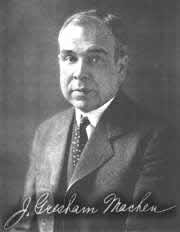
Shortly before he died (January 1, 1937), Dr. J. Gresham Machen sent a final telegram to his friend Professor John Murray. The words of the telegram were these:
“I’m so thankful for the active obedience of Christ. No hope without it.”
I’m convinced that in these short words, Dr. Machen was able to express the essence of the biblical Gospel. Let me explain: 

Theologians talk of a double function of Christ as our Savior in saving us – His passive and active obedience. The passive obedience refers to His laying His life down for us His sheep. He died an atoning death paying the full penalty for sins. Yet, what is often missed is the function of His 33 years of life on earth perfectly fulfilling all the demands of the law. This righteousness, one that has fulfilled the entire law of God is what is credited to our account as believers in Christ. Christ is our righteousness!

CHRIST DIED FOR OUR SINS, AND LIVED FOR OUR RIGHTEOUSNESS
 
The Lord Jesus Christ not only died an atoning death for our sins, but before He ever went to the cross, He lived a sinless life that perfectly fulfilled the righteous standards of the law. If all that was necessary for our justification was the death of Jesus on the cross, He could have come down to earth on a parachute on Good Friday, died on the cross for us, and three days later, risen again. But we all know that this is not what happened. Why? Because that would never have been enough.    Keep Reading >>>

Tuesday, October 18, 2011

Too Much And Too Many

Let me remind you of where we are at so you can get your bearings.  “The Mute Christian” is written is show Christians that it is their duty to refrain from complaints and murmuring in trials.  We are now on the last main division where he gives answers to ten objections to this silence.  Today we will cover two objections and Thomas Brooks’ answers because, as both objections are really similar, so are the answers.  When told that it is their great duty to refrain from murmuring against God in afflictions, some will say “my afflictions daily multiply and increase upon me; like the waves of the sea, they come rolling over the neck of one another; and how then can I hold my peace” and others will say though “they were many, yet if they were not great I would be mute, but alas! they are very great”.  If you have a copy of “The Mute Christian” yourself and try to follow along it is going to be tough because I am going to weave together some of his answers to both of these objections.  The following is taken from pages 359-364 of volume 1 in my Banner of Truth edition.    Continue Reading>>>

Thursday, September 22, 2011

Distinguishing Law, Gospel and Grace

“Now behold, one came and said to Him, ‘Good Teacher, what good thing shall I do that I may have eternal life?’ So He said to him, ‘Why do you call Me good? No one is good but One, that is, God. But if you want to enter into life, keep the commandments.’” (Matt. 19:16, 17).

If someone asked you how to obtain eternal life, what would your answer be? We know1 that eternal life comes by believing in God’s Son, as John 3:14-18 tells us, rather than by keeping the commandments. We know this is true because we were saved by believing in Christ, not by trying to keep God’s commands. So how are we to understand the words of Christ to this person? This passage is one in which acquiring the skill of identifying and distinguishing law, gospel, and grace is crucial to its understanding.

What are they?

Romans 3:20 teaches us two truths about God’s law: (1) by the deeds of the law no flesh will be justified in God’s sight, and (2) the law brings an awareness of sin. Law always refers to some demand by God which brings condemnation and death (cf. 2 Car. 3:7-9). Now we understand that the words of our Lord about keeping the commandments and obtaining eternal life were actually an attempt to show the young man his sin and need of a Savior.

On the other hand, gospel does not make demands but rather refers to what God has done by sending His Son to die for our sins and to be raised from the dead (1 Cor. 15:1-4). The law says “do” while the gospel says “done.” Trusting in Christ is not a demand but a response to the gospel.

Grace, however, does make demands upon the believer in light of the gospel, but they are demands to obedience motivated primarily by love and gratitude (1 John 4:14-19). This understanding is why the Bible can describe today’s believers as under grace rather than under law (Rom. 6:14).

In summary, keeping these three distinctions in mind will help us properly understand the Bible.     Keep Reading...

Tuesday, August 16, 2011

Satan the Proud and Powerful (Part 2)

In our day there has been a renewal of interest in the work of Satan. Hollywood has given us The Exorcist and The Omen and a host of other films to whet our appetite for the occult. Within Christian circles there has arisen a new concern for ministries of deliverance. Some of these deliverance ministries have developed a bizarre and radically unbiblical view of demon possession and deliverance.

For example, we hear that we can recognize the departure of a demon from a human soul by a manifest sign that is linked to the particular point of bondage. We have people saying that particular demons cause particular sins. There is, they say, a demon of alcohol, a demon of depression, a demon of tobacco, and so on. I have listened to tapes from well-known deliverance ministers (whose names I will not mention, to protect the guilty) in which they teach the signs of departure of the demon. A sigh, for example, indicates the departure of the demon of tobacco. Since the tobacco demon enters with the inhaling of smoke, he leaves us with an audible exhale. Likewise vomiting may be the sign of the departure of the demon of alcohol. There are demons for every conceivable sin. Not only must each one of these demons he exorcized, but there are necessary procedures to keep them from returning on a daily basis.    Keep Reading...

Wednesday, May 18, 2011

30 Sins of the Tongue

Understand and remember what are the sins of the tongue to be avoided. And they are very many, and many of them very great: the most observable are these:
 
1. The first among all sins of commission is that of blasphemy, which is the reproaching of God: to speak contemptuously of God, or to vilify him, or dishonor him, by the denying of his perfections, and to debase him, by false titles, doctrines, images, resemblances, as likening him to man in any of our imperfections; anything that is a reproaching of God is blasphemy.

2. Another sin of the tongue is, false doctrine, or teaching things false and dangerous as from God. If any falsely say, he had such or such a point by divine inspiration, vision, or revelation, that makes him a false prophet. But if he only says falsely, that this or that doctrine is contained in the Scripture, or delivered by tradition to the church, this is but to be a false teacher.

3. Another of the sins of the tongue is, an opposing of godliness indirectly, by false application of true doctrine, and an opposing of godly persons for the sake of godliness, and objecting for no good reason against particular truths and duties of religion; or defending those points and practices which would subvert or undermine religion: a secret endeavor to make all serious godliness seem a needless thing. There are many that seem orthodox, that are impious and malicious opposers of that truth in the application, which themselves do notionally hold, and positively profess.

4. Another great sin of the tongue is, the profane deriding of serious godliness, and the mocking, and jesting, and scorning at godly persons as such; or scorning at some of their real or supposed imperfections, for their piety sake, to make them odious, that piety through them might be made odious. When men so speak, that the drift and tendency of their speech is to draw men to a dislike of truth or holiness. Keep Reading...


Friday, December 17, 2010

Little Sins????

The following is from Thomas Brook’s classic, Precious Remedies Against Satan’s Devices.  It is long, but powerful stuff to aid us in putting to sin to death.

That even those very sins that Satan paints, and puts new names and colors upon, cost the best blood, the noblest blood, the life-blood, the heart-blood of the Lord Jesus. That Christ should come from the eternal bosom of his Father to a region of sorrow and death; that God should be manifested in the flesh, the Creator made a creature; that he who was clothed with glory should be wrapped with rags of flesh; he who filled heaven and earth with his glory should be cradled in a manger; that the almighty God should flee from weak man—the God of Israel into Egypt; that the God of the law should be subject to the law, the God of the circumcision circumcised, the God who made the heavens working at Joseph’s homely trade; that he who binds the devils in chains should be tempted... Continue Reading>>>