The purpose of this Blog is to introduce men and women all over the World to the Doctrines of Grace; the 5 Solas; Reformation Theology and the Lord and Savior Jesus Christ.
Showing posts with label Absolutes. Show all posts

Friday, November 16, 2012

Is Morality Real?

There are 4 reasons to believe that Morality is real:

1. All people have a sense of morality.
2. No real truth can be subjective.
3. Everyone responds to injustice.
4. Morality is not unknown.

1. All people have a sense of morality.
-All recorded cultures have standards even though each has their own variations.
-Without even knowing what good and evil is, the individual knows there is something they ought to do and ought not to do. 

As Frank Turek puts it:
“…Why do most human beings seem to have that same intuitive sense that they ought to do good and shun evil? (1)
The fact that everyone has some sense of morality (on the cultural and individual level), leads us to believe there are transcendent ethics which we all pull from.

2. No real truth can be subjective.

If morality were just a set of different beliefs held by each individual, there would inevitably be contradictions between them. The fact there people do get into disagreements about what is right, instead of naturally doing what is right all the time, is evidence of that. Because there are disagreements however, this show one of two things about morality (if indeed it is real):

1) It is either illogical or
 
2) There is an objective standard that is true

The problem with the first is obvious. There is nothing in reality that is shown to follow non-logical patters. No matter what idea is claimed, it has to fit into reality.
With the second however, there is room left for individual error. The faults of individuals have no impact on the objective standard; just as opinion of if a room is 65° or 75° has no impact on the thermometer reading 70°.

Though even when a person denies that logic is real, as Jason Lisle says:   Continue at Shrewd Dove Apologetics

Wednesday, April 18, 2012

Can We Prove the Existence of God?

Can we prove the existence of God? What exactly does it mean to prove something? What would count as a proof of God's existence? To explore these questions, let's consider one popular argument for God's existence and test it against some different criteria for proofs. Here's the argument:
1. If God does not exist, there are no objective, culture-transcending moral duties.
2. There are objective, culture-transcending moral duties.
3. Therefore, God exists.
Is this a proof of God's existence? One suggestion is that any sound argument constitutes a proof. An argument is sound if and only if (a) all its premises are true and (b) it is deductively valid, in the sense that its conclusion follows necessarily from its premises (i.e., it's logically impossible for the premises to be true but the conclusion to be false).

Is our argument sound? It's certainly deductively valid: it has the valid argument form of modus tollens (if P then Q; not Q; therefore, not P). Moreover, both of its premises are true. There are indeed objective, culture-transcending moral duties, such as the duty to care for one's children, and it's very hard to see what would ground such moral obligations if there were no God. At any rate, I believe that both premises are true, and so do many other people. But does everyone believe both premises? Well, no---and therein lies the rub.

Limitations of Sound Arguments


There's another obvious problem with the idea that any sound argument amounts to a proof. Consider the following argument for the existence of God:
  1. Either the moon is made of green cheese or God exists.
  2. The moon is not made of green cheese.
  3. Therefore, God exists.   Continue at James Anderson

Tuesday, August 30, 2011

Essential vs. Peripheral Doctrine

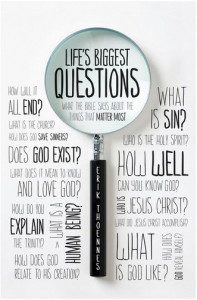
Erik Thoennes, Life’s Biggest Questions: What the Bible Says About the Things That Matter Most, (Wheaton: Crossway, 2011), 35–37 (formatting added):

Essential vs. Peripheral Doctrine
The ability to discern the relative importance of theological beliefs is vital for effective Christian life and ministry. Both the purity and unity of the church are at stake in this matter. The relative importance of theological issues can fall within four categories:
  1. absolutes define the core beliefs of the Christian faith;
  2. convictions, while not core beliefs, may have significant impact on the health and effectiveness of the church;
  3. opinions are views or personal judgments that generally are not worth dividing over; and
  4. questions are currently unsettled issues.
These categories can be best visualized as concentric circles, similar to those on a dart board, with the absolutes as the “bull’s eye” (see fig. 3.4).   Keep Reading...