The purpose of this Blog is to introduce men and women all over the World to the Doctrines of Grace; the 5 Solas; Reformation Theology and the Lord and Savior Jesus Christ.
Showing posts with label Hermeneutics. Show all posts

Friday, May 17, 2013

The Difference Between Original Autographs and Original Texts

If you're looking for a way to critique the authority of Scripture, there are seemingly endless options. There are historical critiques (e.g., many of these books are forgeries). There are logical critiques (e.g., the Gospels contradict themselves). There are moral critiques (e.g., God is immoral to order the slaughter of entire cities). And there are hermeneutical critiques (e.g., no one can agree on what the Bible means).
In recent years, however, a more foundational challenge has arisen. All of the above critiques are essentially the same; they all argue the words of the Bible are not true. But this newer and more foundational challenge is not about whether the words of the Bible are true, but whether we have the words of the Bible at all.    

At the core of this challenge is the fact that we only have handwritten copies of these books we treasure. And, in reality, we only have copies of copies of copies. And given that scribes made mistakes, and that the transmission process was imperfect, how can we be sure that these texts have been preserved? How can we be sure we actually have the words of Scripture?

Bart Ehrman's best-selling book Misquoting Jesus focuses on this issue as it pertains to the New Testament text: 
What good is it to say that the autographs (i.e., the originals) were inspired? We don't have the originals! We have only error-ridden copies, and the vast majority of these are centuries removed from the originals and different from them . . . in thousands of ways.    Continue at Michael J. Kruger

Friday, May 10, 2013

Should We Interpret a Bible Verse Literally or Figuratively?

It depends on context. A person’s soul is in peril if he thinks Jesus was using poetic exaggeration when He said, “I am the way, and the truth, and the life. No one comes to the Father except through me” (John 14:6). On the other hand, a Bible reader might maim himself unnecessarily if he fails to recognize the hyperbole in Jesus’ statement that we should cut off our hands and gouge out our eyes to avoid sin (Matthew 5:29-30). Like all people who have ever spoken or written, biblical authors use different styles of communication at different times.

Of course, everything the Bible affirms is true, regardless of its literary genre. Still, every time we open our Bibles, we must determine what style of communication is being used and read accordingly. As a primer, here are a few of the literary styles used in Scripture and some rules for interpreting them taken from Robert Stein’s helpful book, A Basic Guide to Interpreting the Bible.   

Historical narrative recounts events and is meant to be understood literally – not as fable. In this vein, Article XIII of the Chicago Statement on Biblical Hermeneutics insists that literary techniques not be used to evade historical accounts.[i] For instance, some scholars have tried to fictionalize the story of Jonah and the Fish, but Christ treats Jonah as a real person in Matthew 12:40-42, and so should we. More than 40 percent of the Old Testament and nearly 60 percent of the New is historical narrative, including much of the material in the Gospels and Acts.

– Songs and poetry are geared toward evoking emotion rather than speaking with scientific accuracy. With biblical poetry, the reader must determine the author’s message without misconstruing symbolism as narrative description. For example, the song in Exodus 15 poetically describes Pharaoh’s army as being “thrown into the [Red] sea” (15:1) even though it actually followed the Israelites through the parted waters before God sent them crashing back down.

– Proverbs are pithy sayings that express general truths or rules of thumb; they don’t convey ironclad guarantees. A classic example is Proverbs 22:6, “Train up a child in the way he should go; even when he is old he will not depart from it.” While parental training generally sets the course for a child’s life, there are exceptions. (See BibleMesh blog article, “Is Proverbs 22:6 a guarantee?”)    Continue at Peter Cockrell

See also:


Wednesday, November 28, 2012

16 Rules of Bible Interpretation

Jesus, in the preamble to quoting a verse from the Old Testament said, “…have you not read what was spoken to you by God…” (Matt. 22:31). He then went on to quote a verse from the book of Genesis. Think about that for a moment. Jesus believed (and held people accountable for doing so) that when someone read a verse from the Old Testament, they were reading something spoken to them by God. That is a very high view of Scripture, to be sure. 

The testimony of Jesus and of the Bible is that “All Scripture is God breathed” (2 Tim. 3:16). Therefore, when we open up a page in our Bibles, we are treading upon holy ground. The Bible, although a book, is also unlike any other book. It is not simply a book giving facts about God. The Bible is a book written by God. Certainly, human writers were involved, but the text of Scripture is inspired or breathed out by God Himself. Just having this concept in place would greatly help us in our Bible studies. 

What do I mean by that? 

Well, many people view the interpretation of God’s Word as “no big deal” really. To them it is nothing more important than the reading of any other book, at least in their methodology. Continue at John Samson


Monday, October 8, 2012

Understanding Dispensationalists

1 Cor 15:51-53 presents a problem to the doctrine of pretribulational rapture, because it speaks of “the last trumpet.” Now classic dispensationalist theory interprets 1 Cor 15:51-53 as referring to the rapture. Seven years afterthe rapture another trumpet is sounded at the visible second coming of Christ, in connection with the gathering of elect Jews (Matt 24:31). Hence, apparently, the trumpet sound described in 1 Cor 15:52 is not really the last. If, on the other hand, the rapture of 1 Cor 15:51-53 and the visible second coming of Matt 24:31 are essentially simultaneous (contrary to classic dispensationalist theory), the two trumpets are presumably also the same, and there is no difficulty.

Thus there is an obvious difficulty in reconciling the two texts (1 Cor 15:51-53 and Matt 24:31) with dispensationalist theory. Now, there is a standard dispensationalist answer to this difficulty. In fact, this answer is fairly “obvious” within the dispensationalist system. The readers who are familiar enough with the general principles of the system may be able to figure it out for themselves. My concern is not with whether there is an answer, but with the hermeneutical question: how is the answer obtained?

One must in effect keep raising hermeneutical questions. What are the principles by which we undertake to understand 1 Cor 15:51-53 and to reconcile it with Matt 24:31? When classic dispensationalists talk about those principles, they tell us that we must interpret “literally” or “plainly.” Now what is a “literal” interpretation of 1 Cor 15:51-53? To be “literal” could mean simply to take fully into account all the grammatical, contextual, and historical clues throwing light on this passage. That is sometimes demanding. But it would be sound. On the other hand, to be “literal” could imply that we are to stick to what is most “plain” or “obvious.”   Read the rest at Vern Poythress

Wednesday, June 20, 2012

Homosexuality, Polyester, and Shellfish

Churches and ministries are coming under increasingly aggressive pressure from militant homosexuality. Some homosexuals are combing websites looking for sermons and statements that they can use in the media to ridicule Christianity and build sympathy for their cause.

When challenged, many Christians and even many pastors, struggle to defend and explain their position in a way that is Scriptural, consistent, and loving. Homosexuals and the media often point to other Old Testament verses that forbid things that Christians now eat or use. How do we explain that? 

Well, here’s a short briefing paper that I hope will answer some of these questions, and also help Christians and pastors to explain the Bible’s teaching in a loving way. Below you will find a bullet point summary of the paper (each point is explained in fuller detail in the paper). For further reading, please see the books referenced in the footnotes. And a huge thank you to my Research Assistant for the huge amount of work he put into this paper. 

Homosexuality, polyester, and shellfish.

What do these three things have in common? Well, they are all mentioned in the Bible as forbidden by God. And the latter two come up in conversations about the first.  The charge is often that Christians are being inconsistent – we allow polyester and enjoy shellfish, but we still condemn homosexuality.

The real question is not why Christians are inconsistent. The real question is why and how Christians do make a distinction between homosexuality, polyester, and shellfish. Because they do, and it matters.   Continue at David Murray

Thursday, May 10, 2012

John MacArthur on Calvinism, Dispensationalism, Israel and Hermeneutics

In April 2007, I made my way through Dr. MacArthur’s controversial lecture, “Why Every Self-Respecting Calvinist Is a Premillennialist” (given at the Shepherd’s Conference at Grace Community Church, on March 7, 2007). The lecture can be ordered here (Click here: MacArthur: Why Every Self-Respecting Calvinist is a Premillennialist « Faith by Hearing).
 
Regrettably, I am just now getting around to completing my response–my day job kept getting in the way.  Better late than never, perhaps?

As we have come to expect of him, Dr. MacArthur spoke with great passion, covered much ground quickly, and had a great deal to say. No question, Dr. MacArthur commands authority. One can easily see why Dr. MacArthur is so widely-respected. When it comes to the gospel, he’s on the side of the angels. When it comes to eschatology, however, I must beg to differ.

As a Reformed amillennarian (who was raised a dispensationalist) I had a powerful gut-level reaction to Dr. MacArthur’s lecture.  While this lecture was well-received by the friendly and largely dispensational home court audience to whom it was delivered, surely Dr. MacArthur knew that his words would amount to picking a fight with those Reformed amillennarians who may have been present. This was not the playful jab that conference speakers often take at one another at such events. No, this was a warning of sorts–a shot fired across the bow.   Continue at Kim Riddlebarger

Wednesday, March 28, 2012

United Families Dividing Churches

The Family Integrated Church Movement (FICM) is having a growing impact within fundamental Baptist churches. Since the mid-1990s an increasing number of families within fundamental churches have gravitated toward the family-integrated approach. In addition, families entrenched in the movement have been drawn to fundamental churches because of their emphasis on Biblical preaching and conservatism. At first glance the influence of the FICM might seem entirely beneficial for traditional churches, but unfortunately not all of the impact has been positive. The FICM mindset can divide churches. 

Understanding the FICM


The FICM is comprised of evangelical churches, pastors, and laymen who share a distinct philosophical approach toward the family and church. Advocates of family-integrated churches (FIC) believe that families should always worship and fellowship together in age-integrated (i.e., multigenerational) services and activities. Conversely they insist that virtually all age-segregated ministries and activities at church, such as Sunday School or youth ministries, are unequivocally unbiblical. Also, they often speak of the father as the conduit of spirtual growth in the family.

The FICM is not a denomination but rather a loose association of churches and organizations represented by a variety of denominational perspectives. Some key leaders are the following:
  • Scott Brown, director of the National Center for Family-Integrated Churches (NCFIC)
  • Doug Phillips, president of Vision Forum Ministries
  • Voddie Baucham Jr., professor, author, and pastor of Grace Family Baptist Church near Houston, Texas
  • Eric Wallace, president of the Institute for Uniting Church and Home (IUCAH).
The NCFIC, founded in 2001, is the flagship organization for the FICM and has a national network of more than 800 churches. It should be no surprise that the FICM has close ties to some currents of the homeschooling movement. While homeschooling is not essential to the FICM, the vast majority of families in FIC homeschool their children.  Continue at Sharper Iron

Saturday, March 3, 2012

The Biblical Counseling Movement After Adams

The Biblical Counseling Movement After Adams by Heath Lambert (Wheaton, IL: Crossway, 2011)

It may surprise some that the brief history of biblical counseling is a complex one considering its fairly straightforward premise that the Bible is the sufficient foundation and guiding authority of counseling. But biblical counseling is itself, in fact, a complex practice shaped by diverse influences - hermeneutics, psychology, ecclesiology, apologetics, and even epistemology. The interplay of these various disciplines naturally leads to different emphases and practices by biblical counselors.
 
Heath Lambert has performed a great service in providing a succinct well organized summary of the biblical counseling movement as it has developed after Jay Adams. It is a book I recommend for those who want an overview of the biblical counseling movement but aren't ready to tackle David Powlison's hefty 352 page, The Biblical Counseling Movement, a book I recommend for those who want to dig deeper. One of the prominent characteristics of Lambert's book is that it is not simply a history of the movement, but an invitation to participate in it; to know not only what the movement is, but where it has been; and to play a part in where it is going. In fact, the foreword itself, written by David Powlison, outlines six stages of development to help the reader know his or her role in the movement and Lambert himself makes his own suggestions about where the movement needs development in Chapter 6, "An Area Still in Need of Advancement."  Continue at Winston Smith

Wednesday, February 8, 2012

Tattoos and Skin Deep Hermeneutics

It used to be easy for Christians to formulate an opinion about tattoos. Sailors had them. And some prisoners. Other than corpsmen and convicts the only ink you saw in church was on the page.

This is not a pointed tirade against tattoos, nor a defense of them; it’s a jab at bad hermeneutics. I have found that some like to decorate their arguments with Bible verses that have no place in the debate.

These are the three usual suspects…

1. Thou shalt not tattoo thyself.
Leviticus 19:28 ”You shall not make any cuts on your body for the dead or tattoo yourselves: I am the Lord.”

This one is the biggie. It is literally the only verse in the Bible to actually employ the word ‘tattoo.’ So if you can’t get this one to play for your team, you don’t have a team.

The immediate North & South context of the verse should provide a clear indication that an understanding of Leviticus’ place in the canon of Scripture is going to be a key. The verse below says don’t make your daughter a prostitute. I sure hope that still applies. But the verse above says you can’t trim your beard or the hair next to your ears. Ever been to an orthodox synagogue? The gents who congregate there (and keep the whole Mosaic Law—kudos for consistency) look a little different from those who attend the men’s breakfast at your church, right? If Christians don’t need to apply verse  27, then why do we have to obey vs 28 of the same chapter?  Continue at Clint Archer

Saturday, August 6, 2011

Revealed or Concealed?

In my last post, I tried to lay a foundation for an understanding of some ground-level issues relating to hermeneutics, or principles of interpretation of Scripture. Like I mentioned there, studying hermeneutics is rather tricky, because it seems circular to attempt to interpret Scripture in order to glean biblical principles of interpretation. You know, chicken or egg?

I suggested that the way out of this conundrum was to consider the nature of Scripture itself, particularly as defined in the opening verses of the book of Hebrews. From those verses we learned that God spoke, and thus Scripture is fundamentally communication. And based on that, the interpreter’s default orientation to the text is to understand it in its plain, normal sense, just like he does with other communication.

John MacArthur summarizes the point well:  Read it HERE

Friday, May 20, 2011

Harold Camping glorifies God: Seventeen Ways

NOTE: this is a companion-piece to Harold Camping is not a false prophet.
It is tempting to write "Inadvertently, unintentionally, and by means of contrast" — and let that suffice. However...

First, Harold Camping glorifies God because all things are God's servants (Psalm 119:91). Camping can't not glorify God. You can't not glorify God. You will either glorify Him as His servant, or as His tool; but you will glorify him (cf. Isaiah 10:5-16).


Second, Harold Camping glorifies God because, by his refusal to repent for past false guesses and his insistence on "doubling down" and putting all his weight on yet another guess, he illustrates God's wisdom in warning us: "Like a dog that returns to his vomit is a fool who repeats his folly" (Proverbs 26:11). Keep Reading...

Tuesday, January 18, 2011

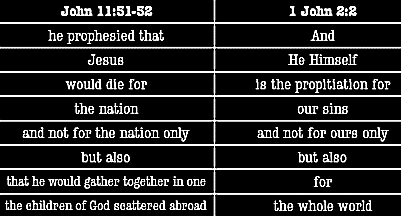
Understanding 1 John 2:2

You say that Christ died for His people, His sheep, His friends, for His Church and yet 1 John 2:2, speaking of Jesus, states, “He is the propitiation for our sins, and not for ours only but also for the sins of the whole world.” How do you explain that?
 
I can certainly see how someone would use this verse to undermine the reformed doctrine of Particular Redemption, yet Scripture, I believe, is not contradictory to itself. There is one Divine Author of Scripture and He does not contradict Himself. So how are we to understand 1 John 2:2? 

I have written elsewhere about the principles of correct interpretation of scripture. There is only one correct interpretation of scripture. Though there may be many applications of a verse, it only means what it was intended to mean when it was written. 

In my article entitled “Playing Marbles with Diamonds” I refer to a number of principles of biblical interpretation (hermeneutics), three of which would apply here: Continue Reading>>>

See also - 1 John 2:2 – Karate Exegesis