The purpose of this Blog is to introduce men and women all over the World to the Doctrines of Grace; the 5 Solas; Reformation Theology and the Lord and Savior Jesus Christ.
Showing posts with label Church History. Show all posts

Wednesday, June 27, 2012

Fruit of Controversy

Let us not fear the opposition of men; every great movement in the Church from Paul down to modern times has been criticized on the ground that it promoted censoriousness and intolerance and disputing. Of course the gospel of Christ, in a world of sin and doubt, will cause disputing; and if it does not cause disputing and arouse bitter opposition, that is a fairly sure sign that it is not being faithfully proclaimed. As for me, I believe that a great opportunity has been opened to Christian people by the “controversy” that is so much decried. Conventions have been broken down; men are trying to penetrate beneath pious works to the thing that these words designate; it is becoming increasingly necessary for a man to choose whether he will stand with Christ or against Him. Such a condition, I for my part believe, has been brought about by the Spirit of God . . . Controversy, in other words, has resulted in a striking intellectual and spiritual advance. Some of us discern in all this the work of the Spirit of God. And God grant that His fire be not quenched! God save us from any smoothing over of these questions on the interests of a hollow pleasantness; God grant that great questions of principle may never rest until they are settled right! It is out of such times of questioning great revivals come. God grant that it may be so today! Controversy of the right sort is good; for out of such controversy, as Church history and Scripture alike teach, there comes the salvation of souls.
—J. Gresham Machen, What Is Faith? (MacMillan, 1925), 41–43. 

Saturday, June 16, 2012

Church History and Israel’s Future

Romans 11:26 promises that all Israel will be saved. Dispensationalists understand this verse to refer to a national salvation of ethnic Israel after the fullness of the Gentiles has come in.
 
Non-premillennialists sometimes imply that such an interpretation is a dispensationalist invention, because it means that God still has a future plan for national Israel.

But did you know that many throughout church history, including many in the Reformed tradition have shared that same interpretation?

None other than John Calvin, in his commentary on Romans 11:25-26, noted that “when the Gentiles shall come in, the Jews also shall return from their defection to the obedience of faith.” Other Reformers, such as Martin Bucer, Peter Martyr, and Theodore Beza similarly concluded that there would be a future calling and conversion of the Jewish people.

A belief in the future salvation of national Israel was especially strong among the Dutch Reformed and the English Puritans of the seventeenth century. Regarding the Dutch Calvinists of that time period, J. Van Den Berg explains that for “virtually all Dutch theologians of the seventeenth century, ‘the whole of Israel’ indicated the fullness of the people of Israel ‘according to the flesh’: in other words, the fullness of the Jewish people. This meant that there was a basis for an expectation of a future conversion of the Jews—an expectation which was shared by a large majority of Dutch theologians” (Puritan Eschatology, 140).

Commenting on the English Puritans, Iain Murray similarly notes: “This same belief concerning the future of the Jews is to be found very widely in seventeenth-century Puritan literature. It appears in the works of such well-known Puritans as John Owen, Thomas Manton and John Flavel. … It is also handled in a rich array of commentaries, both folios and quartos – David Dickson on the Psalms, George Hutcheson on the Minor Prophets, Jeremiah Burroughs on Hosea, William Greenhill on Ezekiel, Elnathan Parr on Romans and James Durham on Revelation: a list which could be greatly extended.” (The Puritan Hope, 43).   Continue at Nathan Busenitz

Thursday, March 22, 2012

Holiness Wars: Antinomianism in Church History

Like Moses (Dt 6:5; Lev 19:18), Jesus taught that the whole law was summarized by the command to love God and neighbor (Mat 22:37). He came not to abolish but to fulfill the law (Mat 5:17-20). Nevertheless, Jesus was famously accused by the religious leaders as an “antinomian” for refusing to accord the same weight to the extrabiblical rules of the elders. Evidently, Paul, too, was accused of “antinomianism” by his critics. “And why not do evil that good may come?—as some people slanderously charge us with saying” (Rom 3:8; cf. 6:1). Encouraging believers in God’s grace, nevertheless warned them against “using your freedom as a cover-up for evil” (1 Pet 2:16). Peter adds that “lawless people” were using the gospel as an excuse for license; “ignorant and unstable,” they were twisting the Scriptures “to their own destruction” (2 Pet 3:16-18). It should be noted that the charge of antinomianism and the reality of a lawlessness based on Scripture-twisting could only arise perpetually throughout the church’s history because the gospel of free justification in Christ apart from works is so clearly taught in Scripture. 

As Packer’s first type indicates, the first form of explicit antinomianism was a stripe of Gnosticism. Gnostics identified the body with evil, the prison-house of the soul, longing to be reunited with the cosmic Christ (distinguished from the human Jesus). For some, this meant extreme asceticism and mistreatment of the body; for others, licentiousness, since it didn’t matter what the body did, as long as the spirit was pure. The church father Augustine was famously converted from a life of debauchery in Manichaean Gnosticism.  Continue at Michael Horton

Wednesday, October 12, 2011

So You Believe in Christ, Do You? Are You Sure?

Allow me to describe an all too common phenomenon in human experience. A previous generation of human beings strive and struggle to make or accomplish a great achievement only to see later generations squander the hard earned fruits of the previous generation’s labors. For example, a father who works and slaves to build a business empire to leave to his son only to see the son (or maybe the grandson) run the business empire into the ground. This doesn’t always happen, but it frequently happens.

OK, so what does this have to do with Christianity? A lot! Today’s average American evangelical Christian does not have a strong grasp on theology and church history, and this is a bad thing. It’s not to say that every Christian has to be a professional theologian or church historian, but Christians should have some rudimentary knowledge of what they believe and how what they believe came to be. In our educational institutions, we teach our children American history and we also teach them the U.S. Constitution. Now you can make all sorts of arguments as to the quality of this education; that’s not the point. The point is that as a society, we feel it’s important to impart to our children the history of our nation and the principles upon which this nation was founded.    Continue Reading...

Friday, August 12, 2011

What Cessationism Is Not

Much ado has been made (both on this blog and elsewhere) about the recent “anti-cessationist” comments of a popular Seattle-based pastor. I don’t desire to enter a war of words, or become embroiled in an online controversy. But I do hope to make a helpful contribution to the conversation.

Over the last few years, I’ve enjoyed investigating the historical record regarding the charismatic gifts, especially the gift of tongues. And I can only hope that the above pastor, and his co-author, will treat the material responsibly in their upcoming work on the subject. (Who knows, maybe they’d be open to a two-views book?)


I would also hope that, in the process of critiquing the cessationist position, the authors do not create a straw man version of cessationism. (I’ll admit that, based on what I’ve read so far, I’m afraid the straw man is already under construction.)

Nonetheless, in an effort to dismantle a fallacious misrepresentation before it is built, I offer the following four clarifications about what cessationism is not:  Read them HERE

Thursday, August 11, 2011

Before you Convert to Roman Catholicism

Roman Catholicism has a gospel that does not give peace, because it fundamentally violates the Scriptural teaching on how one is made right with God. Rome has a false gospel that cannot save, hence, I have no reason to abandon the peace I have with God through Christ’s perfect atonement for the treadmill of Rome’s sacramental system of salvation… the person who has embraced the gospel of grace has not only landed his boat on the far side [of the Tiber River], but has torn the boat apart to use the wood as a pulpit from which to proclaim freedom in Christ to those trapped on the other shore. – Dr. James White
 
At his blog at www.aomin.org, Dr. White also writes: 

Last week I received the following e-mail, and I felt it would be best to share my response here on the blog.

Dear Mr. White, For someone considering converting to Catholicism, what questions would you put to them in order to discern whether or not they have examined their situation sufficiently? Say, a Top 10 list. Thanks. Read them HERE

Tuesday, July 19, 2011

The Athanasian Creed

The origin of the Athanasian Creed is unknown. As the name suggests, the Creed was originally ascribed to Athanasius—the great “father of Nicene orthodoxy”—as early as the ninth century. However, since the seventeenth century, the document has been regarded as conclusively non- Athanasian for several reasons:
  1. Athanasius never mentioned the Creed anywhere in his writings.
  2. The councils of Constantinople (381), Ephesus (431), and Chalcedon (451) do not refer to the document. 
  3. Athanasius died in 373, so it is very likely that it would have been written before then.
Because it was original attributed to Athanasius, the Athanasian Creed had considerable influence. The Creed was used by the Lutheran Churches and and many of the Reformed Churches, and was mentioned in the Augsburg Confession, the Formula of Concord, the Thirty- nine Articles, the Second Helvetic Confession, the Belgic Confession, and the Bohemian Confession (Philip Schaff, Creeds of Christendom). Keep Reading...

Thursday, August 12, 2010

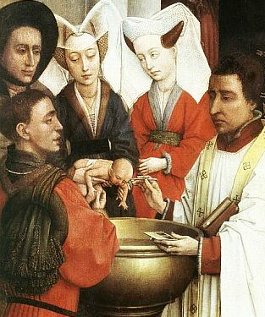
Baptism in History, Part 2

The writings of the third and fourth centuries reveal varying teachings on baptism. These include baptismal regeneration, baptism as a replacement for circumcision, and baptism as a step of faith. The church accepts some of these arguments today. Others have been rejected. Conclusions some claim are apostolic but which are based on rejected propositions should be viewed with skepticism.
Tertullian, in On Baptism (early 3rd century), argues against infant baptism: “[T]he delay of baptism is preferable; principally, however, in the case of little children.”1 He gives several reasons. One is that the infant is “innocent.” The church under the more theologically precise Augustine soon rejected the “innocence” of infants. But if we read Tertullian generously, as not necessarily commenting on original sin, but as asserting that the status of an infant is “safe,” then the church agrees (see the Westminster Confession of Faith, Calvin, Hodge, Shedd, and Warfield [all referenced by Boettner2] and Spurgeon3). Although Augustine later rightly contradicted Tertullian’s words, Tertullian may have stood on a relatively orthodox basis when he argued for credo-baptism. Read the rest HERE

Thursday, August 5, 2010

Matrix of Reformed Baptists


The three part series Matrix of Reformed Baptists seeks to discover the religious, political, and social pressures which formed and developed that which has come to be known as Reformed Baptist Churches.  Without knowing something of these shaping influences over the course of seventeen hundred years of Church history, we cannot rightly understand how these churches came to be what they are today.
In Lesson One it will be seen that from the time of Constantine onward the dominant expression of the Christian Church has been that system wherein the State compelled its citizenry to embrace the “Christian” religion.  From the 4th century through the 15th century this Constantinian Model of Christianity was Roman Catholicism.  After the first few tumultuous and uncertain years of the Protestant Reformation the dust settled and a Constantinian Model of Christianity could be found throughout European countries not only in the Roman Catholic version but also in the Reformed version.  But whether Catholic or Reformed it was Constantianism still.  It was the Corpus Christianum of old whether supported by a Catholic Emperor or a Protestant and Reformed King.
When in the 16th Century the Pope was removed as head of the Catholic Church of England and Henry VIII declared himself to be head of the Church of England nothing essentially changed.  The Church goers in London were just as much compelled in religion under the one as the other.  This series of social and political pressures brings us to the turbulent 17th century in England where Baptist Churches were brought into being. Read the rest HERE

Saturday, July 24, 2010

Baptism in History, Part 1

 What did those with close exposure to the Apostles teach? In The History of the Church, written in the 4th century, Eusebius relates this story:
When the tyrant was dead [Diocletian, A.D 96], and John [the Apostle]…used to go when asked…sometimes to appoint bishops, sometimes to organize whole churches, sometimes to ordain one person of those pointed out by the Spirit…. [He] finally looked at the bishop and indicating a youngster he had noticed, of excellent physique, attractive appearance, and ardent spirit, he said, ‘I leave this young man in your keeping’…. [T]he bishop accepted him and promised everything…the cleric took home the youngster entrusted to his care, brought him up…and finally gave him the grace of baptism.2
If the implications of the details of the story are correct, this boy was selected by John from those in the church. He was in this church, noticed (presumably pointed out by the Holy Spirit) by the Apostle John and raised by a bishop who had some relationship with the Apostle. Even though he was present in the church and raised on John’s order, he received baptism only after he was “brought up.” Read the rest HERE