The purpose of this Blog is to introduce men and women all over the World to the Doctrines of Grace; the 5 Solas; Reformation Theology and the Lord and Savior Jesus Christ.
Showing posts with label Dan Miller. Show all posts

Wednesday, April 11, 2012

A Call to Suffocate Pornography

During both World Wars, the U.S. government supplied tobacco to our troops. By 1964, 46 percent of adults in this nation smoked—including inside public buildings, during commercial flights, and on televised advertisements. That year, with the help of Surgeon General Luther L. Terry’s book, Smoking and Health, the winds of change began to blow in fresher air.

In 1965 Congress required manufacturers to post health warnings on cigarette packs. In 1969 Congress outlawed tobacco advertising on television and radio. In 1989 smoking was banned on all domestic flights. In 2000 California banned smoking in public places, including bars and restaurants. Twenty-six states have since followed suit, including Minnesota which established an indoor smoking ban in 2007.

Today less than 20 percent of adults in the U.S. smoke. Over the last half century, scientific research, governmental regulation, and public information campaigns have combined to alter our society’s perspective on smoking. While tobacco usage remains legal, what once was widely regarded as a harmless pleasure is now deemed an addictive health hazard.

The Witherspoon Institute


The Witherspoon Institute (TWI) recently proclaimed that what the U.S. has done with tobacco must now be done with Internet pornography. TWI first met in December 2008 at Princeton, NJ. Its participants published The Social Costs of Pornography: A Statement of Findings and Recommendations, a brief summary of The Social Costs of Pornography: A Collection of Papers, edited by James R. Stoner, Jr., and Donna M. Hughes. It is vital to note that the signatories represent “every major shade of religious belief … from atheism and agnosticism to Christianity, Judaism, and Islam. Both the left and the right in American politics are represented, including social conservatism and contemporary feminism.” The signatories also supply a wide range of professional expertise in “economics, medicine, psychiatry, psychology, philosophy, sociality, journalism, and law” (p. 10).  Continue at Dan Miller

Thursday, August 12, 2010

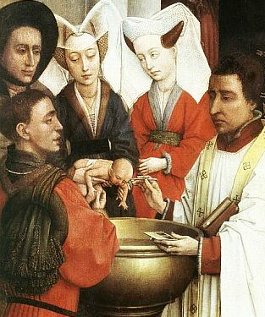
Baptism in History, Part 2

The writings of the third and fourth centuries reveal varying teachings on baptism. These include baptismal regeneration, baptism as a replacement for circumcision, and baptism as a step of faith. The church accepts some of these arguments today. Others have been rejected. Conclusions some claim are apostolic but which are based on rejected propositions should be viewed with skepticism.
Tertullian, in On Baptism (early 3rd century), argues against infant baptism: “[T]he delay of baptism is preferable; principally, however, in the case of little children.”1 He gives several reasons. One is that the infant is “innocent.” The church under the more theologically precise Augustine soon rejected the “innocence” of infants. But if we read Tertullian generously, as not necessarily commenting on original sin, but as asserting that the status of an infant is “safe,” then the church agrees (see the Westminster Confession of Faith, Calvin, Hodge, Shedd, and Warfield [all referenced by Boettner2] and Spurgeon3). Although Augustine later rightly contradicted Tertullian’s words, Tertullian may have stood on a relatively orthodox basis when he argued for credo-baptism. Read the rest HERE

Saturday, July 24, 2010

Baptism in History, Part 1

 What did those with close exposure to the Apostles teach? In The History of the Church, written in the 4th century, Eusebius relates this story:
When the tyrant was dead [Diocletian, A.D 96], and John [the Apostle]…used to go when asked…sometimes to appoint bishops, sometimes to organize whole churches, sometimes to ordain one person of those pointed out by the Spirit…. [He] finally looked at the bishop and indicating a youngster he had noticed, of excellent physique, attractive appearance, and ardent spirit, he said, ‘I leave this young man in your keeping’…. [T]he bishop accepted him and promised everything…the cleric took home the youngster entrusted to his care, brought him up…and finally gave him the grace of baptism.2
If the implications of the details of the story are correct, this boy was selected by John from those in the church. He was in this church, noticed (presumably pointed out by the Holy Spirit) by the Apostle John and raised by a bishop who had some relationship with the Apostle. Even though he was present in the church and raised on John’s order, he received baptism only after he was “brought up.” Read the rest HERE