The purpose of this Blog is to introduce men and women all over the World to the Doctrines of Grace; the 5 Solas; Reformation Theology and the Lord and Savior Jesus Christ.
Showing posts with label Teaching. Show all posts

Wednesday, March 27, 2013

Who Will Teach the Women Who Want to Be Taught?

It may be better to sleep on the corner of the rooftop than live with a quarrelsome woman, but friends, educate that woman and there is hardly a limit to what she can do with her mouth and mind—for good or evil.

God created woman as a helper knowing Adam would need help. What that help was exactly will be up for debate for centuries; we only know that the command to both man and woman at that point was to be fruitful, multiply, and subdue the earth. A friend of mine confesses that at times he fears exposing his weaknesses to women in his life for various reasons. To which I replied that a woman was born to see a need, to come and encompass that need, nurture it until the time is right for it to be birthed into something more beautiful than he could imagine. We are built to help in ways men will never be able to help. That is our good design.

Disciplers on the Rise

Another friend and I were talking recently about the droves of women coming out of seminary in the coming years. These women have or will have studied biblical texts, learned Hebrew and Greek proficiently, interacted with scholars, and written theses. They have a deep and true abiding love of God's Word, and a respect for the inerrancy of it. Women make up more than 51 percent of seminary students, and we can probably expect that number to grow.

These women have taken the command to be fruitful and multiply seriously, and for many, in the absence of their own children, they have become incubators of God's Word. They meditate on it, murmur on it, pray it, speak it, and teach it. They are poised for a gracious reception of hungry souls, souls weary of milk, starving for meat. They are disciples.    Continue at Lore Ferguson

Tuesday, November 27, 2012

10 Tips for Destroying Your Children’s Souls

“Whoever causes one of these little ones who believe in me to sin, it would be better for him if a great millstone were hung around his neck and he were thrown into the sea. (Mark 9:42 ESV)
The above text is actually more about not being the means by which disciples falter, but it can also be applied to being a daddy.  It goes without saying that I do not desire the destruction of my children.  One because I love them.  Two because a millstone seems like a really uncomfortable necklace—especially for swimming in the sea.

If you, however, think a millstone necklace would be fashionable attire here are 10 ways that you can work towards making your children stumble and turn away from Jesus.  In no particular order
  1. Be an unrepentant hypocrite.  We all have elements of hypocrisy.  It’s when we are unrepentant in our hypocrisy that it becomes deadly.
  2. Display with your life and lips that things are more precious than Christ.  The thing you pick can be as insignificant as parking spaces or as significant as a large house.  It doesn’t matter.  Set something other than Christ as your affection and you are well on your way to shopping for a new millstone.
  3. Neglect teaching.  Leave it up to the Sunday school teacher, the television, their peers, or favorite musician and you can start picking out millstone colors.
  4. Don’t pray for them.  Discipleship is a work of God.  Your own sanctification as well as that of your children demands a prayerful life.
  5. Be silent in times of danger.  You wouldn’t let little Sally have a tea party on a freeway but will you let her give her heart to an unbeliever?  You probably won’t let junior have a pet cobra but do you let him be saturated with the not so subtle advances of our sex-crazed culture?   Continue at Mike Leake

Monday, May 7, 2012

Reforming Youth Ministry

For too long we have blamed the rebellion of our young people on such things as our school system, broken homes and the influence of the media. As a pastor and youth worker I refuse to point the finger at society anymore. I am not saying the declining morality of our society and the break down of our family structure has not affected our kids. It definitely has had a large impact, but part of the blame is a little closer to home than we like to admit. It is time we stop pointing the finger at our world and point it right back at the church. 

J. I. Packer wrote, "Disregard the study of God, and you sentence yourself to stumble and blunder through life blindfolded, as it were, with no sense of direction and no understanding of what surrounds you. This way you can waste your life and lose your soul." Without a proper understanding of God, our youth will "stumble and blunder" their way to hell. What truths do we want to instill in our kids when they attend our church youth groups? Sex, drugs, peer pressure, dating and other such topics are OK, but are we really meeting our kids' needs or are we just applying a Band-Aid to a gaping wound? If our church youth group is not attempting to teach our kids the attributes and actions of God our Father, then it is we who are at fault for the rebellious acts of our young people.

Paul reminds us, "There is no one righteous, not even one; there is no one who understands, no one who seeks God. All have turned away, they have together become worthless; there is no one who does good, not even one (Rom 3: 10b-12)." If no one is seeking after God, why are we afraid to offend the non-believer with our message? If no one is seeking after God, then the students in your youth group are there because God has drawn them (Jn 6:44). Unless God changes their heart, there will never be a true outward change.

We must be faithful to preach it!


The Holy Spirit will help your students with even the most difficult passages (Jn 14:26). We must be faithful to study and present the complex truths of God's Word and allow the Holy Spirit to use it and apply it to their life. We must be faithful to preach all of God's Word on their level!

It is time we teach our students the heart of God's Word. I am not talking about Christianity 101, but the no-holds-barred approach to the truth. It is time our youth groups tackle issues such as: the holiness of God, the total depravity of man, divine sovereignty, justification and sanctification. Some people feel these issues are too lofty for our young people, but I think it is the cure for which we have begun searching. Until we begin to tackle a proper study of God and the deep, rich truths of His Word, we are guilty of sentencing our kids to a life with no direction and no understanding.   Continue at David Fields

Thursday, February 23, 2012

Teach Children the Bible Is Not About Them

When I go into churches and speak to children I ask them two questions:

First, How many people here sometimes think you have to be good for God to love you? They tentatively raise their hands. I raise my hand along with them.

And second, How many people here sometimes think that if you aren't good, God will stop loving you? They look around and again raise their hands.
These are children in Sunday schools who know the Bible stories and probably all the right answers, and yet they have somehow missed the most important thing of all.

They have missed what the Bible is all about.

They are children like I once was.

As a child, even though I was a Christian, I grew up thinking the Bible was filled with rules you had to keep (or God wouldn't love you) and with heroes setting examples you had to follow (or God wouldn't love you).

I tried to be good. I really did. I was quite good at being good. But however hard I tried, I couldn't keep the rules all the times so I knew God must not be pleased with me.

And I certainly couldn't ever be as brave as Daniel. I remember being tormented by that Sunday school chorus "Dare to Be a Daniel" because, hard as I tried to imagine myself daring to be a Daniel, being thrown to lions and not minding . . . who was I kidding? I knew I'd be terrified out of my skull.
 
How could God ever love me?  Continue at Sally Lloyd-Jones

Thursday, January 19, 2012

Is There Enough Teaching in the Church?

I know this sounds like a crazy notion. I’m not 100% convinced myself. But I’ve begun to wonder if there might not be enough public teaching in today’s church.

That probably sounds nuts to many churchgoers, not to mention most pastors. Plenty of ministers already feel swamped with some combination of morning service, evening service, Sunday school, catechism, and midweek teaching, not to mention extra preps for weddings, funerals, and special events. I also realize I’m swimming up stream against the current of contemporary church thought which says the one thing we certainly have enough of is teaching. We are already stuffed full with Bible studies, services, small groups, conferences, and classes. The last thing we need is another opportunity to get our brains crammed with more information.

But see if you can track with these observations.

(1) Paul told Timothy: “devote yourself to the public reading of Scripture, to exhortation, to teaching” (1 Tim. 4:13). Later, the Apostle told his young protege to “practice these things” and “immerse yourself in them” (v. 15). It seems to me the normal pattern of pastoral ministry should not one of drowning in administration or getting in over your head in meetings or under water in visitation. Normally, the pastor should say of his week, “I was immersed in the public ministry of reading, teaching, and exhorting from the Scriptures.” It’s fair to assume study time counts in this “immersion” but there’s no question Paul is talking about the public activities of reading and preaching the Bible.

(2) Calvin, like many of the Reformers with him and many preachers after him, was teaching all the time. From 1549 onward Calvin preached twice on Sundays and every weekday on alternating weeks. This meant about 10 sermons every two weeks. Now, it’s also worth pointing out Calvin worked himself to death in his early fifties. He’s not a model in everything. But this was also an era when most people died young, and Calvin barely ate and barely slept. So preaching isn’t mainly to blame. Calvin killed Calvin more than teaching killed Calvin.  Continue at Kevin DeYoung

Saturday, January 14, 2012

Toward Word-Centered Ministry

I recently finished teaching through Acts 20:17-38, one of the most influential passages in my life and ministry. In Paul’s lecture to the Ephesians elders he provides for us what I call “an inspired philosophy of ministry.” He explains what his ministry looked like, providing a pattern for the church throughout the ages. We need to know this passage well and apply it to our churches intentionally, especially in a day when there are so many competing voices regarding the nature of Christian ministry.

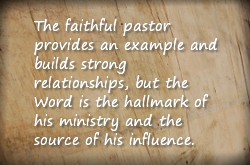
Paul speaks often in this “seminar” of the importance of character and affection (as I noted in this post). He roots spiritual influence both in the leader’s integrity (“you know me” type comments in v. 18-21 and v. 33-35) and relationships (“I wept over you” comments in v. 19 and 31; cp. v. 37-38). But example and engagement are far from sufficient. The genius—the essence—of Christian ministry is the teaching and preaching of Scripture. Paul emphasizes the centrality of the Word in a variety of ways:

1. Paul describes the ministry ideal by using multiple NT words for preaching. Again and again he reminds us of the centrality of the Word to church life. What did he do for three years in Ephesus? Explain and apply the Bible, in every possible manner. As he recounts his ministry, it’s like he’s using a Greek Thesaurus:
  • He declared what was profitable (anangelo, v. 20)
  • He taught the Ephesians (didasko, v. 20)
  • He testified repentance and faith (diamartureo, v. 21)
  • He testified of the gospel (diamartureo, v. 24)
  • He proclaimed the kingdom (kerusso, v. 25)
  • He declared the whole counsel of God (anangelo, v. 27)
  • He admonished the Ephesians (noutheteo, v. 31)
Read the rest at: Sharperiron

Wednesday, January 11, 2012

Teaching the Whole Counsel of God in One Year

One week into my current pastorate, I challenged our congregation to read through the Bible. Desiring to encourage participation, I offered a weekly lesson on how the gospel of Jesus Christ is evidenced in every book of the Bible. Many in our church showed interest, and so with great zeal for God's Word, and with just as much ignorance on what it would take to finish the course, I embarked on teaching Genesis through Revelation in 52 weeks.

In the year that followed, I learned a lot---a lot about the Bible and a lot about biting off more than I could chew. God was gracious to let our band of Bible readers make it from cover to cover. What follows are some traps of, tips, and tools for teaching through and declaring the whole counsel of God.

Traps

First, if you are just beginning at your church, WAIT! Unless providence prohibits, you will have many years to teach through the Bible. With grand intentions, I dove into this marathon in my first year and nearly collapsed. Thus, if this is year one, consider taking on something more manageable. With that said, teaching through the Bible in one year, if done well, will provide an excellent biblical platform on which you can build for years to come.  Keep Reading >>>

Monday, August 22, 2011

Ten Tips for Teaching Kids

The most recent edition of Matthias Media’s enews newsletter had a great little list of tips for teaching young children about God. It was written by Stephanie Carmichael. Carmichael has written several books for young kids and two of them, Grumpy Day and The Birthday Party are available to read online. Here are her tips:

Teach all the time: Young children live in the moment. Help them to learn in the moment by making the most of opportunities as they arise. Talk about God in the day-to-day things you are doing.

Teach at a special time: Try to set aside a special time to read about God. Prepare for this time. If you are going to read the Bible, think about what you will read and how to simplify and explain it.

Questions and answers: Listen to your children’s questions, and give quality time to answering them. But also ask them questions about what you’ve been trying to teach to check they have understood.    Continue Reading...

Wednesday, September 15, 2010

Teaching the Bible to Children

If you are not familiar with David Helm then you should be. He is one of my favorite preachers and has also written The Big Picture Story Bible.
"As someone who tries (and succeeds, most of the time) to establish a regular pattern of family worship at the dinner table, I am always on the lookout for good Bible story resources to use with children of all ages. David Helm's Big Picture Story Bible is an excellent book to read with the youngest members of the covenant community. The book is written in a simple way that little children can understand. The pictures reinforce the meaning of the biblical text and often contain details that generate conversation and lead to a deeper understanding of the gospel. Even better, Helm's redemptive-historical orientation helps even the youngest Christians see the fundamental unity of the Bible and its single gospel message of salvation in Christ. As the title implies, it is an ideal book for helping little people get "the big picture."
- Phillip Ryken, Tenth Presbyterian Church

“The Big Picture Story Bible . . . presents the Bible as a unified story -- and this is so important, even when children are quite young. Children have keen narrative minds and active imaginations. They need to have those capacities respected and developed through hearing the stories of the Bible over and over again. At the same time, parents who read and tell these stories should help children to connect the dots and to learn of God's love and saving purpose from one story to the next.

"Children taught to see the big picture and to know the big story are in a good position to see that knowledge matured through deeper Bible study in years ahead. . . . great gifts for children and young families."
- R. Albert Mohler, Jr., Southern Baptist Theological Seminary

Check out the following message from David Helm about how to teach children the storyline of Scripture...