The purpose of this Blog is to introduce men and women all over the World to the Doctrines of Grace; the 5 Solas; Reformation Theology and the Lord and Savior Jesus Christ.
Showing posts with label Chris Anderson. Show all posts

Tuesday, March 12, 2013

What Does "Unworthily" Mean?

Chris Anderson and friends recently launched a new blog at ChurchWorksMedia.com. Starting today, the blog will appear in our SI Blogroll. To mark the occasion, we commend the article below as a sample of what you’ll find there.—Editor
 
Gathering with the Lord’s church to remember Christ and His work is a vital part of Christian worship and an edifying exercise for both the corporate body and the individual Christian. Yet, Scripture protects the Lord’s Table in 1 Corinthians 11:27, where we are warned not to partake “unworthily” (KJV) or “in an unworthy manner” (ESV). That’s important—so important that people can suffer illness or even death for doing it (v. 30). But what does it mean?

For many, it means bondage. Countless believers have spent their entire lives afraid to partake of the Lord’s Table because they doubt their own worthiness. Communion has become a time when they remember themselves rather than (or at least more than) Christ. They’ve been trained (in part due to the KJV’s translation, in part due to careless teaching) to focus on their relative obedience or disobedience in the days preceding the Table. The result is pride, or despair, or fear—but not worship! Gordon Fee explains:
Unfortunately, this adverb was translated “unworthily” in the KJV. Since that particular English adverb seems more applicable to the person doing the eating than to the manner in which it is being done, this word became a dire threat for generations of English-speaking Christians. (The First Epistle to the Corinthians, 560)
Many of you can say “Amen.” You’re there. I’ve been there. Let’s make sure we’re clear on this. This requirement doesn’t mean that you must be “worthy” to participate based on your performance as a Christian. You’re not ready to partake because you’ve “been good.”
  • First, regardless of what you may think, you’ve never been good. The fact that you think you have just demonstrates that your standard of “good” is far different than God’s.    Continue at Chris Anderson

Saturday, January 14, 2012

Toward Word-Centered Ministry

I recently finished teaching through Acts 20:17-38, one of the most influential passages in my life and ministry. In Paul’s lecture to the Ephesians elders he provides for us what I call “an inspired philosophy of ministry.” He explains what his ministry looked like, providing a pattern for the church throughout the ages. We need to know this passage well and apply it to our churches intentionally, especially in a day when there are so many competing voices regarding the nature of Christian ministry.

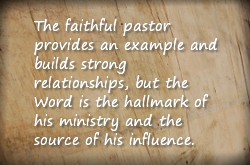
Paul speaks often in this “seminar” of the importance of character and affection (as I noted in this post). He roots spiritual influence both in the leader’s integrity (“you know me” type comments in v. 18-21 and v. 33-35) and relationships (“I wept over you” comments in v. 19 and 31; cp. v. 37-38). But example and engagement are far from sufficient. The genius—the essence—of Christian ministry is the teaching and preaching of Scripture. Paul emphasizes the centrality of the Word in a variety of ways:

1. Paul describes the ministry ideal by using multiple NT words for preaching. Again and again he reminds us of the centrality of the Word to church life. What did he do for three years in Ephesus? Explain and apply the Bible, in every possible manner. As he recounts his ministry, it’s like he’s using a Greek Thesaurus:
  • He declared what was profitable (anangelo, v. 20)
  • He taught the Ephesians (didasko, v. 20)
  • He testified repentance and faith (diamartureo, v. 21)
  • He testified of the gospel (diamartureo, v. 24)
  • He proclaimed the kingdom (kerusso, v. 25)
  • He declared the whole counsel of God (anangelo, v. 27)
  • He admonished the Ephesians (noutheteo, v. 31)
Read the rest at: Sharperiron