The purpose of this Blog is to introduce men and women all over the World to the Doctrines of Grace; the 5 Solas; Reformation Theology and the Lord and Savior Jesus Christ.
Showing posts with label Fiction. Show all posts

Tuesday, December 3, 2013

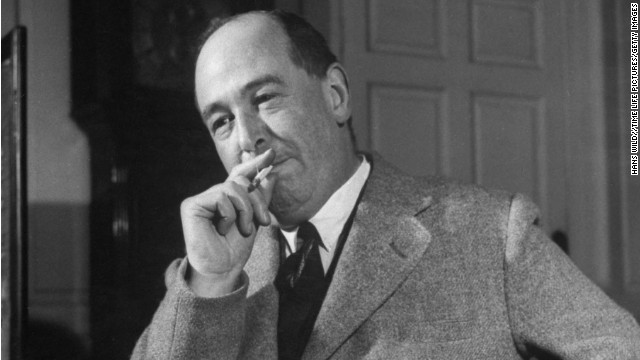
The C.S. Lewis You Never Knew

(CNN) – He looked like a “red-faced pork butcher in shabby tweeds,” lived secretly with a woman for years and was so turned on by S&M that he once asked people at a party whether he could spank them.

We’re talking, of course, about C.S. Lewis, the Christian icon and author of classics such as “Mere Christianity” and “The Chronicles of Narnia.”

It’s tempting to remember Lewis only as the self-assured defender of Christianity who never met an argument he couldn't demolish. His death 50 years ago, on November 22, 1963, was overshadowed by the assassination of President John F. Kennedy. He has since become a patron saint of American evangelicals.

But the actual man whom friends called “Jack” had a “horrible” personal life, thought he had failed as a defender of Christianity and spent so much time in pubs that his publishers initially struggled selling him to a religious audience, scholars say.   Continue at John Blake

Tuesday, February 5, 2013

The Ancient Mystery That Holds the Secret of America's Future

The Harbinger

 
Is it fact or fiction? That is the question everyone asks when they first encounter Jonathan Cahn’s book The Harbinger. The answer is both, I guess—a little from column a and a little from column b. How about this: The Harbinger is meant to be fact presented in the form of a novel; in reality it is an unfortunate mixture of truth and error presented in the form of a script. Still with me?


What is demonstrably factual is that The Harbinger is a phenomenon. It has held steady for forty weeks on the New York Times list of bestsellers, selling over 700,000 copies through fifteen reprints. At the time I write this, Amazon ranks it #2 on their list of Christian fiction and #7 on their list of Christian theology. The book had largely escaped my view until the past few weeks when I received a series of emails from people wondering what it was all about. I finally caved and read it. Consider this more of an explanation of what it is than a thorough review.

I will get to the content in a moment, but first a word about the form. Though described as a novel, the book is actually far closer to a script (a script that would make an exceptionally tedious play or film). There is very little action, only the barest semblance of a plot, and no development at all of the three characters. Instead, the book is composed of amateurish dialog that proceeds at a plodding pace. The writing is repetitive to the point that it could easily have been boiled down to a third or a half of its current length. The book is a chore to read and, speaking personally, the end simply could not come too soon.    Continue at Tim Challies

Monday, October 29, 2012

The Burpo-Malarkey Doctrine

It's odd and troubling that the best-selling evangelical book of the past decade is a fanciful account of heaven spun from the imagination of a four-year-old boy. (Believe it or not, The Purpose-Driven Life and The Prayer of Jabez are both now more than a decade old.) Peddling fiction about the afterlife as non-fiction is the current Next Big Thing in the world of evangelical publishing.

Heaven is for Real, by Todd Burpo, tells the story of Burpo's son, Colton, who says he visited heaven while anesthetized for an appendectomy at age 4. Colton, now 13, says in heaven he got a halo and real wings (though they were too small for his liking). He also claims he sat on Jesus' lap while the angels sang to him; he saw Mary standing beside Jesus' throne; and he met the Holy Spirit (who, according to Colton, is "kind of blue").

More than seven million copies of this book are now in circulation, and the publisher has been assembling a sizable catalogue of spin-off products, including a planned movie version (to be produced by televangelist/prosperity preacher T. D. Jakes).

That book is not to be confused with The Boy Who Came Back from Heaven, by Kevin Malarkey—another runaway best-seller. Malarkey's book is about his son Alex, who at age 6 was nearly killed (and left permanently paralyzed) in a devastating automobile accident. In the immediate aftermath, and then during his rehabilitation, Alex says he made multiple trips to heaven and back.

The Malarkeys' version of heaven is considerably darker and not as full of details as the Burpos'. "There is a hole in outer Heaven," Alex says. "That hole goes to hell." The devil evidently uses this portal freely, because he is a major figure in Alex Malarkey's description of paradise. Alex says he has personally seen Satan many times, first at the accident scene and then later in heaven.   Continue at Phil Johnson

Tuesday, June 19, 2012

Heaven Tourism

Travelling to heaven and back is where it’s at today. Don Piper spent ninety minutes there and sold four million copies of his account. Colton Burpo doesn’t know how long he was there, but his travel diary has surpassed 6 million copies sold, with a kids’ edition accounting for another half million. Bill Wiese obviously booked his trip on the wrong web site and found himself in hell, which did, well, hellish things to his sales figures. Still, 23 Minutes in Hell sold better than if he had described a journey to, say, Detroit, and he even saw his book hit the bestseller lists for a few weeks. There have been others as well, and together they have established afterlife travel journals as a whole new genre in Christian publishing—a genre that is selling like hotcakes, or Amish fiction, for that.

I’ll grant that the cost of this type of journey is rather steep (you’ve got to die, though only for just a few minutes), but it’s a sound investment when you factor in the sales figures. I can think of quite a few authors who would trade a few minutes of life for 50+ weeks on the bestseller lists and a few appearances on TBN.

The most recent heaven tourist is Mary C. Neal. Much like Todd Burpo, who is responsible for taking his son’s adventures to print, Neal only decided to write about her experiences many years after the fact, after all those other “I went to heaven” books began to sell in the hundreds of thousands. But that’s definitely just coincidence. She initially self-published her book To Heaven and Back, but once it started generating buzz (i.e. selling lots and lots of copies), Waterbrook Multnomah stooped down and scraped it off the bottom of a shoe somewhere, and promptly re-issued it. With the extra marketing nudge, it has now made its debut on the New York Times list of bestsellers. I gave it a skim—I just couldn’t bear to read it all the way—and found that it is much the same as the others. In fact, it may be worse than the others in that it contains even less Christian theology, less gospel and far more New Age, sub-Christian nonsense. That a publisher of Christian books would even consider taking this to print is appalling.   Continue at Tim Challies
Wednesday, August 24, 2011

ON DANGEROUS READING: A Warning Against The Reading of Novels, Fiction, and Other Poisonous Literature

"Now, all works of fiction are full of scenes of imaginary distress, which are constructed to impress the sensibilities. The fatal objection to the habitual contemplation of these scenes is this, that while they deaden the sensibilities, they afford no occasion or call for the exercise of active sympathies. Thus the feelings of the heart are cultivated into a monstrous, an unnatural, and unamiable disproportion.[2] He who goes forth in the works of active benevolence among the real sufferings of his fellow creatures will have his sensibilities impressed, and at the same time will have opportunity to cultivate the principle of benevolence by its exercise. Thus the qualities of his heart will be nurtured in beautiful harmony, until they become an ornament to his character and a blessing to his race. This is God's "school of morals." This is God's plan for developing and training the emotions and moral impulses. "Pure religion and undefiled before God and the Father is this, to visit the fatherless and the widows in their affliction, and to keep himself unspotted from the world." [James 1.27.] And the adaptation of this plan of cultivation to the laws of man's nature shows that the inventor is the same wise Being who created man. It is by practicing this precept of the gospel that man is truly humanized. But the beholder of these fictitious sorrows has his sympathies impressed, and therefore deadened, while those sympathies must necessarily remain inert and passive, because the whole scene is imaginary. And thus, by equal steps, he becomes at once sentimental and inhuman. While the Christian, whose heart has been trained in the school of duty, goes forth with cheerful and active sympathies in exercises of beneficence towards the real woes of his neighbor, the novel reader sits weeping over the sorrows of imaginary heroes and heroines, too selfish and lazy to lay down the fascinating volume and reach forth his hand to relieve an actual sufferer at his door."   Read the rest HERE

See Also:

The lost art of thinking in today's entertainment-saturated, image-driven postmodern society