The purpose of this Blog is to introduce men and women all over the World to the Doctrines of Grace; the 5 Solas; Reformation Theology and the Lord and Savior Jesus Christ.
Showing posts with label Time. Show all posts

Wednesday, July 3, 2013

News is BAD for You – and Giving up Reading it will Make you Happier

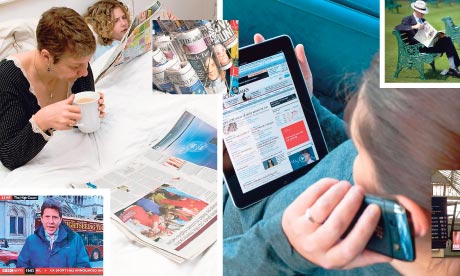
Out of the ­10,000 news stories you may have read in the last 12 months, did even one allow you to make a better decision about a serious matter in your life, asks Rolf Dobelli. Photograph: Guardian/Graphic
 
In the past few decades, the fortunate among us have recognised the hazards of living with an overabundance of food (obesity, diabetes) and have started to change our diets. But most of us do not yet understand that news is to the mind what sugar is to the body. News is easy to digest. The media feeds us small bites of trivial matter, tidbits that don't really concern our lives and don't require thinking. That's why we experience almost no saturation. Unlike reading books and long magazine articles (which require thinking), we can swallow limitless quantities of news flashes, which are bright-coloured candies for the mind. Today, we have reached the same point in relation to information that we faced 20 years ago in regard to food. We are beginning to recognise how toxic news can be.

News misleads. Take the following event (borrowed from Nassim Taleb). A car drives over a bridge, and the bridge collapses. What does the news media focus on? The car. The person in the car. Where he came from. Where he planned to go. How he experienced the crash (if he survived). But that is all irrelevant. What's relevant? The structural stability of the bridge. That's the underlying risk that has been lurking, and could lurk in other bridges. But the car is flashy, it's dramatic, it's a person (non-abstract), and it's news that's cheap to produce. News leads us to walk around with the completely wrong risk map in our heads. So terrorism is over-rated. Chronic stress is under-rated. The collapse of Lehman Brothers is overrated. Fiscal irresponsibility is under-rated. Astronauts are over-rated. Nurses are under-rated.   Continue at Rolf Dobelli

Monday, May 6, 2013

Busyness is Not a Virtue

People who often say they’re “too busy” or “crazy busy” sound like buzzing busy signals. And when you start sounding like an appliance, it makes it hard to connect with you. My reaction to your busy signal is much like that of Mindy Kaling, who sees stress as non-conversation:
imageNo one ever wants to hear how stressed out anyone else is, because most of the time everyone is stressed out. Going on and on in detail about how stressed out I am isn’t conversation. It’ll never lead anywhere. No one is going to say, “Wow, Mindy, you really have it especially bad. I have heard some stories of stress, but this just takes the cake.”
Likewise, going on about how busy you are isn’t conversation and doesn’t lead anywhere — except making your conversation partner bored, or worse, peeved. People who act super busy send the same message, making time spent with them never feel quite whole. Interestingly, I find that most people who are legitimately occupied — with their work, or family, or art, or what-have-you — rarely play the “too busy” card, or go out of their way to make time for meaningful connection exactly because they’ve been busy.   Continue at iDoneThis

Monday, August 27, 2012

Vacating the Internet

They say that absence makes the heart grow fonder. That may be true as it pertains to friends and family, but it was not my experience this summer when I abandoned the Internet and digital technologies for a week. In early August we headed south and spent a week holed up in a cabin in a Virginia state park (Lake Anna, if you need to know). As we did two summers ago, we decided to declare this a digital-free vacation, leaving all computers and iPads and iPods and other gear out of the equation. The only electronic gear we allowed was Kindles, since that is the primary means through which Aileen and the kids read books, and a GPS, since I’ve forgotten how to read a map. I can’t say that I missed much of what we left behind.

Now let’s be clear—there are certain ways in which I’ve learned to put boundaries on my use of electronic and Internet-connected devices. If I learned anything from writing The Next Story it’s that our technologies are always threatening to form us in their image; if we do not take them captive, they will take us captive. With varying degrees of success, I’ve found ways of taking my devices and technologies under my control. Still, I often grow lazy and complacent and in such times I find myself checking email a hundred times a day or haphazardly googling any little question that may come to mind. In such times I use my devices without reflection or restriction and I use them at the expense of other things that ought to maintain a higher priority.  Continue at Tim Challies