The purpose of this Blog is to introduce men and women all over the World to the Doctrines of Grace; the 5 Solas; Reformation Theology and the Lord and Savior Jesus Christ.
Showing posts with label Theory. Show all posts

Monday, June 10, 2013

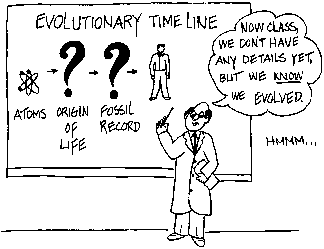
Doubting Darwin

The sky is falling! Many interest groups and journalists raced to tell that to the public when a modest but important bill became law in Tennessee early in April.

 The law instructs teachers and administrators to "create an environment within public elementary and secondary schools that encourages students to explore scientific questions, learn about scientific evidence, develop critical thinking skills, and respond appropriately and respectfully to differences of opinion about controversial issues." 

What's not to like? The law, similar to one in Louisiana, also protects teachers who help students (I'm quoting from the official legislative summary) "understand, analyze, critique, and review in an objective manner the scientific strengths and scientific weaknesses of existing scientific theories covered in the course being taught. ..." Oh, here's the problem: Evolution is one of the theories that can now be analyzed and critiqued. 

The American Association for the Advancement of Science, the American Civil Liberties Union of Tennessee, the American Institute of Biological Sciences, the National Association of Geoscience Teachers, and many others have gone ape over the inclusion of evolution. They revere critical thinking and the freedom to explore, but not when it might produce irreverence toward their idol.   Continue at  Marvin Olasky

Monday, October 8, 2012

Understanding Dispensationalists

1 Cor 15:51-53 presents a problem to the doctrine of pretribulational rapture, because it speaks of “the last trumpet.” Now classic dispensationalist theory interprets 1 Cor 15:51-53 as referring to the rapture. Seven years afterthe rapture another trumpet is sounded at the visible second coming of Christ, in connection with the gathering of elect Jews (Matt 24:31). Hence, apparently, the trumpet sound described in 1 Cor 15:52 is not really the last. If, on the other hand, the rapture of 1 Cor 15:51-53 and the visible second coming of Matt 24:31 are essentially simultaneous (contrary to classic dispensationalist theory), the two trumpets are presumably also the same, and there is no difficulty.

Thus there is an obvious difficulty in reconciling the two texts (1 Cor 15:51-53 and Matt 24:31) with dispensationalist theory. Now, there is a standard dispensationalist answer to this difficulty. In fact, this answer is fairly “obvious” within the dispensationalist system. The readers who are familiar enough with the general principles of the system may be able to figure it out for themselves. My concern is not with whether there is an answer, but with the hermeneutical question: how is the answer obtained?

One must in effect keep raising hermeneutical questions. What are the principles by which we undertake to understand 1 Cor 15:51-53 and to reconcile it with Matt 24:31? When classic dispensationalists talk about those principles, they tell us that we must interpret “literally” or “plainly.” Now what is a “literal” interpretation of 1 Cor 15:51-53? To be “literal” could mean simply to take fully into account all the grammatical, contextual, and historical clues throwing light on this passage. That is sometimes demanding. But it would be sound. On the other hand, to be “literal” could imply that we are to stick to what is most “plain” or “obvious.”   Read the rest at Vern Poythress

Tuesday, June 26, 2012

Green ‘Drivel’ Exposed

Two months ago, James Lovelock, the godfather of global warming, gave a startling interview to msnbc.com in which he acknowledged he had been unduly “alarmist” about climate change.

The implications were extraordinary.

Lovelock is a world-renowned scientist and environmentalist whose Gaia theory — that the Earth operates as a single, living organism — has had a profound impact on the development of global warming theory.

Unlike many “environmentalists,” who have degrees in political science, Lovelock, until his recent retirement at age 92, was a much-honoured working scientist and academic.

His inventions have been used by NASA, among many other scientific organizations.

Lovelock’s invention of the electron capture detector in 1957 first enabled scientists to measure CFCs (chlorofluorocarbons) and other pollutants in the atmosphere, leading, in many ways, to the birth of the modern environmental movement.

Having observed that global temperatures since the turn of the millennium have not gone up in the way computer-based climate models predicted, Lovelock acknowledged, “the problem is we don’t know what the climate is doing. We thought we knew 20 years ago.” Now, Lovelock has given a follow-up interview to the UK’s Guardian newspaper in which he delivers more bombshells sure to anger the global green movement, which for years worshipped his Gaia theory and apocalyptic predictions that billions would die from man-made climate change by the end of this century.   Continue at Toronto Sun

Monday, May 21, 2012

What Happened Before the Big Bang?

A BBC documentary with this title was aired on SBS-TV in Australia in April, 2012. In it, several cosmologists discus ‘the unthinkable’—perhaps the big bang was not the beginning of everything after all. It seems that scientists have discovered a new law. Well, not actually new—just one that has been treated as if it didn’t exist for the last half century or so by ‘big-bangers’ such as Stephen Hawking, Roger Penrose, Paul Davies, Edwin Hubble, et al, namely the law of Cause and Effect.

The program explains that the concept of the big bang1 postulates that “everything we see in the universe today—us, trees, galaxies, zebras—emerged, in an instant, from nothing. And that’s a problem. It’s all effect and no cause.” We are then given five different explanations from five different scientists concerning what this cause may (or may not) have been.

Prof. Michio Kaku and the meaning of ‘nothing’


Dr Michio Kaku is Professor of Theoretical Physics at City University, New York. He asks: “How can it be that everything comes from nothing?” His solution: “If you think about it a while, you begin to realise it all depends on how you define ‘nothing’!”2
 
We are then shown a huge NASA vacuum chamber, the largest in the world—the nearest we can get to a state of nothing, but which still has dimensions (‘nothing in 3D’), and through which light can pass. Prof. Kaku tells us: “I think there are two kinds of nothing. First there is something I call absolute nothing: no equations, no space, no time, no anything that the human mind can conceive of, just nothing. Then there is the vacuum which is nothing but the absence of matter.” 

The host then comments: “Prof. Kaku’s version of nothing is the perfect vacuum where on the face of it there is only energy. But in a perfect vacuum, energy sometimes transforms itself temporarily and briefly into matter. It is one of these tiny explosions that might have been going on and ended up in the big bang.”

Prof. Kaku: “So for me the universe did not come from absolute nothing—that is a state of no equations, no empty space, no time; it came from a pre-existing state—also a state of nothing. Our universe did in fact come from an infinitesimally tiny little explosion that took place giving us the big bang, and giving us the galaxies and stars we have today.”   Continue at Russell Grigg

Saturday, November 5, 2011

Peter Enns on Paul, Adam, and Evolution

For Peter Enns, evolution denies the historical Adam and Eve, and that gives rise to the questions he’s trying to answer. The fact that Paul viewed Adam as the first human being has, for Enns, been shown to be wrong scientifically. Enns asserts that Paul is theologically right on the point that Jesus defeated sin and death, but that he “may be wrong” on what caused the problem–Adam’s sin. Though he “may be wrong” on that, Enns asserts, Paul is right about sin and death and the solution. Enns says that even if Adam and Eve didn’t bit an apple, sin and death are real.

Enns seems to want to keep the theology while discarding the history as he explains: “I don’t need a historical Adam to make all that happen… I understand why Paul says what he says, cause he’s an ancient man, cause he’s a Jew.”

For Enns, the theory of evolution carries as much authority as Scripture, and it shows that Paul was wrong about Adam being the first human. Moreover, the interpretations that Paul and the other biblical authors provide of earlier Scripture are just possibilities, not necessarily correct readings that function as controls on how those earlier texts should be read.

Peter Enns is trying to combine two different religions, evolution and Christianity...  Read the rest HERE

Wednesday, July 20, 2011

Should Christians Embrace Evolution?

Should Christians embrace evolution? It is an increasingly urgent question and one that seems increasingly difficult to answer. Like you, I have grown accustomed to hearing Christians declare that, in the end, it doesn’t really matter a whole lot what you believe about creation, whether you embrace a literal six-day creation or a version that allows for some kind of evolution. If only it was that simple. The fact is that there are many other doctrines that lean heavily upon the doctrine of creation. As this one topples and falls, many other crumble along side it. 

Just a couple of weeks ago WORLD magazine declared Should Christians Embrace Evolution? their book of the year for 2011. I received the book just days after and eagerly opened it up to see what the fuss was all about. What I found is a book that offers a series of biblical and scientific responses to the question of evolution. Edited by Norman Nevin, the chapters are written by a list of distinguished scientists and theologians. Keep Reading...

Saturday, January 29, 2011

Cautions for Mere Christianity

C.S. Lewis’ Mere Christianity is a classic. It is a winsome, thoughtful, well-written defense of the Christian faith. Some of its better known sections–like the famous liar, lunatic, Lord, trilemma–have become part of the way evangelicals think and speak. No doubt God has used Lewis and Mere Christianity to awaken affections for Christ, engage the mind for Christ, and remove obstacles for the Spirit to draw people to Christ. I’m thankful for all this. More than that, I’ve benefited from every Lewis book I’ve read.

But C.S. Lewis was not an evangelical. Mere Christianity shows why.

Let me highlight two significant problems. Continue Reading>>>

Tuesday, March 30, 2010

The Atonement: Theory or Doctrine?

I'm currently reading through a short book on the atonement in the bible and church history. The author believes in penal substitution, and that it is one of many metaphors to explain the cross. The publishers' blurb on the back cover begins with this sentence:

The Penal Substitutionary theory of the atonement says that Jesus suffered the divine punishment for our sins at Calvary.
Early in the book Calvin is credited with being the first to give a "full-blown penal substitutionary account of the atonement" and "the first full statement of penal substitution," and again "the first complete statement of a penal substitutionary theory of the atonement" (emphasis mine).

In describing penal substitution the author at times designates it as a metaphor, at times as a doctrine, and at other times as a theory. Significantly, in commenting on Isaiah 53, the author says that this chapter "comes as close as anything in the Bible to teaching penal substitutionary atonement. Still, there is not a fully worked out theory here." Read the rest HERE