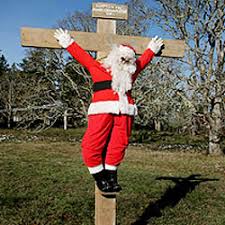
The purpose of this Blog is to introduce men and women all over the World to the Doctrines of Grace; the 5 Solas; Reformation Theology and the Lord and Savior Jesus Christ.
Showing posts with label Santa Claus. Show all posts

Monday, December 24, 2012

Why Jesus Is Infinitely Better Than Santa Claus

Santa lives at the North Pole … JESUS is everywhere.  

Santa rides in a sleigh … JESUS rides on the wind and walks on the water.  

Santa comes but once a year… JESUS is an ever-present help.  

Santa fills your stockings with goodies … JESUS supplies all your needs by the riches of His grace.  

Santa comes down your chimney uninvited … JESUS stands at your door and knocks, and enters your heart.  

You have to wait in line to see Santa … JESUS is as close as the mention of His name.  
Santa lets you sit on his lap … JESUS lets you rest in His arms.  

Santa doesn’t know your name, all he can say is, “Hi little boy or girl, what’s your name?” … JESUS knew your name before you did. Not only does He know your name, He knows your history and future, and He even knows your heart and how many hairs are on your head.    Continue at RPM

Friday, December 14, 2012

My Favorite Santa Claus Story

There are a lot of Santa Claus stories floating around this time of year. Almost all of them are completely based in fantasy. Flying reindeer; a sleigh full of gifts; precarious chimney climbing; a fluffy red suit — all of that is total fiction.

But when my kids used to ask me, “Dad, is Santa Claus real?” I didn’t say “No.” In fact, I answered in the affirmative.

(Pause for dramatic effect.)

Santa_Claus
Like any good student of church history, I explained that Santa Claus was actually a fourth-century pastor named Nicholas of Myra who was later considered a saint by the medieval Roman Catholic Church. He was a favorite of Dutch sailors who called him, “Sinter Klaas” (or “Saint Nicholas”) which then came into English as “Santa Claus.”

Of course, I was careful to point out that the modern American version of Saint Nicholas bears absolutely no resemblance to the fourth-century pastor from Asia Minor. The real Nicholas did not live in the North Pole. He was not Scandinavian. He did not drive a team of magical caribou. He did not work with elves. Nor did he travel the world every Christmas Eve exchanging presents for milk and cookies.

No, he was a pastor. He worshipped the Lord Jesus Christ. And he would have been appalled at the way his legacy has been used to obscure the true meaning of Christmas.

But I digress…    Continue at Nathan Busenitz

Tuesday, December 20, 2011

Why Lie to Your Kids about Santa?

I’m no Scrooge. I lodge no objections to celebrating Christmas or singing inane jingles, like Jingle Bells. My family understands that, pagan roots aside, the plastic conifer in our living room is not a subtle mark of our allegiance to the forces of darkness. It’s a tree (model).

We do, however, prefer singing “Hark the Herald Angel Sings” over the misdirected praise of “Oh Christmas Tree,” though I’m not even fanatic about enforcing that.

We tolerate the poetic inaccuracy of “We three kings of Orient are” because it rolls off the tongue better than “We indeterminable number of Gentile scholars of Persia are.”

But… I am nervous about the potential confusion which may cloud a 4 year old’s faith in my honesty. 

Angels on high, a pregnant virgin, God in a manger, a guiding star… are impossibilities. Yet, “all things are possible with God.” [Yes, you need to believe in the virgin birth to be a Christian] We ask our children to trust us on these claims with their lives. Then we add a fictitious, omniscient fat guy with a red-nosed reindeer to the mix. At a certain age we matter-of-factly disclose that we were just kidding about the chimney intrusion, the Elven workshop, and the works-based naughty-or-nice judgment. “Those parts are make-believe, the rest is gospel truth. Trust me, son.”

Misinformation has a way of taking root in our memories. Do you picture the stable with oxen lowing on a silent night? Were the angels actually singing? Was there a villainous inn keeper? These details are not found in Scripture.  Keep Reading >>>

Saturday, November 26, 2011

'Tis the Season in Which We Celebrate America's Christian Heritage

One of our local radio stations is already playing Christmas music full-time. It’s amazing how many songs have been written about Christmas. Most of them are secular, but the most common message they convey is one of family joy, of children and Santa Claus, of remembrance of all the Christmases we enjoyed in the past with loved ones who are no longer with us.

So despite the attempts by atheists to ban Christianity from American public life, particularly in the public schools, they cannot eradicate Christmas from family life, let alone the shopping malls. As anyone can see, Christmas has acquired great economic power. And that is because Christianity is at the foundation of our spiritual life and political system.

Secular humanism tries to give the impression that Christianity was just a passing phase in American history, and that our culture is advancing into a new secular religion more in keeping with modern values. But the humanist movement cannot remove the need in people’s lives for attachment to their Creator. In recent years we’ve seen a revival of religious fervor in America, particularly in the South where mega-churches have been built to accommodate the large numbers of people who need all the spiritual nourishment they can get.

Everybody seems to recognize that our modern civilization is in very big trouble. We have a national debt in the trillions of dollars. We are at war with radical Islam. We have a socialist regime in Washington at odds with our constitutional form of government. Our technological advances are astounding, yet we have mobs in the streets calling for the end of capitalism, the very system that created all of these goodies.

Perhaps a refresher course in American history and our Christian roots is needed to strengthen our convictions of how the American people should go about reconstructing their future. Getting people to live in obedience to the Ten Commandments has always been an uphill battle, even in colonial times.

Paul Johnson, a great admirer of the American system of political and religious freedom, wrote in his book, A History of the American People: "There was a spiritual event in the first half of the 18th century in America, and it proved to be of vast significance, both in religion and in politics."

He is referring to the Great Awakening, a religious revival started by impassioned preachers determined to bring as many souls as possible to the saving grace of Jesus Christ.  Keep Reading >>>

Saturday, December 25, 2010

Santa Christ?

It is always easier to lament and critique the new paganism of secularism’s blatant idolatry than to see how easily the church-and we ourselves-twist or dilute the message of the incarnation in order to suit our own tastes. But sadly, we have various ways of turning the Savior into a kind of Santa Claus.

Santa Clause Christianity

For one thing, in our worship at Christmas we may varnish the staggering truth of the incarnation with what is visually, audibly, and aesthetically pleasing. We confuse emotional pleasure-or worse, sentiment-with true adoration.

For another thing, we may denigrate our Lord with a Santa Claus Christology. How sadly common it is for the church to manufacture a Jesus who is a mirror reflection of Santa Claus. He becomes Santa Christ.

Santa Christ is sometimes a Pelagian Jesus. Like Santa, he simply asks whether we have been good. More exactly, since the assumption is that we are all naturally good, Santa Christ asks us whether we have been “good enough.” So just as Christmas dinner is simply the better dinner we really deserve, Jesus becomes a kind of added bonus who makes a good life even better. He is not seen as the Savior of helpless sinners. Continue Reading>>>

Domesticated Transcendence

From Michael Gerson writing in The Washington Post:

Christmas has become a kind of alternative religion, offering watered-down versions of profound theological doctrines. Its miracles are found on 34th Street, not in Bethlehem. The visitation of Gabriel has become the visitation of Clarence, assuring us that it is a wonderful life. The modern cult of Christmas offers a domesticated form of transcendence. Naughty or nice instead of good or evil. A jolly old elf rather than an illegitimate child, destined for an early death…

I choose to take a more liberal view of the Christmas cult. Its tacky materialism can be unattractive. But the desire for Christmas miracles and visiting angels – for Tiny Tim not to die and for hooves on the rooftop and for George Bailey to be the richest man in town; for just one night of calm and hope – are not things to be lightly dismissed.

‘If I find in myself,’ says [C.S.] Lewis, ‘a desire which no experience in this world can satisfy, the most probable explanation is that I was made for another world.’ In this argument, the sentimental desires of Christmas are hints and rumors and reminders of a birth that somehow represents their culmination. Put another way: The hopes and fears of all the years are met in Thee tonight.

Thursday, December 23, 2010

Santa Claus with the Baby in Bethlehem (Part 2)

In honor of St. Nicholas the gift giver, Christians began to celebrate December 6 (his feast day) by giving presents. The tradition developed over time.  For good boys and girls, St. Nicholas would come in his red Bishop’s robe and fill boots with gifts on the night of December 5.  For bad boys and girls St. Nicholas was to be feared.  In highly catholic parts of Europe, St. Nicholas became a deterrent to erring young children.  In Germany, he was often accompanied by Knecht Ruprecht (farmhand Rupert) who threatened to eat misbehaving children.  In Switzerland, St. Nicholas threatened to put wicked children in a sack and bring them back to the Black Forest.  In the Netherlands, St. Nicholas’ helper would tie them in a sack and bring them back to Spain.  In parts of Austria, the priest, dressed up in Christmas garb,  would visit the homes of naughty children and threaten them with rod-beatings. At least nowadays, he only checks his list! Continue Reading>>>

Wednesday, December 22, 2010

Santa Claus with the Baby in Bethlehem (Part 1)

Is there anything quite as tacky as making Santa Claus kneel before the manger? Is this a weak attempt at baptizing secular Christmas traditions? Or is it a subtle slam at secluarism (Ha, Ha! Your Santa bows to our Savior!”)? I’m not sure, but either way it seems a bit off.

But then again, maybe not.

If you know anything about the real Santa Claus, the man who has become the namesake for all that seems kitschy and consumerist about Christmas, I imagine he’d appreciate the chance to worship the little babe in the straw.

So who exactly was St. Nicholas? The unsatisfying answer is that nobody knows for sure.  To quote one Nicholas scholar “We can grant a bishop of that name who had a great impact on his homeland.  We can also accept December 6 as the day of his death and burial.  These are all the facts we can hold to.  Further we cannot go.” (Gustav Anrich quoted by Charles W. Jones in Saint Nicholas of Bari, Myra, and Manhattan). Continue Reading>>>