The purpose of this Blog is to introduce men and women all over the World to the Doctrines of Grace; the 5 Solas; Reformation Theology and the Lord and Savior Jesus Christ.
Showing posts with label Poor. Show all posts

Thursday, February 16, 2012

Gambling and the Common Good

Kentucky, the state where I live, is abuzz these days with discussion over expanded gambling.The governor here wants it, and conservative Christian groups don’t. This argument is hardly limited to here. I lived through it in my ancestral home on the Mississippi Gulf Coast, as the casino industry promised an economic turnaround if voters would just give them the right to exist. Almost every state is involved in some discussion of state-sponsored gambling.

I think there are bigger issues involved than how they are typically framed.

First of all, pro-gambling elected officials aren’t evil villains (necessarily). Yes, some of them are personally corrupt and poised to profit from the industry they are enabling. But many of these elected officials have good aims. They want to educate children, build infrastructure, and so on without raising a tax burden. I think gambling is an illusory way to do this, but, still, I acknowledge good intentions at the root of some of the cheerleaders for the industry. Continue at Russell Moore

Friday, December 16, 2011

Don't Like Handouts? Neither Does the Bible

Many passages in Holy Scriptures implore rulers to treat the poor fairly.

It is only a slight exaggeration to suggest God measures nations largely by justice towards "the least of these." Is charity best dispensed publicly through a secular state or privately by churches? Does Washington really not do enough?

Despite the demagoguery trumpeted every election, America's rich pay almost all our taxes while the less fortunate are net recipients of government largesse. 

Washington's focus has shifted from defense and foreign affairs into social programs advancing egalitarianism. The federal government's primary endeavor reflects paying people not to produce.

Many assume these public initiatives represent biblical governance concerning the destitute but such passages were proclaimed under very different political and economic contexts. Americans take for granted that those without political connections can still acquire property, enjoy legal rights, access the ballot, testify in courts, and obtain medicine, police, fire and other protections.

However, throughout antiquity (and many places still), justice was seldom blind. Far more frequently the state pillaged the poor. Government didn't exist to protect all citizens equally, but to empower rulers as an instrument of plunder.

Might made right. Without defined constitutional parameters, justice generally reflects the whims of the powerful.  Keep Reading >>>


Monday, December 12, 2011

The Tragedy of American Compassion

Tragedy and Compassion – two words that we don’t normally associate together. How could compassion be tragic? While we likely have different levels of bad news in mind when think of tragedy, we are all in agreement that tragedy is bad and something ought to be done. Although I think the TV news industry is working hard to widen the definition to include hangnails.

Compassion is a bit more complicated. We tend to think of compassion from the same perspective that we think of love – the unbiblical, Greco-Roman emotional view. Americans view compassion today differently than we did 250 years ago. We want to “relieve suffering” but don’t stop to think about the proper way of doing this, or even if there is such a thing. There are some issues – life threatening, for example – for which rapid elimination of the threat is proper. But there are many life issues that are the accumulation of bad decisions for which there is no proper quick relief. We can look at G.W. Bush’s policy in the Middle East, thinking the solution there was to quickly implant democratic governments. People will not value the liberty a representative government of laws brings until they realize their need of it. Small children will not realize the value of math if mom tells them the answers rather than teaches and asks diagnostic questions.  Keep Reading >>>

Saturday, November 19, 2011

If I Become Rich, Won’t Someone Else Become Poor?

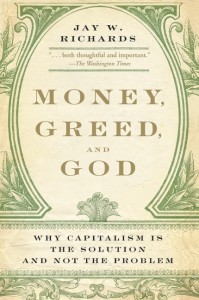
This is the most readable defense of capitalism I’ve read (and it’s more relevant than ever with the recent “Occupy Wall Street”-type protests):


Richards debunks eight myths, which are listed in the book’s table of contents:
  1. Can’t We Build a Just Society? Myth no. 1: The Nirvana Myth (contrasting capitalism with an unrealizable ideal rather than with its live alternatives)
  2. What Would Jesus Do? Myth no. 2: The Piety Myth (focusing on our good intentions rather than the unintended consequences of our actions)
  3. Doesn’t Capitalism Foster Unfair Competition? Myth no. 3: The Zero-sum Game Myth (believing that trade requires a winner and a loser)
  4. If I Become Rich, Won’t Someone Else Become Poor? Myth no. 4: The Materialist Myth (believing that intellect cannot create new wealth)
  5. Isn’t Capitalism Based on Greed? Myth no. 5: The Greed Myth (believing that the essence of capitalism is greed)
  6. Hasn’t Christianity Always Opposed Capitalism? Myth no. 6: The Usury Myth (believing that charging interest on money is always exploitive)  Keep Reading >>>

Wednesday, September 21, 2011

Discontinuity: the Poor, Israel, and the Church

Much of the push for the church to engage in social transformation and indiscriminate care for the poor of the world comes from a wrong understanding of the relationship between the church and Israel. There is no doubt that Israel was called to care for the poor in their land—regardless of their creed. The alien, foreigner, slave, and sojourning widow were all protected by the Law, and if Israel would have kept the law, there would have been no poor in the land.

The question is this: does the church have a similar task? Is the church charged to care for the poor of the world, in the same way Israel was? I have argued elsewhere that the answer is “no,” but here I want to explain why the difference is important and helpful in understanding God’s mission to the world.

First, it has to be noted that Israel’s call to care for the poor was constrained in a very significant way. While it was not limited by creed, it was bound by geography. Israel was not called to care for the poor in Egypt. When a drought hit a neighboring country, the Israelites would have been more likely to celebrate than send a food pack. Contrast that with the church; we are quick to send aide around the world, but are rightly cautious to aide the non-believing poor in our own community. Why is that?     Keep Reading...

Wednesday, August 24, 2011

Biblical Pillars for Mercy Ministry

Yesterday John Piper gave a challenge to his readers to try to support their understanding of showing love to the unbelieving poor with “strong pillars” of theological argument. People are lost and on their way to hell, and many of them are suffering in this life as well. It has always struck me as particularly meaningless and eternally inconsequential when churches use their resources to do that which God has not called us to do. The poor, as Piper said, deserve better than bad arguments with bad theological foundations.

Last week I made the case that the Bible does not command churches to use their resources to lower the poverty rate, and I quibbled with Tim Keller’s statement that Christians owe the poor as much as we can possibly give them. But Keller’s views on mercy ministry are really so extreme, that it is easy to be accused of arguing with a straw man (plus I want to take this to heart) so I want to spend a few posts explaining what I see is a full biblical view of mercy ministry.

So over the next few weeks/months, I will use this blog to explain how our response to the poor should be influenced by Scripture (only one post a week, so no need to tune out till November if this doesn’t interest you). If you have sat on a mission’s committee and been frustrated by the social agenda of many missionaries, if you have seen the homeless man on the side of the road with the sign that says “will work for beer” and wondered what you should do, if have ever dared to ask the question: “does the Bible command Christians to work for social justice issues?” then this series of posts will be helpful to you.   Keep Reading...