The purpose of this Blog is to introduce men and women all over the World to the Doctrines of Grace; the 5 Solas; Reformation Theology and the Lord and Savior Jesus Christ.
Showing posts with label Kingdom of God. Show all posts

Tuesday, April 15, 2014

The Kingdom of God: Already but Not Yet - Part I

The view presented below is held by premillennialists (those who believe in a 1,000 year earthly reign of Christ between his second coming and eternity), amillennialists (those who believe the millennium is occurring now, in heaven, among the saints with Christ, and who believe the second coming will be followed immediately by the eternal state), as well as some postmillennialists. Although these groups disagree over the nature and timing of the millennium, they are in agreement in their rejection of dispensationalism and their affirmation of one people of God.

A.        The People of God and the Promise of the Kingdom

1.         There is in God’s redemptive purpose one people, the elect. This single body of elect people, however, when viewed within the context of biblical history, is comprised of differing individuals and assumes diverse forms. Beginning with Gen. 12, however, God selected out from among all the peoples of the earth one man, Abraham, and pledged Himself to him and his seed to be their God. Thus beginning with Abraham and extending to the first advent of Christ the elect of God were found almost wholly within the bounds of one ethnic body, Israel, the physical descendants of Abraham, Isaac, and Jacob.   Continue at Sam Storms


Friday, February 28, 2014

CHILDLIKENESS by B.B. Warfield

This article is long, but well worth your time to read. It is not only sound biblical teaching, it is also a model of careful interpretation of Scripture. In it, Warfield presents various interpretations of the passage explaining why they are superficial and inferred — to one degree or another. The last two paragraphs, giving us a more accurate interpretation of the passage, are pure gold. A beautiful picture of the sovereign, free grace of God in salvation.

CHILDLIKENESS
by B.B. Warfield

“Verily I say unto you, Whosoever shall not receive the Kingdom of God as a little child, he shall in no wise enter therein.” — Mark 10:15

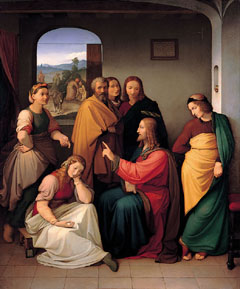
The declaration embodied in this verse, apparently very simple, and certainly perfectly clear in its general sense, is not without its perplexities when examined in its detailed implications. The occasion of its enunciation was an incident in the life of our Lord which manifests His beautiful tenderness as few others of those narrated in the Gospels. In the prosecution of His mission He went up and down the land, as we are told, “doing good.” It was characteristic of His teaching that the common people heard Him gladly. It was of the essence of the beneficent impression that He made that He drew to Him all who were afflicted and were suffering with diverse diseases.   Continue at  Eric T. Young

Wednesday, February 26, 2014

10 Connections Between Jesus and the Kingdom of God


kingdom-of-god1 

The kingdom of God is, in essence, God's redemptive reign. Yet it can be easy to overlook this prominent theme in the life of Jesus, and tempting to assume rather than investigate the importance of the kingdom for Jesus. When we miss the significance of the kingdom to Jesus, however, we can miss the significance of the kingdom for biblical theology and ethics.

So how important was the kingdom of God to Jesus? What was his relationship to the in-breaking of the eschatological kingdom? Let's examine ten ways Jesus related to the kingdom.

1. Jesus inaugurates the kingdom. With the coming of Christ, the kingdom begins not in the coronation of a mighty king but in the birth of a crying baby. Yet as Jesus' ministry begins in Mark, he announces, "The time is fulfilled, and the kingdom of God is at hand; repent and believe in the gospel" (Mark 1:15). What Israel had long awaited, Christ had now inaugurated.   Continue at Phillip Bethancourt

Thursday, October 11, 2012

The Kingdom of God: A Closer Look by Tullian Tchividjian

This week's essay from the Mission of God Study Bible focuses on the Kingdom of God. I've recently released a book on the Kingdom entitled Subversive Kingdom, but my friend Tullian Tchividjian is the author of today's post.
 
Many of you may remember the three-part interview (part one | part two | part three) I did here on the blog with Tullian when his book Jesus + Nothing = Everything came out. Tullian now has another book that just released called Glorious Ruin in which he takes an honest and refreshing look at the reality of suffering, the ways we tie ourselves in knots trying to deal with it, and the comfort of the gospel for those who can't seem to fix themselves--or others.
I'm giving away a copy of this Bible each week to commenters, so be sure to leave a comment below to be entered in the giveaway. You can also order your copy of the Mission of God Study Bible here.

The Kingdom of God

by Tullian Tchividjian

According to Jesus, it's impossible for Christians to properly understand the practical nature of the Christian life without properly understanding the nature of their citizenship in God's kingdom. In fact, one of the primary biblical descriptions of Christians is that they're citizens in God's kingdom.

So what is the kingdom of God? Sinclair Ferguson defines the kingdom as "the rule and reign of God, the expression of his gracious sovereign will. To belong to the kingdom of God is to belong to the people among whom the reign of God has already begun." George Eldon Ladd defines the kingdom as "the realm in which God's reign may be experienced." Simply put, the kingdom of God is a kingdom where God's appointed King--Jesus--is presently reigning in and through the lives of His people, accomplishing His will "on earth as it is in heaven" (Mt 6:10).   Continue at Tullian Tchividjian

Friday, February 18, 2011

Does the Kingdom Grow?

When you look at the Gospels and examine the verbs associated with the kingdom, you discover something surprising. Much of our language about the kingdom is a bit off. We often speak of “building the kingdom,” “ushering in the kingdom,” “establishing the kingdom,” or “helping the kingdom grow.” But is this really the way the New Testament talks about the kingdom? George Eldon Ladd, the man who put kingdom back on the map for evangelicals, didn’t think so.
The Kingdom can draw near to men (Matt. 3:2; 4:17; Mark 1:15; etc.); it can come (Matt. 6:10; Luke 17:20; etc.), arrive (Matt. 12:28), appear (Luke 19:11), be active (Matt. 11:12). God can give the Kingdom to men (Matt. 21:43; Luke 12:32), but men do not give the Kingdom to one another.
Further, God can take the Kingdom away from men (Matt. 21:43), but men do not take it away from one another, although they can prevent others from entering it. Men can enter the Kingdom (Matt. 5:20; 7:21;Mark 9:47; 10:23; etc.), but they are never said to erect it or to build it. Men can receive the Kingdom (Mark 10:15; Luke 18:17), inherit it (Matt. 25:34), and possess it (Matt. 5:4), but they are never said to establish it. Men can reject the Kingdom, i.e., refuse to receive it (Luke 10:11) or enter it (Matt. 23:13), but they cannot destroy it.
They can look for it (Luke 23:51), pray for its coming (Matt. 6:10), and seek it (Matt. 6:33; Luke 12:31), but they cannot bring it. Men may be in the Kingdom (Matt. 5:19; 8:11; Luke 13:29; etc.), but we are not told that the Kingdom grows. Men can do things for the sake of the Kingdom (Matt. 19:12; Luke 18:29), but they are not said to act upon the Kingdom itself. Men can preach the Kingdom (Matt. 10:7; Luke 10:9), but only God can give it to men (Luke 12:32). (The Presence of the Future, 193) Continue Reading>>>

Friday, October 15, 2010

Women in the Life and Ministry of Jesus

The popularity of The Da Vinci Code has forced Christians to realize that their beliefs are open to challenge. As a result, many Christians are interested in subjects that used to draw yawns. A few years ago, no one wanted to hear about the Gnostic Gospels and why we reject them, for example. One issue raised by The Da Vinci Code is Jesus’ relationship to women. We can easily surmise that the Mary Magdalene nonsense of The Da Vinci Code is bogus, but what was Jesus’ real attitude toward women?
On the one hand, He established the church by training her basic leaders, the apostles. Only men were chosen as apostles, and the concept of male leadership in the church is consistent throughout Scripture: the Old Testament priests had to be male (according to Moses) and Paul teaches that church leaders who teach doctrine or Bible to men must be male, as must elders (1 Tim. 2:9-15, 3:1-2).
On the other hand, God used prophetesses as a channel of divine communication (e.g., Miriam, Deborah, in the Old Testament and the daughters of Agabus in the New), and both men and women were encouraged to prophesy in the early church (1 Cor. 11:3-11).
Most of us understand that the reasons for these restrictions on leadership have nothing to do with competence or ability. Most of us know strong, capable godly women who have mastered the Word, as well as not-so-godly Christian men who have not. Continue Reading>>>