The purpose of this Blog is to introduce men and women all over the World to the Doctrines of Grace; the 5 Solas; Reformation Theology and the Lord and Savior Jesus Christ.
Showing posts with label Joseph. Show all posts

Friday, December 14, 2012

Joseph of Nazareth Meets Planned Parenthood


A few years ago the Planned Parenthood Federation of America got my attention by pioneering a Christmas card. The group sent a holiday greeting — complete with sentimental snowflakes and stars — with the caption “Choice on Earth.”

Evangelicals and Roman Catholics rightly noted the incongruity of the nation’s largest abortion provider using an ancient Christian holiday to promote abortion rights. The give-and-take over this card was a quick controversy, forgotten once all the wrapping paper and tinsel were put away for the season.

But the card made me think of Joseph, and how this obscure Middle Eastern laborer could show 21st-century Christians how to celebrate Christmas in a culture of death?

For too long, Christians have concentrated almost exclusively on what we do not believe about Joseph.

We rightly insist that he was not the birth-father of Jesus. Mary, a virgin, conceived the Messiah through the power of the Holy Spirit, with no biological contribution from a man (Luke 1:34-35). And yet, there is so much more that Scripture has to say about Joseph.  Continue at Russell D. Moore

Saturday, October 20, 2012

You Sold Me But God Sent Me

If you please, one more blog about Joseph and his bouts with adversity and eventual triumph. Surely, Joseph as an Old Testament type of Christ knew the feeling of a world against him. He knew what it was like to have nothing go his way. The more Joseph tried, circumstances worsened. The more someone liked him, the worse it became. Jacob, his father loved him more than any of his children, and so his brethren sold him into slavery. Potiphar took a liking to Joseph and so did Potiphar's wife, and he was thrust innocently into prison. And while in prison, the warden began to favor the young Hebrew slave; surely Joseph questioned within what tragedy was next. However, Joseph prevailed over his adversity, and in so doing he left us a principle on how to overcome adversity—the firm conviction that God sovereignly uses evil to work good.

Joseph’s life is the proverbial, “one step forward and two steps backward.” But through it all he maintained his faith in God. His synopsis of all that had happened to him is stated in Genesis 45:5, “But now, do not therefore be grieved or angry with yourselves because you sold me here; for God sent me before you to preserve life.” In short, Joseph said, “You sold me; God sent me.”

How does adversity work? How can it cripple your resolve? By making you feel this is more than you can bear. Almost every crisis has the delusion of being the worse problem ever confronted. Have you noticed when you undergo adversity that at the time it seems to be more than you can bear? Once the trial ends and you look back, you think it wasn't as bad as you once thought. But when adversity comes again it becomes the worst difficulty you ever experienced.  A little girl was struggling to uproot a large weed.  When she finally succeeded, her father patted her on the head and said, "My, that was hard, wasn't it?"  "Yes," she replied, "and the trouble was, the whole world was hanging onto the other end!"  Almost always the present problem feels like it’s you against the world. Present distress seems to be the worst pain possible. "Now no chastening seems to be joyful for the present, but painful" (Hebrews 12:11).   Continue at Michael Durham

Monday, December 19, 2011

The Simple Announcement

If you didn’t pay careful attention, you might pass right over one of the most important announcements in the New Testament: the miraculous birth of Jesus Christ. Matthew took only one verse to announce it. Such a concise statement, though it doesn’t all by itself prove the point, strongly suggests that our Lord and Savior’s virgin birth was not simply a man-made story.

A human author, writing strictly on his own initiative, would tend to describe such an amazing event in an expansive, detailed, and elaborate manner. But not the apostle Matthew. He does relate additional circumstances surrounding the virgin birth, but the basic fact is stated in one simple sentence: “After His mother Mary was betrothed to Joseph, before they came together, she was found with child of the Holy Spirit.”

Matthew devotes the previous seventeen verses to Jesus’ human genealogy but just this part of one verse to His divine genealogy. As the Son of God, Jesus “descended” from His heavenly Father by a miraculous and never-repeated act of the Holy Spirit; even so, the Holy Spirit chose to announce that astounding truth by just one brief, declarative sentence. As all God’s Word does, Matthew’s simple statement contains the solemn tone of authenticity. By contrast, a human fabrication would tend to have that false ring of exaggeration to it, being filled out with much more “convincing” material than what this inspired version needed.

Scripture gives us little information about Mary and even less about Joseph. Mary was undoubtedly a godly young woman, probably a native of Nazareth who came from a relatively poor family. Joseph was the son of Jacob (Matt. 1:16) and was a craftsman, probably a carpenter (13:55). Most significant, he was a “just man” (1:19), one who placed saving trust in the coming Messiah.  Keep Reading >>>

Monday, November 28, 2011

The First Christmas: Myths and Realities

I. A Reality Check

Here’s a true-false quiz:

1. Mary and Joseph had to travel as quickly as possible to Bethlehem because Mary could have given birth at any moment.

2. The Bethlehem innkeeper was fully booked, and so Mary had to give birth to Jesus in the barn/stall nearby/behind the inn.

3. Initially, this experience must have been frightening and lonely for Mary and Joseph.

4. “The little Lord Jesus no crying he makes.”

5. The angels who appeared to the shepherds had wings.

How’d you do on the quiz? Check your answers below. (Some of these thoughts are taken from a talk I gave on what really happened that first Christmas.)

Marcus Borg, a member of the liberal Jesus Seminar, claims that the Gospels are in serious conflict: Jesus was born “in a stable” in Luke but in a home in Matthew (Marcus Borg [and N.T. Wright], The Meaning of Jesus: Two Visions [San Francisco: HarperSF, 1999], 180). As it turns out, this isn’t really a conflict at all. Contrary to the traditional Christmas story, Jesus was indeed born in a home! Borg’s claim is based on the notable King James Version’s mistranslation of Luke 2:7: “there was no room for them in the inn.” But the KJV rendering goes against Luke’s in(n)tention.  Keep Reading >>>

Friday, December 10, 2010

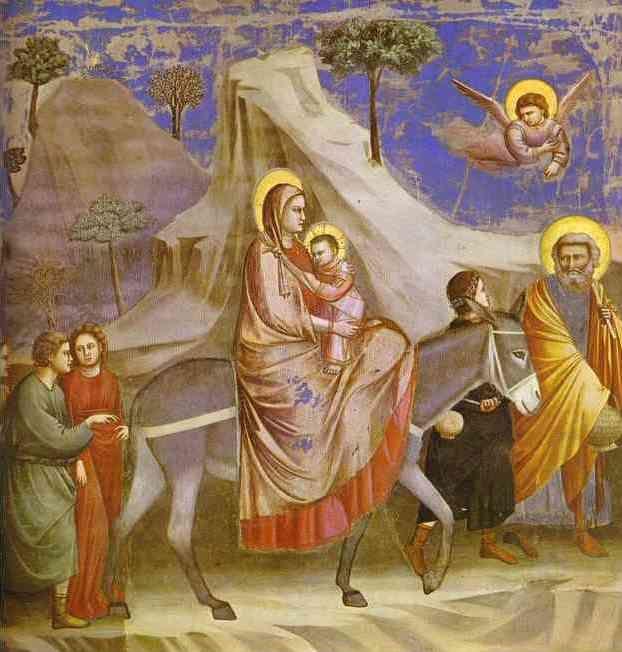
Out of Egypt I Called My Son

Now when they had departed, behold, an angel of the Lord appeared to Joseph in a dream and said, “Rise, take the child and his mother, and flee to Egypt, and remain there until I tell you, for Herod is about to search for the child, to destroy him.” And he rose and took the child and his mother by night and departed to Egypt and remained there until the death of Herod. This was to fulfill what the Lord had spoken by the prophet, “Out of Egypt I called my son.” (Matthew 2:13-15) That last verse has caused lots of consternation.  The Holy Family goes to Egypt, and this somehow fulfills Hosea’s reference to Israel’s exodus? As I mentioned last week, at first glance it looks like Matthew is connecting the dots by the slimmest of connections. Continue Reading>>>