The purpose of this Blog is to introduce men and women all over the World to the Doctrines of Grace; the 5 Solas; Reformation Theology and the Lord and Savior Jesus Christ.
Showing posts with label Hyper-Calvinism. Show all posts

Wednesday, July 10, 2013

A Brief Clarification of Calvinism, Arminianism & Hyper-Calvinism

D. Martyn Lloyd-Jones once observed that "the ignorant Arminian does not know the difference between Calvinism and hyper-Calvinism." The good news is that not all Arminians are ignorant. The bad news, however, is that such ignorance is not limited to Arminians.
Throughout evangelical history, where evangelical Calvinism as spread among Bible believing Christians, charges of hyper-Calvinism inevitably arise from those who do not know the difference. That pattern is being repeated today both within and beyond the borders of the Southern Baptist Convention. Examples of such careless accusations are not hard to find.

One of the most recent and most egregious came in the exhibit hall during the recent Southern Baptist Convention in Houston, Texas. On Monday, June 10, 2013, the day before the convention actually began, Baptist21 interviewed the president of Louisiana College about the treatment of some Calvinistic professors whose contracts were not renewed by the administration. In the course of responding to questions that he had been sent in advance, Dr. Joe Aguillard (though he probably would not identify himself as an Arminian) proved Lloyd-Jones' point.   Continue at Founders

Tuesday, June 19, 2012

SEVEN REASONS WHY CALVINISTS BELIEVE IN EVANGELISM


1) Because God has commanded it.   The gospel is to preached to every creature (Mark 16:15).   This is why Calvinists have been at the forefront of missionary endeavor. The man acknowledged as "the Father of Modern Missions" was William Carey, and William Carey was a Calvinist. If a missionary (strictly speaking) is someone who leaves his homeland to preach the gospel elsewhere, then John Calvin qualifies as a missionary. Spurgeon said of him: " John Calvin…is looked upon now, of course, a theologian only, but he was really one of the greatest of gospel preachers. When Calvin opened the Book and took a text, you might be sure that he was about to preach "Through grace are ye saved, and that not of yourselves, it is the gift of God." (MTP 14:216) Even if we had no other reason, we would still evangelize…because it is a clear command from God. 
 
2) Because we believe that God has ordained the means of bringing many sons to glory as well as the end. Hyper-Calvinists believe He has ordained the end but not the means, non-Calvinists believe that He has ordained the means but not the end, Calvinists alone consistently take the balanced view that He has ordained both. If we don't evangelize, someone else rightly will. Calvinists believe as much in man's responsibility as they do in God's sovereignty. 
 
3) Evangelism gives Calvinists the glorious opportunity to praise the God whom they believe unconditionally elected them to salvation. We love to preach the gospel in all its fullness. Just to recount the old, old story of Jesus and His love thrills our soul and leads us to praise His name. We glorify God when we proclaim the gospel.   Continue at Colin Maxwell

Monday, September 26, 2011

A Word to Squeamish Preachers and Hyper-Calvinists

If you really long to save men's souls, you must tell them a great deal of disagreeable truth.

The preaching of the wrath of God has come to be sneered at nowadays, and even good people are half ashamed of it; a maudlin sentimentality about love and goodness has hushed, in a great measure, plain gospel expostulations and warnings.

But, my brethren, if we expect souls to be saved, we must declare unflinchingly with all affectionate fidelity, the terrors of the Lord.

"Well," said the Scotch lad when he listened to the minister who told his congregation that there was no hell, or at any rate only a temporary punishment, "Well," said he, "I need not come and hear this man any longer, for if it be as he says, it is all right, and religion is of no consequence, and if it be not as he says, then I must not hear him again, because he will deceive me."

"Therefore," says the apostle, "Knowing the terrors of the Lord we persuade men." Let not modern squeamishness prevent plain speaking concerning everlasting torment. Are we to be more gentle than the apostles? Shall we be wiser than the inspired preachers of the word? Until we feel our minds overshadowed with the dread thought of the sinner's doom we are not in a fit frame for preaching to the unconverted. We shall never persuade men if we are afraid to speak of the judgment and the condemnation of the unrighteous.    Keep Reading...

Saturday, September 24, 2011

Calvinism, Systematic Theology and Scripture

At some level, every Calvinist who is not hyper embraces a paradox (you can call it tension, antinomy, aporia, really deep mystery, or whatever you like, but I prefer "paradox"). This is properly true of every Christian, but it is especially true of Biblical Calvinists. Our theology generates paradox, whether it's the apparent duality of divine wills, multiple senses of God's love and hatred for fallen humanity, or the compatibility of deterministic divine sovereignty and real human choice/freedom/responsibility. Calvinism without the essential balance of Biblically-derived paradox is in danger of going the way of Herman Hoeksema and the PRC. Characteristically, hyper-Calvinists eschew paradoxes in every possible way. Arminians, for their part, also seem reluctant to embrace paradoxes. Some take great delight in calling Calvinistic paradoxes "contradictions," ignoring the fact that these are unavoidable if we take divine revelation and historic/orthodox Christianity at face value.
 
THEOparadox is essentially a call for Calvinists (and others) to do two things:
 
1. Go whole hog and embrace every Biblically justified paradox, refusing to exegetically "adjust" any verse or passage of Scripture that might create a seeming contradiction in Systematic Theology.

 2. Be rigorous in trying to understand, explain and evaluate possible resolutions to these paradoxes, but accept the fact that we can ultimately have no greater certainty than the very words of Scripture afford us.    Keep Reading...

Friday, July 15, 2011

The What and Why of Hyper-Calvinism

The title is not going to set the world on fire, but it’s nevertheless a very good book: The Emergence of Hyper-Calvinism in English Nonconformity 1689-1765. The book was written by Peter Toon (1939-2009) and first published in 1967; it includes a preface by the ubiquitous J.I. Packer. This is a scholarly, densely footnoted, technical little tome. But it contains simple, valuable lessons. Packer says, “The story is a cautionary tale with timely lessons for those who seek a revival of Reformed Christianity to-day” (8).

I see three lessons, given in increasing order of importance.

1. Toon shows, as Ken Stewart has more recently, that the Reformed faith is not completely uniform. This isn’t to say there’s not a basic continuity from Calvin to Beza to the Puritans to Old Princeton to the present day. But at many points in Reformed history it’s not been neat or clear what the Reformed position is. Keep Reading...

Monday, September 27, 2010

Calvinism Compared to Arminianism and Hyper-Calvinism

Doctrine: Arminianism
(Unbalanced)
Calvinism
(balanced)
Hyper-Calvinism
(Unbalanced)
Man’s responsibility Rightly emphasize it but believe it implies man’s ability & so deny man’s total depravity. Believe that man is absolutely responsible for his actions while God is absolutely sovereign. Deny man’s responsibility in a vain effort to protect the doctrine of man’s depravity. Reduces man to being a block of wood.
God’s Sovereignty Believe it in regards to creation & providence etc., but deny it in the most important matter of all i.e. salvation. Believe this truth holds in every situation. “All my ways shall ever be… ordered by His wise decree” Hold to this doctrine but over emphasize it to the exclusion of man’s responsibility.
Man’s depravity Deny this doctrine believing that all men have the ability to repent & believe the gospel. Believe that while all men are required to repent etc., SIN has robbed them of the power to do so. Hold to this doctrine but over emphasize it to the exclusion of man’s responsibility.
Election Make it conditional upon faith. Effectively self election rather than “God’s election” Place it where it belongs – in the hand of God. Unconditional so as to put God under no obligation. Hold to this doctrine but over emphasize it to the exclusion of man’s responsibility.
Extent of the Atonement Believe that it extends to every last son of Adam, including those who eternally in hell when Jesus died. Believe that although sufficient for all men in its merit…yet intended to redeem only the elect. Afraid to preach the universal aspect of the atonement (Compare the Calvinist belief) lest they be considered Arminian.
Effect of the Atonement Largely ineffectual since many of those for whom Christ is said to have died are bearing those same sins in Hell for which He is said to have died. Totally effectual since every last one for whom Christ died will be gathered in, thus making His feeling of satisfaction (Isaiah 53:10) credible. There does not seem to be any imbalance here on this particular point.
Preaching of the Atonement Although sound in preaching the free offer of the gospel, their theology is inherently compromised. Preach the free offer of the gospel, assuring every last man (elect or not) that if they come to the Cross, they will find pardon. Will only preach it as a fact. As above, will not offer it. Believe that the free offer implies creature power… which it doesn’t.
Effectual grace Believe that the grace of God can always be resisted by the sinner. Believe that the elect and non elect alike can resist the grace of God… but there comes a time when the elect find it irresistible. Too much emphasis on this doctrine leaves them in a state of practical fatalism.
Perseverance of the Saints Rank Arminians believe that true Christians can lose their salvation. Others who disbelieve the first 4 points of Calvinism, effectively believe the last. The elect will persevere in holiness unto the end and so will be saved, being kept by the power of God through faith. Although they believe this doctrine in theory…yet their over emphasis on other points leaves them constantly in a state of gloomy doubt.
Evangelism 
 
Click here for article on Calvin – the Soulwinner.


Believe it in although their basic message is compromised & they have no absolute assurance of the success of their mission. Believe in it – can offer a Savior who actually accomplished something at Calvary – as opposed to merely making it possible – and have absolute guarantee by divine decree that their mission will be successful. Don’t believe in evangelism at all. At best will but state the gospel facts, but will not plead with men to be saved as the great Calvinist evangelists did in the past.
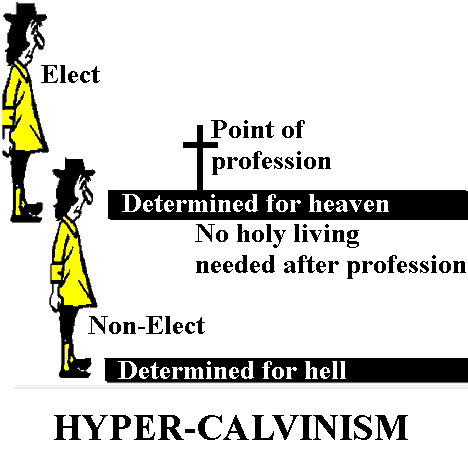
Holiness Holiness is to be found among all schools of God’s people… often despite their doctrine. Holiness is to be found among all schools of God’s people… often despite their doctrine. Holiness is to be found among all schools of God’s people… often despite their doctrine. Unfortunately there are those in the hyper camp who believe that if you are going to be saved, then you will be saved no matter how you live. Such Antinomianism is to be abhorred and separated from.

  HT: BobHanks