Previously (Part 1)
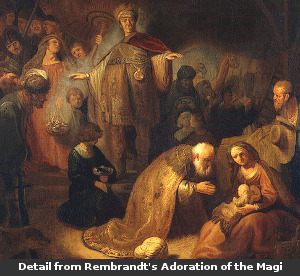
we looked at a few myths surrounding the visit of the Magi to the child
Jesus in Bethlehem. We questioned the ideas about the sources of their
knowledge of the star and the “King of the Jews” as lying in
astronomical phenomena or in astrological “signs.” What is an
alternative explanation for their knowledge?
It is possible that the oracles of Balaam served as the source for
their expectation of a Jewish king. Of the four oracles delivered by
that fascinating man from beyond the Euphrates River (Num. 22:5),
the last is most expressive: “I see him, but not now; I behold him, but
not near: a star shall come out of Jacob, and a scepter shall rise out
of Israel” (Num. 24:17).
It is possible that the Magi from Persia had preserved the words of
their “ancestor” Balaam and remembered his ancient prophecy when a
“Star” did appear out of Jacob. Mention of the scepter also echoes an
earlier Messianic reference in Gen 49:10.
An even stronger source for the Magi’s scriptural knowledge comes from the Book of Daniel. In the LXX Greek translation (Dan. 2:2,10), one of the words translated “wise men” is the same as the Greek word used in Matthew 2 (μάγοι/magoi).
These Magi in ancient Babylon served as a religious caste in the state
religion. One of their functions was to interpret dreams—a role in which
they failed miserably in Daniel 2:1-13. Note Daniel 2:13—“So
the decree went out, and the wise men (Magi) were about to be killed;
and they sought Daniel and his companions, to kill them.” Therefore,
Daniel and his three friends were associated with the Magi due to their
God-given ability (Dan. 1:20-21). When Daniel accurately interpreted Nebuchadnezzar’s dream (Dan. 2:17-45),
he was rewarded with an even higher position among them: “Then the king
gave Daniel high honors and many great gifts, and made him ruler over
the whole province of Babylon and chief prefect over all the wise men
(including the Magi) of Babylon” (Dan. 2:48). Continue at Will Varner


No comments:
Post a Comment